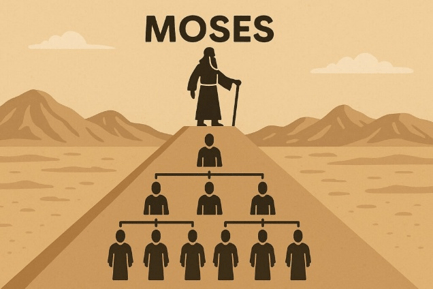
Exodus 18 Jethro’s Wise Advice
13 The next day, Moses took his seat to hear the people’s disputes against each other. They waited before him from morning till evening.
14 When Moses’ father-in-law saw all that Moses was doing for the people, he asked, “What are you really accomplishing here? Why are you trying to do all this alone while everyone stands around you from morning till evening?”
15 Moses replied, “Because the people come to me to get a ruling from God. 16 When a dispute arises, they come to me, and I am the one who settles the case between the quarreling parties. I inform the people of God’s decrees and give them his instructions.”
17 “This is not good!” Moses’ father-in-law exclaimed. 18 “You’re going to wear yourself out—and the people, too. This job is too heavy a burden for you to handle all by yourself. 19 Now listen to me, and let me give you a word of advice, and may God be with you. You should continue to be the people’s representative before God, bringing their disputes to him. 20 Teach them God’s decrees, and give them his instructions. Show them how to conduct their lives. 21 But select from all the people some capable, honest men who fear God and hate bribes. Appoint them as leaders over groups of one thousand, one hundred, fifty, and ten. 22 They should always be available to solve the people’s common disputes, but have them bring the major cases to you. Let the leaders decide the smaller matters themselves. They will help you carry the load, making the task easier for you. 23 If you follow this advice, and if God commands you to do so, then you will be able to endure the pressures, and all these people will go home in peace.”
24 Moses listened to his father-in-law’s advice and followed his suggestions. 25 He chose capable men from all over Israel and appointed them as leaders over the people. He put them in charge of groups of one thousand, one hundred, fifty, and ten. 26 These men were always available to solve the people’s common disputes. They brought the major cases to Moses, but they took care of the smaller matters themselves.
27 Soon after this, Moses said good-bye to his father-in-law, who returned to his own land.
You’ve got to hand it to Jethro; this guy is brilliant when it comes to executive strategy. While we know practically nothing about Jethro’s position in Midian, obviously, he understands the need to develop leaders and then delegate responsibility to them. One of the key points in ministry is to keep the main thing the main thing. If we allow ourselves to become sidetracked into lesser matters, we will wind up feeling exhausted and defeated and we’ll have no time or energy left to fulfill God’s purpose in our lives.
The temptation to become distracted isn’t a problem for lazy people; it’s a problem for those already excellent at problem-solving who want to make sure that everything is done JUST RIGHT! While Moses might be able to continue to solve all the problems of the Israelites himself, he will have neither time nor energy to listen to God.
Capable people sometimes fail to remember that they became capable because someone else delegated responsibility to them. While in Greek mythology, Pallas Athena springs forth fully formed from Zeus’s forehead, the rest of us take years to mature and become competent. There are no shortcuts to excellence.
Moses is a big enough person to appreciate Jethro’s advice and follow it. A lesser man might have listened to Jethro, complimented him on his wisdom, and then completely ignored it. Moses, however, fully realizes that he’s about to drop from exhaustion and that there must be some other way to handle things.
When Moses follows Jethro’s advice, he accomplishes several things at once. First, Moses removes much of the burden from himself. Frankly, the daily deluge of petty problems has left Moses feeling as if he’s being stoned to death with millet. It’s not the severity of the problems, but the sheer number of them that is overwhelming. Second, Moses is shifting responsibility onto the shoulders of men who undoubtedly know the individuals involved far better than he does. While Moses might not know anything about the family of Ben-Isaac, for example, the local leaders know them far too well and are fully aware that they are chronic complainers, always trying to stir up trouble with the neighbors. Third, by delegating responsibility, Moses is not only relieving himself of a burden but also giving these men the opportunity to develop leadership skills. Fourth, by giving these men the chance to make small decisions, Moses is ensuring that they will be less likely to criticize him, for now these men will better understand the burdens of leadership. After carrying out Jethro’s suggestions for problem-solving, Moses now has the peace necessary for him to spend long amounts of time with God.
This story should cause us to examine our own lives. Are we so caught up in the need to control people or events that we are refusing to delegate when we should? Delegating involves trusting God to guide those assuming authority so that they actually do develop leadership skills. We must be willing to live with the fact that these people will make mistakes when they first start; however, we too have made mistakes and the world has not fallen apart.
May God help us to delegate when He wants us to so that we will be able to spend time with Him and receive His peace.
PRAYER: Father God, thank You for loving us and caring for us. Lord, help us to trust You and to allow others to carry part of our burdens. In the mighty and precious Name of King Jesus. Amen.


Leave a Reply