
Exodus 20:17 “You shall not covet your neighbor’s house. You shall not covet your neighbor’s wife, or his male or female servant, his ox or donkey, or anything that belongs to your neighbor.”
This is the last of the Ten Commandments, and one of the most comprehensive. Here God is forbidding His people from coveting anything that belongs to those around them. But what does the term “covet” mean? “To covet” means to have an intense desire for something that belongs to someone else. This term often implies a longing that is fueled by envy or an insatiable wish for what others possess. It can suggest a wrongful or inordinate desire, particularly when it disregards the rights of others. Here, “an insatiable wish” indicates a wish that cannot be fulfilled or appeased, no matter how hard someone tries.
While the Israelites remained in Egypt, it’s likely that they coveted the Egyptians’ possessions, their freedom, and their social status. Israelite women might have coveted the clothing they saw Egyptian women wearing. Egyptian nobles would certainly have had better food than the Israelites. But as the Israelites were leaving Egypt, the same Egyptians loaded the Israelites with their most precious possessions, begging them to leave as quickly as possible.
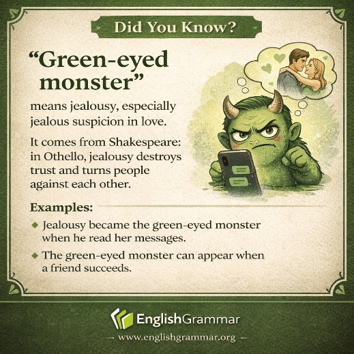
When I was a child, my mother would describe anyone envying someone else for any reasons as being influenced by a green-eyed monster. In fact, Mom was quoting Shakespeare. An internet search reveals the following: The term “green-eyed monster” refers to jealousy and originates from Shakespeare’s play Othello. In Act 3, Scene 3, the character Iago warns Othello about jealousy, describing it as a monster that mocks those it consumes. This metaphor illustrates how jealousy can take control of a person, leading to destructive behavior and emotional turmoil.
The phrase captures the essence of jealousy as a powerful, consuming emotion that can lead to tragic outcomes. Despite warning Othello of the danger of jealousy, Iago actually inflames it, manipulating Othello by suggesting that his wife, Desdemona, may be unfaithful. In the play Othello, jealousy consumes Othello, eventually causing him to murder Desdemona. When Othello learns of Desdemona’s innocence, he commits suicide because he is consumed by remorse.
This commandment helps distinguish the Law of Moses from other ancient codes of justice. When asking the question regarding moral regulations in ancient codes, we find the following: Ancient codes often addressed moral emotions indirectly rather than explicitly forbidding them. While there are no known ancient legal codes that outright ban moral emotions like empathy or guilt, many codes established guidelines for behavior that implicitly shaped emotional responses.
Key Examples:
- Hammurabi’s Code: This ancient Babylonian code included laws that emphasized justice and retribution, which could influence feelings of guilt or responsibility in individuals. It aimed to regulate behavior through consequences rather than addressing emotions directly.
- Ancient Egyptian Laws: These often promoted virtues like Ma’at (truth, balance, order), which encouraged moral emotions such as compassion and fairness, rather than forbidding them.
- Greek Philosophical Texts: While not legal codes, texts from philosophers like Aristotle discussed emotions in the context of virtue ethics, suggesting that moral emotions were essential for virtuous living rather than something to be suppressed.
Overall, ancient codes focused more on regulating actions and societal order than on the emotional states themselves. While many of these writings hint at jealousy as being wrong, this commandment leaves no room for doubt: jealousy is wrong, period. Those who begin by admiring another’s possessions should watch themselves carefully, least they find themselves beginning to covet. When we covet anything, we cheapen ourselves and leave ourselves open for Satan to attack in all kinds of ways. It’s a very short jump from “I WISH I had what he/she has” to “I DESERVE to have what he/she has” to “I MUST have what he/she has.” The final step in this parade is “I will SEIZE what he/she has or destroy them in the process.” Notice that we can begin by merely admiring someone else’s possessions but end in thievery and possibly assault or even murder.
Hebrews 13:5-6 tells us, “5 Keep your lives free from the love of money and be content with what you have, because God has said, “Never will I leave you; never will I forsake you.” 6 So we say with confidence, “The Lord is my helper; I will not be afraid. What can mere mortals do to me?” When we trust in God and rest in Him, we have peace, a deep abiding peace that comforts and consoles us. We don’t have to envy anybody else, for God is our Provider and He will give us those things we need.
Perhaps one of the most poignant poems about the fallacy of envying someone else is this poem:
Richard Coryby Edward Arlington Robinson
Whenever Richard Cory went down town,
We people on the pavement looked at him:
He was a gentleman from sole to crown,
Clean favored, and imperially slim.
And he was always quietly arrayed,
And he was always human when he talked;
But still he fluttered pulses when he said,
“Good-morning,” and he glittered when he walked.
And he was rich—yes, richer than a king—
And admirably schooled in every grace:
In fine, we thought that he was everything
To make us wish that we were in his place.
So on we worked, and waited for the light,
And went without the meat, and cursed the bread;
And Richard Cory, one calm summer night,
Went home and put a bullet through his head.
PRAYER: Father God, thank You for loving us and caring for us. Lord, help us to be content, realizing that You are the Source of all things good and that You will give us what we need. In the mighty and precious Name of King Jesus. Amen.


Leave a Reply