Exodus 24:14 Moses told the elders, “Stay here and wait for us until we come back. Aaron and Hur are here with you. If anyone has a dispute while I am gone, consult with them.”
15 Then Moses climbed up the mountain, and the cloud covered it. 16 And the glory of the Lord settled down on Mount Sinai, and the cloud covered it for six days. On the seventh day the Lord called to Moses from inside the cloud. 17 To the Israelites at the foot of the mountain, the glory of the Lord appeared at the summit like a consuming fire. 18 Then Moses disappeared into the cloud as he climbed higher up the mountain. He remained on the mountain forty days and forty nights.
Seventy of the Israelite elders, plus Moses and Aaron, Nahab and Abihu, Aaron’s sons, and Joshua have just shared a covenant meal with God without being struck dead. These men have seen the Face of God. God is now calling Moses to the mountaintop to give him specific instructions on how the Israelites are to serve Him. Meanwhile, God has delegated Aaron and Hur as problem-solving leaders. Surely, having seen God and having entered into a covenant with Him, these seventy elders should be able to support Aaron and Hur and handle the Israelites; instead, they fail miserably.
Exodus 32 The Gold Calf
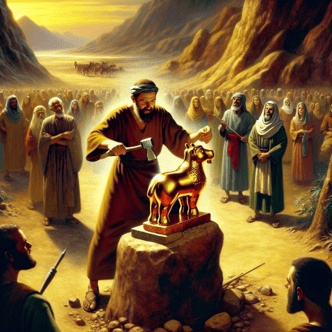
32 When the people saw how long it was taking Moses to come back down the mountain, they gathered around Aaron. “Come on,” they said, “make us some gods who can lead us. We don’t know what happened to this fellow Moses, who brought us here from the land of Egypt.” 2 So Aaron said, “Take the gold rings from the ears of your wives and sons and daughters, and bring them to me.”
Right here is where Aaron falls short! Not counting Moses and Joshua, who are on Mount Sinai, seventy elders, plus Aaron’s two sons, plus Aaron also shared the covenant meal with God. That’s seventy-three men, each one of whom might demonstrate awe for God and leadership. Does Aaron even try to engage these other men? Who knows? Perhaps those men are simply waiting for Aaron to ask them before becoming involved. Perhaps Aaron is jealous of Moses and wants to prove that he can handle everything by himself. All we know is that when given the chance to stand firm for the One True Living God, Aaron collapses morally.
Aaron could remind the Israelites that the Egyptian gods they are demanding were powerless before the Lord, but he doesn’t. Instead, Aaron does one of the worst things possible; he capitulates and creates an idol of Apis, an Egyptian deity represented by a bull, a deity of strength and fertility.
3 All the people took the gold rings from their ears and brought them to Aaron. 4 Then Aaron took the gold, melted it down, and molded it into the shape of a calf. When the people saw it, they exclaimed, “O Israel, these are the gods who brought you out of the land of Egypt!”
This incident proves several things: Aaron is a wimp who has no regard for the One True Living God, even though he’s already witnessed so many miracles. While Moses has been spending time with God, Aaron clearly has not. Notice that Aaron fails to involve the seventy elders who also shared that covenant meal. Where are those guys? Hiding in their tents?
Aaron’s two sons are no better, for they also ate and drank in God’s presence, but now they are hiding in the background. “Aaron hasn’t asked for help, so let him handle it!”
5 Aaron saw how excited the people were, so he built an altar in front of the calf. Then he announced, “Tomorrow will be a festival to the Lord!”
“The Lord!” Aaron, which Lord are you talking about? The same Lord who has already forbidden creating any graven images or fancy altars? The same Lord who has called Moses to the top of Mount Sinai while covering the mountain with fire and smoke and shaking the ground on which you’re standing? The same Lord whose face you saw as you shared a covenant meal in which you promised to be true to Him forever? That Lord?
The story of the golden calf is one of the many failures of faith described in the Bible. There are many ways to examine this story. First, there is the failure of seventy-three men who came off Mount Sinai after sharing a covenant meal with God, seeing His face, and living to tell about it. What did these men say to their friends and families and to all the people under their authority? Did these men accurately share the details of the covenant with God, or did they simply preen, assuming they had become God’s favorites? Obviously, nobody was teaching anyone the fear of the Lord. Next, these men did not share Moses’ instructions to remain, to wait, and to take any problems to Aaron and Hur.
For all we know, Hur might have tried to speak up; however, Aaron might have been intent on gaining popularity with the people. After all, what if Moses were never to come down off the mountain? At that point, Aaron would become the logical leader and HE would get all the respect and attention Moses had been getting.

The saddest part of this story is that God was giving Moses all the instructions the Israelites would need, not only for their journey, but for millenia of worshiping Him. This involved process took forty days and forty nights. Had Aaron and his sons and the seventy elders handled the Israelites wisely and promptly, they could have stifled the muttering before it reached epic dimensions. But these men remained silent, perhaps hoping someone else would handle the problem. Notice that the forty days and nights had ended and that Moses and Joshua were returning down the mountain at the time Aaron produced the golden calf. The waiting period was nearly over; a few more hours would have seen Moses’ return. But the Israelites committed heresy just as God was about to bless them. The end results were anything but peaceful!
So many times, we pray and then expect God to respond immediately, not realizing that some answers to prayer take preparation. Sometimes, we are the problem for we are not prepared emotionally, physically, mentally, or spiritually for the way in which God chooses to answer our prayers. I was called to be a missionary at the age of 11; however, God did not activate that call until I was 38 years old. By that point, I had the training, experience, and maturity necessary to act on the call.
Sometimes God delays giving us money because He knows we wouldn’t handle it properly. Sometimes God’s answer remains “No,” because He knows we are asking for something that would eventually hurt us. God’s timing and His judgment are perfect.
Want peace? Wait on God’s timing and while you’re waiting, ask God to change You so that You will be able to handle the answers to your prayers the way He intends.
PRAYER: Father God, thank You for loving us and caring for us. Lord, help us to wait patiently for Your perfect timing, even if waiting becomes difficult. In the mighty and precious Name of King Jesus. Amen.


Leave a Reply