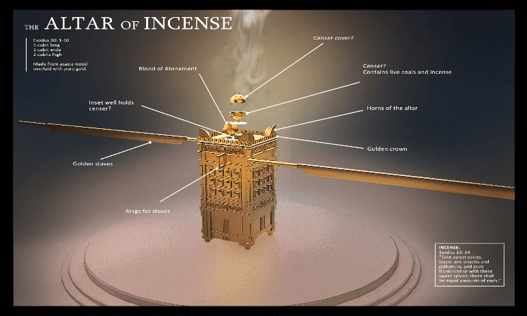
Exodus 37 Making the Altar of Incense
37:25 He made the incense altar of acacia wood. Its length was a cubit and its width a cubit—it was square—and two cubits was its height. Its horns were of one piece with it. 26 And he overlaid it with pure gold: its top, its sides all around, and its horns. He also made for it a molding of gold all around it. 27 He made two rings of gold for it under its molding, by its two corners on both sides, as holders for the poles with which to bear it. 28 And he made the poles of acacia wood, and overlaid them with gold.
If you’re like most of us, you might feel impelled to read the descriptions of creating the Tabernacle furnishings; however, you find it B*O*R*I*N*G*!!! You might even give God a guilty look as you quickly skip over all these descriptions. “Great,” you think as you yawn, “so this proves the ancient Israelites could keep records meticulously. So what?”
The first thing to notice is the quality of the materials that went into the altar. What’s so important about acacia wood? An AI search reveals the following:
Durability and Strength
- Acacia wood, also known as shittim wood, is known for its density and strength, making it ideal for constructing enduring structures.
- It was used in significant religious artifacts such as the Ark of the Covenant and the Tabernacle, emphasizing its importance in sacred contexts.
Symbolic Significance
- Beyond its practical uses, acacia wood carried deep spiritual symbolism, representing purity, protection, and God’s provision.
- Its thorny branches symbolized trials and resilience, reflecting God’s enduring strength, and the union of humanity and divinity.
Availability
- Acacia trees were prevalent in the regions surrounding ancient Israel, making the wood readily accessible for construction.
Overall, acacia wood was not only a practical resource but also held significant spiritual and symbolic value in the Biblical narrative.
God ordered Moses to overlay the altar with pure gold. While the gold was partially to demonstrate how precious this altar was, that gold would also help protect the altar from termites.
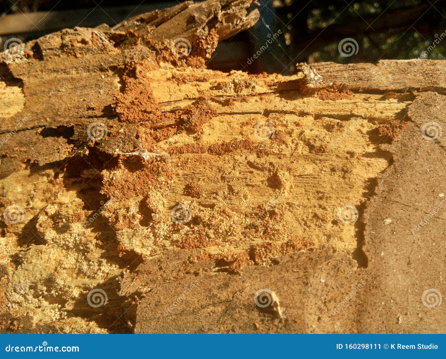
When we first arrived in Ghana, we began learning about various kinds of wood. One of the cheapest and most readily available kinds of wood was called “wawa.” Wawa was a very soft wood, and while it was quite affordable, it was also very weak and incredibly attractive to termites. In those days, termite mounds were everywhere. Termites could appear in your home at any time, particularly if a builder had used low-quality wood.
Termites will voraciously consume all kinds of material, particularly cotton sheets and clothing. Even if termites don’t chew up something, they will spread “termite mud” all over things, spoiling them. Years ago, termites came up through a tiny crack in a cement floor, entered the bottom drawer of a filing cabinet, and spread mud over several floppy discs, spoiling them completely. Yet another time, termites came up through an electrical outlet and consumed an entire paperback book, leaving only the cover.
You would think that God wouldn’t have to worry about termites consuming the various parts of the Tabernacle; however, you would be wrong. There are desert subterranean termites, specifically Amitermes desertorum, in the Sinai region, infesting various wood and fruit trees. Even today, the Holy Monastery of Saint Catherine has had to combat termite infestations. This is why throughout the descriptions of creating the various parts of the Tabernacle, acacia wood continues to be mentioned.
The altar of incense was designed to be used twice daily, combining prayer and worship. Throughout the Bible, incense is used to represent the prayers of believers. And this brings us to the point of this study.
We can tell you from much sad experience that termites work quietly and persistently. Few things are more difficult to eradicate than termites. One end of the house in which we live has suffered repeated termite infestations, and we fear the wooden beams of our roof are likely turning into lace, no thanks to those persistent insects. We once had a wooden chest that appeared quite strong, until we realized that we could practically put our fingers through the bottom boards. The termites had found our chest, leaving nothing but poor-grade fire wood.
While we might not build small altars for ourselves, we still need someplace to which we can retreat, where we can pray quietly. John Wesley, the founder of Methodism, was one of nineteen children, nine of whom survived beyond infancy. Susanna Wesley, John’s mother,
used her apron as a signal for prayer. In her busy household, she found it challenging to find a quiet place to pray. To create a moment of solitude, she would pull her apron over her head, signaling to her children that she was in prayer and should not be disturbed. This practice became well-known in her family, allowing her to dedicate time to her spiritual life amidst daily distractions. Think about that! Here was a woman with every excuse for not praying; after all, the “termites of exigency” were all around her; yet, she prayed regularly and trained her children to give her time and space to do so.
All of us are assailed by termites of various kinds-jobs, tight schedules, housework, financial burdens, health challenges, etc. If we are not careful, these termites can consume our time for prayer and worship just as surely as those Ghanaian termites consumed wawa boards.
Your place of worship might be your car as you commute to and from work. Now, phone apps allow us to listen to Scripture, to prayers, and to praise music anytime and anywhere. You might have to worship in bits as you bathe or brush your teeth. From experience, we strongly encourage you to worship and pray before your day gets started, for once the “termites of time” appear, prayer and worship become very difficult. May God help you, so that you create an altar, even if it’s only your bathroom sink, and continue to pray and worship God. Your prayers are still just as valuable to God and to you as that costly incense was in the days of Moses.
PRAYER: Father God, thank You for loving us and caring for us. Lord, help us to follow hard after You all the days of our lives. Help us to carve out time to pray and worship, realizing that some time is far better than none. In the mighty and precious Name of King Jesus. Amen.


Leave a comment