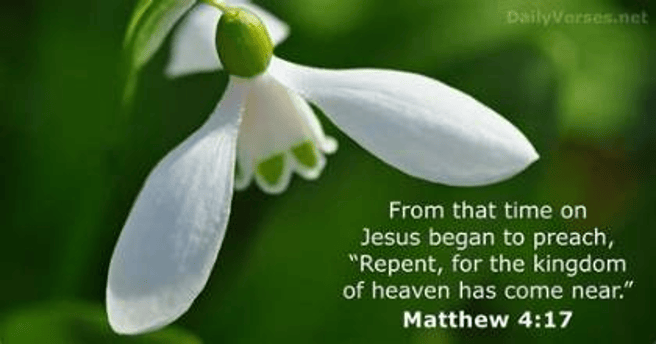
Matthew 4:12-17 The Ministry of Jesus Begins
12 When Jesus heard that John had been arrested, he left Judea and returned to Galilee. 13 He went first to Nazareth, then left there and moved to Capernaum, beside the Sea of Galilee, in the region of Zebulun and Naphtali. 14 This fulfilled what God said through the prophet Isaiah:
15 “In the land of Zebulun and of Naphtali, beside the sea, beyond the Jordan River, in Galilee where so many Gentiles live, 16 the people who sat in darkness have seen a great light. And for those who lived in the land where death casts its shadow, a light has shined.” [Isaiah 9:1-2]
17 From then on Jesus began to preach, “Repent of your sins and turn to God, for the Kingdom of Heaven is near. [or is coming soon]”
Yesterday, we considered the temptations Jesus endured in preparation for ministry. Today, we consider the next question: How did Jesus know when to begin ministry? John’s Gospel states that Jesus began baptizing and teaching once he returned from the wilderness. This news upset John the Baptist’s disciples, who had assumed that John was the only person authorized to baptize. When John the Baptist’s disciples went to him to report what this upstart was doing, they were shocked at John’s answer. John 3:23-31 describes the scene.
“23 At this time John the Baptist was baptizing at Aenon, near Salim, because there was plenty of water there; and people kept coming to him for baptism. 24 (This was before John was thrown into prison.) 25 A debate broke out between John’s disciples and a certain Jew over ceremonial cleansing. 26 So John’s disciples came to him and said, “Rabbi, the man you met on the other side of the Jordan River, the one you identified as the Messiah, is also baptizing people. And everybody is going to him instead of coming to us.”
YIPES! Now we’re getting to the heart of the matter. Until now, John the Baptist’s disciples have prided themselves on their choice to follow John, the primo prophet and his teaching. If ever there is a way to become holy, surely serving this embodiment of the Prophet Elijah must be it. Not that John’s disciples have tried to flaunt themselves, you understand, but they have remained in the shadows, trying to appear humble while basking in reflected glory. Now “everybody is going to him instead of coming to us.”
One of the hardest things for many ministers, many missionaries, many workers in any field to do is to recognize when someone new appears and begins to attract all the attention that previously went to them. Church planters must wrestle with this problem, for it takes one kind of person to plant a church while it might take an entirely different personality to grow the church. An AI search of problems in handing over reveals the following: Determining when to hand over leadership in church planting is crucial for sustainability. This transition can arise due to various factors such as calling, crisis, burnout, or retirement. Planning for this moment is essential, as many church planters often focus on the initial establishment without considering future leadership transitions.
Key Considerations
- Timing: Recognizing the right moment for transition is vital. This could be when the church reaches a certain size, or the planter feels they can no longer lead effectively.
- Preparation: Developing a succession plan early can help ensure a smooth transition. This includes identifying potential leaders and providing them with mentorship.
- Communication: Open dialogue with the congregation about the transition can foster trust and support.
- Support Systems: Establishing a support network for the new leader can help them succeed in their role.
John the Baptist was well aware of his calling, for God had revealed it to him during those quiet years with the Essenes. But John also knew his limitations and realized that he was preparing the way for someone far greater, for the Messiah. John 3:27-31 contains part of John’s answer. 27 John replied, “No one can receive anything unless God gives it from heaven. 28 You yourselves know how plainly I told you, ‘I am not the Messiah. I am only here to prepare the way for him.’ 29 It is the bridegroom who marries the bride, and the bridegroom’s friend is simply glad to stand with him and hear his vows. Therefore, I am filled with joy at his success. 30 He must become greater and greater, and I must become less and less.
31 “He has come from above and is greater than anyone else. We are of the earth, and we speak of earthly things, but he has come from heaven and is greater than anyone else.”
John had witnessed the Holy Spirit descending on Jesus during his baptism, a sure sign that Jesus was God’s son and that God was about to do something magnificent with him. John feels Jesus is the Messiah. As of now, Jesus has begun work in Judea, but God is about to give Jesus a sign that it’s time to change his focus. Matthew 4:12 “When Jesus heard that John had been arrested, he left Judea and returned to Galilee.”
Up to now, John the Baptist has been preaching, teaching, and baptizing. But John has infuriated Herod. John’s imprisonment is primarily due to his bold denunciation of Herod Antipas, the tetrarch of Galilee and Perea. Herod has unlawfully taken Herodias, his brother Philip’s wife, as his own. John, adhering to the moral and legal standards of the Mosaic Law, publicly condemns this union. In Mark 6:18, John is recorded as saying to Herod, “It is not lawful for you to have your brother’s wife.” This rebuke angers Herodias, who holds a grudge against John and seeks to kill him. However, Herod fears John, recognizing him as a righteous and holy man, and thus initially protects him, albeit by imprisoning him.
(https://biblehub.com/topical/naves/i/imprisonment_of_john_the_baptist.htm)
God is not a God of confusion but a God of peace. As long as John is working in one location, Jesus continues to work somewhere else. But once John is imprisoned, Jesus moves to the Galilee to fulfill the prophecies of Isaiah 9:1-2. “In the land of Zebulun and of Naphtali, beside the sea, beyond the Jordan River, in Galilee where so many Gentiles live, the people who sat in darkness have seen a great light. And for those who lived in the land where death casts its shadow, a light has shined.” [Isaiah 9:1-2]
Jesus takes up God’s message where John has left off, urging people to repent because the Kingdom of Heaven is coming soon. Once John is imprisoned, Jesus moves back into Galilee, where he is from originally. What’s so important about Galilee?
In the Bible, Galilee was referred to as “Galilee of the Gentiles” due to its diverse population. This region, historically significant in ancient Israel, was home to many non-Jewish inhabitants, including Phoenicians, Syrians, and Sidonians. The term reflects the area’s demographic diversity, which was notable during biblical times. While Judea was predominantly Jewish, Galilee was a cultural melting pot, making it a strategic location in which Jesus could reach several different cultures simultaneously.
The chorus to Kenny Rogers’ famous country song “The Gambler,” advises us, “You got to know when to hold ’em, know when to fold ’em.” John the Baptist knows that he has done his part and now Jesus has come to continue. God allows John to be imprisoned so that his disciples will turn and follow the Messiah, God’s Son, rather than persisting in following John.
May all of us who are in ministry be willing to follow John’s example-preferably without being imprisoned or beheaded!
PRAYER: Father God, thank You for loving us and caring for us. Lord, help us to recognize when it’s time for us to hand over to others so that You might lead us into some new and different work. In the mighty and precious Name of King Jesus. Amen.


Leave a comment