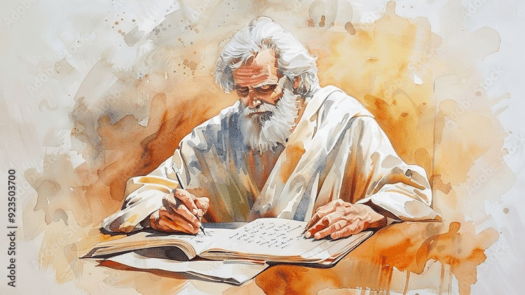
All the previous studies in this unit so far have been laying the groundwork for some of the most important teachings Jesus ever gave, namely, “the Sermon on the Mount,” as recorded in Matthew 5-6 and Luke 6:17-49. Yesterday, we described the scene as Jesus called Matthew to become a disciple. But some more background would be helpful.
Pastor Chuck Swindoll introduces the Gospel of Matthew in this fashion:
Who wrote the book?
While Matthew did not sign his own name to “his” gospel, the early church uniformly attested to the apostle’s authorship of the book. As early as AD 140, a Christian named Papias wrote that Matthew had compiled the sayings of the Lord in Hebrew (presumably before Matthew translated them into Greek for a larger audience).
Matthew’s name appears in all the biblical lists of the twelve apostles, though Mark and Luke refer to him as Levi. His history as a tax collector distinguished him from the other apostles, and immediately after his call to follow Jesus—an event he recorded in Matthew 9:9—Matthew hosted a feast for Jesus in his home with an invitation list made up of Matthew’s sinful friends. Apparently, Matthew did not think it odd that Jesus and he would associate with the sinful and downtrodden of society.
Where are we?
Matthew is the most Jewish-centric of the four gospels. The apostle regularly invoked the writings of the Old Testament prophets in an effort to illustrate Jesus’s identity as Israel’s long-awaited Messiah.
However, the gospel of Matthew has been notoriously difficult to date. Several factors speak to a date ranging from AD 60–65. First of all, the book makes no mention of the destruction of the temple, an event which occurred in AD 70. Such a cataclysmic event likely would have received some comment, particularly in a book so clearly influenced by Judaism. The largely Jewish character of the book also suggests it was written at a time when much of the evangelism by Christians was directed more exclusively at Jews, something that became less and less common as the decades passed. Finally, many scholars believe Mark to have been the first gospel composed, making it most probable that Matthew was written soon after.
Why is Matthew so important?
The apostle Matthew, a Jew himself, offered a decidedly Jewish perspective on the ministry of Jesus. He included more than fifty direct citations—and even more indirect allusions—from the Old Testament. This exceeds any of the other gospels and indicates that Matthew had the Jewish population in mind when he sat down to write. Matthew’s extensive connections between Jesus and the Old Testament provide ample prophetic evidence for Jesus’s ministry but also give contemporary readers a glimpse into how first-century readers approached the Old Testament with a Christ-centered mind-set.
In addition, Matthew’s gospel answers the question on the mind of every Jewish reader: “If Jesus is the King of the Jews, then where is God’s promised kingdom?” Matthew reveals that Jesus did offer the kingdom to Israel, but the offer was rejected (Matthew 4:17; 16:13–28; 21:42–43). God’s primary work in the world is now accomplished through the building of Christ’s church, after which Jesus will come again to earth and establish His kingdom—ruling the world from Israel.
What’s the big idea?
Matthew wrote his account of Jesus’s ministry to show that Jesus was and is indeed the King, Israel’s long-awaited Messiah. He reflected this concern in his opening line, “The record of the genealogy of Jesus the Messiah, the son of David, the son of Abraham” (Matthew 1:1). From there, Matthew consistently took his readers back to the Old Testament, providing Old Testament testimony regarding the birth of Jesus, Bethlehem as the location of Jesus’s birth, the flight to Egypt, Herod’s slaughter of the infants, and the beginning of Jesus’s ministry. In a world where many in the Jewish community had claimed the role of Messiah for themselves, Matthew’s commitment to grounding the life of Jesus in the Old Testament raised Jesus above the multitude of these false messiahs. The apostle painted a portrait of our Lord that highlights His uniqueness among all others to ever walk this earth.
How do I apply this?
After enduring four hundred years of prophetic silence, God’s people must have wondered whether or not He had deserted them. After centuries of regular communication from God, the people found themselves without a genuine prophet or spokesman for God. However, the ministries of John and Jesus reminded God’s people that He had not forgotten them. God’s silence during that period was merely a precursor to pulling the linchpin of His redemptive plan. God hadn’t forgotten—He remembered His people. Matthew made that clear.
It was true then, and it is certainly true today. Do you ever feel as though God has deserted you or that He sits in silence in the face of your requests? As we read through the pages of Matthew, not only do we see Jesus Christ revealed as Israel’s King and Messiah, but His coming to earth as God in the flesh reminds us of His deep love for us. Now resurrected and ascended, the Lord Jesus will always be with us, even to the end of time (Matthew 28:20).
Christ’s commission to His followers is still His mandate to us today: “Make disciples of all the nations” (Matthew 28:19). Christ’s work of building His church is the work He does through each of us.
Further exploration into Matthew’s background reveals some interesting facts. Both Matthew the disciple and James, another disciple, are described as “the son of Alphaeus.” The Eastern Orthodox tradition believes these two men were brothers; however, other traditions differ. It’s not certain whether this disciple James became a disciple before Matthew.
Many authorities believe that Matthew wrote his Gospel later in life. Mark wrote his Gospel first, about 70 A.D. with both Matthew and Luke drawing material from Mark’s Gospel, independently producing their Gospels within a few years of each other. Allegedly, Mark received much of his information from Simon Peter and was writing to appeal to a Gentile audience. Matthew was writing to a predominantly Jewish audience. As a Greek, Luke was aiming at a highly-educated Gentile audience. John wrote his Gospel later, with estimated dates ranging from 75-100 A.D. and was appealing to a mixed audience of Jewish and Gentile Christians.
Sometimes people become frustrated because the Gospels list different events in a different order. The key point is not the order of events but the manner in which a Gospel portrays Jesus. Rather than contradicting one another, each of the Gospels illustrates a different aspect of Jesus’ life and ministry. As you read the different Gospels, you might find that you enjoy one more than the others. Preferences are not important; what’s important is that the more you learn about Jesus, the more you will love him.
PRAYER: Father God, thank You for loving us and caring for us. Lord, please give us a hunger to know You more. In the mighty and precious Name of King Jesus. Amen.


Leave a comment