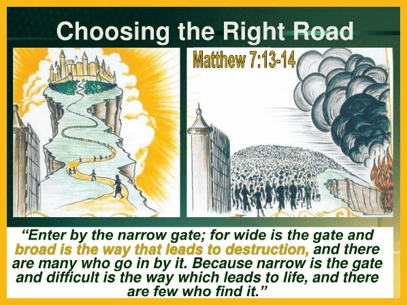
The Narrow and Wide Gates
Matthew 7:13 “Enter through the narrow gate. For wide is the gate and broad is the road that leads to destruction, and many enter through it. 14 But small is the gate and narrow the road that leads to life, and only a few find it.”
“If it were easy, everybody would do it.” Bruce Farrell, Cardiothoracic resident, Upstate Medical Center, Syracuse, NY, 1976
When I began surgery residency as a female resident in 1976, I was one of four females in a large unit. We had one female surgery professor, a distinguished lady who wound up her career covered with international honors. But those of us working at that time struggled. Many times, we were judged unfairly and we had to work twice as hard as the male residents to gain approval. Those were the days of open operations that are now performed using laparoscopy or robotic surgery. Tedious vascular procedures that used to take eight hours are now performed using minimally invasive techniques in the radiology suite with excellent results. I watched as some promising female junior residents diverted into easier fields such as radiology rather than endure the long hours, sleep deprivation, and physical hardships involved in operations lasting several hours. One morning after being awake all night, I nearly fell asleep while first assisting an attending on an emergency laparotomy. “Ah, standing by memory, I see!” the attending surgeon jovially observed.
Even though Jesus is teaching about the glories of the Kingdom of God, he refuses to sugar coat the requirements. One of the paradoxes of the Kingdom of God is that the rewards are glorious; however, following Jesus can mean sorrow, suffering, and sometimes even martyrdom. Luke 9:23-26 Then he said to them all: “Whoever wants to be my disciple must deny themselves and take up their cross daily and follow me. 24 For whoever wants to save their life will lose it, but whoever loses their life for me will save it. 25 What good is it for someone to gain the whole world, and yet lose or forfeit their very self? 26 Whoever is ashamed of me and my words, the Son of Man will be ashamed of them when he comes in his glory and in the glory of the Father and of the holy angels.
Later on, Jesus is approached by three different men, each one of whom claims to desire to become his disciple. But it turns out that they are more in love with the idea than with the reality. Luke 9:2 3 Then he said to them all: “Whoever wants to be my disciple must deny themselves and take up their cross daily and follow me. 24 For whoever wants to save their life will lose it, but whoever loses their life for me will save it. 25 What good is it for someone to gain the whole world, and yet lose or forfeit their very self? 26 Whoever is ashamed of me and my words, the Son of Man will be ashamed of them when he comes in his glory and in the glory of the Father and of the holy angels.”
While many people choose to believe that being a Christian means you will never suffer, that’s far from the case. Recently, social media posts have shown a photo of a Nigerian pastor whose congregation has been attacked twice, with increasing numbers of members slaughtered for their faith.
What happened to Jesus’ twelve disciples? Judas Iscariot betrayed Jesus and subsequently hanged himself. Saint John died of natural causes, reportedly the only apostle not martyred. (There are reports that John survived being boiled in oil.) But what about the other disciples?
- James (son of Zebedee): Executed by Herod Agrippa I around 44 AD.
- Peter: Traditionally believed to have been crucified upside down in Rome.
- Andrew: Said to have been crucified on an X-shaped cross.
- Philip: Believed to have been crucified or stoned.
- Bartholomew: Traditionally said to have been flayed alive.
- Matthew: Various accounts suggest he was martyred, possibly by sword or other means.
- Thomas: Traditionally believed to have been killed by a spear in India.
- James (son of Alphaeus): Accounts vary, with some suggesting he was stoned or beaten to death.
- Thaddeus (Jude): Believed to have been martyred, possibly by arrows or other means.
- Simon the Zealot: Various traditions suggest he was martyred, possibly by crucifixion.
Reflecting on Jesus’ teachings and the suffering many Christians have endured, Reginald Heber wrote the following hymn in 1812.
The Son of God Goes Forth to War
The Son of God goes forth to war, a kingly crown to gain;
His blood-red banner streams afar! Who follows in His train?
Who best can drink His cup of woe, triumphant over pain,
Who patient bears his cross below—He follows in His train.
That martyr first, whose eagle eye could pierce beyond the grave;
Who saw his Master in the sky, and called on Him to save.
Like Him, with pardon on his tongue in midst of mortal pain,
He prayed for them that did the wrong: Who follows in his train?
A glorious band, the chosen few on whom the Spirit came;
Twelve valiant saints, their hope they knew, and mocked the cross and flame.
They met the tyrant’s brandished steel, the lion’s gory mane;
They bowed their heads the death to feel: Who follows in their train?
A noble army, men and boys, the matron and the maid,
Around the Savior’s throne rejoice, in robes of light arrayed.
They climbed the steep ascent of Heav’n, through peril, toil and pain;
O God, to us may grace be giv’n, to follow in their train.
PRAYER: Father God, thank You for loving us and caring for us. Lord, help us to follow hard after You, no matter the cost. In the mighty and precious Name of King Jesus. Amen.


Leave a Reply