1 Timothy 1:18 Timothy, my son, I am giving you this command in keeping with the prophecies once made about you, so that by recalling them you may fight the battle well, 19 holding on to faith and a good conscience, which some have rejected and so have suffered shipwreck with regard to the faith. 20 Among them are Hymenaeus and Alexander, whom I have handed over to Satan to be taught not to blaspheme.
Sometimes, theological discussions might leave us scratching our heads. We have just passed October 31st, Reformation Day. On October 31,1517, Martin Luther nailed his 95 theses to the church door at Wittenburg in protest of many degenerate practices that were marring the Catholic Church. Luther had no intention of separating from the Catholics; however, Church leaders reacted violently. Luther’s act sparked the movement that became the Reformation.
The gist of Martin Luther’s 95 Theses centered on the critique of the Catholic Church’s practice of selling indulgences. (Indulgences were supposed to be a means of buying someone’s way out of Purgatory and had become a highly lucrative business. The poem that accompanied the sale of indulgences has been translated “As soon as the coin in the coffer rings, the soul from purgatory springs.” Catchy, right? Proves that even in sixteenth century Germany, advertising was alive and well. The idea was that it was possible to buy one’s way into heaven. This must have been a great surprise to God!) (P.S. I was raised in the Lutheran Church and learned that doggerel about indulgences during my preparation for confirmation.)
Luther argued that salvation could not be bought and emphasized the importance of faith and repentance over monetary transactions. He believed that the Church’s practices were corrupt and that true forgiveness and salvation come from God’s grace alone, not through human efforts or financial contributions. The Theses were intended to spark debate on these issues and ultimately contributed to the Protestant Reformation, challenging the authority of the Church and promoting a return to biblical teachings.
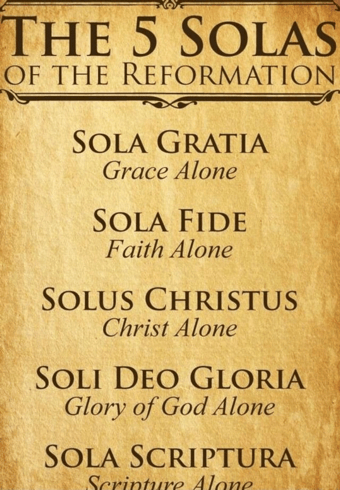
Martin Luther’s theological development in the 1510s has been characterized as a progression of solae as logical consequences: first solus Christus, (Christ alone) then sola gratia, (grace alone), then sola fide, (by faith alone), finally sola scriptura. (Scripture alone). All these beliefs were to be sola deo gloria, (to the glory of God.)
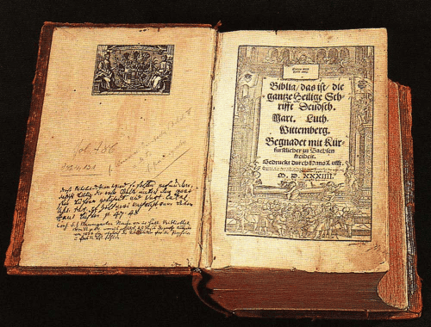
Previously, the Bible had only been available in Latin and priests read and interpreted it as they chose. But Luther translated the Bible into German. The website German History in Documents and Images gives us the following information:
Martin Luther’s German translation of the New Testament was printed in 1522, and in 1534, his translation of the entire Bible into German was published in Wittenberg. While Luther is named as its author, other scholars such as Philip Melanchton collaborated on the translation. Luther continued to revise the translated text for the rest of his life, and a completely revised edition was printed in 1541. This image shows the title page of the 1534 Bible. It reads: “The Bible, that is the Entire Holy Scripture [in] German. Mart. Luth. Wittemberg. Favored with Electoral Freedom in Saxony. Printed by Hans Lufft. 1534.” Aided by the recently invented printing press, Luther’s German Bible soon found distribution across the German-speaking territories. It became not only a medium for the spread of Protestantism, but also for the expansion of literacy in sixteenth-century Germany. Written in Early New High German, the text also represents a milestone in the development of the modern German language.
Recommended Citation The Luther Bible (1534), published in: German History in Documents and Images, <https://germanhistorydocs.org/en/from-the-reformations-to-the-thirty-years-war-1500-1648/ghdi:image-5348> [October 27, 2026].
Heresies come in all shapes and sizes. In ancient Ephesus, Timothy had to confront those teaching antinomianism, the rejection of moral laws and ethical standards in Christianity. Those espousing this view presumed that you could live a highly immoral life and still be acceptable to God. (This must have been a great surprise to God!) Unlike the medieval Catholic Church, these people really didn’t believe that they were sinners. The medieval Catholics believed they were sinners; however, the Church was promoting the idea that sin could be paid for with money.
Then there were those teaching that the resurrection of the dead had already occurred, so everyone currently alive had already missed out. Again, the medieval Catholic Church looked forward to the resurrection of the dead but allowed their agents to collect money so souls could skip purgatory.
If you want to read about a fascinating man, investigate Luther. Not only was Luther a thoughtful theologian, but he was also a hymn writer, a Bible translator, and a husband and father. Luther and his wife Katherine had six children. In addition to their own children, Luther and Katherine had numerous other people living in their home with them. Katherine’s aunt, Lena, lived with them for many years. They helped raise eight orphaned nieces and nephews and provided lodging for various tutors, exiled clergymen, escaped nuns, government officials and visitors, university colleagues and many students. Many meals were eaten with as many as twenty-five at the table! All visitors were expected to take part in family customs, devotions, and prayer.
For recreation the Luthers enjoyed a bowling lane of sorts in their garden, board games such as chess, and music. They had a pet dog. They grew much of their own food in a small garden at the Black Cloister and then later as a farm outside Wittenberg.
Luther and Katie were diligent parents, disciplining their children, but doing so in love. Luther commented once to Justus Jonas children were the “best gifts of God,” and lamented that so many parents seemed to overlook and ignore them.
Luther prepared his Small Catechism with parents and children in mind. He used it diligently within his own home. He also wrote hymns for his children to share with them the wonders of the gospel. The well-known Christmas hymn, From Heaven Above to Earth I Come, was written by Luther for his children.
While away from Wittenberg at the time of the Diet of Augsburg, Luther wrote his son a charming letter describing heaven as a pleasant garden filled with delightful activities for faithful boys and girls. (https://stjohns-salisbury.org/2017/05/07/a-brief-history-of-the-luther-children/Prepared by Pastor Paul D. Nolting, Immanuel Lutheran Church in Mankato, Minnesota)
Luther was a colorful character. When Philipp Melancthon, one of his friends, was obsessed with the possibility that he might commit an unpardonable sin, Luther huffed, “Philipp! Fear God and sin boldly!” There have been many occasions in my life when I have been forced to follow that advice, praying as I have done so.
In closing, I want to share what is perhaps Luther’s greatest hymn, “A Mighty Fortress Is Our God.”
- A mighty fortress is our God,
A bulwark never failing;
Our helper He, amid the flood
Of mortal ills prevailing.
For still our ancient foe
Doth seek to work us woe;
His craft and power are great,
And armed with cruel hate,
On earth is not his equal. - Did we in our own strength confide,
Our striving would be losing,
Were not the right Man on our side,
The Man of God’s own choosing.
Dost ask who that may be?
Christ Jesus, it is He;
Lord Sabaoth, His name,
From age to age the same,
And He must win the battle. - And though this world, with devils filled,
Should threaten to undo us,
We will not fear, for God hath willed
His truth to triumph through us.
The prince of darkness grim,
We tremble not for him;
His rage we can endure,
For lo, his doom is sure;
One little word shall fell him. - That word above all earthly powers,
No thanks to them, abideth;
The Spirit and the gifts are ours
Through Him who with us sideth.
Let goods and kindred go,
This mortal life also;
The body they may kill:
God’s truth abideth still;
His kingdom is forever.
PRAYER: Father God, thank You for loving us and caring for us. Lord, You are truly our mighty fortress. Help us to trust You remembering that You are our Savior and Lord. In the mighty and precious Name of Jesus. Amen.


Leave a Reply