1 Timothy 5 Advice about Widows, Elders, and Slaves
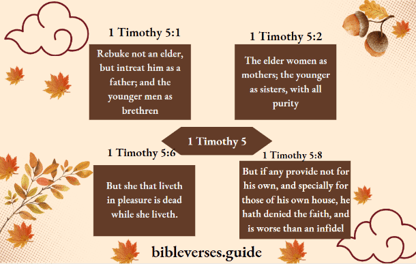
5 Never speak harshly to an older man, but appeal to him respectfully as you would to your own father. Talk to younger men as you would to your own brothers. 2 Treat older women as you would your mother, and treat younger women with all purity as you would your own sisters.
At first, we read this advice and wonder why Paul is bothering; after all, these principals ought to be no-brainers. But Timothy has been called to pastor a church with a wide variety of members, including everyone from slaves to the very wealthy. On the street, slaves command no respect at all; however, in the church, things should be far different. Paul wants Timothy to realize that everyone deserves respect, regardless of social status, wealth, or age. Young female servants and slaves are particularly vulnerable in Ephesus, for they might be sent on errands without anyone to protect them; meanwhile, daughters from prosperous households will only venture on the streets when appropriately chaperoned. Imagine having lived as the lowest of the low in a household, only to be treated with respect in the church. How exhilarating!
3 Take care of any widow who has no one else to care for her. 4 But if she has children or grandchildren, their first responsibility is to show godliness at home and repay their parents by taking care of them. This is something that pleases God.
Our generation is one of the first to send the elderly to nursing homes where we might forget them, but in previous generations, the elderly stayed with families. Why is caring for the elderly such a godly activity? Whenever we care for those who are helpless and who lack resources, we are fulfilling God’s purposes, for He cares for widows and orphans and for all who are helpless. Caring for the elderly can be difficult and strenuous and sometimes, we have no choice apart from allowing them to enter nursing homes. But even when a nursing home has proven to be the best option, we should still do our best to visit, to call, and to engage them as much as we can.
What about orphans? Parts of the foster care system work while other parts are tragically broken. I had one foster sister who was as dear to me as if she was my blood relative; however, there are also horror stories of foster children who have been abused. One summer I served as the recreation director for a small orphanage near my home. It was heart-breaking to see people who would only visit the orphans occasionally but who refused to give them the time they needed. We had seventeen children, and each one of them really needed all of my care. All I could do was to try to help as much as possible and pray God would make up for my deficiencies.
5 Now a true widow, a woman who is truly alone in this world, has placed her hope in God. She prays night and day, asking God for his help. 6 But the widow who lives only for pleasure is spiritually dead even while she lives. 7 Give these instructions to the church so that no one will be open to criticism.
8 But those who won’t care for their relatives, especially those in their own household, have denied the true faith. Such people are worse than unbelievers.
9 A widow who is put on the list for support must be a woman who is at least sixty years old and was faithful to her husband. 10 She must be well respected by everyone because of the good she has done. Has she brought up her children well? Has she been kind to strangers and served other believers humbly? Has she helped those who are in trouble? Has she always been ready to do good?
Here Paul draws a distinction between true widows who have no family members to help them and widows who have become trouble-makers and gossip mongers. When true widows who have served others have no other means of support, the church should step in to help, realizing that these women constitute a great resource. But what about younger widows?
11 The younger widows should not be on the list, because their physical desires will overpower their devotion to Christ and they will want to remarry. 12 Then they would be guilty of breaking their previous pledge. 13 And if they are on the list, they will learn to be lazy and will spend their time gossiping from house to house, meddling in other people’s business and talking about things they shouldn’t. 14 So I advise these younger widows to marry again, have children, and take care of their own homes. Then the enemy will not be able to say anything against them. 15 For I am afraid that some of them have already gone astray and now follow Satan.
16 If a woman who is a believer has relatives who are widows, she must take care of them and not put the responsibility on the church. Then the church can care for the widows who are truly alone.
Here, Paul points out that younger widows still able to bear children are better off re-marrying and caring for households of their own. Support from the church should go to the elderly and those truly in need, not merely to those who want to have an easy time of it. And what about male elders who have devoted all their time and energy to the church?
17 Elders who do their work well should be respected and paid well, especially those who work hard at both preaching and teaching. 18 For the Scripture says, “You must not muzzle an ox to keep it from eating as it treads out the grain.” And in another place, “Those who work deserve their pay!”
A century ago, there were churches that would literally package up used tea bags and send them to missionaries with the idea that the missionaries didn’t deserve anything better. Meanwhile, those same missionaries were contending with language learning, cross-cultural problems, local conflicts, and diseases about which those same churches knew nothing. During Hudson Taylor’s first missionary term, his sending agency refused to release the money he needed but demanded that he rent accommodation not only for himself but for the family of a doctor who was coming out from England to China.
Local pastors might fare little better, with wealthy church members conducting impromptu inspections of the mission house to make sure the pastor’s wife was maintaining an impossibly high standard of housekeeping. (True story from my home area: The Ladies’ Aid was meeting at the home of some newly-weds in the late 1930’s. One member climbed the stairs, only to return to compliment the hostess on the lace on the pillow cases in the guest bedroom. For this lady to have seen that lace, she had to enter that room and peel back the bedspread!)
19 Do not listen to an accusation against an elder unless it is confirmed by two or three witnesses. 20 Those who sin should be reprimanded in front of the whole church; this will serve as a strong warning to others.
Church gossip is as old as the church itself, and leaders are always open to criticism, no matter how carefully they conduct themselves. Here Paul is giving Timothy timeless advice, and the quality of those two or three witnesses should also be ascertained, lest three people conspire to get rid of a church elder. Notice that Paul says that those who SIN should be reprimanded in front of the whole church. But he says nothing about those who are victims of vicious gossip. Again, opening anyone up to criticism by the entire church is a final step and must be undertaken after all considerations have been explored.
21 I solemnly command you in the presence of God and Christ Jesus and the highest angels to obey these instructions without taking sides or showing favoritism to anyone.
22 Never be in a hurry about appointing a church leader. Do not share in the sins of others. Keep yourself pure.
23 Don’t drink only water. You ought to drink a little wine for the sake of your stomach because you are sick so often.
24 Remember, the sins of some people are obvious, leading them to certain judgment. But there are others whose sins will not be revealed until later. 25 In the same way, the good deeds of some people are obvious. And the good deeds done in secret will someday come to light.
These verses could be summed up by saying “Don’t jump to conclusions! Give everyone the benefit of the doubt. You might make an assumption that will prove to be wrong and embarrass yourself.”
What about the advice for wine-drinking? Notice Paul says “Drink a LITTLE wine…” Wine was viewed as medicine, and therefore would be taken in moderate amounts. Also, there were many places where wine was the safest drink while the water was contaminated. Through the years, Christian alcoholics have quoted this verse to justify their alcoholism; however, that is a total misuse of Scripture and should not be tolerated.
As we read this advice, ask God to show you what pertains to your situation and do not receive condemnation. If there is something you feel you should change, ask God to help, for He will surely do so.
PRAYER: Father God, thank You for loving us and caring for us. Lord, help us to treat everyone with respect, no matter their circumstances. Give us wisdom and insight so that we might help our elderly relatives as you want us to. And help us to always apply Your Word to our lives only after asking for Your insights. In the mighty and precious Name of King Jesus. Amen.


Leave a Reply