Archive for the ‘Uncategorized’ Category

DECEMBER 4, 2025 WHAT’S SO IMPORTANT ABOUT BLOOD? #15 SACRIFICES OF GRATITUDE

December 4, 2025

Genesis 33:1-4 Jacob looked up and saw Esau coming with his four hundred men. He divided the children between Leah and Rachel and the two maidservants. He put the maidservants out in front, Leah and her children next, and Rachel and Joseph last. He led the way and, as he approached his brother, bowed seven times, honoring his brother. But Esau ran up and embraced him, held him tight and kissed him. And they both wept.

5 Then Esau looked around and saw the women and children: “And who are these with you?”

Jacob said, “The children that God saw fit to bless me with.”

6-7 Then the maidservants came up with their children and bowed; then Leah and her children, also bowing; and finally, Joseph and Rachel came up and bowed to Esau.

8 Esau then asked, “And what was the meaning of all those herds that I met?”

“I was hoping that they would pave the way for my master to welcome me.”

9 Esau said, “Oh, brother. I have plenty of everything—keep what is yours for yourself.”

10-11 Jacob said, “Please. If you can find it in your heart to welcome me, accept these gifts. When I saw your face, it was as the face of God smiling on me. Accept the gifts I have brought for you. God has been good to me and I have more than enough.” Jacob urged the gifts on him and Esau accepted.

12 Then Esau said, “Let’s start out on our way; I’ll take the lead.”

13-14 But Jacob said, “My master can see that the children are frail. And the flocks and herds are nursing, making for slow going. If I push them too hard, even for a day, I’d lose them all. So, master, you go on ahead of your servant, while I take it easy at the pace of my flocks and children. I’ll catch up with you in Seir.”

15 Esau said, “Let me at least lend you some of my men.”

“There’s no need,” said Jacob. “Your generous welcome is all I need or want.”

16 So Esau set out that day and made his way back to Seir.

17 And Jacob left for Succoth. He built a shelter for himself and sheds for his livestock. That’s how the place came to be called Succoth (Sheds).

18-20 And that’s how it happened that Jacob arrived all in one piece in Shechem in the land of Canaan—all the way from Paddan Aram. He camped near the city. He bought the land where he pitched his tent from the sons of Hamor, the father of Shechem. He paid a hundred silver coins for it. Then he built an altar there and named it El-Elohe-Israel (Mighty Is the God of Israel).

It’s an absolute miracle! After weeks of agonizing over how to handle the meeting with Esau, Jacob finds that God has already been working in Esau’s heart. Esau has just arrived heading an army of 400 warriors. Trembling with fear, Jacob leads the way, followed by the maid servants with their children, Leah with her children, and finally, Rachel and Joseph. To indicate complete subservience, Jacob approaches Esau, falling to his knees and bowing seven times. But Esau runs to Jacob, pulling him up from the ground, hugging him and kissing him, weeping as he does so. When Jacob realizes what Esau is doing, he immediately bursts into tears as well. Jacob is weeping for two reasons: he’s weeping at the sight of his brother but also with relief that Esau is not going to slaughter his family and him.

Eventually, Esau takes the lead back to Canaan and Jacob settles near Shechem. In gratitude for all God has done, Jacob builds an altar and names it El-Elohe-Israel, or “Mighty is the God of Israel.” Although the Bible doesn’t specifically mention blood sacrifices, nobody builds an altar unless they are going to perform sacrifices as well. Why would Jacob do such a thing? Jacob left Canaan as a penniless young man, running for his life. Now Jacob has 2 wives, 2 concubines, 11 sons, and so much livestock that he can afford to give Esau herds as a present. Genesis 32:13-15 tells us, “Then he prepared a present for his brother Esau from his possessions: two hundred female goats, twenty male goats, two hundred ewes and twenty rams, thirty camels with their nursing young, forty cows and ten bulls, twenty female donkeys and ten male donkeys.” Not only has God prospered Jacob, but He has also given Jacob a special blessing.

These days, we don’t perform animal sacrifices to show our gratitude. But there are still other ways we can make sacrifices. We can sacrifice our time, our money, or our talents. We can see those around us who are suffering. I have become addicted to online stories about people like store clerks, waiters and waitresses, laundromat attendants, janitors, school crossing guards, and school lunch ladies who notice those quietly suffering and begin doing small things to relieve that suffering and encourage those struggling to survive. One farmer in the American South quietly donated money to a local pharmacy for years so that those short of funds would still be able to fill their prescriptions.

Never underestimate the value of small donations. The used clothing you have in your closet might bless someone who is shivering in rags. Those running shoes you aren’t wearing because they look shabby would warm someone else’s feet. The trick is to find ways of connecting people in need with the answers to their needs. Some people can’t even afford the small amounts of money charged at resale shops such as Salvation Army or St. Vincent de Paul.

My husband and I help patients and their families make up the difference in their bills, and sometimes the amounts that help are less than the cedi equivalent of $3. But for people who have nothing, those small amounts mean the difference between their successful discharge from the hospital or being forced to remain in hopes that a relative will bring money from the village. Sadly, those in the village are just as poor as the patients and their families, making discharge difficult.

I do not tell these stories to boast, for we feel we must help. We give because God impels us to do so. But we also give out of gratitude, knowing that no matter how much we give, God will always bring more so that we can help more people. You cannot out-give God.

May God help each one of us so that we will find new ways of sacrificing and honoring Him as we do so!

PRAYER: Father God, thank You for loving us and caring for us. Lord, help us to give as You lead us, knowing that You can always provide more. In the mighty and precious Name of King Jesus. Amen.

DECEMBER 3, 2025 WHAT’S SO IMPORTANT ABOUT BLOOD? #14 SOMETIMES YOU BECOME A LIVING SACRIFICE

December 3, 2025

Genesis 32:32 1-2 And Jacob went his way. Angels of God met him. When Jacob saw them, he said, “Oh! God’s Camp!” And he named the place Mahanaim (Campground).

3-5 Then Jacob sent messengers on ahead to his brother Esau in the land of Seir in Edom. He instructed them: “Tell my master Esau this, ‘A message from your servant Jacob: I’ve been staying with Laban and couldn’t get away until now. I’ve acquired cattle and donkeys and sheep; also men and women servants. I’m telling you all this, my master, hoping for your approval.’”

6 The messengers came back to Jacob and said, “We talked to your brother Esau and he’s on his way to meet you. But he has four hundred men with him.”

7-8 Jacob was scared. Very scared. Panicked, he divided his people, sheep, cattle, and camels into two camps. He thought, “If Esau comes on the first camp and attacks it, the other camp has a chance to get away.”

9-12 And then Jacob prayed, “God of my father Abraham, God of my father Isaac, God who told me, ‘Go back to your parents’ homeland and I’ll treat you well.’ I don’t deserve all the love and loyalty you’ve shown me. When I left here and crossed the Jordan, I only had the clothes on my back, and now look at me—two camps! Save me, please, from the violence of my brother, my angry brother! I’m afraid he’ll come and attack us all, me, the mothers and the children. You yourself said, ‘I will treat you well; I’ll make your descendants like the sands of the sea, far too many to count.’”

13-16 He slept the night there. Then he prepared a present for his brother Esau from his possessions: two hundred female goats, twenty male goats, two hundred ewes and twenty rams, thirty camels with their nursing young, forty cows and ten bulls, twenty female donkeys and ten male donkeys. He put a servant in charge of each herd and said, “Go ahead of me and keep a healthy space between each herd.”

17-18 Then he instructed the first one out: “When my brother Esau comes close and asks, ‘Who is your master? Where are you going? Who owns these?’—answer him like this, ‘Your servant Jacob. They are a gift to my master Esau. He’s on his way.’”

19-20 He gave the same instructions to the second servant and to the third—to each in turn as they set out with their herds: “Say ‘Your servant Jacob is on his way behind us.’” He thought, “I will soften him up with the succession of gifts. Then when he sees me face-to-face, maybe he’ll be glad to welcome me.”

21 So his gifts went before him while he settled down for the night in the camp.

22-23 But during the night he got up and took his two wives, his two maidservants, and his eleven children and crossed the ford of the Jabbok. He got them safely across the brook along with all his possessions.

24-25 But Jacob stayed behind by himself, and a man wrestled with him until daybreak. When the man saw that he couldn’t get the best of Jacob as they wrestled, he deliberately threw Jacob’s hip out of joint.

26 The man said, “Let me go; it’s daybreak.”

Jacob said, “I’m not letting you go ’til you bless me.”

27 The man said, “What’s your name?”

He answered, “Jacob.”

28 The man said, “But no longer. Your name is no longer Jacob. From now on it’s Israel (God-Wrestler); you’ve wrestled with God and you’ve come through.”

29 Jacob asked, “And what’s your name?”

The man said, “Why do you want to know my name?” And then, right then and there, he blessed him.

30 Jacob named the place Peniel (God’s Face) because, he said, “I saw God face-to-face and lived to tell the story!”

31-32 The sun came up as he left Peniel, limping because of his hip. (This is why Israelites to this day don’t eat the hip muscle; because Jacob’s hip was thrown out of joint.)

Jacob is paralyzed with fear! God has commanded Jacob to return to his family; however, Jacob fled originally because he feared his angry twin Esau was going to kill him. If Jacob has prospered and has become wealthy with wives and children and servants, what about Esau? When Jacob messages Esau that he is coming, the messengers report that Esau is heading toward Jacob with 400 fighting men, undoubtedly as tough and fearless as Esau. Jacob divides his camp into two groups in hopes that one will survive Esau’s attacks and then to soften Esau’s heart, Jacob sends three different groups of livestock as a present for Esau. Finally, Jacob sends his wives and children across the ford of Jabbok, remaining alone; that’s when God meets Jacob.

God in the form of a man wrestles with Jacob and finally dislocates Jacob’s hip to end the contest.

26 The man said, “Let me go; it’s daybreak.”

Jacob said, “I’m not letting you go ’til you bless me.”

27 The man said, “What’s your name?”

He answered, “Jacob.”

28 The man said, “But no longer. Your name is no longer Jacob. From now on it’s Israel (God-Wrestler); you’ve wrestled with God and you’ve come through.”

29 Jacob asked, “And what’s your name?”

The man said, “Why do you want to know my name?” And then, right then and there, he blessed him.

30 Jacob named the place Peniel (God’s Face) because, he said, “I saw God face-to-face and lived to tell the story!”

Jacob’s first encounter with God is when he is a lonely fugitive fleeing for his life. Now once more, Jacob is alone, fearing for his life and the lives of all who are traveling with him. God has blessed Jacob abundantly; however, Jacob fears that all these blessings are about to evaporate as Esau takes revenge. At this point, Jacob might be agonizing over all his previous trickery, realizing that God has blessed him in spite of his lies and cheating, not because of them.

Suddenly, a man appears and grabs hold of Jacob, beginning to wrestle with him. After twenty years of herding sheep in the wilderness, Jacob is tough and wiry. The soft spoiled mama’s boy is gone, and Jacob is both strong and quick. The two opponents are closely matched, and hours go by with neither gaining an advantage over the other. Finally, the day is breaking, and Jacob senses that something new is about to happen. When Jacob’s opponent requests release, Jacob demands a blessing. Jacob’s opponent gives him a new name, “Israel-God Wrestler,” indicating that he has wrestled with God and has prevailed. That’s when Jacob suddenly realizes that he has been wrestling with God in human form and that he only remains alive because God is merciful.

In this part of Jacob’s story, Jacob himself becomes a living sacrifice. For the rest of his life, Jacob will limp due to his hip injury. Anytime the weather changes, anytime Jacob has traveled long distances, or even in the middle of the night, when that hip hurts, Jacob will remember his wrestling match with God and God’s words. Jacob has put his life on the line, and God has blessed him and given him a new name, one with the promise of a bright future. The more Jacob considers this encounter, the more he realizes that God could have made a swift end of him. But God knew precisely how strong Jacob was and tempered his strength to that of Jacob. Notice also that Jacob did not give up, despite being exhausted. It was God who called a halt to the wrestling match, not Jacob. Jacob had no idea how this thing was supposed to end; he only knew that he had to hold on as long as possible. By being persistent, Jacob has won a new name and has secured all the promises God has made to him.

There are times in our lives when we feel called to take a stand, but then find ourselves alone and exposed. Those are the times when we must choose: Will we stand for God or will we falter and hide, hoping we won’t suffer? Romans 12:1-2 tells us, “So here’s what I want you to do, God helping you: Take your everyday, ordinary life—your sleeping, eating, going-to-work, and walking-around life—and place it before God as an offering. Embracing what God does for you is the best thing you can do for him. Don’t become so well-adjusted to your culture that you fit into it without even thinking. Instead, fix your attention on God. You’ll be changed from the inside out. Readily recognize what he wants from you, and quickly respond to it. Unlike the culture around you, always dragging you down to its level of immaturity, God brings the best out of you, develops well-formed maturity in you.”

1 Peter 2:21-25 tells us, “This is the kind of life you’ve been invited into, the kind of life Christ lived. He suffered everything that came his way so you would know that it could be done, and also know how to do it, step-by-step. He never did one thing wrong, not once said anything amiss. They called him every name in the book and he said nothing back. He suffered in silence, content to let God set things right. He used his servant body to carry our sins to the Cross so we could be rid of sin, free to live the right way. His wounds became your healing. You were lost sheep with no idea who you were or where you were going. Now you’re named and kept for good by the Shepherd of your souls.”

In the history of the world, there has only been one human blood sacrifice that God has approved, the life, death, and resurrection of Jesus Christ. True, there have been millions of saints and martyrs who have voluntarily laid down their lives for others, but those sacrifices are of a different nature and cannot deliver anyone from their sins. But we can give ourselves as a living sacrifice to God so that He can use us as He wishes. If you love someone deeply, you will do anything to please them. God’s love for us is beyond our comprehension, for He has sent Jesus to die for all of our sins, no matter how terrible. When we offer God our lives, we are giving Him the best gift possible. Let us constantly and daily live with the eyes of our spirits fixed on God so that He can guide us into all truth.

PRAYER:  Father God, thank You for loving us and caring for us. Lord, You have promised us eternal life if we will only believe in Christ Jesus and accept what he has already done for us. Lord, we confess that we are sinners and without You, we have no hope. We give our lives to You; help us to fulfill Your perfect Will for our lives. In the mighty and precious Name of King Jesus. Amen.

DECEMBER 2, 2025 WHAT’S SO IMPORTANT ABOUT BLOOD? #13 BLOOD SACRIFICES AND TREATIES

December 2, 2025

Genesis 31:1-2 Jacob learned that Laban’s sons were talking behind his back: “Jacob has used our father’s wealth to make himself rich at our father’s expense.” At the same time, Jacob noticed that Laban had changed toward him. He wasn’t treating him the same.

3 That’s when God said to Jacob, “Go back home where you were born. I’ll go with you.”

4-9 So Jacob sent word for Rachel and Leah to meet him out in the field where his flocks were. He said, “I notice that your father has changed toward me; he doesn’t treat me the same as before. But the God of my father hasn’t changed; he’s still with me. You know how hard I’ve worked for your father. Still, your father has cheated me over and over, changing my wages time and again. But God never let him really hurt me. If he said, ‘Your wages will consist of speckled animals’ the whole flock would start having speckled lambs and kids. And if he said, ‘From now on your wages will be streaked animals’ the whole flock would have streaked ones. Over and over God used your father’s livestock to reward me.

10-11 “Once, while the flocks were mating, I had a dream and saw the billy goats, all of them streaked, speckled, and mottled, mounting their mates. In the dream an angel of God called out to me, ‘Jacob!’

“I said, ‘Yes?’

12-13 “He said, ‘Watch closely. Notice that all the goats in the flock that are mating are streaked, speckled, and mottled. I know what Laban’s been doing to you. I’m the God of Bethel where you consecrated a pillar and made a vow to me. Now be on your way, get out of this place, go home to your birthplace.’”

14-16 Rachel and Leah said, “Has he treated us any better? Aren’t we treated worse than outsiders? All he wanted was the money he got from selling us, and he’s spent all that. Any wealth that God has seen fit to return to us from our father is justly ours and our children’s. Go ahead. Do what God told you.”

Well, tricky Jacob has suffered at the hands of his equally tricky Uncle Laban for twenty years. But despite all Laban’s cheating, God has prospered Jacob to the point that his cousins are muttering threats. Jacob’s wives complain that they are treated worse than strangers-something unthinkable in this culture. So, Jacob and his family take off for Canaan.

17-18 Jacob did it. He put his children and his wives on camels and gathered all his livestock and everything he had gotten, everything acquired in Paddan Aram, to go back home to his father Isaac in the land of Canaan.

19-21 Laban was off shearing sheep. Rachel stole her father’s household gods. And Jacob had concealed his plans so well that Laban the Aramean had no idea what was going on—he was totally in the dark. Jacob got away with everything he had and was soon across the Euphrates headed for the hill country of Gilead.

22-24 Three days later, Laban got the news: “Jacob’s run off.” Laban rounded up his relatives and chased after him. Seven days later they caught up with him in the hill country of Gilead. That night God came to Laban the Aramean in a dream and said, “Be careful what you do to Jacob, whether good or bad.”

25 When Laban reached him, Jacob’s tents were pitched in the Gilead mountains; Laban pitched his tents there, too.

26-30 “What do you mean,” said Laban, “by keeping me in the dark and sneaking off, hauling my daughters off like prisoners of war? Why did you run off like a thief in the night? Why didn’t you tell me? Why, I would have sent you off with a great celebration—music, timbrels, flutes! But you wouldn’t permit me so much as a kiss for my daughters and grandchildren. It was a stupid thing for you to do. If I had a mind to, I could destroy you right now, but the God of your father spoke to me last night, ‘Be careful what you do to Jacob, whether good or bad.’ I understand. You left because you were homesick. But why did you steal my household gods?”

31-32 Jacob answered Laban, “I was afraid. I thought you would take your daughters away from me by brute force. But as far as your gods are concerned, if you find that anybody here has them, that person dies. With all of us watching, look around. If you find anything here that belongs to you, take it.” Jacob didn’t know that Rachel had stolen the gods.

33-35 Laban went through Jacob’s tent, Leah’s tent, and the tents of the two maids but didn’t find them. He went from Leah’s tent to Rachel’s. But Rachel had taken the household gods, put them inside a camel cushion, and was sitting on them. When Laban had gone through the tent, searching high and low without finding a thing, Rachel said to her father, “Don’t think I’m being disrespectful, my master, that I can’t stand before you, but I’m having my period.” So even though he turned the place upside down in his search, he didn’t find the household gods.

36-37 Now it was Jacob’s turn to get angry. He lit into Laban: “So what’s my crime, what wrong have I done you that you badger me like this? You’ve ransacked the place. Have you turned up a single thing that’s yours? Let’s see it—display the evidence. Our two families can be the jury and decide between us.

38-42 “In the twenty years I’ve worked for you, ewes and she-goats never miscarried. I never feasted on the rams from your flock. I never brought you a torn carcass killed by wild animals but that I paid for it out of my own pocket—actually, you made me pay whether it was my fault or not. I was out in all kinds of weather, from torrid heat to freezing cold, putting in many a sleepless night. For twenty years I’ve done this: I slaved away fourteen years for your two daughters and another six years for your flock and you changed my wages ten times. If the God of my father, the God of Abraham and the Fear of Isaac, had not stuck with me, you would have sent me off penniless. But God saw the fix I was in and how hard I had worked and last night rendered his verdict.”

43-44 Laban defended himself: “The daughters are my daughters, the children are my children, the flock is my flock—everything you see is mine. But what can I do about my daughters or for the children they’ve had? So let’s settle things between us, make a covenant—God will be the witness between us.”

45 Jacob took a stone and set it upright as a pillar.

46-47 Jacob called his family around, “Get stones!” They gathered stones and heaped them up and then ate there beside the pile of stones. Laban named it in Aramaic, Yegar-sahadutha (Witness Monument); Jacob echoed the naming in Hebrew, Galeed (Witness Monument).

48-50 Laban said, “This monument of stones will be a witness, beginning now, between you and me.” (That’s why it is called Galeed—Witness Monument.) It is also called Mizpah (Watchtower) because Laban said, “God keep watch between you and me when we are out of each other’s sight. If you mistreat my daughters or take other wives when there’s no one around to see you, God will see you and stand witness between us.”

51-53 Laban continued to Jacob, “This monument of stones and this stone pillar that I have set up is a witness, a witness that I won’t cross this line to hurt you and you won’t cross this line to hurt me. The God of Abraham and the God of Nahor (the God of their ancestor) will keep things straight between us.”

53-55 Jacob promised, swearing by the Fear, the God of his father Isaac. Then Jacob offered a sacrifice on the mountain and worshiped, calling in all his family members to the meal. They ate and slept that night on the mountain. Laban got up early the next morning, kissed his grandchildren and his daughters, blessed them, and then set off for home.

Laban really can’t build a case against Jacob and he knows it; therefore, Laban saves face by erecting a monument of stones marking a boundary of peace between Laban and Jacob. To seal the agreement, Jacob offers sacrifices and worships, involving the entire family. Traditionally, eating meat from the sacrifice indicates participation in the sacrifice, making everyone in the family a party to this agreement. Once more, blood sacrifices indicate the absolute nature of this agreement. The implication is that breaking this treaty will result in bloodshed.

When we make agreements, how serious are we? Do we mean what we say, or are we hoping to go back on our word? May God help us to remain honest.

PRAYER: Father God, thank You for loving us and caring for us. Lord, help us to be people of our word, no matter what. In the mighty and precious Name of King Jesus. Amen.

DECEMBER 1, 2025 WHAT’S SO IMPORTANT ABOUT BLOOD? #12 ANOTHER KIND OF SACRIFICE

December 1, 2025

Genesis28:10-12 Jacob left Beersheba and went to Haran. He came to a certain place and camped for the night since the sun had set. He took one of the stones there, set it under his head and lay down to sleep. And he dreamed: A stairway was set on the ground and it reached all the way to the sky; angels of God were going up and going down on it.

13-15 Then God was right before him, saying, “I am God, the God of Abraham your father and the God of Isaac. I’m giving the ground on which you are sleeping to you and to your descendants. Your descendants will be as the dust of the Earth; they’ll stretch from west to east and from north to south. All the families of the Earth will bless themselves in you and your descendants. Yes. I’ll stay with you, I’ll protect you wherever you go, and I’ll bring you back to this very ground. I’ll stick with you until I’ve done everything I promised you.”

16-17 Jacob woke up from his sleep. He said, “God is in this place—truly. And I didn’t even know it!” He was terrified. He whispered in awe, “Incredible. Wonderful. Holy. This is God’s House. This is the Gate of Heaven.”

18-19 Jacob was up first thing in the morning. He took the stone he had used for his pillow and stood it up as a memorial pillar and poured oil over it. He christened the place Bethel (God’s House). The name of the town had been Luz until then.

20-22 Jacob vowed a vow: “If God stands by me and protects me on this journey on which I’m setting out, keeps me in food and clothing, and brings me back in one piece to my father’s house, this God will be my God. This stone that I have set up as a memorial pillar will mark this as a place where God lives. And everything you give me, I’ll return a tenth to you.”

Jacob is leaving before his twin Esau can kill him. After tricking Isaac into giving the blessing that should have gone to Esau, Jacob is heading eastward to stay with his mother’s brother Laban. At this point, Jacob might be by himself or only leading a donkey; certainly, there is nobody else around the night Jacob has his magnificent vision. God speaks to Jacob, making incredible promises to him. In the morning, Jacob takes the stone he has used as a pillow and stands it up as a memorial pillar, pouring oil over it. Not only does Jacob christen this place as Bethel, the House of God, but Jacob also promises that if God will protect him and prosper him, when Jacob returns this way, he will give a tenth of his possessions to God.

Jacob has no animals with him, so he uses the only thing he has to make an offering, the anointing oil he carries with him as part of his daily toilet. This oil is likely quite precious and one of the most expensive things Jacob has; therefore, it is a valid sacrifice. The stone acts as a type of altar. Although Jacob is not slaughtering animals, this offering is just as binding as any animal sacrifice might be. God has made His promises and now Jacob responds to seal the covenant.

At this point in the story, we might question what God is up to. Here is this guy who has deceived and cheated his brother out of his birthright as well as his father’s blessing. This man doesn’t exactly look like patriarchal material, for goodness’ sake. But God knows what he’s doing. Even though Jacob is sneaky and a cheat, God is going to take him through decades of training. By the time Jacob is through working for Laban, he will be a far better man and will have learned to listen to God and to rely on God.

Despite all his failings, Jacob does one thing right: he responds to God’s promises by making the only sacrifice he can under limited circumstances. God is wonderful, for He always meets us where we are and then develops us from there if we will only let Him.

Today, ask God what He wants to do with you. After all, God took Jacob from being a penniless fugitive to become a father of nations and one of the heroes of the faith. Let’s pray.

PRAYER: Father God, thank You for loving us and caring for us. Lord, here we are. We give You our hearts and our lives. Please guide us and help us to fulfill Your perfect Will for us. In the mighty and precious Name of King Jesus. Amen.
NOVEMBER 30, 2025 WHAT’S SO IMPORTANT ABOUT BLOOD? #11 SACRIFICES FOR THE WRONG REASON ARE WORTHLESS!

November 30, 2025

Genesis 27 When Isaac had become an old man and was nearly blind, he called his eldest son, Esau, and said, “My son.”

“Yes, Father?”

2-4 “I’m an old man,” he said; “I might die any day now. Do me a favor: Get your quiver of arrows and your bow and go out in the country and hunt me some game. Then fix me a hearty meal, the kind that you know I like, and bring it to me to eat so that I can give you my personal blessing before I die.”

5-7 Rebekah was eavesdropping as Isaac spoke to his son Esau. As soon as Esau had gone off to the country to hunt game for his father, Rebekah spoke to her son Jacob. “I just overheard your father talking with your brother, Esau. He said, ‘Bring me some game and fix me a hearty meal so that I can eat and bless you with God’s blessing before I die.’

8-10 “Now, my son, listen to me. Do what I tell you. Go to the flock and get me two young goats. Pick the best; I’ll prepare them into a hearty meal, the kind that your father loves. Then you’ll take it to your father, he’ll eat and bless you before he dies.”

11-12 “But Mother,” Jacob said, “my brother Esau is a hairy man and I have smooth skin. What happens if my father touches me? He’ll think I’m playing games with him. I’ll bring down a curse on myself instead of a blessing.”

13 “If it comes to that,” said his mother, “I’ll take the curse on myself. Now, just do what I say. Go and get the goats.”

14 So he went and got them and brought them to his mother and she cooked a hearty meal, the kind his father loved so much.

15-17 Rebekah took the dress-up clothes of her older son Esau and put them on her younger son Jacob. She took the goatskins and covered his hands and the smooth nape of his neck. Then she placed the hearty meal she had fixed and fresh bread she’d baked into the hands of her son Jacob.

Jacob and Esau are twins. Before they were born, the twins were kicking up such a fuss inside the womb that Rebekah prayed and God told her, “Two nations are in your womb, two peoples butting heads while still in your body. One people will overpower the other, and the older will serve the younger.”

When her time to give birth came, sure enough, there were twins in her womb. The first came out reddish, as if snugly wrapped in a hairy blanket; they named him Esau (Hairy). His brother followed, his fist clutched tight to Esau’s heel; they named him Jacob (Heel). Isaac was sixty years old when they were born.

The boys grew up. Esau became an expert hunter, an outdoorsman. Jacob was a quiet man preferring life indoors among the tents. Isaac loved Esau because he loved his game, but Rebekah loved Jacob. (Genesis 25:22-28)

Esau is a hunter, an outdoorsman, and impulsive and impatient. When Esau returns from hunting one day, he is so hungry that he willingly gives up his birthright as the first-born twin to Jacob in return for the stew Jacob is cooking. “Pottage” is an old term for soup or stew, so this is the origin of the saying “to sell your birthright for a mess of pottage.” Esau isn’t worried-after all, what can that wimp Jacob do to him?

Now Isaac is elderly and blind and wants to give Esau a final blessing before he dies. This matter of the blessing is serious stuff, the equivalent of a will. Realizing what’s about to happen, Rebekah hatches a plan for Jacob, her favorite, to gain this blessing.

There are two blood sacrifices mentioned in this story: the animals Esau kills during his hunt and the two young goats Jacob slaughters for Rebekah to cook for Isaac. Esau is thick-headed but honest; however, Rebekah and Jacob are crafty. So two young goats are slaughtered to complete the charade.

Dressed in Esau’s clothes and with hairy goat skin on his neck, Jacob goes to blind Isaac and secures a magnificent blessing. Arriving late, Esau must content himself with a blessing that is almost nearly a curse. Fearing Esau’s wrath, Rebekah urges Jacob to flee to her family in Padan-Aram, several days’ journey to the East.

Why mention this story in conjunction with discussions on blood sacrifice? There are two sacrifices here: the animals Esau kills and the two goats Jacob slaughters for Rebekah to prepare food for Isaac. Esau obediently carries out his father’s request; unfortunately, he arrives too late. But what good are the goats that Jacob slaughters? These poor animals have died because Rebekah wants to cheat her unfavorite son out of his blessing so that her favorite can enjoy it.

Sacrifices that are attempts to manipulate God or people bring curses and not blessings. As a result of his deception, Jacob must flee hundreds of miles away, where he will wind up suffering while working twenty years for his Uncle Laban, who is even craftier than Jacob. Ultimately, God will bless Jacob; however, what if Rebekah had not interfered and had allowed events to take their normal course? Jacob might still have gone to Laban anyway, but he would not have been forced to cut ties with his family as he did. Rather than trust God to care for Jacob, Rebekah insists on acting as her own amateur Providence-something that never works.

Throughout the world, people offer sacrifices of all kinds in attempts to manipulate God or spirits. But ever since the life, death, and resurrection of Jesus Christ, there has only been one effective blood sacrifice, the death of Jesus Christ on the cross at Calvary for the sins of the world. There’s an old hymn that tells us:

1 What can wash away my sin?
Nothing but the blood of Jesus.
What can make me whole again?
Nothing but the blood of Jesus.

Refrain:
O precious is the flow
that makes me white as snow;
no other fount I know;
nothing but the blood of Jesus.

2 For my pardon this I see:
nothing but the blood of Jesus.
For my cleansing this my plea:
nothing but the blood of Jesus. [Refrain]

3 Nothing can for sin atone:
nothing but the blood of Jesus.
Naught of good that I have done:
nothing but the blood of Jesus. [Refrain]

4 This is all my hope and peace:
nothing but the blood of Jesus.
This is all my righteousness:
nothing but the blood of Jesus. [Refrain]

PRAYER: Father God, thank You for loving us and caring for us. Lord, help us to remember that the only sacrifice You desire is for us to turn our hearts over to You and to follow You all the days of our lives. We ask this in the mighty and precious Name of King Jesus. Amen.

NOVEMBER 29, 2025 WHAT’S SO IMPORTANT ABOUT BLOOD? #10 WORSHIP BRINGS BLESSINGS!

November 29, 2025

(Isaac has moved to the Philistine area of Gerar due to a famine in other areas; however, he has become so prosperous, that Abimelech, the Philistine commander, orders him to move away from him. Resentful, the Philistines have clogged up all the wells Abraham previously dug.)

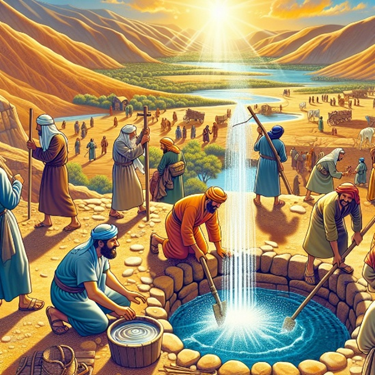
Genesis 26:17-18 So Isaac left. He camped in the valley of Gerar and settled down there. Isaac dug again the wells which were dug in the days of his father Abraham but had been clogged up by the Philistines after Abraham’s death. And he renamed them, using the original names his father had given them.

19-24 One day, as Isaac’s servants were digging in the valley, they came on a well of spring water. The shepherds of Gerar quarreled with Isaac’s shepherds, claiming, “This water is ours.” So Isaac named the well Esek (Quarrel) because they quarreled over it. They dug another well and there was a difference over that one also, so he named it Sitnah (Accusation). He went on from there and dug yet another well. But there was no fighting over this one so he named it Rehoboth (Wide-Open Spaces), saying, “Now God has given us plenty of space to spread out in the land.” From there he went up to Beersheba. That very night God appeared to him and said,

“I am the God of Abraham your father; don’t fear a thing because I’m with you. I’ll bless you and make your children flourish because of Abraham my servant.”

25 Isaac built an altar there and prayed, calling on God by name. He pitched his tent and his servants started digging another well.

26-27 Then Abimelech came to him from Gerar with Ahuzzath his advisor and Phicol the head of his troops. Isaac asked them, “Why did you come to me? You hate me; you threw me out of your country.”

28-29 They said, “We’ve realized that God is on your side. We’d like to make a deal between us—a covenant that we maintain friendly relations. We haven’t bothered you in the past; we treated you kindly and let you leave us in peace. So—God’s blessing be with you!”

30-31 Isaac laid out a feast and they ate and drank together. Early in the morning they exchanged oaths. Then Isaac said good-bye and they parted as friends.

32-33 Later that same day, Isaac’s servants came to him with news about the well they had been digging, “We’ve struck water!” Isaac named the well Sheba (Oath), and that’s the name of the city, Beersheba (Oath-Well), to this day.

All Isaac has wanted is to escape the drought that has evidently taken over some parts of the land. Moving westward into Philistia, Isaac has prospered to the extent that the Philistines are both envious and anxious. When the Philistines order Isaac to leave, he settles in one area and begins opening wells that the Philistines have clogged up out of spite. It’s mind-boggling to think that in an area in which water is scarce anybody would do something so foolish, but jealous people don’t think rationally.

Isaac’s men keep opening up the old wells, and the Philistines keep trying to claim them. But Isaac persists and his men finally create a well without any controversy. Isaac names this well Rehoboth, “Wide open spaces.” From there, Isaac moves to Beersheba, where God meets him, reassuring him that God will continue to fulfill His promises of health, protection, and prosperity. In response to this divine visitation, Isaac builds an altar and undoubtedly sacrifices perfect animals on that altar. After all, the only reason for an altar to be built is as a place of animal sacrifice.

Isaac sacrifices, worships, and prays, and his men begin digging yet another well. Meanwhile, Abimelech and his chief men show up. After evicting Isaac from Philistia, Abimelech has evidently had second thoughts, realizing that Isaac is so powerful that offending him is a sad mistake. Isaac and Abimelech make a treaty and part as friends. Just as the dust from Abimelech’s retinue is clearing, Isaac’s men come to him fairly jumping with joy. After several days of hot fruitless toil, Isaac’s men have found another vein of water and have created yet another well. Isaac calls this well and the area around it Beersheba- “the well of the oath.”  

What does blood have to do with this story? It is after Isaac speaks with God, building an altar and offering sacrifices, that Abimelech and his men come to make peace. Once more, God is responding to Isaac’s faithfulness.

Today, God does not demand blood sacrifices from us, for Jesus has made the ultimate blood sacrifice for the sins of the world. But we must believe in what Jesus has done, confess our sins, and turn away from our sins to follow God and His Holy Word. God asks that we make living sacrifices of ourselves. May God help us so that we will not postpone that decision, for none of us know the day our lives might end.

PRAYER: Father God, thank You for loving us and caring for us. Lord, help us to confess our sins to You and accept Your free gift of eternal life through Christ Jesus. It’s in the mighty and precious Name of Jesus that we pray. Amen.

NOVEMBER 28, 2025 WHAT’S SO IMPORTANT ABOUT BLOOD? #9 WHAT ABOUT HUMAN SACRIFICE?

November 28, 2025

Genesis 22:1 After all this, God tested Abraham. God said, “Abraham!”

“Yes?” answered Abraham. “I’m listening.”

2 He said, “Take your dear son Isaac whom you love and go to the land of Moriah. Sacrifice him there as a burnt offering on one of the mountains that I’ll point out to you.”

3-5 Abraham got up early in the morning and saddled his donkey. He took two of his young servants and his son Isaac. He had split wood for the burnt offering. He set out for the place God had directed him. On the third day he looked up and saw the place in the distance. Abraham told his two young servants, “Stay here with the donkey. The boy and I are going over there to worship; then we’ll come back to you.”

6 Abraham took the wood for the burnt offering and gave it to Isaac his son to carry. He carried the flint and the knife. The two of them went off together.

7 Isaac said to Abraham his father, “Father?”

“Yes, my son.”

“We have flint and wood, but where’s the sheep for the burnt offering?”

8 Abraham said, “Son, God will see to it that there’s a sheep for the burnt offering.” And they kept on walking together.

9-10 They arrived at the place to which God had directed him. Abraham built an altar. He laid out the wood. Then he tied up Isaac and laid him on the wood. Abraham reached out and took the knife to kill his son.

11 Just then an angel of God called to him out of Heaven, “Abraham! Abraham!”

“Yes, I’m listening.”

12 “Don’t lay a hand on that boy! Don’t touch him! Now I know how fearlessly you fear God; you didn’t hesitate to place your son, your dear son, on the altar for me.”

13 Abraham looked up. He saw a ram caught by its horns in the thicket. Abraham took the ram and sacrificed it as a burnt offering instead of his son.

14 Abraham named that place God-Yireh (God-Sees-to-It). That’s where we get the saying, “On the mountain of God, he sees to it.”

15-18 The angel of God spoke from Heaven a second time to Abraham: “I swear—God’s sure word!—because you have gone through with this, and have not refused to give me your son, your dear, dear son, I’ll bless you—oh, how I’ll bless you! And I’ll make sure that your children flourish—like stars in the sky! like sand on the beaches! And your descendants will defeat their enemies. All nations on Earth will find themselves blessed through your descendants because you obeyed me.”

19 Then Abraham went back to his young servants. They got things together and returned to Beersheba. Abraham settled down in Beersheba.

Abraham is distraught! After reveling having Isaac as the son of his old age, now Abraham is about to do the unthinkable. Following God’s orders, Abraham is to take Isaac and two servants, plus wood for a burnt offering, and travel three days to the Land of Moriah, where he must offer Isaac as a sacrifice to the Lord. How can God possibly demand that Abraham do this terrible thing? Beautiful, handsome Isaac, the pride and joy of his parents-how can Abraham possibly give up this miracle child? The night before they are to leave, Abraham slips into the tent where Isaac is sleeping and listens to his quiet breathing and smells his sweet little boy scent. Abraham traces Isaac’s dark curly hair, his sweet mouth, his long eyelashes, and his lovely smooth skin. Isaac is a handsome boy, and he is already developing muscles as he runs and plays and works with Abraham. The thought of what God is calling Abraham to do is almost more than Abraham can think about.

The next morning, Abraham, Isaac, the two servants, and a donkey set out for the land of Moriah. The closer the little band come to the mountains of Moriah, the heavier Abraham’s heart becomes. “Lord God,” Abraham cries within himself, “How can You possibly demand this of me? Isaac is the child of my old age, the child of promise. You have promised that my descendants will be countless; how can I have descendants if Isaac dies today?” Abraham’s feet seem heavier and heavier as he trudges up the mountainside to a level place that appears to shine with a holy light. Now it’s just Abraham and Isaac, for Abraham has left the two servants with the donkey at the foot of the mountain. Isaac carries the wood while Abraham carries the flint and knife. As they climb, Abraham wonders if he will be able to kill Isaac when the time comes or if he will simply plunge the knife into his own breast.

When Isaac innocently asks Abraham about the sheep for the sacrifice, Abraham can scarcely answer. Abraham said, “Son, God will see to it that there’s a sheep for the burnt offering.”

When Abraham and Isaac reach the place for the sacrifice, Abraham builds an altar, lays out the wood, and then ties up Isaac, laying him on the wood. Trembling within himself, Abraham picks up the knife. And then comes the miracle.

11-14 Just then an angel of God called to him out of Heaven, “Abraham! Abraham!”

“Yes, I’m listening.”

 “Don’t lay a hand on that boy! Don’t touch him! Now I know how fearlessly you fear God; you didn’t hesitate to place your son, your dear son, on the altar for me.”

Abraham looked up. He saw a ram caught by its horns in the thicket. Abraham took the ram and sacrificed it as a burnt offering instead of his son.

Abraham named that place God-Yireh (God-Sees-to-It). That’s where we get the saying, “On the mountain of God, he sees to it.”

Then God speaks to Abraham, The angel of God spoke from Heaven a second time to Abraham: “I swear—God’s sure word!—because you have gone through with this, and have not refused to give me your son, your dear, dear son, I’ll bless you—oh, how I’ll bless you! And I’ll make sure that your children flourish—like stars in the sky! like sand on the beaches! And your descendants will defeat their enemies. All nations on Earth will find themselves blessed through your descendants because you obeyed me.”

Throughout history, there have been human sacrifices; that is why Abraham wasn’t surprised that God would demand he sacrifice Isaac. But how could Abraham possibly give up his only son, the son of promise?

We read this story and think “EWWW! How nasty!” But that response totally misses the point. God never wanted Abraham to slaughter Isaac; however, He did want to see if Abraham’s commitment to Him was complete. Abraham’s willingness to give up what was most precious to him proved that Abraham wouldn’t withhold anything from God.

The only human sacrifice God has ever approved happened when God’s Son Jesus came as a man, living a sinless life and dying a cruel shameful death that he did not deserve. Abraham’s willingness to sacrifice Isaac foreshadows Jesus’ sacrifice.

Today, God requires different sacrifices. We might have planned illustrious careers for ourselves, with wealth and power. God asks, “Are those things more important than I am?” We might virtually worship our families. God will ask, “Are you willing to trust your relatives to Me?” We might When my husband and I left America for Ghana, God and I made a deal. God would take care of my relatives in America if I would take care of other people’s relatives in Ghana. Through the years, I have done the best I can to care for my patients here as if they were my blood relatives.

As a child in Sunday School, I learned this wonderful hymn by Cecil Frances Alexander. As you read these words, ask yourself what God wants from you.

PRAYER: Father God, thank You for loving us and caring for us. Lord, we give you our lives and our hearts. Please take them and use us for Your Glory. In the mighty and precious Name of King Jesus. Amen.

1. Jesus calls us o’er the tumult
Of our life’s wild, restless sea;
Day by day his sweet voice sounding,
Saying, “Christian, follow me.”

2. Brothers Simon, Andrew heard it
By the Galilean lake,
Turned from home, and toil, and kindred,
Leaving all for His dear sake.

3. Jesus calls us from the worship
Of the vain world’s golden store,
From each idol that would keep us,
Saying, “Christian, love me more.”

4. In our joys and in our sorrows,
Days of toil and hours of ease,
Still he calls, in cares and pleasures,
“Christian, love me more than these.”

5. Jesus calls us—By your mercies,
Savior, may we hear your call,
Give our hearts to your obedience,
Serve and love you best of all.

NOVEMBER 27, 2025 WHAT’S SO IMPORTANT ABOUT BLOOD? #8 WHAT’S THE POINT OF CIRCUMCISION?

November 27, 2025

Genesis 17: 1-2 When Abram was ninety-nine years old, God showed up and said to him, “I am The Strong God, live entirely before me, live to the hilt! I’ll make a covenant between us and I’ll give you a huge family.”

3-8 Overwhelmed, Abram fell flat on his face.

Then God said to him, “This is my covenant with you: You’ll be the father of many nations. Your name will no longer be Abram (Exalted Father, Their Shield, Their Protection), but Abraham, meaning that ‘I’m making you the father of many nations.’ (The name Abraham includes everything already implied by the name Abram.) I’ll make you a father of fathers—I’ll make nations from you, kings will issue from you. I’m establishing my covenant between me and you, a covenant that includes your descendants, a covenant that goes on and on and on, a covenant that commits me to be your God and the God of your descendants. And I’m giving you and your descendants this land where you’re now just camping, this whole country of Canaan, to own forever. And I’ll be their God.”

9-14 God continued to Abraham, “And you: You will honor my covenant, you and your descendants, generation after generation. This is the covenant that you are to honor, the covenant that pulls in all your descendants: Circumcise every male. Circumcise by cutting off the foreskin of the penis; it will be the sign of the covenant between us. Every male baby will be circumcised when he is eight days old, generation after generation—this includes house-born slaves and slaves bought from outsiders who are not blood kin. Make sure you circumcise both your own children and anyone brought in from the outside. That way my covenant will be cut into your body, a permanent mark of my permanent covenant. An uncircumcised male, one who has not had the foreskin of his penis cut off, will be cut off from his people—he has broken my covenant.”

Here God institutes circumcision for all of Abraham’s male descendants as a harmless form of cutting covenant. The shedding of blood during the rite of circumcision harks back to the blood covenant God has cut with Abram in Genesis 15. Not only does circumcision honor that covenant, but it also marks all Jewish males as being dedicated to the Lord. Sadly, there will be those who reject this mark of God’s covenant with Abram. Centuries later, during the Greco-Roman period, some young Jewish men will undergo painful operations to reverse the circumcision so that they can exercise naked in the gymnasiums without ostracism, essentially breaking that covenant.

15-16 God continued speaking to Abraham, “And Sarai your wife: Don’t call her Sarai any longer; call her Sarah. I’ll bless her—yes! I’ll give you a son by her! Oh, how I’ll bless her! Nations will come from her; kings of nations will come from her.” (The names Sarai and Sarah both come from the same root, meaning “to rule” or “to be strong;” however, the name Sarah also has international implications. Some people translate Sarah to mean “Princess.”)

17 Abraham fell flat on his face. And then he laughed, thinking, “Can a hundred-year-old man father a son? And can Sarah, at ninety years, have a baby?”

18 Recovering, Abraham said to God, “Oh, keep Ishmael alive and well before you!”

19 But God said, “That’s not what I mean. Your wife, Sarah, will have a baby, a son. Name him Isaac (Laughter). I’ll establish my covenant with him and his descendants, a covenant that lasts forever.

20-21 “And Ishmael? Yes, I heard your prayer for him. I’ll also bless him; I’ll make sure he has plenty of children—a huge family. He’ll father twelve princes; I’ll make him a great nation. But I’ll establish my covenant with Isaac whom Sarah will give you about this time next year.”

22 God finished speaking with Abraham and left.

23 Then Abraham took his son Ishmael and all his servants, whether house born or purchased—every male in his household—and circumcised them, cutting off their foreskins that very day, just as God had told him.

24-27 Abraham was ninety-nine years old when he was circumcised. His son Ishmael was thirteen years old when he was circumcised. Abraham and Ishmael were circumcised the same day together with all the servants of his household, those born there and those purchased from outsiders—all were circumcised with him.

We’ve already discussed circumcision, but notice Abraham’s obedience. Abraham doesn’t argue with God or question Him. “That very day,” Abraham circumcises every male in his household, no matter their origins. Why would all these men willingly undergo circumcision? First, there was Abraham’s character. These men knew Abraham and trusted him implicitly; if Abraham told them that the One True Living God had ordered circumcision, they would obey. Second, circumcision was not a new phenomenon; the Egyptians and other groups had practiced circumcision for years. There might have been some men scratching their heads in confusion; however, they trusted Abraham and they knew Abraham trusted God. By his instant obedience, Abraham proved that he was worthy of God’s trust. And God rewarded Abraham for his faithfulness.

Abraham also reaped another reward by his instant obedience in ordering circumcision for all males of the household: Sarai was renamed Sarah and God promised that she would bear a son in her old age, and that they would name the boy “Isaac,” which means “laughter.” The blood shed during the household circumcisions constituted a form of blood sacrifice.

It is fascinating to speculate what might have happened had Abraham not obeyed God in the matter of circumcision. Would Isaac still have been born or would Sarah have remained barren? Would God have blessed Ishmael and multiplied him as He had promised? Would the story of the Jewish people have ended with Abraham for lack of obedience? Praise God that these are idle speculations, for Abraham was obedient and the results would be miraculous!

PRAYER: Father God, thank You for loving us and caring for us. Lord, help us to be obedient even in the hard and difficult things. In the mighty and precious Name of King Jesus. Amen.

ARCHIBALD THE ANKLE UPDATE NOVEMBER 26, 2025 CRUTCHES!!!

November 26, 2025

One of the many lessons Archibald the Ankle is teaching me is the value of various kinds of crutches. Several years ago, we helped Taala Ruth, a young girl with terrible orthopedic problems. Eventually, Taala reached the point that she can walk without crutches, even though she has undergone a Girdlestone procedure, removing the ball of her left thigh bone because of infection, and has a fused right knee due to infection, injury, and malnutrition at a critical time. It was only a few months ago that Taala gave back her elbow crutches, the same crutches I am now using.

For those needing crutches, elbow crutches are far superior to those with cross pieces that fit in the armpit. The danger of armpit crutches is that if one leans on the crosspiece, one can easily put too much pressure on the nerves, damaging them permanently and making it impossible to use the hand and forearm. A trick with these crutches is for them to be short enough that there is at least 2-3 inches between the armpit and the top of the crutch. All the patient’s weight should go on the hand grips and not on the top cross pieces. The advantage of armpit crutches is that they are simple and easily manufactured, making them the predominant type of crutch in rural Africa.

Elbow crutches depend on pressure on the hand grips with the elbow supports keeping the upper arm stable. But not all elbow crutches are created equal. When we looked for crutches for Taala Ruth, we got the best ones we could; however, they have mobile clips that fit around the upper arm. Threading one’s arm through these clips can be difficult, and removing the crutches when entering a vehicle or sitting down can also be difficult. There are more expensive kinds of elbow crutches that have a rigid support molded and attached to the crutch. Such crutches are easier to handle because they are less tricky when the user wants to put them aside.

Remember that my condition is not permanent. Tomorrow is Thanksgiving in the U.S. and I am deeply grateful for many things:

  1. I am grateful that my injury was minor and that I should heal within a few weeks without operation.
  2. I am grateful that the pain is reducing daily. The pitfall is that I might forget and put more weight on my injured leg than I should.
  3. I am grateful that my injury demonstrated the fact that obstructing a public path with a log might lead to disastrous injuries. Had a local motorcycle rider hit that log, he could have flown off his bike, landing on his head and snapping his neck, dying instantly. I do, however, agree that our local motorcycle riders and motoking drivers constitute a public menace. Controlling these people is a big problem.
  4. I am grateful that we had crutches at the house and that we were able to secure a wheelchair.
  5. I am grateful that I am able to maneuver around our home.
  6. I am grateful that I am able to rest. Until my injury, I had not taken annual leave.
  7. I am grateful that I am learning to handle videos and to convert Power Point presentations into videos for upload onto Youtube.
  8. I am grateful for the loving care my husband and our friends give me daily.
  9. I thank God that because of my injury, I will be able to celebrate Thanksgiving without worrying that I might be called to an emergency at the hospital. I cannot tell the numbers of holiday celebrations that have been forfeited or postponed because of my work. I have also been able to attend two weddings without interruption due to my injury.
  10. I thank God that He continues to care for us and to provide. Despite my injury, we are still helping support patients and their families with medicines, blood, and feeding.
  11. Most of all, I thank God for sending His Son Jesus Christ to live as a sinless man, to die for all of our sins, and to defeat death, hell, and the grave! Because He lives, we live also.

NOVEMBER 26, 2025 WHAT’S SO IMPORTANT ABOUT BLOOD? #7 WHAT DOES “CUTTING COVENANT” REALLY MEAN? IT’S A LOT MORE SERIOUS THAN YOU MIGHT THINK!

November 26, 2025

Genesis 15

1 After all these things, this word of God came to Abram in a vision: “Don’t be afraid, Abram. I’m your shield. Your reward will be grand!”

2-3 Abram said, “God, Master, what use are your gifts as long as I’m childless and Eliezer of Damascus is going to inherit everything?” Abram continued, “See, you’ve given me no children, and now a mere house servant is going to get it all.”

4 Then God’s Message came: “Don’t worry, he won’t be your heir; a son from your body will be your heir.”

5 Then he took him outside and said, “Look at the sky. Count the stars. Can you do it? Count your descendants! You’re going to have a big family, Abram!”

6 And he believed! Believed God! God declared him “Set-Right-with-God.”

7 God continued, “I’m the same God who brought you from Ur of the Chaldees and gave you this land to own.”

8 Abram said, “Master God, how am I to know this, that it will all be mine?”

9 God said, “Bring me a heifer, a goat, and a ram, each three years old, and a dove and a young pigeon.”

10-12 He brought all these animals to him, split them down the middle, and laid the halves opposite each other. But he didn’t split the birds. Vultures swooped down on the carcasses, but Abram scared them off. As the sun went down a deep sleep overcame Abram and then a sense of dread, dark and heavy.

13-16 God said to Abram, “Know this: your descendants will live as outsiders in a land not theirs; they’ll be enslaved and beaten down for 400 years. Then I’ll punish their slave masters; your offspring will march out of there loaded with plunder. But not you; you’ll have a long and full life and die a good and peaceful death. Not until the fourth generation will your descendants return here; sin is still a thriving business among the Amorites.”

17-21 When the sun was down and it was dark, a smoking firepot and a flaming torch moved between the split carcasses. That’s when God made a covenant with Abram: “I’m giving this land to your children, from the Nile River in Egypt to the River Euphrates in Assyria—the country of the Kenites, Kenizzites, Kadmonites, Hittites, Perizzites, Rephaim, Amorites, Canaanites, Girgashites, and Jebusites.”

Abraham is in despair! What good are all his possessions if he has no heir and the only one who might inherit from him is a trusted house servant, Eliazer of Damascus? That’s when God speaks to Abraham, who at this point is still referred to as Abram, assuring him that God will give him a son and that his descendants will be beyond number. But God knows that Abram/Abraham isn’t sure he believes these assurances, so God cuts covenant with him.

David Guzik tells us in his Enduring Word Commentary: Abram knew exactly what to do with these animals. He understood that according to the custom of his time, God told him to get a contract ready for signing.

i. In those days, contracts were sometimes made by the sacrificial cutting of animals, with the split carcasses of the animals lying on the ground. The covenant was made when parties to the agreement walked through the animal parts together, repeating the terms of the covenant. The Lord made a covenant in Genesis 15:18 is literally, “the Lord cut a covenant.”

ii. Jeremiah 34:18-20 refers to this same practice of a covenant made by cutting animals and repeating the oath of the covenant as one walks through the animal parts.

iii. The symbolism was plain. First, this was a covenant so serious, it was sealed with blood. Second, if one were to break this covenant, let this same bloodshed be poured out on their animals and on them.

iv. When Abram had his doubts and wanted assurance from the Lord, God said to him clearly, “Let’s sign a contract and settle this once for all.”

c. And when the vultures came down on the carcasses, Abram drove them away: As Abram waited for the Lord to appear and walk through the carcasses with him (to sign the covenant), God didn’t come right away. Abram had to wait and fight off the vultures until God appeared to complete the covenant ceremony.

i. Abram had reason to expect that God would come down and walk through the animal parts with him, because God had previously appeared to him in some way (Genesis 12:7). It seems Abram knew God could take some physical form. (https://enduringword.com/bible-commentary/genesis-15/)

WOW! Here God doesn’t merely order Abram to offer animals as a sacrifice but to split their bodies and arrange them. Traditionally, only one animal was needed for a covenant ceremony; however, such a proceeding was very serious business, for both parties to the covenant would have to walk around and between the body parts, chanting the covenant and stating that if they broke the covenant, then they and their animals would die just as the animals offered had died. The amazing thing is that God does not demand Abram walk around the animal bodies but God Himself moves in the traditionally approved fashion as symbolized by the smoking firepot and the flaming torch. God does what Abram was unable to do at that point, pledging His divine honor.

For the rest of Abram’s life, he would remember this night, the profound darkness, and the flaming torch and smoking firepot. Why didn’t Abram also walk around the animal bodies? He was probably prostrate with his face to the earth, knowing that he was in the presence of the One True Living God. The awe of God and the fear of God were so great that Abram couldn’t do anything else.

One fascinating detail is the mention of the Amorites. Genesis 14 describes Abram uniting with three Amorite chiefs, Mamre, Aner, and Eshcol, to deliver Lot and the Sodomites from their captors. Obviously, these men must have been honorable or Abram would have had nothing to do with them. Other translations of these same verses quote God as saying, “The iniquity of the Amorites is not yet complete.” By the time the Israelites return from Egypt, God orders them to destroy the Amorites completely, indicating that the downward moral slide the Amorites have been pursuing has finally reached the point of no return.

What can we learn from this account of an extreme blood sacrifice? Don’t play games with God! God knows your heart better than you do, and God desires that people should love Him and serve Him. You don’t have to worry about cleaning yourself up before you come to God because God specializes in clean-ups. My husband did not become a Christian until he was 37 years old, and as a former sailor, he had an extensive vocabulary of swear words. But when Bob came to Jesus, Jesus cleaned up his heart, his mind, and his heart; in fact, the change was so complete that a supervisor sent him to see the company doctor because they thought Bob had gone crazy.

If you are serious with God, God will be serious with you. Let’s pray.

PRAYER: Father God, thank You for loving us and caring for us. Lord, we long to be clean and holy, but we are stuck in our sins. Please deliver us from our sins and cleanse our hearts and our minds. In the mighty and precious Name of King Jesus. Amen.