Archive for the ‘Uncategorized’ Category

JUNE 17, 2022 SOLOMON THE SUPERSTAR #6 1 KINGS 6:1 – 38 SOLOMON’S TEMPLE – BEWARE OF EDIFICE COMPLEXES!

June 17, 2022

1 Kings 6:1 – 38 “In the four hundred and eightieth year after the Israelites had come out of the land of Egypt, in the month of Ziv, the second month of the fourth year of Solomon’s reign over Israel, he began to build the house of the LORD. (Ziv was the second month of the ancient Hebrew lunar calendar, usually occurring within the months of April and May.)

The house that King Solomon built for the LORD was sixty cubits long, twenty cubits wide, and thirty cubits high. (The house was approximately 90 feet long, 30 feet wide, and 45 feet high (27.4 meters long, 9.1 meters wide, and 13.7 meters high). The portico at the front of the main hall of the temple was twenty cubits long, (20 cubits is approximately 30 feet or 9.1 meters) extending across the width of the temple and projecting out ten cubits in front of the temple. (10 cubits is approximately 15 feet or 4.6 meters.) He also had narrow windows framed high in the temple.

The Chambers

Against the walls of the temple and the inner sanctuary, Solomon built a chambered structure around the temple, in which he constructed the side rooms. The bottom floor was five cubits wide, the middle floor six cubits, and the third floor seven cubits. He also placed offset ledges around the outside of the temple, so that nothing would be inserted into its walls. The temple was constructed using finished stones cut at the quarry, so that no hammer or chisel or any other iron tool was heard in the temple while it was being built.

 The entrance to the bottom floor was on the south side of the temple. A stairway led up to the middle level, and from there to the third floor.

 So, Solomon built the temple and finished it, roofing it with beams and planks of cedar. He built chambers all along the temple, each five cubits high and attached to the temple with beams of cedar.

God’s Promise to Solomon

Then the word of the LORD came to Solomon, saying: “As for this temple you are building, if you walk in My statutes, carry out My ordinances, and keep all My commandments by walking in them, I will fulfill through you the promise I made to your father David. And I will dwell among the Israelites and will not abandon My people Israel.”

The Temple’s Interior   

So, Solomon built the temple and finished it. He lined the interior walls with cedar paneling from the floor of the temple to the ceiling, and he covered the floor with cypress boards.

He partitioned off the twenty cubits at the rear of the temple with cedar boards from floor to ceiling to form within the temple an inner sanctuary, the Most Holy Place. And the main hall in front of this room was forty cubits long.  (40 cubits is approximately 60 feet or 18.3 meters.)

The cedar paneling inside the temple was carved with gourds and open flowers. Everything was cedar; not a stone could be seen.

 Solomon also prepared the inner sanctuary within the temple to set the ark of the covenant of the LORD there. 20 The inner sanctuary was twenty cubits long, twenty cubits wide, and twenty cubits high. He overlaid the inside with pure gold, and he also overlaid the altar of cedar.  

So, Solomon overlaid the inside of the temple with pure gold, and he extended gold chains across the front of the inner sanctuary, which was overlaid with gold. So, he overlaid with gold the whole interior of the temple, until everything was completely finished. He also overlaid with gold the entire altar that belonged to the inner sanctuary.

The Cherubim

In the inner sanctuary he made two cherubim, each ten cubits high, out of olive wood. One wing of the first cherub was five cubits long, and the other wing was five cubits long as well. So, the full wingspan was ten cubits. The second cherub also measured ten cubits; both cherubim had the same size and shape, and the height of each cherub was ten cubits. (10 cubits is 15 feet or 4.6 meters.)

And he placed the cherubim inside the innermost room of the temple. Since their wings were spread out, the wing of the first cherub touched one wall, while the wing of the second cherub touched the other wall, and in the middle of the room their wingtips touched. He also overlaid the cherubim with gold. Then he carved the walls all around the temple, in both the inner and outer sanctuaries, with carved engravings of cherubim, palm trees, and open flowers. And he overlaid the temple floor with gold in both the inner and outer sanctuaries.

The Doors

For the entrance to the inner sanctuary, Solomon constructed doors of olive wood with five-sided doorposts. The double doors were made of olive wood, and he carved into them cherubim, palm trees, and open flowers and overlaid the cherubim and palm trees with hammered gold. In the same way he made four-sided doorposts of olive wood for the sanctuary entrance. The two doors were made of cypress wood, and each had two folding panels. He carved into them cherubim, palm trees, and open flowers; and he overlaid them with gold, hammered evenly over the carvings.

The Courtyard

Solomon built the inner courtyard with three rows of dressed stone and one row of trimmed cedar beams.

The foundation of the house of the LORD was laid in the fourth year of Solomon’s reign, in the month of Ziv. In his eleventh year and eighth month, the month of Bul, the temple was finished in every detail and according to every specification. So, he built the temple in seven years. (Bul was the eighth month of the ancient Hebrew lunar calendar, usually occurring within the months of October and November.)
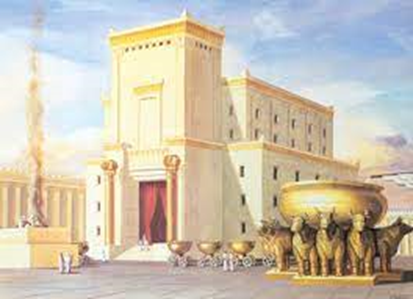
It’s difficult to split up this chapter because the descriptions flow from one area to the next. Overall, the temple is made with stones cut and dressed at the quarry and then moved from the mountains to Jerusalem so that there would be no sound of chisels and hammers at the work site. The sheer size of these stones is mind – boggling. According to one source, the smallest stones weight between 2 to 5 tons and the largest stone of them all – possibly the largest building stone in antiquity – is 13.6 meters long, 4.6 meters thick and 3.3 meters high, and is estimated to weigh 570 tons. The builders used dry construction – there is no cement between the stones. (https://www.jerusalem-insiders-guide.com/temple-of-jerusalem.html) These stones may have been dragged by oxen from the quarries.

One thing that has always puzzled me is why the width of the chambers increased from story to story rather than decreasing. It is possible that the thickness of the walls decreased slightly with each new story. That would allow for more space with less weight on the structures below.

Cedar and gold are used extensively throughout the temple. Both these items are luxury items that were generally used sparingly even in the homes of the very wealthy; however, Solomon lines rooms with cedar and then overlays them with gold, sparing no expense. Solomon actually inherited much of this gold from his father David.  

In the midst of this building frenzy, God steps in and speaks to Solomon. “Then the word of the LORD came to Solomon, saying: “As for this temple you are building, if you walk in My statutes, carry out My ordinances, and keep all My commandments by walking in them, I will fulfill through you the promise I made to your father David. And I will dwell among the Israelites and will not abandon My people Israel.” It would seem that God is less impressed with the glories of the new temple and far more concerned about heart attitudes. Sadly, Solomon appears to accept this warning but refuses to heed it.

APPLICATION: How much use are fancy buildings? Some people have coined a term for those insisting on building elaborate houses of worship; these people are said to possess an “edifice complex.” Through the centuries, building programs have caused problems. In modern times, building programs have sometimes resulted in church splits, leaving fewer people to bear the costs of ongoing construction. At the same time, the money spent on buildings could have done a great deal to relieve suffering in the areas immediately around the church.

When Jesus was speaking with the Samaritan woman at the well, he told her, “God is spirit, and his worshipers must worship in the Spirit and in truth.” (John 4:24) Most effective ministry takes place outside church buildings, not inside. One wonders how enthusiastically the ancient Israelites glorified God when they came to Solomon’s temple and realized the enormous wealth that had been spent on it. It is fascinating to note that at no point does the Bible indicate that God had any hand in the plans for the temple, apart from the general layout that was originally given to Moses for the tabernacle in the wilderness. Sadly, it is quite possible for people to get caught up in appearances and to fail to worship “in spirit and in truth.” This problem of heart attitude is exactly what God warned Solomon about.

Truly, our lives are to be places of worship. Our workplaces, our homes, and our places of recreation should be just as sacred to God as any church building. Worship is not something that you can turn off and on like a water faucet. We must check our hearts! Are we impressed with beautiful structures and programs, forgetting that they are worthless unless God shows up? May God help us!

PRAYER: Father God, thank You for loving us and for caring for us. Lord, help us to worship You in spirit and in truth. Help us to remember that You are not impressed by programs or structures but only by our hearts. In the mighty and precious Name of King Jesus. Amen.
JUNE 16, 2022 SOLOMON THE SUPERSTAR #5 1 KINGS 5:1 – 18 SOLOMON BUILDS THE TEMPLE AND THE ISRAELITES LEARN ABOUT TANSTAAFL

June 16, 2022

1 Kings 5:1 – 18 “1 Now when Hiram king of Tyre heard that Solomon had been anointed king in his father’s place, he sent envoys to Solomon; for Hiram had always been a friend of David.

 And Solomon relayed this message to Hiram:

 “As you are well aware, due to the wars waged on all sides against my father David, he could not build a house for the Name of the LORD his God until the LORD had put his enemies under his feet.  But now the LORD my God has given me rest on every side, and there is no adversary or crisis.

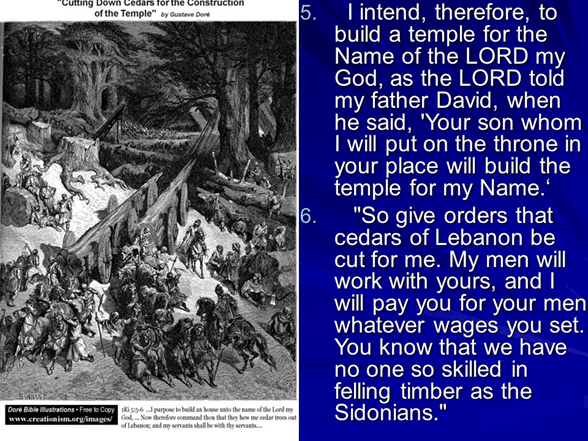
So, behold, I plan to build a house for the Name of the LORD my God, according to what the LORD said to my father David: ‘I will put your son on your throne in your place, and he will build the house for My Name.’

Now therefore, order that cedars of Lebanon be cut down for me. My servants will be with your servants, and I will pay your servants whatever wages you set, for you know that there are none among us as skilled in logging as the Sidonians.”

When Hiram received Solomon’s message, he rejoiced greatly and said, “Blessed be the LORD this day! He has given David a wise son over this great people!” Then Hiram sent a reply to Solomon, saying:

“I have received your message; I will do all you desire regarding the cedar and cypress timber. My servants will haul the logs from Lebanon to the Sea, and I will float them as rafts by sea to the place you specify. There I will separate the logs, and you can take them away. And in exchange, you can meet my needs by providing my household with food.” So, Hiram provided Solomon with all the cedar and cypress timber he wanted, and year after year Solomon would provide Hiram with 20,000 cors of wheat as food for his household, as well as 20,000 baths of pure olive oil. (20,000 cors is approximately 124,800 bushels or 4.4 million liters (probably about 3,800 tons or 3,400 metric tons of wheat. 20,000 baths is approximately 116,000 gallons or 440,000 liters of olive oil).

And the LORD gave Solomon wisdom, as He had promised him. There was peace between Hiram and Solomon, and the two of them made a treaty.

 Then King Solomon conscripted a labor force of 30,000 men from all Israel. He sent them to Lebanon in monthly shifts of 10,000 men, so that they would spend one month in Lebanon and two months at home. And Adoniram was in charge of the forced labor.

Solomon had 70,000 porters and 80,000 stonecutters in the mountains, not including his 3,300 foremen who supervised the workers. And the king commanded them to quarry large, costly stones to lay the foundation of the temple with dressed stones. So, Solomon’s and Hiram’s builders, along with the Gebalites, quarried the stone and prepared the timber and stone for the construction of the temple.

When the Israelites rejected having God as their supreme ruler and demanded a king, Samuel warned them what would happen, and now those warnings are coming to pass. These warnings are delineated in 1 Samuel 8:10 – 18. “So, Samuel spoke all the words of the LORD to the people who were asking him for a king. He said, “This will be the manner of the king who will reign over you: He will take your sons and appoint them to his own chariots and horses, to run in front of his chariots.

He will appoint some for himself as commanders of thousands and of fifties, and others to plow his ground, to reap his harvest, to make his weapons of war, and to equip his chariots.

 And he will take your daughters to be perfumers, cooks, and bakers. He will take the best of your fields and vineyards and olive groves and give them to his servants. He will take a tenth of your grain and grape harvest and give it to his officials and servants. And he will take your menservants and maidservants and your best cattle and donkeys and put them to his own use.

He will take a tenth of your flocks, and you yourselves will become his slaves. When that day comes, you will beg for relief from the king you have chosen, but the LORD will not answer you on that day.”

Up until now, the Israelites have been enjoying the prosperity of Solomon’s regime; however, Solomon is embarking on ambitious construction projects that require lots of laborers. There is a labor force of 30,000 men going to Lebanon in one month shifts of 10,000 at a time. There are 70,000 porters and 80,000 stone cutters, plus 3,300 overseers. The total of these workers alone is 183,300. And Solomon is just getting started. Before Solomon is through, every bit of Samuel’s prophecies will come true. How do we know this? After Solomon dies and Rehoboam becomes king, the people come to him and beg for relief. 1 Kings 12:4 “Your father put a heavy yoke on us. But now you should lighten the burden of your father’s service and the heavy yoke he put on us, and we will serve you.” True, Solomon accomplishes wonderful things during his reign and builds a magnificent temple, but all of these buildings come with a heavy cost for the average Israelite.

APPLICATION: In the Robert Heinlein novel The Moon is a Harsh Mistress, Heinlein makes use of the phrase “TANSTAAFL.” This acronym stands for the saying “There Ain’t No Such Thing As A Free Lunch.” The characters in the novel who succeed in overcoming the enormous challenges they face have to learn this truth repeatedly. Nothing useful or outstanding has ever been achieved by wishing or talking; most achievements demand hard work and sacrifice. Now that Solomon is firmly entrenched as king, the Israelites are about to learn the truth of the phrase TANSTAAFL. There’s a lot of money flowing through the kingdom, and much of it is going directly to Solomon and those immediately under him.

It is always a mistake to trust in people rather than in God. So far, Israel has had Saul, David, and now Solomon as king. Each of these men accomplishes different things; however, life is not easy for the common people who must make these kingdoms function.

Where are you putting your trust? Recent events internationally have proven the truth that rulers such as presidents and prime ministers are not to be trusted. Currently, Russia has embarked on a war of conquest in Ukraine using the flimsiest of excuses, and the rest of the international community is letting this happen.

The writer of Psalm 121 got it right when he said, “I lift up my eyes to the hills. From where does my help come?

My help comes from the LORD, the Maker of heaven and earth. He will not allow your foot to slip; your Protector will not slumber. Behold, the Protector of Israel will neither slumber nor sleep. The LORD is your keeper; the LORD is the shade on your right hand. The sun will not strike you by day, nor the moon by night. The LORD will guard you from all evil; He will preserve your soul. The LORD will watch over your coming and going, both now and forevermore.”

TANSTAAFL! When you trust earthly rulers, the price they demand will be exorbitant. Trust the Lord, the Maker of heaven and earth, the Protector of Israel.

PRAYER: Father God, thank You for loving us and for caring for us. Lord, help us to trust in You rather than any earthly rulers. Thank You for being our Shield and our Protector. In the mighty and precious Name of King Jesus. Amen.

JUNE 15, 2022 1 KINGS 4: 20 – 34 SOLOMON THE SUPERSTAR # 4 RICHES AND POWER AND WISDOM! SOLOMON HAS IT ALL!

June 15, 2022

1 Kings 4:20 – 34 “The people of Judah and Israel were as numerous as the sand on the seashore, and they were eating and drinking and rejoicing. And Solomon reigned over all the kingdoms from the Euphrates to the land of the Philistines, as far as the border of Egypt. These kingdoms offered tribute and served Solomon all the days of his life.

Solomon’s provisions for a single day were thirty cors of fine flour, (30 cors is approximately 187 bushels or 6,600 liters (probably about 5.5 tons or 5 metric tons of flour).  sixty cors of meal, 60 cors is approximately 375 bushels or 13,200 liters (probably about 11 tons or 10 metric tons of meal). ten fat oxen, twenty range oxen, and a hundred sheep, as well as deer, gazelles, roebucks, and fattened poultry. For Solomon had dominion over everything west of the Euphrates —over all the kingdoms from Tiphsah to Gaza—and he had peace on all sides. Throughout the days of Solomon, Judah and Israel dwelt securely from Dan to Beersheba, each man under his own vine and his own fig tree.

Solomon had 4,000 stalls for his chariot horses and 12,000 horses. Each month the governors in turn provided food for King Solomon and all who came to his table. They saw to it that nothing was lacking. Each one also brought to the required place their quotas of barley and straw for the chariot horses and other horses.

 And God gave Solomon wisdom, exceedingly deep insight, and understanding beyond measure, like the sand on the seashore. Solomon’s wisdom was greater than that of all the men of the East, greater than all the wisdom of Egypt. He was wiser than all men—wiser than Ethan the Ezrahite, and wiser than Heman, Calcol, and Darda, the sons of Mahol. And his fame spread throughout the surrounding nations.

Solomon composed three thousand proverbs, and his songs numbered a thousand and five. He spoke of trees, from the cedar in Lebanon to the hyssop growing in the wall, and he taught about animals, birds, reptiles, and fish.

So, men of all nations came to listen to Solomon’s wisdom, sent by all the kings of the earth, who had heard of his wisdom.”

Now we know just why Solomon had to have all that administrative staff. The challenges of providing logistics for this kingdom are staggering. Obviously, Solomon has a huge number of people living at the palace, as well as maintaining the army and all those horses and chariots. Some sources believe that Solomon may have controlled at least 60,000 square miles of territory. Part of that land might have included nations who were semi – autonomous but who still paid tribute to Solomon, leaving 34,000 square miles directly under Solomon’s control. At any rate, administering such a kingdom called for a great deal of organization.

One of the most comforting phrases in the Bible is the description of Israel in the days of Solomon. “Throughout the days of Solomon, Judah and Israel dwelt securely from Dan to Beersheba, each man under his own vine and his own fig tree.” Recently, we celebrated the anniversary of the landings on Normandy Beach known as D Day. If you are familiar with the music of that era, you realize that the situation described by this verse was the dream of most of those fighting on both sides. All that most people want is to have peace and to dwell securely in their own homes, enjoying the fruits of their labors. The mention of vines and fig trees would imply that the Israelites were enjoying small gardens with grapes and figs, not to mention other fruits as well. Today Israel produces wonderful fruit of all kinds.    

One worrisome thing is the large number of horses and chariots Solomon possessed. Later on, we learn that Solomon was also sending to Egypt for horses and trading in horses throughout the Middle East. In light of the instructions to the kings of Israel in Deuteronomy 17, was this expansion of the cavalry something God approved of or merely something that Solomon did on his own? Who knows? At any rate, Solomon became extremely rich.

God also kept his promise to Solomon concerning wisdom. In an era in which wise men were prized, Solomon stood out above all the rest. “He was wiser than all men—wiser than Ethan the Ezrahite, and wiser than Heman, Calcol, and Darda, the sons of Mahol. And his fame spread throughout the surrounding nations.”  Although none of these men’s names mean anything to us today, they were famous at that time for their sagacity, and Solomon exceeded them all.

APPLICATION: God has always kept his promises, including his promises to Solomon. But should we be asking for the same things that Solomon did? Proverbs 29:7 – 9 says, “Two things I ask of You— do not refuse me before I die: Keep falsehood and deceitful words far from me. Give me neither poverty nor riches; feed me with the bread that is my portion. Otherwise, I may have too much and deny You, saying, ‘Who is the LORD?’ Or I may become poor and steal, profaning the name of my God.”

Very few of us can actually handle wealth in a holy fashion. The temptation to indulge ourselves is too great for most of us. As we will learn later, Solomon was not immune to these temptations either.

PRAYER: Father God, thank You for loving us and for caring for us. Lord, help us to appreciate the blessings You have already given us and to trust You for Your provision for our lives. In the mighty and precious Name of King Jesus. Amen. 

JUNE 14, 2022 SOLOMON THE SUPERSTAR #3 1 KINGS 4:1 – 19 GOD EVEN RECOGNIZES ADMINISTRATORS, SECRETARIES, AND CLERKS

June 14, 2022

1 Kings 4:1 – 19 “So King Solomon ruled over Israel, and these were his chief officials: Azariah son of Zadok was the priest; Elihoreph and Ahijah, the sons of Shisha, were secretaries; Jehoshaphat son of Ahilud was the recorder; Bnaiah son of Jehoiada was in charge of the army; Zadok and Abiathar were priests; Azariah son of Nathan was in charge of the governors; Zabud son of Nathan was a priest and adviser to the king; Ahishar was in charge of the palace; and Adoniram son of Abda was in charge of the forced labor.

Solomon had twelve governors over all Israel to provide food for the king and his household. Each one would arrange provisions for one month of the year, and these were their names: Ben-hur in the hill country of Ephraim; Ben-deker in Makaz, in Shaalbim, in Beth-shemesh, and in Elon-beth-hanan; Ben-hesed in Arubboth (Socoh and all the land of Hepher belonged to him); Ben-abinadab in Naphath-dor (Taphath, a daughter of Solomon, was his wife); Baana son of Ahilud in Taanach, in Megiddo, and in all of Beth-shean next to Zarethan below Jezreel, from Beth-shean to Abel-meholah and on past Jokmeam; Ben-geber in Ramoth-gilead (the villages of Jair son of Manasseh in Gilead belonged to him, as well as the region of Argob in Bashan with its sixty great cities with walls and bronze bars); Ahinadab son of Iddo in Mahanaim; Ahimaaz in Naphtali (he had married Basemath, a daughter of Solomon); Baana son of Hushai in Asher and in Aloth; Jehoshaphat son of Paruah in Issachar; Shimei son of Ela in Benjamin; Geber son of Uri in the land of Gilead, including the territories of Sihon king of the Amorites and of Og king of Bashan. There was also one governor in the land of Judah.“

Looking at these names, you might think, “Oh dear! Another list of incomprehensible names!” But look at what these people were doing. Secretaries, recorders, high priests, army commanders, heads of the governors, governors, an advisor to the king and the man in charge of forced labor. Each one of these men had massive responsibilities that increased as Solomon’s kingdom grew. Then there were the twelve governors responsible for supplying the palace, no mean feat in itself. Centuries later, we know about these men because God made sure that their names were preserved. These men performed excellently and God has recognized that fact.

Later on, we will read the descriptions of the responsibilities of these men, and those responsibilities were enormous. Before Solomon’s reign was over, his kingdom was one of the richest in the entire Middle East, and these were the men who made things possible. Without the efforts of these men, none of God’s promises would have come true for Solomon.

APPLICATION: So many times, we may feel that we are merely cogs in a machine. We get so caught up in the demands of our job that we fail to remember the big picture. There is a story about two stone masons who were working on small carvings in one of the medieval cathedrals. A passer – by asked the first mason, “What are you doing?” “I’m carving one small item that will be on the roof of this building. Once my carving is in place, nobody will ever see it,” the man grumbled. Then the passer – by asked the second man the same question. “I am helping build a place of worship to the glory of God,” the second mason answered. “But your carving will be in an obscure place,” the passer – by observed. “Yes, but God will see it!” answered the mason.

When we see these lists of names in the Bible, we should be encouraged. These men have done outstanding work, and God continues to honor them long after their work is over. God sees our efforts and knows our struggles. God knows the temptation to slack off and to do as little as possible when nobody is looking. God knows the times we have come to work when we were sick or when our family was in turmoil. And God knows the times we have put forth extra effort, even though it has cost us a great deal.

Take heart! Just as God has preserved the names and reputations of these men, God will also remember you. Your struggles have not been in vain and someday God will reward you.

Isaiah 43:2 – 3 tells us, ““Do not fear, for I have redeemed you; I have called you by your name; you are Mine!

2 When you pass through the waters, I will be with you; and when you go through the rivers, they will not overwhelm you. When you walk through the fire, you will not be scorched; the flames will not set you ablaze.

 For I am the LORD your God, the Holy One of Israel, your Savior; I give Egypt for your ransom, Cush and Seba in your place.”

Comfort yourself with the thought that God sees all your trials and all your hard work! You are precious to God, and He is with you, both now and forever!

PRAYER: Father God, thank You for loving us and for caring for us. Lord, help all those who read this to be encouraged and to trust that You are fully aware of their struggles and their needs. Help them to rely on You for their strength and inspiration. In the mighty and precious Name of King Jesus. Amen.  
JUNE 13, 2022 SOLOMON THE SUPERSTAR #2 1 KINGS 3:16 – 28 WOULD YOU GIVE YOUR CHILD TO ANOTHER MOTHER TO SAVE ITS LIFE?

June 13, 2022

2 Kings 3:16 – 28 “At that time two prostitutes came to the king and stood before him. One woman said, “Please, my lord, this woman and I live in the same house, and I gave birth while she was in the house. On the third day after I gave birth, this woman also had a baby. We were alone, with no one in the house but the two of us. During the night this woman’s son died because she rolled over on him. So, she got up in the middle of the night and took my son from my side while I was asleep. She laid him in her bosom and put her dead son at my bosom. The next morning, when I got up to nurse my son, I discovered he was dead. But when I examined him, I realized that he was not the son I had borne.”

 “No,” said the other woman, “the living one is my son and the dead one is your son.”

But the first woman insisted, “No, the dead one is yours and the living one is mine.” So, they argued before the king.

Then the king replied, “This woman says, ‘My son is alive and yours is dead,’ but that woman says, ‘No, your son is dead and mine is alive.’”

The king continued, “Bring me a sword.” So, they brought him a sword, and the king declared, “Cut the living child in two and give half to one and half to the other.”

Then the woman whose son was alive spoke to the king because she yearned with compassion for her son. “Please, my lord,” she said, “give her the living baby. Do not kill him!”

But the other woman said, “He will be neither mine nor yours. Cut him in two!”  Then the king gave his ruling: “Give the living baby to the first woman. By no means should you kill him; she is his mother.”

When all Israel heard of the judgment the king had given, they stood in awe of him, for they saw that the wisdom of God was in him to administer justice.”

There is a phrase “a Solomon come to judgement,” and this story is the origin of that phrase. Until now, Solomon hasn’t done anything that a pagan king would not have done, apart from sacrificing to the Lord. But pagan kings will also sacrifice to their gods. In the handling of this incident, Solomon begins to demonstrate God’s gift of divine wisdom. Two prostitutes give birth 3 days apart, but one of them rolls over on her child at night as they sleep on a mat together. Realizing that she has smothered her child, this woman swiftly exchanges her dead baby for her colleague’s live one and lies down again. The other prostitute wakes and realizes that there is a dead baby lying next to her and that this baby is not hers. The two women come to Solomon, and Solomon settles the matter in a dramatic fashion by threatening to cut the baby in half. The mother of the dead baby agrees to this division; why should she care? But the actual mother of the child longs for the life of the child and is willing to give it up rather than see the child put to death.    

APPLICATION: This story seems so simple but it is really profound. God has given Solomon His wisdom. Without the wisdom of God, Solomon might have descended into a morass of arguments between the two women, culminating in a hair – pulling match right there in the throne room!

Which of us does not need divine wisdom? We are parents and workers, students and teachers. We may be supervisors or we may be in the ranks of those who are supervised. No matter our situation, we need the perfect wisdom that only God can give.

James 3:117 tells us, “But the wisdom that comes from heaven is first of all pure; then peace-loving, considerate, submissive, full of mercy and good fruit, impartial and sincere. Peacemakers who sow in peace reap a harvest of righteousness.” The name “Solomon” means “man of peace.” God gave Solomon wisdom so that he could truly be a man of peace. Today, let us ask God to give us His wisdom, so that we too will be able to become people of peace.

PRAYER: Father God, thank you for loving us and for caring for us. Lord, help each of us to ask You for Your wisdom so that Your peace will pervade our lives. In the mighty and precious Name of King Jesus. Amen.

JUNE 12, 2022 SOLOMON THE SUPERSTAR??? 1 KINGS 3:1 – 15 GOD SPEAKS TO SOLOMON

June 12, 2022

1 Kings 3:1 – 15 “Later, Solomon formed an alliance with Pharaoh king of Egypt by marrying his daughter. Solomon brought her to the City of David until he had finished building his palace and the house of the LORD, as well as the wall around Jerusalem.
The people, however, were still sacrificing on the high places because a house for the Name of the LORD had not yet been built. And Solomon loved the LORD and walked in the statutes of his father David, except that he sacrificed and burned incense on the high places.
Now the king went to Gibeon to sacrifice there, for it was the great high place. Solomon offered a thousand burnt offerings on the altar there.
One night at Gibeon the LORD appeared to Solomon in a dream, and God said, “Ask, and I will give it to you!”
Solomon replied, “You have shown much loving devotion to Your servant, my father David, because he walked before You in faithfulness, righteousness, and uprightness of heart. And You have maintained this loving devotion by giving him a son to sit on his throne this very day. And now, O LORD my God, You have made Your servant king in my father David’s place. But I am only a little child, not knowing how to go out or come in. Your servant is here among the people You have chosen, a people too numerous to count or number.
Therefore, give Your servant an understanding heart to judge Your people and to discern between good and evil. For who is able to govern this great people of Yours?”
Now it pleased the Lord that Solomon had made this request. So, God said to him, “Since you have asked for this instead of requesting long life or wealth for yourself or death for your enemies—but you have asked for discernment to administer justice— behold, I will do what you have asked. I will give you a wise and discerning heart, so that there has never been nor will ever be another like you.
Moreover, I will give you what you did not request—both riches and honor—so that during all your days no man in any kingdom will be your equal. So, if you walk in My ways and keep My statutes and commandments, just as your father David did, I will prolong your days.”
Then Solomon awoke, and indeed it had been a dream. So, he returned to Jerusalem, stood before the ark of the covenant of the Lord, and offered burnt offerings and peace offerings. Then he held a feast for all his servants.


Solomon is beginning his reign and trying to put things on a firm foundation. The first wife Solomon chooses is Pharaoh’s daughter. Many commentators believe that while this woman is not an Israelite, she likely becomes a proselyte, believing in the God of Israel. This marriage evidently takes place at a time when Egypt is not as strong as it was formerly, and Pharaoh is anxious to ally himself with a strong nation that controls several of the major trade routes. Solomon brings his new wife to Jerusalem.
At this point, Gibeon is still the primary site for sacrifices to the God of Israel. Solomon personally offers 1,000 burnt offerings on the altar at Gibeon. It is while Solomon is at Gibeon that God speaks to him one night.
God makes Solomon an incredible offer. “Ask, and I will give it to you!” Solomon makes a wonderful reply. “Solomon replied, “You have shown much loving devotion to Your servant, my father David, because he walked before You in faithfulness, righteousness, and uprightness of heart. And You have maintained this loving devotion by giving him a son to sit on his throne this very day. And now, O LORD my God, You have made Your servant king in my father David’s place. But I am only a little child, not knowing how to go out or come in. Your servant is here among the people You have chosen, a people too numerous to count or number.
Therefore, give Your servant an understanding heart to judge Your people and to discern between good and evil. For who is able to govern this great people of Yours?”
Now it pleased the Lord that Solomon had made this request. So, God said to him, “Since you have asked for this instead of requesting long life or wealth for yourself or death for your enemies—but you have asked for discernment to administer justice— behold, I will do what you have asked. I will give you a wise and discerning heart, so that there has never been nor will ever be another like you.
Moreover, I will give you what you did not request—both riches and honor—so that during all your days no man in any kingdom will be your equal. So, if you walk in My ways and keep My statutes and commandments, just as your father David did, I will prolong your days.”

APPLICATION: Solomon makes a very hopeful beginning, and God honors that. There is one small comment that niggles at our consciousness. “And Solomon loved the LORD and walked in the statutes of his father David, except that he sacrificed and burned incense on the high places.” Was Solomon always sacrificing to the God of Israel, or was he also burning incense and sacrificing to other gods, even at this point? We don’t know. We do know that Solomon asks only for wisdom to rule properly, and this pleases God immensely. God makes fantastic promises to Solomon, assuring him of wisdom, riches, honor, and long life if he will walk in God’s ways and keep His statutes.

God keeps His promises, and here at the dawning of Solomon’s reign, everything is full of hope. Solomon has eliminated those who might have betrayed him and is making a great start with God. So far, Solomon only has taken one wife and is doing well.

What would we ask for if God made the same offer to us that He made to Solomon? Would we be as humble as Solomon, or would we ask for something baser and less worthy? We fail to realize that we can ask God for things. We have the same opportunity to ask God for wisdom that Solomon did. What are we doing with our divine opportunities? Are we asking for things that will glorify God or are we asking for something less?

PRAYER: Father God, thank You for loving us and for caring for us. Lord, help us to thoroughly love You and worthily magnify Your Holy Name. Thank You for the privilege of prayer. Help us to pray for those things that will glorify You. In the mighty and precious Name of King Jesus. Amen.

JUNE 11, 2022 SOLOMON THE SUPERSTAR #1 2 KINGS 1:28 – 46 AS A LEADER, WHOM CAN YOU TRUST?

June 11, 2022

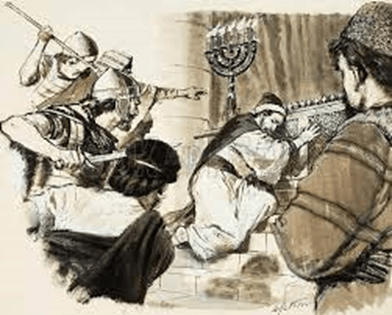
1 Kings 1:28 – 46 “When the news reached Joab, who had conspired with Adonijah but not with Absalom, he fled to the tent of the LORD and took hold of the horns of the altar.

It was reported to King Solomon: “Joab has fled to the tent of the LORD and is now beside the altar.”

So, Solomon sent Benaiah son of Jehoiada, saying, “Go, strike him down!”

And Benaiah entered the tent of the LORD and said to Joab, “The king says, ‘Come out!’”

But Joab replied, “No, I will die here.”

So, Benaiah relayed the message to the king, saying, “This is how Joab answered me.”

And the king replied, “Do just as he says. Strike him down and bury him, and so remove from me and from the house of my father the innocent blood that Joab shed. The LORD will bring his bloodshed back upon his own head, for without the knowledge of my father David he struck down two men more righteous and better than he when he killed with the sword Abner son of Ner, commander of Israel’s army, and Amasa son of Jether, commander of Judah’s army. Their blood will come back upon the heads of Joab and his descendants forever; but for David, his descendants, his house, and his throne, there shall be peace from the LORD forever.”

So Benaiah son of Jehoiada went up, struck down Joab, and killed him. He was buried at his own home in the wilderness. And the king appointed Benaiah son of Jehoiada in Joab’s place over the army, and he appointed Zadok the priest in Abiathar’s place.

Then the king summoned Shimei and said to him, “Build a house for yourself in Jerusalem and live there, but do not go anywhere else. On the day you go out and cross the Kidron Valley, know for sure that you will die; your blood will be on your own head.”

“The sentence is fair,” Shimei replied. “Your servant will do as my lord the king has spoken.” And Shimei lived in Jerusalem for a long time.

After three years, however, two of Shimei’s slaves ran away to Achish son of Maacah, king of Gath. And Shimei was told, “Look, your slaves are in Gath.” So Shimei saddled his donkey and set out to Achish at Gath in search of his slaves, and he brought them back from Gath.

When it was reported to Solomon that Shimei had gone from Jerusalem to Gath and had returned, the king summoned Shimei and said to him, “Did I not make you swear by the LORD and warn you, ‘On the day you leave and go elsewhere, know for sure that you will die’? And you told me, ‘The sentence is fair; I will comply.’ So why have you not kept your oath to the LORD and the command that I gave you?”

The king also said, “You know in your heart all the evil that you did to my father David. Therefore, the LORD will bring your evil back upon your head. But King Solomon will be blessed and David’s throne will remain secure before the LORD forever.”

Then the king commanded Benaiah son of Jehoiada, and he went out and struck Shimei down, and he died. Thus, the kingdom was firmly established in the hand of Solomon.”

As King David was dying, he charged Solomon to eliminate Joab for having murdered two military commanders more righteous than he in his bid to maintain power. Joab supported Adonijah in his abortive bid to seize the throne; who knows what Joab might decide to do in the future? There are still many in the army who are loyal to Joab. When Joab seeks sanctuary in the temple, he assumes that he will be safe; however, Solomon sends Benaiah to kill Joab anyway. Remember that sanctuary can only be granted if someone who has shed blood has done so accidentally. There was nothing accidental about Joab’s murders of Abner and Amasa.  

Joab’s treachery of three men proved his undoing. Although initially, Joab was loyal to David, Joab’s loyalty was tested during the incident with Bathsheba when David ordered Joab to send Uriah to the hottest part of the battle. Joab betrayed three men: Abner, Amasa, and David. To remain commander of the military, Joab assassinated both Abner and Amasa. Joab supported Adonijah’s bid for the throne, ignoring the fact that David intended to make Solomon king. By murdering Abner and Amasa in peacetime, Joab brought blood – guilt on David. Not once did Joab ever display any signs of remorse over his actions; meanwhile, David repented of his sins with Bathsheba and Uriah.

Solomon handles Shimei very wisely, ordering him to build a house, to remain in Jerusalem, and not to cross the Kidron Valley. Were Shimei to cross the Kidron Valley east of Jerusalem and pass over the Mount of Olives, he would soon reach a major north – south route that would connect with the road to Gath. But when some of Shimei’s slaves escape to Gath, Shimei takes off after them, forgetting Solomon’s warning. Why can’t Shimei send someone else to collect the slaves? Perhaps Shimei feels that Solomon is not nearly as strong as his father David or perhaps Shimei thinks he will rush down to Gath, about 30 km. from Jerusalem, and return before Solomon hears about it. But Solomon learns about Shimei’s trip, and this is the excuse he needs to put Shimei to death.

APPLICATION: This part of Solomon’s story makes grim reading, but Solomon is a political realist. Now that the proven conspirators are out of the picture, Solomon can proceed to establish his kingdom. Abiathar, Joab, Adonijah, and Shimei all had one thing in common: they were double – minded. James 1:8 tells us that” a double – minded man is unstable in all his ways.”

While it is important to have colleagues who are intelligent and skillful, such colleagues are worthless if you cannot trust them. Trust is something that is easily destroyed and difficult to rebuild. If you have workers who are eager to learn, you can do a great deal with training. Before we had very many trained nurses at our mission hospital, we used ward assistants who were trained on the job. Those people were compassionate about their care and diligent, and our patients got excellent care. Many of those people have gone on to become nurses or even specialists such as physician assistants and nurse anesthetists, and they are still doing well.  

There are men in the kingdom whom Solomon can trust: Zadok, the high priest, and Benaiah, who now is military commander. As time goes on, Solomon will assemble others. But the One in whom Solomon will need to trust the most is the God who has chosen him to become king.

PRAYER: Father God, thank You for loving us and for caring for us. Lord, please guide all leaders as they handle those under them. Help leaders to make wise decisions according to Your Word. In the mighty and precious Name of King Jesus. Amen.

JUNE 10, 2022 DAVID, A MAN AFTER GOD’S OWN HEART #40 1 KINGS 2:1 – DAVID SETTLES OLD SCORES AS HE’S DYING AND SOLOMON TAKES OVER!

June 10, 2022

1 Kings 2:1 – “As the time drew near for David to die, he charged his son Solomon, “I am about to go the way of all the earth. So be strong and prove yourself a man. And keep the charge of the LORD your God to walk in His ways and to keep His statutes, commandments, ordinances, and decrees, as is written in the Law of Moses, so that you may prosper in all you do and wherever you turn, and so that the LORD may fulfill His promise to me: ‘If your descendants take heed to walk faithfully before Me with all their heart and soul, you will never fail to have a man on the throne of Israel.’

Moreover, you know what Joab son of Zeruiah did to me—what he did to Abner son of Ner and Amasa son of Jether, the two commanders of the armies of Israel. He killed them in peacetime to avenge the blood of war. He stained with the blood of war the belt around my waist and the sandals on my feet. So, act according to your wisdom, and do not let his gray head go down to Sheol in peace.

But show loving devotion to the sons of Barzillai the Gileadite, and let them be among those who eat at your table, because they stood by me when I fled from your brother Absalom. Keep an eye on Shimei the son of Gera, the Benjamite from Bahurim who is with you. He called down bitter curses against me on the day I went to Mahanaim, but when he came down to meet me at the Jordan, I swore to him by the LORD: ‘I will never kill you with the sword.’ Now therefore, do not hold him guiltless, for you are a wise man. You know what you ought to do to him to bring his gray head down to Sheol in blood.”

Then David rested with his fathers and was buried in the City of David. The length of David’s reign over Israel was forty years—seven years in Hebron and thirty-three years in Jerusalem.

So, Solomon sat on the throne of his father David, and his kingdom was firmly established.

Now Adonijah son of Haggith went to Bathsheba the mother of Solomon, who asked, “Do you come in peace?”

“Yes, in peace,” he replied. Then he said, “I have something to tell you.”

“Say it,” she answered.

“You know that the kingship was mine,” he said. “All Israel expected that I should reign, but the kingship has turned to my brother, for it has come to him from the LORD. So now I have just one request of you; do not deny me.”

“State your request,” she told him. Adonijah replied, “Please speak to King Solomon, since he will not turn you down. Let him give me Abishag the Shunammite as my wife.”

“Very well,” Bathsheba replied. “I will speak to the king for you.”

So, Bathsheba went to King Solomon to speak to him for Adonijah. The king stood up to greet her, bowed to her, and sat down on his throne. Then the king had a throne brought for his mother, who sat down at his right hand.

“I have just one small request of you,” she said. “Do not deny me.”

“Make your request, my mother,” the king replied, “for I will not deny you.”

So, Bathsheba said, “Let Abishag the Shunammite be given to your brother Adonijah as his wife.”

King Solomon answered his mother, “Why do you request Abishag the Shunammite for Adonijah? Since he is my older brother, you might as well request the kingdom for him and for Abiathar the priest and for Joab son of Zeruiah.”

Then King Solomon swore by the LORD: “May God punish me, and ever so severely, if Adonijah has not made this request at the expense of his life. And now, as surely as the LORD lives—the One who established me, who set me on the throne of my father David, and who founded for me a dynasty as He promised—surely Adonijah shall be put to death today!”

So, King Solomon sent the order to Benaiah son of Jehoiada, who struck down Adonijah, and he died.

Then the king said to Abiathar the priest, “Go back to your fields in Anathoth. Even though you deserve to die, I will not put you to death at this time, since you carried the ark of the Lord GOD before my father David, and you suffered through all that my father suffered.” So, Solomon banished Abiathar from the priesthood of the LORD and thus fulfilled the word the LORD had spoken at Shiloh against the house of Eli. (Abiathar was the final descendant of Eli to serve as high priest. None of his sons succeeded him. This fulfilled God’s prophecy against Eli.)  

David is dying, giving Solomon his last advice and commissioning Solomon to settle old scores for David. In Proverbs 4:4, Solomon mentions David having taught him God’s commandments. Perhaps David focused only on Solomon because he planned to make Solomon king after him; however, this means that David failed to teach his other sons in the same fashion.

David’s advice to Solomon is excellent: “And keep the charge of the LORD your God to walk in His ways and to keep His statutes, commandments, ordinances, and decrees, as is written in the Law of Moses, so that you may prosper in all you do and wherever you turn, and so that the LORD may fulfill His promise to me.” David also asks Solomon to treat the sons of Barzillai the Gileadite as his own relatives for the kindness their father showed to David when he fled from Absalom to Mahanaim.

If David were to stop here, he would have done admirably; however, David has a few scores to settle, and now he wants Solomon to handle them for him. Joab has been David’s military commander for years; however, Joab has also murdered two commanders of the armies of Israel, Abner and Amasa, so that he would remain in power. Since Joab was under David’s authority, it is as if David himself has murdered these men. “He killed them in peacetime to avenge the blood of war. He stained with the blood of war the belt around my waist and the sandals on my feet.” David does not mention that Joab has supported Adonijah; however, Solomon fully realizes Joab’s potential as an enemy. David tells Solomon that it’s time to eliminate Joab.

Shimei – this relative of King Saul cursed David when David was fleeing from Absalom; however, once the tide of war had turned, Shimei rushed to the Jordan with 1,000 men to help David and his followers return to Jerusalem. Shimei prostrated himself before David, and David promised that he, David, would never kill Shimei. David has kept that promise, but has no compunction about ordering Solomon to have Shimei killed. Shimei has been a turncoat once; there is nothing to prevent him from supporting Adonijah in the future.

What about Adonijah? All this time, Adonijah has been cooling his heels at home; however, this guy has incredible nerve! Somehow, Adonijah is still clinging to the idea that the kingship was his and that all Israel expected him to reign, even though he acknowledges that the kingship has come to Solomon from the Lord.  Now Adonijah gets Bathsheba to ask Solomon to give Adonijah Abishag, David’s former nurse, as his wife. Solomon swiftly recognizes this as another ploy to seize power. Solomon replies to his mother, “Why do you request Abishag the Shunammite for Adonijah? Since he is my older brother, you might as well request the kingdom for him and for Abiathar the priest and for Joab son of Zeruiah.” Adonijah’s arrogance costs him his life; Solomon has him killed that very day.

Abiathar the priest has supported Adonijah, even though it was David who saved his life and who sheltered him. Now Solomon banishes Abiathar from the priesthood, ordering him to go home to his farm at Anathoth. Solomon does not have Abiathar killed out of respect because Abiathar carried the ark before King David, and Solomon honors that service. But by banishing Abiathar, Solomon has now eliminated another potential threat to his kingship. (Side note: generations later, the prophet Jeremiah comes from Anathoth.)

APPLICATION: Personally, I have always had a few problems with David’s orders to Solomon. Is David correct in advising Solomon to eliminate these people? David promised Shimei that he would not kill him. By ordering Solomon to have Shimei killed, David has fulfilled the letter of his promise but has left Shimei thinking that he is safe when he is not. On the other hand, Shimei is a dangerous rabble rouser who might pose a threat to Solomon. While Shimei has sworn allegiance to David, he might yet attempt to undermine Solomon.    

It’s hard to feel sympathy for Adonijah. There’s a word in Yiddish, “chutzpah,” meaning extreme audacity. It is said that a man with chutzpah would shoot his parents and then try to throw himself on the mercy of the court because he was an orphan. Adonijah has plenty of chutzpah but very little wisdom! Adonijah is still a very attractive man and can marry any number of lovely well – born maidens. But no, Adonijah has to request David’s former nurse and bed warmer as a wife, citing his royal prerogative. As if that weren’t enough, Adonijah tries to use Bathsheba to make his request for him.

 Somehow, Adonijah has overlooked the fact that it was Bathsheba who helped arrange for Solomon’s emergency coronation while Adonijah and his co – conspirators were feasting a few hundred meters away. Bathsheba is a savvy lady; she agrees to put Adonijah’s request before Solomon, knowing full well what Solomon’s reaction will be. All that we have recorded are Bathsheba’s words; however, what we cannot know is Bathsheba’s facial expressions as she is making this request. For all we know, Bathsheba might be shaking her head “no” all the time she is speaking! Solomon quickly recognizes Adonijah’s request as a threat and Adonijah pays for his chutzpah with his life.

What can we learn from the story of Solomon as he consolidates his power? There are two sides to each of these stories. Once Solomon has been anointed as king over all Israel, each of the major conspirators has a window of opportunity during which he can potentially come to Solomon to beg forgiveness and to swear allegiance. Shimei, Joab, Adonijah, and Abiathar all are aware that God has anointed Solomon as king; yet, not a single one of them comes to swear allegiance to Solomon. This causes us to wonder if these men are really accepting Solomon as king, or are they merely waiting for another opportunity to stage an uprising? The silence is deafening, and Solomon rightly assumes that these men remain his enemies.

It is tough to be a leader when those below you are continuing to hatch plots to overthrow you. Countering those plots sucks up time, energy, and resources that would be better applied elsewhere. While Solomon’s methods are extreme, those in leadership must assess their subordinates wisely. It is far better to recommend an unhappy subordinate for a position elsewhere than to keep that person around so that he or she can foment rebellion. May God help all in leadership positions to handle those working under them wisely!

PRAYER: Father God, thank You for loving us and for caring for us. Lord, help all those in leadership positions to make wise decisions when faced with subordinates who are trying to undermine them. You are a God of peace and you bless peace makers. Let leaders seek Your peace in all situations, particularly in managerial ones. In the matchless Name of King Jesus. Amen.

JUNE 9, 2022 DAVID, A MAN AFTER GOD’S OWN HEART #39 1 KINGS:28 – 53 DAVID SQUASHES THE REBELLION BY ANOINTING SOLOMON AS KING

June 9, 2022

1 Kings 1:28 – 53 “Then King David said, “Call in Bathsheba for me.” So, she came into the king’s presence and stood before him.

And the king swore an oath, saying, “As surely as the LORD lives, who has redeemed my life from all distress, I will carry out this very day exactly what I swore to you by the LORD, the God of Israel: Surely your son Solomon will reign after me, and he will sit on my throne in my place.”

Bathsheba bowed face down in homage to the king and said, “May my lord King David live forever!”

Then King David said, “Call in for me Zadok the priest, Nathan the prophet, and Benaiah son of Jehoiada.” So, they came before the king.

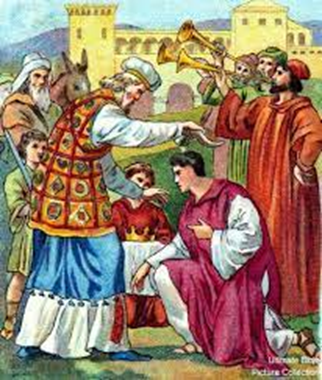
“Take my servants with you,” said the king. “Set my son Solomon on my own mule and take him down to Gihon. There Zadok the priest and Nathan the prophet are to anoint him king over Israel. You are to blow the ram’s horn and declare, ‘Long live King Solomon!’ Then you shall go up with him, and he is to come and sit on my throne and reign in my place. For I have appointed him to be ruler over Israel and Judah.”

“Amen,” replied Benaiah son of Jehoiada. “May the LORD, the God of my lord the king, so declare it. Just as the LORD was with my lord the king, so may He be with Solomon and make his throne even greater than that of my lord King David.”

Then Zadok the priest, Nathan the prophet, and Benaiah son of Jehoiada, along with the Cherethites and Pelethites, went down and set Solomon on King David’s mule, and they escorted him to Gihon. Zadok the priest took the horn of oil from the tabernacle and anointed Solomon. Then they blew the ram’s horn, and all the people proclaimed, “Long live King Solomon!”

All the people followed him, playing flutes and rejoicing with such a great joy that the earth was split by the sound. (The Gihon Spring is only 800 meters, or a few minutes’ walk from Ein Rogel.)

 Now Adonijah and all his guests were finishing their feast when they heard the sound of the ram’s horn. “Why is the city in such a loud uproar?” asked Joab. As he was speaking, suddenly Jonathan the son of Abiathar the priest arrived. “Come in,” said Adonijah, “for you are a man of valor. You must be bringing good news.”

“Not at all,” Jonathan replied. “Our lord King David has made Solomon king. And with Solomon, the king has sent Zadok the priest, Nathan the prophet, and Benaiah son of Jehoiada, along with Cherethites and Pelethites, and they have set him on the king’s mule. Zadok the priest and Nathan the prophet have anointed him king at Gihon, and they have gone up from there with rejoicing that rings out in the city. That is the noise you hear.

Moreover, Solomon has taken his seat on the royal throne. The king’s servants have also gone to congratulate our lord King David, saying, ‘May your God make the name of Solomon more famous than your own name, and may He make his throne greater than your throne.’

And the king has bowed in worship on his bed, saying, ‘May the LORD God of Israel be praised! Today He has provided one to sit on my throne, and my eyes have seen it.’”

At this, all the guests of Adonijah arose in terror and scattered. But Adonijah, in fear of Solomon, got up and went to take hold of the horns of the altar.

It was reported to Solomon: “Behold, Adonijah fears King Solomon, and he has taken hold of the horns of the altar, saying, ‘Let King Solomon first swear to me not to put his servant to the sword.’” And Solomon replied, “If he is a man of character, not a single hair of his will fall to the ground. But if evil is found in him, he will die.”

So, King Solomon summoned Adonijah down from the altar, and he came and bowed down before King Solomon, who said to him, “Go to your home.”

Just as Adonijah is beginning to think that this coup is going to work, everything falls apart. David might be in failing health, but there’s nothing wrong with his brain. When Bathsheba and Nathan inform David of what Adonijah is attempting, David immediately issues the orders necessary to elevate Solomon to the throne. Zadok the high priest and Benaiah, the head of the mighty men, set Solomon on the king’s mule and go to the Gihon spring, accompanied by the Cherethites and Pelethites who have formed David’s body guard for years. Using the anointing oil from the temple, Zadok anoints Solomon and blows the shofar, the ram’s horn. All the people who have accompanied Solomon begin shouting and playing instruments. There is so much noise that the earth shakes. Then Solomon returns to the palace and sits on David’s throne. King David himself hails Solomon as his successor, saying,” May the LORD God of Israel be praised! Today He has provided one to sit on my throne, and my eyes have seen it.’”

Fearing the wrath of Solomon, Adonijah rushes to the temple and grasps the horns of the altar, seeking refuge from Solomon. After all, if Adonijah’s takeover had succeeded, Adonijah would have gleefully murdered Solomon without a qualm. Solomon makes an interesting pronouncement concerning Adonijah, “If he is a man of character, not a single hair of his will fall to the ground. But if evil is found in him, he will die.” Solomon knows Adonijah is not a man of good character, and when ordered to go home and stay there, Adonijah will find it difficult to stay home.

APPLICATION: The chorus from the country western song “The Gambler” says, “You’ve got to know when to hold ‘em and know when to fold ‘em.” For every ruler or every head of an organization, the time comes when he or she must hand over authority. David has delayed in acknowledging Solomon as his successor. Now Adonijah’s attempted takeover has given David the necessary impetus to anoint Solomon as king and fulfill his promise to Bathsheba. Blessedly, there are still righteous men surrounding David in the persons of Nathan the prophet, Zadok the high priest and Benaiah, as well as David’s body guard. Once David has set things in motion, these men move swiftly and decisively. The noise of Solomon’s celebration drowns out Adonijah’s little party.

If David anointed Solomon earlier, would the mess with Adonijah have been averted? Tough to call. Even though David knows that his health is failing, it is tough to give over power to someone else. Adonijah’s attempt to seize power provides the strong nudge that David needs to let go and allow Solomon to become king. David is really not losing anything; his health no longer allows him to be the strong leader that Israel needs. And nobody is going to deny David the honor he richly deserves. There has been, is, and always will be only one King David.

May God help those of us who are leaders to know when it’s time to hand over. And may God supply capable and diligent successors so that we may hand over without regrets.

PRAYER: Father God, thank You for loving us and for caring for us. Lord, help each of us to know when it is time to relinquish control. Please give us competent people to whom we can hand over leadership. In the mighty and precious Name of King Jesus. Amen.

JUNE 8, 2022 DAVID, A MAN AFTER GOD’S OWN HEART #38 1 KINGS 1:1 – 27 WHEN YOU SPOIL A CHILD, LOOK OUT!

June 8, 2022

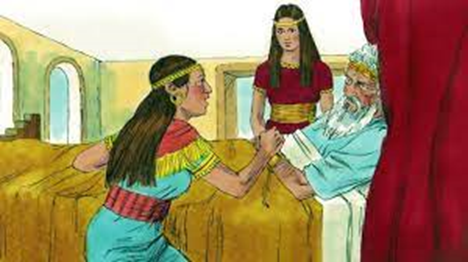
1 Kings:1 – 27 “Now King David was old and well along in years, and though they covered him with blankets, he could not keep warm. So, his servants said to him, “Let us search for a young virgin for our lord the king, to attend to him and care for him and lie by his side to keep him warm.”

Then they searched throughout Israel for a beautiful girl, and they found Abishag the Shunammite and brought her to the king. The girl was unsurpassed in beauty, and she cared for the king and served him, but he had no relations with her.

At that time Adonijah, David’s son by Haggith, began to exalt himself, saying, “I will be king!” And he acquired chariots and horsemen and fifty men to run ahead of him. (His father had never once reprimanded him by saying, “Why do you act this way?” Adonijah was also very handsome, born next after Absalom.)

So Adonijah conferred with Joab son of Zeruiah and with Abiathar the priest, who supported him. But Zadok the priest, Benaiah son of Jehoiada, Nathan the prophet, Shimei, Rei, and David’s mighty men would not join Adonijah.

And Adonijah sacrificed sheep, oxen, and fattened calves near the stone of Zoheleth, (literally, “the serpent’s stone) which is next to En-rogel. He invited all his royal brothers and all the men of Judah who were servants of the king. But he did not invite Nathan the prophet, Benaiah, the mighty men, or his brother Solomon.

Then Nathan said to Bathsheba the mother of Solomon, “Have you not heard that Adonijah son of Haggith has become king, and our lord David does not know it? Now please, come and let me advise you. Save your own life and the life of your son Solomon. Go at once to King David and say, ‘My lord the king, did you not swear to your maidservant, “Surely your son Solomon will reign after me, and he will sit on my throne”? Why then has Adonijah become king?’ Then, while you are still there speaking with the king, I will come in after you and confirm your words.”

So, Bathsheba went to see the king in his bedroom. Since the king was very old, Abishag the Shunammite was serving him. And Bathsheba bowed down in homage to the king, who asked, “What is your desire?”

“My lord,” she replied, “you yourself swore to your maidservant by the LORD your God: ‘Surely your son Solomon will reign after me, and he will sit on my throne.’ But now, behold, Adonijah has become king, and you, my lord the king, did not know it. And he has sacrificed an abundance of oxen, fattened calves, and sheep, and has invited all the other sons of the king, as well as Abiathar the priest and Joab the commander of the army. But he did not invite your servant Solomon. And as for you, my lord the king, the eyes of all Israel are upon you to tell them who will sit on the throne of my lord the king after him. Otherwise, when my lord the king rests with his fathers, I and my son Solomon will be counted as criminals.”

And just then, while Bathsheba was still speaking with the king, Nathan the prophet arrived. So, the king was told, “Nathan the prophet is here.” And Nathan went before the king and bowed facedown to him.

“My lord the king,” said Nathan, “did you say, ‘Adonijah will reign after me, and he will sit on my throne’? For today he has gone down and sacrificed an abundance of oxen, fattened calves, and sheep, and has invited all the sons of the king, the commanders of the army, and Abiathar the priest. And behold, they are eating and drinking before him, saying, ‘Long live King Adonijah!’ But me your servant he did not invite, nor Zadok the priest, nor Benaiah son of Jehoiada, nor your servant Solomon. Has my lord the king let this happen without informing your servant who should sit on the throne after my lord the king?”

It’s difficult to keep track of David’s sons; however, if Absalom was born just after Amnon, then Adonijah is son #3. Adonijah is a spoiled brat; not once has David ever disciplined him for any reason. Although David has been a great king and military leader, he has failed as a father. Consider the facts: Amnon raped his half – sister, Tamar. Absalom assassinated Amnon and then fomented rebellion. Now both Amnon and Absalom are dead; in the natural scheme of things, Adonijah as the next son would be in line for the throne, and Adonijah is ready to seize this opportunity.

David is now in his seventies and his heart is failing, making it impossible for him to maintain his body temperature. The family employs Abishag, a lovely young maiden, to nurse David and to lie in the bed next to him to keep him warm. This relationship is completely asexual; Abishag is acting as a human heating pad. Adonijah makes a major mistake by assuming that his father is senile as well as in poor health and begins to pave the way for his usurpation of the throne.

 Adonijah is following exactly in the steps of Absalom and has even enticed Joab the military commander, and Abiathar the priest to join him. Now, Joab has good reasons to be fed up with David. Not only has David put Joab in very difficult positions many times, but at one point, David attempted to oust Joab as head of the armies and put Amasa, a traitor, in Joab’s place. Joab has an eye to the main chance, and he figures that David may soon die. Even if Joab knows about David’s promise to Bathsheba, he may resent Bathsheba for having sex with David in the first place and for any part she has played in the death of her husband Uriah. Joab also may be a staunch traditionalist who believes in following the order of succession of sons.

The puzzler here is Abiathar. When Saul massacred the priests at Nob, Abiathar was the only one who escaped, and he immediately fled to David at the Cave of Adullam and became David’s high priest and counselor. But according to some sources, (The Jewish Encyclopedia) eventually the Holy Spirit left Abiathar, making it impossible for him to consult the Urim and Thummim. David appointed Zadok high priest in the place of Abiathar. So now David has his military commander and his former high priest both conspiring with his spoiled third son.

The site of Adonijah’s sacrifices is at En – Rogel, at the junction of the Hinnom and Kidron valleys, 500 meters south of the Old City of Jerusalem. Adonijah doesn’t dare enter the city quite yet; however, he is within easy walking distance. As Adonijah and his co – conspirators are feasting, Bathsheba and the prophet Nathan swiftly go to David, reminding him of his promise to make Bathsheba’s son Solomon king.

APPLICATION: The book of Proverbs tells us that “If you refuse to discipline your son, it proves you don’t love him; for if you love him, you will be prompt to punish him.” (The Living Bible) Unfortunately, David has made the same mistake as so many other busy important fathers; he has left the rearing of his sons to their mothers and has withheld correction. Adonijah may have grown up viewing David as some semi – mythical being who appears periodically to issue edicts and father more children and who then withdraws back into the throne room.

As a young man, Adonijah has absorbed all the palace gossip and frankly believes that David is a straw man who can easily be deposed. More than that, Adonijah has found willing co – conspirators in two disgruntled leaders, Joab and Abiathar. Apart from Solomon, Adonijah’s other brothers are also willing to enter into the conspiracy. Who knows what crumbs of power and wealth might be lying there for the taking when Adonijah makes his move? So Adonijah and his band of traitors weave their plans, unaware that Bathsheba and the prophet Nathan are aware of everything. Pure – hearted Zadok and Benaiah and the other mighty men have also been left out, a fatal mistake by Adonijah.

In the movie “The Lion King,” the little lion sings a song about “Oh, I just can’t wait to be king!” The song amply illustrates the fact that this youngster has no understanding whatsoever of what it means to be a compassionate and effective ruler. Were this young lion to gain power now, it would be a disaster. Adonijah is in a similar position.

Here is what C.S. Lewis said about kingship in The Chronicles of Narnia. “For this is what it means to be a king: to be first in every desperate attack and last in every desperate retreat, and when there’s hunger in the land (as must be now and then in bad years) to wear finer clothes and laugh louder over a scantier meal than any man in your land.” –C.S. Lewis, The Horse and His Boy in The Chronicles of Narnia (New York: HarperCollins, 1954/1994), 309-310.)

King David is prepared to fulfill those conditions of royalty while Adonijah is not. David might be old, but he is not senile, and his heart is pure. David has promised Bathsheba to make Solomon king. Now that is about to happen. Adonijah is headed for disaster because he has never learned self – discipline or self – sacrifice. All Adonijah knows is self – interest.  

What can we learn from this sad story? Children need standards and when we refuse to teach them godly ones, the world will teach them something else. We can succeed in every other sphere of life, but if we fail to teach and discipline our children, we are unleashing untold evil on the world.

PRAYER: Father God, thank You for loving us and for caring for us. Lord, help all those of us who are parents in any fashion to teach our children, to guide our children, to discipline them, and to set good examples so that if they stray, they will have a standard to which to return. In the mighty and precious Name of King Jesus. Amen.