Archive for the ‘Uncategorized’ Category

MARCH 15, 2021 MERCY 15: DON’T WASTE YOUR SORROWS!

March 15, 2021

Exodus 6:1 – 9 “But the LORD said to Moses, “Now you will see what I will do to Pharaoh, for because of My mighty hand he will let them go; because of My strong hand he will drive them out of his land.” God also told Moses, “I am the LORD. I appeared to Abraham, to Isaac, and to Jacob as God Almighty, but I did not make Myself known to them by My name, ‘the LORD.’ I also established My covenant with them to give them the land of Canaan, the land where they lived as foreigners. Furthermore, I have heard the groaning of the Israelites, whom the Egyptians are enslaving, and I have remembered My covenant.

Therefore tell the Israelites: ‘I am the LORD, and I will bring you out from under the yoke of the Egyptians and deliver you from their bondage. I will redeem you with an outstretched arm and with mighty acts of judgment. I will take you as My own people, and I will be your God. Then you will know that I am the LORD your God, who brought you out from under the yoke of the Egyptians. And I will bring you into the land that I swore to give to Abraham, Isaac, and Jacob. I will give it to you as a possession. I am the LORD!’” Moses relayed this message to the Israelites, but on account of their broken spirit and cruel bondage, they did not listen to him.”

Things are heating up in Egypt! Moses finds himself stuck between the Israelites, who are blaming him for their suffering and Pharaoh, who views him as a trouble maker. Things are getting even worse as Pharaoh’s task masters take this opportunity to abuse the Israelite workers.

The Israelites are thrilled when they first hear the message from Moses, but now they wish Moses had stuck with those sheep in the wilderness! God encourages Moses, who then relays His messages to the Israelites, but the Israelites aren’t interested. Frankly, the Israelite elders never thought following God was going to be this difficult! Evidently, the Israelites have selectively remembered the nice parts of the stories of Abraham, Isaac, Jacob, and Joseph, while forgetting the years of suffering. Jacob’s twenty years of service to Laban, Joseph’s career as a prisoner and slave for thirteen years before his promotion – nobody wants to remember that stuff!

You can almost hear the elders thinking, “If God is promising to remember His covenant and to take us as His own people, why doesn’t He just do it and get it over with??” The elders have no idea that years of slavery and security in Egypt have left their people unfit for the rigors of the desert, let alone returning to the Promised Land and conquering the tribes still living there. Frankly, at this point, the Israelites aren’t tough enough to make it outside Egypt, and God has a lot of work to do before they will even be able to leave.

APPLICATION: Several years ago, there was an excellent study of the Book of James by Paul E. Billheimer entitled “Don’t Waste Your Sorrows.” (It’s still available through Amazon.) The main message of the book was that God brings us suffering to refine us and to purify us. When we fight against the suffering, we frustrate God’s purposes. If we will look at our suffering and try to learn everything we can from it, we will redeem it and our troubles will not have been wasted.

One of the biggest lessons to come out of the COVID pandemic is the realization of how precious personal contact and touch can be. Many people realize that the family gatherings, the meals with friends, contribute to emotional and mental health and are to be treasured and not to be taken for granted.

What kind of problems are you facing now? Ask God to show you what He wants you to learn from those problems and try to squeeze every bit of goodness you can out of them.

PRAYER: Father God, thank you that you use suffering to purify us and to cleanse us. Help us to be willing to accept your discipline and to hang on, knowing that you are working things out for our good. In the mighty and precious Name of King Jesus. Amen.

MARCH 14, 2021 MERCY 14: “WHAT DO YOU DO WHEN GOD DOESN’T ANSWER QUICKLY??”

March 14, 2021

Exodus 5: 15 – 23 “So the Israelite foremen went and appealed to Pharaoh: “Why are you treating your servants this way? No straw has been given to your servants, yet we are told, ‘Make bricks!’ Look, your servants are being beaten, but the fault is with your own people.” “You are slackers!” Pharaoh replied. “Slackers! That is why you keep saying, ‘Let us go and sacrifice to the LORD.’ Now get to work. You will be given no straw, yet you must deliver the full quota of bricks.”

The Israelite foremen realized they were in trouble when they were told, “You must not reduce your daily quota of bricks.” When they left Pharaoh, they confronted Moses and Aaron, who stood waiting to meet them. “May the LORD look upon you and judge you,” the foremen said, “for you have made us a stench before Pharaoh and his officials; you have placed in their hand a sword to kill us!”

So Moses returned to the LORD and asked, “Lord, why have You brought trouble upon this people? Is this why You sent me? Ever since I went to Pharaoh to speak in Your name, he has brought trouble on this people, and You have not delivered Your people in any way.”

Poor Moses and Aaron! They have delivered the message that God has given them and they have proven themselves to the Israelite elders. They have fulfilled all of God’s orders so far. Why are things going so badly? The same elders who were so happy to receive Moses’s message are having second and third thoughts. What God knows and Moses does not is that the Israelites aren’t fully convinced of the need to leave Egypt. It’s going to take a whole lot more suffering before the Israelites will really be ready to leave Egypt. Until the Israelites are truly miserable, they will not be ready to completely leave Egypt.

APPLICATION: Doing the right thing does not always get you popularity or even approval by your superiors. If you have prayed and asked God to guide you, if you are convinced that you are doing the right thing, you must be ready to continue, even in the face of adversity.

When we first went to the small northern Ghanaian village in which we have spent most of our missionary careers, things were very difficult. In those days, there were no cell phones and the road system was so bad that a trip to our regional capital took 5 hours in dry season and more in rainy season. Many people in our situation were not aware of my qualifications and there were many people in our situation ready to carry wild stories about me to regional health authorities.

The change in public opinion came when our area was convulsed by an ethnic conflict. Suddenly our small clinic was the only source of medical care for nearly 100,000 people from one tribal group. Efforts by regional authorities to send health workers into the area failed. As we expanded our services to include operations and blood transfusions, we transformed a small health center building into a 37 bed bush hospital with a small laboratory, an operating theater, and a pharmacy. Ironically, it was that upheaval that led to the establishment of what is now a district hospital.

What problems are you facing? Are you having second thoughts after having made a good start? If you believe that God has led you to your current position, HOLD ON!!! God is still in the miracle business and He can use the most difficult of circumstances to work His Will.

PRAYER: Father God, thank you for working everything out in our situations. Thank you that we can trust you even when we don’t understand what you are doing. Help us to hang on and trust you! In the mighty and precious Name of King Jesus. Amen.

MARCH 13, 2021 MERCY 13: WHEN YOU DO GOD’S WILL AND GET SMACKED DOWN!

March 13, 2021

Exodus 5:1 – 5 “After that, Moses and Aaron went to Pharaoh and said, “This is what the LORD, the God of Israel, says: ‘Let My people go, so that they may hold a feast to Me in the wilderness.’” But Pharaoh replied, “Who is the LORD that I should obey His voice and let Israel go? I do not know the LORD, and I will not let Israel go.” “The God of the Hebrews has met with us,” they answered. “Please let us go on a three-day journey into the wilderness to sacrifice to the LORD our God, or He may strike us with plagues or with the sword.”

But the king of Egypt said to them, “Moses and Aaron, why do you draw the people away from their work? Get back to your work!” Pharaoh also said, “Look, the people of the land are now numerous, and you would be stopping them from their labor.”

At the time of Moses, Egypt was a world power and Pharaoh was one of the most important rulers in the world. Egypt was a center of learning, of culture, and of , education. Ever since the time of Joseph, the Israelites had occupied the land of Goshen, continuing to herd their animals. As far as the Egyptians were concerned, the Israelites were little better than their animals. And now that Pharaoh had enslaved the Israelites, the Egyptians had even less regard for them.

When Moses and Aaron turn up at the Egyptian royal court with their announcement, Pharaoh is not impressed. After all, the Egyptians have a whole host of gods and everybody knows how to propitiate them; why should the God of the Hebrews be any different? None of the Egyptian gods has ever threatened to strike the country with plagues or with the sword. The Egyptians have been living peacefully for a long time; the eventual overthrow of Egypt by Assyria is far in the future at this point. Pharaoh figures all he has to do is give these people more work and they will forget this ridiculous idea!

Exodus 5:6 – 14 “That same day Pharaoh commanded the taskmasters of the people and their foremen: “You shall no longer supply the people with straw for making bricks. They must go and gather their own straw. But require of them the same quota of bricks as before; do not reduce it. For they are lazy; that is why they are crying out, ‘Let us go and sacrifice to our God.’ Make the work harder on the men so they will be occupied and pay no attention to these lies.”

So the taskmasters and foremen of the people went out and said to them, “This is what Pharaoh says: ‘I am no longer giving you straw. Go and get your own straw wherever you can find it; but your workload will in no way be reduced.’” So the people scattered all over the land of Egypt to gather stubble for straw. The taskmasters kept pressing them, saying, “Fulfill your quota each day, just as you did when straw was provided.” Then the Israelite foremen, whom Pharaoh’s taskmasters had set over the people, were beaten and asked, “Why have you not fulfilled your quota of bricks yesterday or today, as you did before?”

Whew! Things are getting difficult! Just about now, those Israelite elders who were so excited to hear what Moses and Aaron had to say are beginning to question their own sanity. A perfectly reasonable request to carry out a small act of worship has resulted in major persecution. At this point, Moses and Aaron are probably wondering if they heard God rightly as well.

APPLICATION: Many times, doing the right and just thing can bring you nothing but trouble. During our first mission assignment, there came a point where someone who had supposedly donated land and a building for a new mission hospital suddenly was demanding a large amount of financial “appreciation.” While raising funding in America, I was confronted by a family friend knowledgeable in missions. This honest Midwestern farmer had asked me point blank if this project was going to benefit any private individual and I had told him “Absolutely not!” In addition, the mission in which we were serving belonged to the Evangelical Council for Financial Accountability, ECFA. ECFA asserted that funds raised for one purpose could not be diverted to any other purpose without the express written consent of the donors. Failure to secure such consent would constitute a breach of contract between donors and the mission agency.

At one point I had to hand out ECFA brochures at a hospital board meeting and point out the clause in the ECFA statement covering this problem. Blessedly, the board agreed and we were able to keep faith with our donors and our mission, but it was a very difficult time.

Sometimes we must take a stand for righteousness and not back down. While we may suffer for such a position, it is far better to be able to stand before the Lord with clean hands and a pure heart than to have to admit that we have compromised. God will be merciful in encouraging and comforting us, but sometimes the only way out of a bad situation is to go through it.

PRAYER: Father God, thank you for loving us and caring for us so much that you arrange every bit of our lives, even the tough stuff. Thank you that when we encounter opposition, we only have to be sure that you are with us and then to hang on. And thank you that you do bring your children through, giving us the courage to suffer if necessary. In the mighty Name of King Jesus. Amen.

MARCH 12, 2021 MERCY 12: GOD SHOWS HIS FACE TO THOSE WHO WAIT FOR HIM

March 12, 2021

Exodus 4:27 – 31 “Meanwhile, the LORD had said to Aaron, “Go and meet Moses in the wilderness.” So he went and met Moses at the mountain of God and kissed him. And Moses told Aaron everything the LORD had sent him to say, and all the signs He had commanded him to perform. Then Moses and Aaron went and assembled all the elders of the Israelites, and Aaron relayed everything that the LORD had said to Moses. And Moses performed the signs before the people, and they believed. And when they heard that the LORD had attended to the Israelites and had seen their affliction, they bowed down and worshiped.”

Throughout the story of the Exodus, Aaron’s performance is very uneven. Sometimes Aaron does the right thing and does it better than anybody else. Other times, Aaron waffles and falls to public opinion. But here at the beginning, Aaron listens to God and obeys. Remember that Aaron hasn’t even seen Moses for forty years and isn’t certain that Moses is even alive. Now God is instructing Aaron to go out into the desert to an unknown place to meet Moses. How does God speak to Aaron? Does Aaron hear an audible voice, or does God just impress something on Aaron’s spirit? Eventually Aaron’s descendants will be the priests of Israel; perhaps God gives Aaron a special ability to hear His Voice.

Aaron manages to meet Moses. How do these two men find each other out there in the wilderness? Again, this meeting has God’s fingerprints all over it; thousands of miles of scrub trees, rocks, and very little else, and Aaron succeeds in finding Moses. Why talk about this meeting when it only gets two sentences in this chapter? The story of Moses and the Exodus is full of miracles of all sizes. Consider the fact that not only Moses but also Aaron survived the Pharaoh’s attempts to kill all the Hebrew boy babies. Now Aaron, who has been living in Egypt all this time and who has never traveled outside the land of Goshen, succeeds in traveling into the wilderness and meeting Moses. And Aaron believes Moses after not seeing him for forty years – yet another miracle! God must have really said some strong stuff to Aaron.

The next miracle is no less important: the elders of Israel choose to believe Aaron and Moses. Most of those men have probably written Moses off years ago; after all, once Moses disappeared into the wilderness, nobody heard anything from him at all. And here is where the suffering the Israelites have undergone begins to be important. If the Israelites had not become slaves and had not suffered, they would never have become discontented with living in Egypt. After all, Egypt had the Nile River to keep at least part of it green in the most severe drought. Generally, there was plenty of food. But the Israelites have been suffering and crying out to the God of their fathers, and now God is answering.

The elders of Israel must have been completely dazzled! After years of misery, years of crying out to a God who has remained silent, here are Moses and Aaron coming with a definite proclamation and with signs and wonders. It’s no surprise then that the elders of Israel listen and then bow down and worship. This message has the fingerprints of a Holy God all over it and no other response will do apart from worship.

APPLICATION: Do you have a special request for which you have been begging the Lord for years? Is there something that your heart longs for above all else? This story should encourage you to keep praying, but there are some things you need to realize:

1. The desire of the Israelites to be free and to worship their God was a right desire. God can’t bless something selfish or self – serving.

2. The desire of the Israelites lined up with the Word of God as He had given it to their fathers. No matter how desperately you might cling to a desire, if it does not line up with the Word of God, God is not going to grant it.

3. Petitions must be accompanied by worship. Worship indicates that we realize that we are totally insufficient in and of ourselves to accomplish anything, that only God can help us and only God can save us.

4. Worship also indicates gratitude. The elders of Israel worshiped because they were grateful that God had indeed heard their prayers and had sent Moses and Aaron.

“But,” you say, “I don’t know how to worship.” No problem. Simply go to a quiet place. Ask God to be with you and then begin to thank Him for every good thing in your life. If you feel lost for words, open a Bible to Psalms and find one that expresses what you want to say. You can sing to the Lord, but you don’t have to. And some of the deepest worship experiences involve lots of listening and very little speaking; after all, that’s how God got Aaron to go out into the wilderness to meet Moses.

PRAYER: Father God, you know the hearts’ desires of those reading this devotional. You also know that many people feel embarrassed or inadequate when it comes to worshiping You. Please open the eyes of our hearts so that we can begin to worship you, knowing that as we do so, you will continue to guide us. And thank you for granting us the mercy to listen to us. In the mighty Name of King Jesus. Amen.

MARCH 11, 2021 MERCY 11: WHEN GOD CALLED MOSES, HE ALSO CALLED ZIPPORAH!

March 11, 2021

Exodus 4:18 – 26 “Then Moses went back to his father-in-law Jethro and said to him, “Please let me return to my brothers in Egypt to see if they are still alive.” “Go in peace,” Jethro replied. Now the LORD had said to Moses in Midian, “Go back to Egypt, for all the men who sought to kill you are dead.” So Moses took his wife and sons, put them on a donkey, and headed back to Egypt. And he took the staff of God in his hand.

The LORD instructed Moses, “When you go back to Egypt, see that you perform before Pharaoh all the wonders that I have put within your power. But I will harden his heart so that he will not let the people go. Then tell Pharaoh that this is what the LORD says: ‘Israel is My firstborn son, and I told you to let My son go so that he may worship Me. But you have refused to let him go, so I will kill your firstborn son!’”

Now at a lodging place along the way, the LORD met him and was about to kill him. But Zipporah took a flint knife, cut off her son’s foreskin, and touched Moses’ feet with it. “Surely you are a bridegroom of blood to me,” she said. So the LORD let him alone. (When she said, “bridegroom of blood,” she was referring to the circumcision.)

It had been an issue between Moses and Zipporah ever since Moses’s sons were born! Moses tried to demand that his sons be circumcised according to Israelite custom while Zipporah thought the whole idea sounded weird and barbaric. “Let them be circumcised when they get older if they want to,” Zipporah argued. Perhaps Moses succeeded in circumcising one son, but then Zipporah flatly refused to allow the second son to be circumcised. We can’t be sure, but it seems that Moses must have remained quiet. Zipporah thought the whole problem had gone away…. until the night that the angel of the Lord was about to kill Moses. Somehow Zipporah realized that if she cut off the foreskin from the uncircumcised son and touched Moses’s feet with it, the blood on the foreskin would protect Moses.

Why was God ready to kill Moses when He had already commissioned Moses to lead the Israelites out of Egypt? As head of the family, Moses should have insisted on circumcision for both his sons and he had not. God was trying to make sure Moses realized that God’s Will was not a plaything and that Moses could not cherish pet sins in his life. At the same time, God was also sending a strong message to Zipporah, who had not been raised in the Israelite tradition. Moses was about to enter a situation in which his leadership would be repeatedly tried and tested to the max. The last thing that Moses needed was opposition and criticism from his wife. Zipporah needed to realize that when God called Moses to a work, God was also calling Zipporah to support him.

APPLICATION: It’s never easy when one spouse is called to do an extremely difficult/dramatic task and the other has to go along. God never calls just one member of a couple! God always calls couples in pairs; however, sometimes the member with the less dramatic calling may feel that theirs is no calling at all.

God called me to be a missionary when I was eleven years old. When my husband and I first met, I quickly informed him that I had taken a vow of poverty and that I was called to be a missionary. If this man had any problems with either of those two assertions, we could end the relationship immediately! My husband accepted both of those assertions; however, he remained willing to slide along on the coattails of my calling. Then my husband had the chance to spend two weeks on a short term mission trip in a remote part of rural Chile. Every morning of that two weeks, I ran down the street to a church that was open for early morning prayer and prayed earnestly that God would give my husband his own calling. My prayers were answered when my husband got off the airplane, hugged me, and proclaimed, “It’s time to go to the mission field!” While I was pleased and shocked, my husband was astounded; he had had no intention of saying anything of the sort before he got off the plane.

I am a missionary surgeon in a bush hospital. Through the years, our Ghanaian friends have generally introduced us as “Doctor and the husband,” despite my best efforts at correcting them. My calling is the more visible and more dramatic; yet, I could not possibly have succeeded in that role had my husband not been willing to take care of everything else. For years I was the only doctor and I was on call continually with no end to the work. During that time, it was my husband who kept the house and our vehicles running, planned shopping trips, and maintained things at our house. My husband is a gifted mechanic/welder and an EMT. For years, my husband also helped maintain hospital vehicles and other hospital equipment; at the same time, he was also preaching regularly in one of the local churches. One calling was not more important than the other; each of us supported the other.

THERE ARE NO SMALL CALLINGS!!! Some callings are more visible; some callings receive more public attention, but this does not make them more important. Stay at home moms or dads make a big contribution to their families and give kids a sense of security that is hard to find in any other fashion.

Are you frustrated because your spouse receives a lot of attention for the work they do while nobody notices you? Take heart! God sees! God knows! God understands! The same God who called Zipporah to support Moses is also watching you and applauding your faithfulness!

PRAYER: Father God, thank you for your mercy! Thank you that you have a calling for each and every one of us and that you long for us to find that calling and to fulfill your perfect will for us. Thank you that when we are willing to submit to your will, we will find contentment and peace. In the mighty and precious Name of King Jesus. Amen.

MARCH 10, 2021 MERCY 10: LORD, PLEASE SEND SOMEONE ELSE!

March 10, 2021

Exodus 4:6 – 17 “Furthermore, the LORD said to Moses, “Put your hand inside your cloak. ” So he put his hand inside his cloak, and when he took it out, his hand was leprous, white as snow. “Put your hand back inside your cloak,” said the LORD. So Moses put his hand back inside his cloak, and when he took it out, it was restored, like the rest of his skin.

And the LORD said, “If they refuse to believe you or heed the witness of the first sign, they may believe that of the second. But if they do not believe even these two signs or listen to your voice, take some water from the Nile and pour it on the dry ground. Then the water you take from the Nile will become blood on the ground.”

“Please, Lord,” Moses replied, “I have never been eloquent, neither in the past nor since You have spoken to Your servant, for I am slow of speech and tongue.” And the LORD said to him, “Who gave man his mouth? Or who makes the mute or the deaf, the sighted or the blind? Is it not I, the LORD? Now go! I will help you as you speak, and I will teach you what to say.” But Moses replied, “Please, Lord, send someone else.”

Then the LORD’s anger burned against Moses, and He said, “Is not Aaron the Levite your brother? I know that he can speak well, and he is now on his way to meet you. When he sees you, he will be glad in his heart. You are to speak to him and put the words in his mouth. I will help both of you to speak, and I will teach you what to do. He will speak to the people for you. He will be your spokesman, and it will be as if you were God to him. But take this staff in your hand so that you can perform signs with it.”

God is giving Moses more ways of proving to the elders of Israel that God has really sent him. God gives Moses two signs that should convince the most critical observer: changing a healthy hand into a leprous one and back and changing Nile River water into blood. In Moses’s day, leprosy was one of the most feared diseases. Lepers became social outcasts and the destruction of tissue as the leper lost all feeling in hands, feet, and sometimes the face, was horrific in the extreme. And then there was the changing of Nile River water into blood. Egyptian religion was tied to the Nile in many forms. The Nile was the major source of water for all of Egypt, and annual flooding of the Nile brought fresh dirt for farming. The Egyptians venerated the Nile and the idea that anything could taint the water of the Nile would be nearly unthinkable. The Israelites had been in Egypt long enough that they probably had adopted most of the Egyptian ideas about the Nile.

But Moses is still trying to make excuses. Several years ago, I saw a book entitled “Here am I Lord; Send Aaron!” That sums up Moses’s attitude. Some people feel that perhaps Moses stuttered. Perhaps Moses was just uncomfortable with the idea of appearing before the royal court after years of leading followers whose only language was “Baaaa!” At any rate, Moses is trying to wiggle out of this assignment. It’s at this point that God asks Moses, “Who gave man his mouth? Or who makes the mute or the deaf, the sighted or the blind? Is it not I, the LORD? Now go! I will help you as you speak, and I will teach you what to say.”

But Moses is still trying to dodge and begs God to send someone else! Finally God designates Aaron as Moses’s mouthpiece. Moses will tell Aaron what to say and Aaron will speak on Moses’ behalf.

Here in Ghana, when someone is to present a matter to a chief, it is quite common to take someone along as a linguist. At the same time, each chief also has a linguist who speaks on his behalf, even if the chief speaks the same language as the petitioner. In some traditions, linguists were necessary because certain turns of phrase were taboo and commoners might make fatal mistakes when speaking. Perhaps there was such a tradition at the court of Pharaoh and Moses was concerned that he might not speak correctly after all those years in the desert. But God is having none of Moses’s excuses and even reminds him to make sure he takes his staff with him.

APPLICATION: Many times we know what God wants us to do; we just don’t want to do it or we wish someone else would lead the way. Perhaps God is asking you to take a strong moral stand. Perhaps you are in a situation at work in which compromise would seem to be the safest measure. Perhaps God has been working on you to step out and to take a new direction in your life and you wish someone else would do it first!

I love this conversation between God and Moses because it demonstrates how totally human Moses was and how many misgivings he had. Later on, when Moses is bringing down the Ten Commandments from Mount Sinai and when he is meeting with God face to face, it’s hard to remember that Moses really was only a man.

God graphically demonstrates His mercy to Moses in this passage by allowing Moses to negotiate with Him. God didn’t have to assign Aaron to speak for Moses, but God allowed Moses that consideration. Are you worried that you won’t measure up if you step out to do what God wants you to do? Ask God for help. The same God who raised up Aaron to speak for Moses can still help you.

PRAYER: Father God, thank you that you know how weak and fallible we are. Thank you that despite our shortcomings, you still call us to do your work. Help us to follow hard after you, knowing that in our hour of need, you will be there. In the mighty Name of King Jesus. Amen.

MARCH 9, 2021 MERCY 9: WHAT IS THAT IN YOUR HAND???

March 9, 2021

Exodus 4:1 – 5 “Then Moses answered, “What if they refuse to believe me or listen to my voice? For they may say, ‘The LORD has not appeared to you.’”

And the LORD asked him, “What is that in your hand?” “A staff,” he replied. “Throw it on the ground,” said the Lord. So Moses threw it on the ground, and it became a snake, and he ran from it.

“Stretch out your hand and grab it by the tail,” the LORD said to Moses. So he reached out his hand and caught the snake, and it turned back into a staff in his hand. “This is so that they may believe that the LORD, the God of their fathers—the God of Abraham, the God of Isaac, and the God of Jacob—has appeared to you.”

Moses is out there herding sheep, and all he has to work with is his shepherd’s staff. When God asks Moses “What is that in your hand?” Moses probably wonders what is going on. After all, God already knows this staff is all that Moses has with him. But God is about to make an all – important point: God can use anything and anybody to accomplish His work.

As you read through Exodus, keep watching that staff. Moses does miracles with the staff. Moses holds the staff over the Red Sea so that God parts the waters. Later on, Moses holds up that staff with both hands while Joshua defeats the Amalekites. (Aaron and Hur have to help Moses hold up the staff.) Yes, God works through very ordinary people and things to accomplish the extraordinary.

APPLICATION: The question “What is that in your hand?” has particular significance for my husband and me. So many times throughout our work in a small bush hospital in rural Ghana, we have had very few resources. Repeatedly, God has directed us to re – examine our situation to see what He has already provided. And repeatedly, we have found that God HAS been there before us and that there is something we can use.

One prime example of this came when God first led us into missions. In the fall of 1985 I had completed pediatric surgery training. I was working at a clinic and my husband was working as an EMT. Things were going well for us; however, we were quite uncomfortable! We felt a holy restlessness. One day in a hospital elevator, my husband met someone who told him that a missionary surgeon friend was back in town. That missionary surgeon put us in touch with his mission group and they sent us an application. But the application sat on my desk for several weeks. Finally, God prompted me that we should complete the application and submit it. Now the group did not accept us, due to some doctrinal differences; however, once we began applying, the restlessness lifted. From then on, we continued to explore possibilities until we finally were accepted by a group that sent us to Ghana in July 1988.

Yet another example is the time when God directed me to apply to do an Master’s degree in Public Health in 1996. First, God sent an American doctor to Saboba to encourage me; then our Regional Director of Health Services encouraged me. Traveling to Accra, we learned that one of our few contacts in the expatriate community worked in the US Information Services office where she advised people on graduate training programs and where I found a copy of the Tulane University application. Photocopying that application, I completed it and faxed it to New Orleans. I wound up doing the entire application from northeastern Ghana by fax. (No email and no cell phones in those days.) Each time I needed something more to complete the application, somehow, God arranged for it to be there.

The story of our time in New Orleans includes a whole host of miracles; however, none of those would have happened had we not started with the few resources that God gave us. And even today, God continues to ask us to look into our situation to see what He has already given us and to begin with the small things.

What are you hoping to accomplish? Have you prayed about it? And if you have prayed about it, have you examined your circumstances to see if there is anything you should have acted upon that you have ignored because you felt it wasn’t important enough? God is merciful and patient, but you must look in your situation. God is a Gentleman and He is not going to force you. So the question for you today is this: WHAT IS THAT IN YOUR HAND?

PRAYER: Father God, thank you that your mercies are so great that you have already made provision before we even realize that we need something. Please help us not to overlook anything in our situations, realizing that you frequently work through little things. In the matchless Name of King Jesus. Amen.

MARCH 8, 2021 MERCY 8: DO YOU THINK GOD IS SENDING YOU OVER NIAGARA FALLS IN A BARREL?

March 8, 2021

Exodus 3:16 – 22 “Go, assemble the elders of Israel and say to them, ‘The LORD, the God of your fathers, the God of Abraham, Isaac, and Jacob, has appeared to me and said: I have surely attended to you and have seen what has been done to you in Egypt. And I have promised to bring you up out of your affliction in Egypt, into the land of the Canaanites, Hittites, Amorites, Perizzites, Hivites, and Jebusites—a land flowing with milk and honey.’ The elders of Israel will listen to what you say, and you must go with them to the king of Egypt and tell him, ‘The LORD, the God of the Hebrews, has met with us. Now please let us take a three-day journey into the wilderness, so that we may sacrifice to the LORD our God.’

But I know that the king of Egypt will not allow you to go unless a mighty hand compels him. So I will stretch out My hand and strike the Egyptians with all the wonders I will perform among them. And after that, he will release you. And I will grant this people such favor in the sight of the Egyptians that when you leave, you will not go away empty-handed. Every woman shall ask her neighbor and any woman staying in her house for silver and gold jewelry and clothing, and you will put them on your sons and daughters. So you will plunder the Egyptians.”

God is giving Moses his marching orders and Moses is probably wondering if he did the right thing when he went to look at that burning bush! Now God is commanding Moses to first convince the elders of Israel and then take them with him to Pharaoh. While this sounds stressful enough, God is already warning Moses that Pharaoh is NOT going to listen to him and that this refusal will be necessary before the Israelites can leave Egypt. To Moses, this must have sounded like a losing proposition!

APPLICATION: Several years ago, we were sent on our first mission assignment. Several months before we were supposed to leave, I had the chance to discuss our proposed location with a former missionary who was highly knowledgeable about that particular project. From what this man told me, we were being sent into a very difficult situation, one that could fall apart with us in it. I went home and prayed about the problem all that night. By morning, I knew two things: I knew that we were being sent over Niagara Falls in a barrel, but I also knew that God had control of that barrel.

When we proceeded to our assignment, everything happened as I had feared. But God used that situation to move us into the country in which He had chosen for us to serve. Everything we learned during that first two year assignment later became highly useful, and nothing was wasted. To this day, God is still using the language we learned during that assignment and the contacts we made to accomplish His purposes in our lives.

Perhaps you can identify with Moses. You feel as if God is asking you to do the impossible and you wonder how you are going to survive! You really feel as if God is asking you to go over an enormous waterfall without any protection and you are afraid that you are going to drown in the process.

If God is really in your matter and if He is really calling you, then rest assured that He can provide for you and take care of you. Does this mean things are going to be easy? NOPE! But when you KNOW that you are in the center of God’s will for your life, you have that peace that goes beyond all understanding. And if you refuse God’s will for your life, you will be miserable and uncomfortable. Choose to follow God; He can take you to places you would never have dreamed of!

PRAYER: Father God, thank you for loving us so much that you have a perfect plan for our lives! Thank you that when you call us to do hard things, you are already there in our future, waiting for us. Help us to follow hard after you all the days of our lives. In the matchless Name of King Jesus. Amen.

MARCH 7, 2021 MERCY 7: DON’T LIMIT AN ALL – POWERFUL GOD!

March 7, 2021

Exodus 3:12 – 15 “I will surely be with you,” God said, “and this will be the sign to you that I have sent you: When you have brought the people out of Egypt, all of you will worship God on this mountain.” Then Moses asked God, “Suppose I go to the Israelites and say to them, ‘The God of your fathers has sent me to you,’ and they ask me, ‘What is His name?’ What should I tell them?”

God said to Moses, “I AM WHO I AM. This is what you are to say to the Israelites: ‘I AM has sent me to you.’” God also told Moses, “Say to the Israelites, ‘The LORD, the God of your fathers—the God of Abraham, the God of Isaac, and the God of Jacob—has sent me to you.’ This is My name forever, and this is how I am to be remembered in every generation.”

Moses is still having doubts! OK, so there’s a burning bush with a voice coming out of it and the awe of holiness is all over the place. And yes, Moses believes that he is conversing with the God of his fathers. But now Moses has to go back to Egypt, to a group of people who haven’t seen him in forty years and who are only vaguely aware that the God of their fathers exists. Remember, there are no forms of worship for this God at this point. The only kinds of worship the Israelites have been witnessing have been the Egyptian worship practices, with lots of veneration of the dead and a whole panoply of gods.

Before Moses can do anything else, his first challenge is to convince the Israelites that God has really sent him. And that brings up the next problem: what do you call God? God settles the matter Himself by saying “I am that I am.” Prior to this, there was no recorded name for the Lord God Almighty. In Genesis 12:7 God appears to Abraham and speaks with him, but there is never any mention made of the name of God. Later in the same chapter, Abraham builds an altar and calls on the name of the Lord, but we are never told what that name is. Why is this name so important?

Many cultures believe that if you know someone’s secret name, you have control over them. But the Name that God gives Himself does not allow for manipulation or control. God Himself says that He Is. This means that God has always been, is always, and will also be always what He is and nothing else. God goes on to identify Himself as the Lord, the God of Abraham, the God of Isaac, and the God of Jacob.

APPLICATION: How does this passage illustrate God’s mercy?

1. God assures Moses that He will SURELY be with Moses. This statement leaves no room for doubt. If we will only turn our hearts toward God, He will SURELY be with us just as He was with Moses. God does not do this because we deserve His mercy but because He loves us, sinful as we are.

2. God promises Moses that “When you have brought the people out of Egypt, all of you will worship God on this mountain.” God is not planning for anyone to be left behind; His mercy is going to extend to all of the Israelites as well as to Moses. When God chooses to act in mercy, he does a complete work!

3. God is giving Moses authority to speak on His behalf. In effect, the Lord God of the Universe is making Moses His ambassador. God in His mercy is fully aware of all of Moses’s shortcomings and weaknesses, but God also knows how greatly He will be able to use Moses.

4. Moses is only looking at a few weeks or months, but God is looking down the centuries. God is excited because He knows that signs and wonders are coming and that countless generations will bless Moses’s name, quote his words, and even name their children after him.

Many times, we feel a lot like Moses out there in the desert herding sheep. We might be older or living in a remote area. Many of us do not have great social status or public influence. But God sees us totally differently than we do ourselves. THE BIGGEST MISTAKE WE CAN MAKE IS TO LIMIT GOD BECAUSE OF OUR UNBELIEF. Always, always, always give God plenty of wiggle room! If you will allow God to use you, He will do wonderful things and make you a blessing to all those around you.

PRAYER: Father God, thank you for your mercy and your watch care! Thank you that you have far greater plans for us than we have for ourselves. Help us to allow you to use us as you want to and not to limit you. Thank you for loving us and for sending Jesus to die for our sins in the greatest act of mercy of all. Amen.

MARCH 6, 2021 MERCY 6: SEEN ANY BURNING BUSHES LATELY???

March 6, 2021

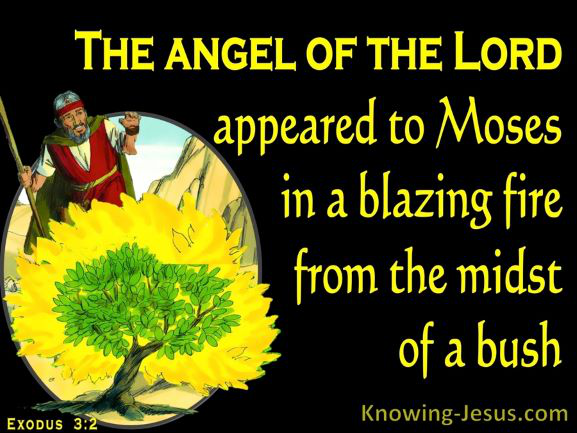
Exodus 3:1 – 10 “Meanwhile, Moses was shepherding the flock of his father-in-law Jethro, the priest of Midian. He led the flock to the far side of the wilderness and came to Horeb, the mountain of God. There the angel of the LORD appeared to him in a blazing fire from within a bush. Moses saw the bush ablaze with fire, but it was not consumed. So Moses thought, “I must go over and see this marvelous sight. Why is the bush not burning up?”

When the LORD saw that he had gone over to look, God called out to him from within the bush, “Moses, Moses!” “Here I am,” he answered. “Do not come any closer,” God said. “Take off your sandals, for the place where you are standing is holy ground.” Then He said, “I am the God of your father, the God of Abraham, the God of Isaac, and the God of Jacob.” At this, Moses hid his face, for he was afraid to look at God.

The LORD said, “I have indeed seen the affliction of My people in Egypt. I have heard them crying out because of their oppressors, and I am aware of their sufferings. I have come down to rescue them from the hand of the Egyptians and to bring them up out of that land to a good and spacious land, a land flowing with milk and honey—the home of the Canaanites, Hittites, Amorites, Perizzites, Hivites, and Jebusites. And now the cry of the Israelites has reached Me, and I have seen how severely the Egyptians are oppressing them. Therefore, go! I am sending you to Pharaoh to bring My people, the Israelites, out of Egypt.” But Moses asked God, “Who am I, that I should go to Pharaoh and bring the Israelites out of Egypt?”

By the time Moses saw that burning bush, he was eighty years old and had been herding sheep for forty years. Moses was married and had at least one son and possibly grandchildren. Egypt had become a distant if painful memory and Moses thought he would spend the rest of his life herding sheep. It wasn’t a bad life, and it certainly beat being a slave in Egypt or being in prison and being tortured. All Moses was hoping for that morning was to find a spring of water for his sheep.

Did Moses even realize that he was on the slopes of a holy mountain? Tough to know. Those who spend their lives outdoors are far more in tune with nature than those who remain inside. Perhaps Moses’s senses were already tingling, signaling that something supernatural was about to happen. At any rate, God knew that Moses had a lot of curiosity, so God caught Moses’ attention with something that shouldn’t exist: a bush that would keep burning but that was not turning to ashes.

God identified Himself and told Moses what He wanted Moses to do. Forty years ago, Moses thought that he could deliver one Israelite from a harsh Egyptian task master, but he never thought of delivering an entire nation. When God informed Moses of the task He wanted Moses to do, Moses had a very natural reaction: “Who? Me?” Moses was probably thinking, “Wait a minute, Lord! If you wanted me to do this, why didn’t you call me when I was young and strong and when I still had some friends in Egypt? Now I’m old and I’ve been away from the Egyptian court for so long that nobody knows me.”

APPLICATION: God’s timing and mercy do not depend on our personal preferences. The very things that Moses saw as drawbacks were the things God was planning to use to accomplish his purpose.

1. Moses had spent 40 years herding sheep in desert conditions. Sheep are stupid, willful, and require a lot of supervision if they are not to get into trouble. Moses needed this experience because the Israelites would behave a lot like those sheep.

2. Moses was no longer a rash middle – aged man, but an elder with experience. In a patriarchal society such as that of the Israelites, these attributes automatically gave Moses the status he would need to convince a group of Israelites that God had really spoken to him.

3. All those years in the desert had made Moses tough and resilient, qualities that he was going to need as he led the Israelites out of Egypt.

The founder of the China Inland Mission, Hudson Taylor, began his work in China but then had to return to England for nine years due to health problems before he could return. It was during those nine years that Taylor gathered others passionate about the Gospel into daily prayer meetings over a map of China. This enforced retreat gave Taylor the chance to consider the mistakes he had made as well as those he had seen other mission groups make. The China Inland Mission was truly born during those nine years of confinement. CIM was responsible for bringing in more than 800 missionaries, starting 125 schools, establishing 300 mission stations in 18 provinces, and directly resulting in 18,000 Christian conversions. CIM was a faith – based mission, depending on voluntary donations. Taylor was fond of saying “God’s work done God’s way will never lack God’s supply.”

Do you feel that you are elderly and that you have been sent to sit on the sidelines for good? Don’t count yourself out so quickly! Remember that Moses wasn’t even called into ministry until he was eighty. God’s mercies are unlimited and His plans are magnificent. No matter how severe your physical limitations, you can always pray. Many of those who gathered for the daily prayers at China Inland Mission headquarters never went to China themselves, but their prayers made the work of thousands who served with CIM possible.

PRAYER: Father God, thank you that you always have something glorious for us to do and that prayer is one of the most important works there is! Help us to open our minds to the possibilities you have for us. Thank you for your mercies that are new every morning! Thank you for your faithfulness! In the mighty Name of King Jesus. Amen.