Archive for the ‘Uncategorized’ Category

FEBRUARY 12, 2021 FORGIVENESS 30: HOW DO YOU DEAL WITH INGRATITUDE?

February 12, 2021

Genesis 40:1 – 15 “Some time later, the king’s cupbearer and baker offended their master, the king of Egypt. Pharaoh was angry with his two officers, the chief cupbearer and the chief baker, and imprisoned them in the house of the captain of the guard, the same prison where Joseph was confined. The captain of the guard assigned them to Joseph, and he became their personal attendant.

After they had been in custody for some time, both of these men—the Egyptian king’s cupbearer and baker, who were being held in the prison—had a dream on the same night, and each dream had its own meaning.

When Joseph came to them in the morning, he saw that they were distraught. So he asked Pharaoh’s officials who were in custody with him in his master’s house, “Why are your faces so downcast today?”

“We both had dreams,” they replied, “but there is no one to interpret them.”

Then Joseph said to them, “Don’t interpretations belong to God? Tell me your dreams.”

So the chief cupbearer told Joseph his dream: “In my dream there was a vine before me, and on the vine were three branches. As it budded, its blossoms opened and its clusters ripened into grapes. Pharaoh’s cup was in my hand, and I took the grapes, squeezed them into his cup, and placed the cup into his hand.”

Joseph replied, “This is the interpretation: The three branches are three days. Within three days Pharaoh will lift up your head and restore your position. You will put Pharaoh’s cup into his hand, just as you did when you were his cupbearer. But when it goes well for you, please remember me and show me kindness by mentioning me to Pharaoh, that he might bring me out of this prison. For I was kidnapped from the land of the Hebrews, and even here I have done nothing for which they should have put me in this dungeon.”

Being a chief cup bearer to a ruler was a highly important position. For one thing, the ruler might ask you to taste the wine before he himself would drink it; if you didn’t collapse and die, then the wine was safe for the ruler to drink. In the same manner, being the chief baker was also a position of great importance. In a land in which bread was a basic staple at every meal, a ruler expected only the very best. Perhaps Pharaoh was having a bad day, but both these men wound up imprisoned in the house of the captain of the guard – an early version of a white collar prison. And the captain of the guard assigned Joseph to take care of them.

Both these gentlemen had dreams on the same night. Notice that Joseph does NOT say, “Oh, I can interpret your dreams.” Instead, Joseph gives God all the credit before interpreting the dreams. When the chief cup bearer gets an encouraging interpretation, the chief baker then recounts his dream.
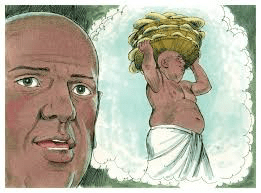
v. 16-23 “I too had a dream: There were three baskets of white bread on my head. In the top basket were all sorts of baked goods for Pharaoh, but the birds were eating them out of the basket on my head.” Joseph replied, “This is the interpretation: The three baskets are three days. Within three days Pharaoh will lift your head off of you and hang you on a tree. Then the birds will eat the flesh of your body.”

On the third day, which was Pharaoh’s birthday, he held a feast for all his officials, and in their presence he lifted up the heads of the chief cupbearer and the chief baker. Pharaoh restored the chief cupbearer to his position, so that he once again placed the cup in Pharaoh’s hand. But Pharaoh hanged the chief baker, just as Joseph had interpreted the dream to them. The chief cupbearer, however, did not remember Joseph; he forgot all about him.”

When the chief cup bearer’s dream came true, Joseph must have been ecstatic! At last he was going to get out of prison. But in the euphoria of being restored to an important position, the chief cup bearer forgot Joseph. And after all, Joseph was a Hebrew while the cup bearer was an Egyptian. As a race, the Egyptians were extremely proud of themselves; perhaps there was an element of racial prejudice at work here.

APPLICATION: Have you ever gone out on a limb to help someone, only to have them take all your efforts for granted? Perhaps you have helped someone get a better job or get a promotion. Perhaps you helped pay school fees for someone’s children, even though you had to scramble to come up with the money. It’s always frustrating and discouraging when you have gone the extra mile to help someone, only to have them forget you, ignore your efforts, or take you for granted.

What’s the lesson of forgiveness here? Sometimes people are very ungrateful and ignore whatever you have done for them. How do you handle such a situation? The best course of action is this: do what you can to help and do it to the glory of God. if people thank you, fine. If people ignore you, forgive them and move on. Don’t get bogged down in unforgiveness. Ingratitude carries its own punishment with it; you don’t have to get involved.

PRAYER: Father God, we ourselves are so ungrateful! You have given us life and health. You have given us a wonderful and beautiful world to live in and to enjoy. And most of all, you sent your son Jesus to die for our sins so that we would not bear that punishment ourselves. Help us to forgive those who are ungrateful and to press on into the glorious future you have for us. In the mighty Name of King Jesus. Amen.

FEBRUARY 11, 2021 FORGIVENESS 29: ARE YOU IN IT FOR THE LONG HAUL?

February 11, 2021

Genesis 39:20 b. – 23 “While Joseph was there in the prison, the LORD was with him and extended kindness to him. He granted him favor in the eyes of the prison warden, who put all those held in the prison under Joseph’s authority, so that he was responsible for all that was done there. The warden did not concern himself with anything under Joseph’s authority, because the LORD was with him and gave him success in whatever he did.”

Hauled off to prison on false charges of attempting to rape his mistress, Joseph has two choices: he can either sit there nursing his hurts or he can forgive and go forward. Pity parties with lots of sulking and unforgiveness leave you unfit for anything else; those nights in prison can get really long and there’s plenty of time to brood if you choose to do so.

Resentment and unforgiveness can feel so good, so RIGHT! Once we begin compiling lists of offenses others have committed against us, we can simply add each new day’s worth of wrongs to the list. But the more we concentrate on how wounded we have been, the less we are able to get beyond those wounds. A victim mentality feeds on itself and creates more victims; those whom we resent become victims of our resentment and our hatred.

Perhaps during those long nights in prison, Joseph begins to remember his family and gets a little homesick. In the stillness, Joseph remembers every time he pestered his older brothers or carried lies about them to their father. Joseph remembers the anguish in the eyes of his brothers who were sons of concubines as they realized each day that they were second class citizens in the family. After managing Potiphar’s household and the prison, Joseph has a much clearer idea of what it takes to be a leader and how destructive it can be to have someone bent on undermining all those around him. For years Joseph had delighted in being the favorite; only now does he realize how his behavior has torn the fabric of the family to pieces.

Joseph chooses to forgive and move forward. Evidently, Joseph is a bright guy with a lot of administrative ability, and the prison warden soon makes him his right hand man. God is blessing Joseph even as He is teaching Joseph. The mouthy brat who lorded it over his older brothers is gone, replaced by a highly intelligent and thoughtful young man. God had Jacob herding sheep and goats in the wilderness for twenty years to mature him. Now God is putting Joseph through a rigorous training as well.

APPLICATION: Many times we may find ourselves in situations from which there is no easy way out. A commitment to a training program or to a particular project may leave us feeling trapped. At the same time, we may be coldly furious at those who have manipulated our situation. We may also be angry with ourselves for getting into the situation in the first place. And we may be angry with God for allowing something of the sort to happen.

The question you must ask yourself is this: what is God trying to teach me in this situation? God doesn’t do anything haphazardly. And God can engineer a situation that seems intolerable to work for your success. Look at Joseph, thrown into prison and yet becoming the number two man in the entire place.

You need forgive those whom you feel have hurt you. You need to forgive anyone in the situation who is contributing to your feeling of helplessness. And you need to forgive yourself.

PRAYER: Father God, thank you that you can work situations that appear to be disasters out for our good. Thank you that you forgive us for our sins against you when we confess them. Help us to forgive those around us and to forgive ourselves at the same time. In the matchless Name of King Jesus. Amen.

FEBRUARY 10, 2021 FORGIVENESS 28: WHAT DO YOU DO WHEN YOU ARE SEXUALLY HARASSED AT WORK???

February 10, 2021

Genesis 39:1 – 6 “Meanwhile, Joseph had been taken down to Egypt, where an Egyptian named Potiphar, an officer of Pharaoh and captain of the guard, bought him from the Ishmaelites who had taken him there. And the LORD was with Joseph, and he became a successful man, serving in the household of his Egyptian master. When his master saw that the LORD was with him and made him prosper in all he did, Joseph found favor in his sight and became his personal attendant. Potiphar put him in charge of his household and entrusted him with everything he owned. From the time that he put Joseph in charge of his household and all he owned, the LORD blessed the Egyptian’s household on account of him. The LORD’s blessing was on everything he owned, both in his house and in his field. So Potiphar left all that he owned in Joseph’s care; he did not concern himself with anything except the food he ate.”

Wow! Sold as a slave, Joseph now finds himself as the steward in the household of Paroah’s captain of the guard, Potiphar. Things are going really well, and Joseph’s master is so pleased that he leaves the running of his entire business to Joseph. But trouble is coming.

v. 6. b. – 9 “Now Joseph was well-built and handsome, and after some time his master’s wife cast her eyes on Joseph and said, “Sleep with me.” But he refused. “Look,” he said to his master’s wife, “with me here, my master does not concern himself with anything in his house, and he has entrusted everything he owns to my care. No one in this house is greater than I am. He has withheld nothing from me except you, because you are his wife. So how could I do such a great evil and sin against God?”

Joseph is a slave, and slaves have no rights. Technically, whatever a master or mistress demanded, the slave would have to comply. But Joseph feared God and respected his master Potiphar and refused. Eventually Potiphar’s wife virtually attacks Joseph when nobody else is around and when Joseph runs outside, she grabs his cloak and pulls it away from him. Potiphar’s wife then calls the household servants and tells them that Joseph tried to rape her but that she fought him off and he left his cloak behind. What are the household servants supposed to do? They might very well be slaves themselves and they might also be jealous of Joseph’s success. Of course, they will back up their mistress. When Potiphar comes home, his wife tells him the same lies, and he has Joseph hauled off to prison. By now, Joseph might be thinking that this is the end of everything for him!

Sexual harassment has existed as long as people have been on the earth. In this story, Joseph was in a terrible position; as a slave, he had no rights whatsoever. It’s likely that once Potiphar sent Joseph to prison, he also had Joseph beaten. Even if Potiphar suspected his wife of lying, he had no proof and the household servants were there to back up her story.

As a female surgeon in training, I encountered my share of sexual harassment, some of it subtle and some quite overt. Being the victim of such attacks can cause you to feel ashamed, dirty, and unworthy. At the same time, you may also be furious that someone would dare to violate your personhood.

APPLICATION: What does this passage teach about forgiveness? At first, it would seem there is no lesson here; however, as we go further into the story, it becomes obvious that Joseph did not worry about hating Potiphar’s wife or Potiphar. Imprisoned on trumped – up charges, Joseph would certainly be justified in feeling sorry for himself and hating those who put him there. There is never any indication that Joseph succumbs to self – pity or unforgiveness. As the story continues, Joseph actually rises to a position of responsibility in the prison itself.

If you are facing sexual harassment on the job, you need to protect yourself as much as possible. Jobs are not easy to come by and many people are the sole support of their families. While you are forgiving those who are harassing you, also pray for God to deliver you. It is not God’s will for you to be a victim of someone else’s lust. You can pray that God will remove the person who is harassing you or that God will move you somewhere safer and better.

PRAYER: Father God, please help those who are reading this who are victims of sexual harassment. Raise up champions for them or move them into safer situations. Help them to forgive those who have hurt them but also help them realize that forgiveness does not mean remaining in a vulnerable situation. In the mighty Name of King Jesus. Amen.

FEBRUARY 9, 2021 FORGIVENESS 27: HOW FAR WILL YOU GO FOR VENGEANCE???

February 9, 2021

Genesis 37:18 – 30 “Now Joseph’s brothers saw him in the distance, and before he arrived, they plotted to kill him. “Here comes that dreamer!” they said to one another. “Come now, let us kill him and throw him into one of the pits. We can say that a vicious animal has devoured him. Then we shall see what becomes of his dreams!”

When Reuben heard this, he tried to rescue Joseph from their hands. “Let us not take his life,” he said. “Do not shed his blood. Throw him into this pit in the wilderness, but do not lay a hand on him.” Reuben said this so that he could rescue Joseph from their hands and return him to his father.

So when Joseph came to his brothers, they stripped him of his robe—the robe of many colors he was wearing— and they took him and threw him into the pit. Now the pit was empty, with no water in it And as they sat down to eat a meal, they looked up and saw a caravan of Ishmaelites coming from Gilead. Their camels were carrying spices, balm, and myrrh on their way down to Egypt.

Then Judah said to his brothers, “What profit will we gain if we kill our brother and cover up his blood? Come, let us sell him to the Ishmaelites and not lay a hand on him; for he is our brother, our own flesh.” And they agreed. So when the Midianite traders passed by, his brothers pulled Joseph out of the pit and sold him for twenty shekels of silver to the Ishmaelites, who took him to Egypt.

When Reuben returned to the pit and saw that Joseph was not there, he tore his clothes, returned to his brothers, and said, “The boy is gone! What am I going to do?”

Joseph has really done it now! Jacob has sent Joseph out to check on his brothers who have had to wander a long way to find grazing for their animals. Remember that four of these men are already furious with Joseph for having carried tales about them to their father. Joseph has compounded the problem by recounting dreams in which all his family members have become subservient to him. It’s quite possible that while the brothers have been sitting around watching their animals graze, they have been sharing stories about Joseph to the point that now all of them despise him thoroughly.

Joseph shows up to check on his brothers. You can imagine their thoughts, “Hmph! The last time this guy carried information to Dad, four of us wound up in trouble. What’s he want now? And why do we have to put up with him?” The brothers throw Joseph into an empty pit and start mulling over their options. Reuben, the oldest, is no angel, but he cares enough for his father that he is planning to rescue Joseph. But while Reuben is off somewhere, a caravan on its way to Egypt shows up. What a great idea! Don’t kill Joseph or beat him up; after all he IS our own flesh and blood. Just sell him to the caravan and they can send him to Egypt. Problem solved permanently! Why were the brothers reluctant to kill Joseph? Perhaps there are some traditional taboos; historically, the shedding of innocent blood has been thought to bring curses on a land. Reuben returns to find Joseph gone. But does Reuben go home and tell his father what has actually happened? Reuben’s behavior here is quite strange. Reuben SOUNDS as if he really cares about Joseph and his father; but when the pressure is on, Reuben doesn’t tell the truth at all.

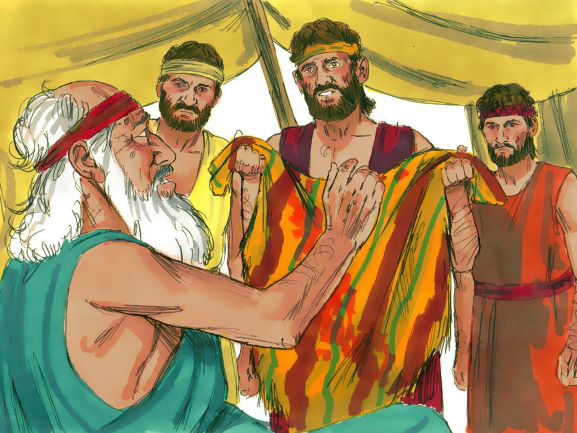
v.31- 36 “they took Joseph’s robe, slaughtered a young goat, and dipped the robe in its blood. They sent the robe of many colors to their father and said, “We found this. Examine it to see whether it is your son’s robe or not.”

His father recognized it and said, “It is my son’s robe! A vicious animal has devoured him. Joseph has surely been torn to pieces!” Then Jacob tore his clothes, put sackcloth around his waist, and mourned for his son many days. All his sons and daughters tried to comfort him, but he refused to be comforted. “No,” he said. “I will go down to Sheol mourning for my son.” So his father wept for him.

Meanwhile, the Midianites sold Joseph in Egypt to Potiphar, an officer of Pharaoh and captain of the guard.”

These are Jacob’s sons all right! Notice that they NEVER make any statements themselves; they only tell Jacob that they have found the robe and ask him if it’s Joseph’s. Jacob jumps to the natural conclusion without the need for any of the sons to lie to him. CLEVER ! But this is their father also. How can they be so cruel?

Jacob did not love his sons unconditionally or equally. Look back to the meeting with Esau; the concubines and their children came first, then Leah, and finally Rachel. There was a definite hierarchy of love in Jacob’s family. In some families, love is very conditional; each sibling feels that he must outdo the others to earn his parents’ love. Sometimes when a parent or grandparent dies, the children or grandchildren fight over the things left behind. The unspoken script is that “If I have a lot of Dad’s/Mom’s/Grandpa’s/Grandma’s things, then it means they loved me best!”

APPLICATION: How do things work in your family? If you are a parent or grandparent, do you play favorites? Do you make sure your children and grandchildren know that you love them or do you try to substitute things or activities for being with them? Don’t copy Jacob! Jacob’s failure to assure all of his sons of his love left them scrambling to prove their own importance.

What does this story have to do with forgiveness? Perhaps you were raised in a dysfunctional family; you may need to forgive your parents and grandparents and your siblings. Refusing to forgive and nourishing hurt feelings only brings more bitterness, more separation, and more loneliness. Refusing to forgive those who wronged you also may cause you to repeat the very behavior you dislike so much.

PRAYER: Father God, help us to forgive anyone in our family who has practiced conditional love. Help us to forgive our siblings, who may have also been victims just as we have. And help us to move forward and copy your unconditional love. In the mighty Name of King Jesus. Amen.
FEBRUARY 8, 2021 FORGIVENESS 26: IS FAMILY PEACE REALLY POSSIBLE?

February 8, 2021

Genesis 37:1 – 11 “Now Jacob lived in the land where his father had resided, the land of Canaan. This is the account of Jacob. When Joseph was seventeen years old, he was tending the flock with his brothers, the sons of Bilhah and Zilpah, his father’s wives, and he brought their father a bad report about them. Now Israel loved Joseph more than his other sons, because Joseph had been born to him in his old age; so he made him a robe of many colors. When Joseph’s brothers saw that their father loved him more than any of them, they hated him and could not speak a kind word to him.

Then Joseph had a dream, and when he told it to his brothers, they hated him all the more. He said to them, “Listen to this dream I had: We were binding sheaves of grain in the field, and suddenly my sheaf rose and stood upright, while your sheaves gathered around and bowed down to mine.”

“Do you intend to reign over us?” his brothers asked. “Will you actually rule us?” So they hated him even more because of his dream and his statements.

Then Joseph had another dream and told it to his brothers. “Look,” he said, “I had another dream, and this time the sun and moon and eleven stars were bowing down to me.”

He told his father and brothers, but his father rebuked him and said, “What is this dream that you have had? Will your mother and brothers and I actually come and bow down to the ground before you?” And his brothers were jealous of him, but his father kept in mind what he had said.”

Sibling rivalry is bad enough when a man only has one wife and several children. But remember that Jacob had 2 wives and 2 concubines. The sons of Leah were Reuben the firstborn of Jacob, Simeon, Levi, Judah, Issachar, and Zebulun. The sons of Rachel were Joseph and Benjamin. The sons of Rachel’s maidservant Bilhah were Dan and Naphtali. And the sons of Leah’s maidservant Zilpah were Gad and Asher. No matter what anybody wanted to think, Bilhah and Zilpah did not enjoy the same status as Rachel and Leah. This same lack of status undoubtedly carried over to their sons.

Everybody knew that Rachel was Jacob’s favorite wife and therefore her two sons, Joseph and Benjamin, were also their father’s favorites. The sons who probably ranked next were Leah’s six sons, with the sons of the maid servants ranking at the bottom.

Any sign of favoritism in a large family causes all kinds of friction, a fact to which Jacob was evidently oblivious. Jacob gave Joseph a special brightly – colored robe, one much nicer and more expensive than the drab brown material all the other sons were wearing. Then Joseph had to make the whole situation vastly worse by telling tales on Dan, Naphtali, Gad, and Asher, the sons of the concubines.

One night seventeen year old Joseph had two dreams. Being a mouthy teenager, Joseph just couldn’t keep these dreams to himself, but shared them with his brothers who were already resentful. The message of the two dreams was the same: some day Joseph would be in a position of power and the rest of the family, including his parents, would bow before him! Bad move, Joseph! In the family structure, Joseph and his brother Benjamin were the youngest sons, while the other sons were all tough grown men. The stage was set for a tragedy.

APPLICATION: Anybody who has ever run a company or a business such as a hospital knows that workers watch for signs of favoritism. If you are the head of an organization, you know that it is like being the head of a large family with lots of children, each one of whom thinks that he or she should have been born an only child! If person A receives any tiny amount of incentive pay, all the other workers will be demanding the same thing.

What does this story teach about forgiveness? This part of the story really features unforgiveness. Joseph’s brothers hated him because his father favored him and because Joseph flaunted the evidence of that favoritism.

Perhaps you find yourself in a situation in which you feel that others are favored while you are not. You can choose to be bitter or you can choose to forgive your bosses and those you feel are being favored. Perhaps your perceptions are faulty; things are seldom what they seem. You might be surprised to learn that others are envying you, feeling that you are getting additional attention, etc. If you choose to remain bitter and envious, you will poison your own attitude.

PRAYER: Father God, please help us to refuse to envy others, whether our fellow workers, our friends, or our relatives. Help us to look to you for our reward and not to others. In the mighty Name of King Jesus. Amen.

FEBRUARY 7, 2021 FORGIVENESS 25: IS VENGEANCE EVER JUSTIFIED???

February 7, 2021

Genesis 34:13 – 24 “But because Shechem had defiled their sister Dinah, Jacob’s sons answered him and his father Hamor deceitfully. “We cannot do such a thing,” they said. “To give our sister to an uncircumcised man would be a disgrace to us. We will consent to this on one condition, that you become circumcised like us—every one of your males. Then we will give you our daughters and take your daughters for ourselves. We will dwell among you and become one people. But if you will not agree to be circumcised, then we will take our sister and go.”

Their offer seemed good to Hamor and his son Shechem. The young man, who was the most respected of all his father’s household, did not hesitate to fulfill this request, because he was delighted with Jacob’s daughter.

So Hamor and his son Shechem went to the gate of their city and addressed the men of their city: “These men are at peace with us. Let them live and trade in our land; indeed, it is large enough for them. Let us take their daughters in marriage and give our daughters to them. But only on this condition will the men agree to dwell with us and be one people: if all our men are circumcised as they are. Will not their livestock, their possessions, and all their animals become ours? Only let us consent to them, and they will dwell among us.”

All the men who went out of the city gate listened to Hamor and his son Shechem, and every male of the city was circumcised.”

Jacob is NOT the only tricky one in the family! Jacob’s sons are plotting revenge. Shechem, the son of the prince of the Hivites, has raped their sister Dinah. The brothers want to place all the blame on Shechem, rather than acknowledge that they are partially responsible for this tragedy by failing to protect Dinah as they should have. So the brothers cook up a scheme; they promise to not only give Dinah in marriage to Shechem but also to become “one people” with the Hivites if the Hivite males will undergo circumcision. The Hivite elders think this is a great deal. Circumcision only hurts for a few days and Jacob’s family is very rich. By undergoing circumcision, the Hivites will have access to Jacob’s fortune. This decision is a tragic mistake.

v. 25 – 31 “Three days later, while they were still in pain, two of Jacob’s sons (Dinah’s brothers Simeon and Levi) took their swords, went into the unsuspecting city, and slaughtered every male. They killed Hamor and his son Shechem with their swords, took Dinah out of Shechem’s house, and went away.

Jacob’s other sons came upon the slaughter and looted the city, because their sister had been defiled. They took their flocks and herds and donkeys, and everything else in the city or in the field. They carried off all their possessions and women and children, and they plundered everything in their houses.

Then Jacob said to Simeon and Levi, “You have brought trouble upon me by making me repugnant to the Canaanites and Perizzites, the people of this land. We are few in number; if they unite against me and attack me, I and my household will be destroyed.”

But Simeon and Levi answered, “Should he have treated our sister like a prostitute?”

Simeon and Levi are Dinah’s direct brothers; Leah is their mother. Interestingly enough, Leah actually bore six sons: Reuben, Simeon, Levi, Judah, Issachar, and Zebulon. Simeon and Levi are the ones who slaughter every male and rescue Dinah from Hamor’s house. All the other brothers show up in chime to loot the city and destroy it, carrying off the women and children and all the possessions.

Is vengeance ever justified? Romans 12:17 – 19 says, “Do not repay anyone evil for evil. Carefully consider what is right in the eyes of everybody. If it is possible on your part, live at peace with everyone. Do not avenge yourselves, beloved, but leave room for God’s wrath. For it is written: “Vengeance is Mine; I will repay, says the Lord.”

Could Jacob have handled this situation differently? God may have given Jacob the new name of Israel, but Jacob is still being manipulative. How did Jacob present the situation to his sons when they returned from the field? It’s likely that Jacob told the story in a manner calculated to appeal to the pride of his sons. When Simeon and Levi are asking their question, are they simply echoing something Jacob has already said? Is Jacob really that unhappy that his sons have wreaked havoc on this city, or is he a bit smug? The Hivite city is wiped out and their plunder now belongs to Jacob’s family; meanwhile, Jacob’s hands are technically clean. One person who is never heard from in this story is Dinah. Would Dinah have married her rapist? We never hear about Dinah again.

APPLICATION: Terrible things happen every day. Many people find themselves or their family members victims of violent crimes. Those who do best are those who forgive and move beyond the horror of the crime. Many have testified that they have found healing when they have prayed for the perpetrators for spiritual and emotional healing. Perhaps you are facing a terrible situation now. Your business or your neighborhood have been destroyed. Let God handle the vengeance. You pray for those who have hurt you and let God heal you as you do so.

PRAYER: Father God, some of us have spent years in pain from horrible crimes committed against us or our families. Lord, help us to forgive the criminals and let you handle them in your wisdom. Help us to heal. In the mighty Name of King Jesus. Amen.

FEBRUARY 6, 2021 FORGIVENESS 24: DINAH’S RAPE – WHO IS TO BLAME???

February 6, 2021

Genesis 34:1- 4 “Now Dinah, the daughter Leah had borne to Jacob, went out to visit the daughters of the land. When Shechem son of Hamor the Hivite, the prince of the region, saw her, he took her and lay with her by force. And his soul was drawn to Dinah, the daughter of Jacob. He loved the young girl and spoke to her tenderly. So Shechem told his father Hamor, “Get me this girl as a wife.”

Everybody in the family knew that Dinah was spoiled. As the only daughter with all those brothers, Dinah generally got whatever she wanted. Dinah’s father and her brothers had warned her repeatedly not to go out without an escort, and Dinah should never have gone out by herself that day! Really, Dinah knew better, but she was bored and her brothers were all out in the fields. Why wait for someone to come and accompany her? Why not just slip over to the neighbors and visit a bit when it was so close? That morning Dinah had asked if one of her brothers could accompany her as she visited; but the boys were full of their own self – importance and had no time for their little sister.

Dinah was willful; her brothers were careless. The result was a community tragedy. Shechem, the crown prince of the region, saw Dinah by herself and grabbed her and raped her. As the son of a traditional ruler, Shechem also was probably spoiled. And this girl wasn’t a Hivite; her people were strangers. Surely the normal social conventions that applied to Hivite maidens didn’t apply to Dinah; besides, the girl had lots of brothers. Why hadn’t one of the brothers accompanied her as she went about the community? But the girl was very pretty; why not get her for a wife? Shechem was certain that if his father could handle the whole situation.

v. 5 – 12 “Jacob heard that Shechem had defiled his daughter Dinah, but since his sons were with his livestock in the field, he remained silent about it until they returned. Meanwhile, Shechem’s father Hamor came to speak with Jacob. When Jacob’s sons heard what had happened, they returned from the field. They were filled with grief and fury, because Shechem had committed an outrage in Israel by lying with Jacob’s daughter—a thing that should not be done.

But Hamor said to them, “My son Shechem longs for your daughter. Please give her to him as his wife. Intermarry with us; give us your daughters, and take our daughters for yourselves. You may settle among us, and the land will be open to you. Live here, move about freely, and acquire your own property.”

Then Shechem said to Dinah’s father and brothers, “Grant me this favor, and I will give you whatever you ask. Demand a high dowry and an expensive gift, and I will give you whatever you ask. Only give me the girl as my wife!”

Two willful spoiled young people and an attack that resulted in rape – life is rarely neat and well – compartmentalized. Deborah was both a perpetrator and a victim; had she observed the normal social conventions and waited for one of her brothers to escort her, she would have been safe. Shechem was equally a perpetrator and a victim. Shechem could easily have asked Dinah to lead him back to her father’s camp, where he could have introduced himself. Or Shechem could have left Dinah alone and simply asked his father to speak on his behalf. Neither Dinah nor Shechem observed the proper social conventions.

What is Jacob’s part in all this? Why does Jacob wait until his sons return from the field before he takes any action? Jacob wants as much backing as possible. And at this point, Jacob is older, probably seventy or eighty years old; he needs his sons to help in this matter. Is Jacob angry with his sons because none of them felt it necessary to accompany their little sister? Was it really necessary for ALL of the boys to go to the field that morning? Is Jacob feeling guilty for not having urged one of the boys to stay back and accompany Dinah? Part of the reaction of Jacob and his sons might be guilt for failing to have protected Dinah.

APPLICATION: How do you respond when something truly terrible happens? Are you willing to acknowledge your contribution to the disaster, or do you try to mindlessly blame everyone else around you, conveniently ignoring the part you have played?

As long as you are blaming others, you cannot forgive them. As long as you fail to acknowledge your failings, you cannot forgive yourself either. We will continue this story tomorrow, but it gives us several examples of the disasters lack of confession and unforgiveness can bring.

PRAYER: Father God, thank you for your mercy and your grace. Help us to face our own shortcomings and to confess them so that we can forgive ourselves and others. Help us to refuse to hold grudges or to seek revenge. In the mighty Name of King Jesus. Amen.
FEBRUARY 5, 2021 FORGIVENESS 23: CONFRONTING THOSE WHOM YOU HAVE WRONGED!

February 5, 2021

Genesis 33:1 – 17 “Now Jacob looked up and saw Esau coming toward him with four hundred men. So he divided the children among Leah, Rachel, and the two maidservants. He put the maidservants and their children in front, Leah and her children next, and Rachel and Joseph at the rear. But Jacob himself went on ahead and bowed to the ground seven times as he approached his brother.

Esau, however, ran to him and embraced him, threw his arms around his neck, and kissed him. And they both wept. When Esau looked up and saw the women and children, he asked, “Who are these with you?”

Jacob answered, “These are the children God has graciously given your servant.” Then the maidservants and their children approached and bowed down. Leah and her children also approached and bowed down, and then Joseph and Rachel approached and bowed down.

“What do you mean by sending this whole company to meet me?” asked Esau.

“To find favor in your sight, my lord,” Jacob answered.

“I already have plenty, my brother,” Esau replied. “Keep what belongs to you.”

But Jacob insisted, “No, please! If I have found favor in your sight, then receive this gift from my hand. For indeed, I have seen your face, and it is like seeing the face of God, since you have received me favorably. Please take my present that was brought to you, because God has been gracious to me and I have all I need.” So Jacob pressed him until he accepted.

Then Esau said, “Let us be on our way, and I will go ahead of you.”

But Jacob replied, “My lord knows that the children are frail, and I must care for sheep and cattle that are nursing their young. If they are driven hard for even a day, all the animals will die. Please let my lord go ahead of his servant. I will continue on slowly, at a comfortable pace for the livestock and children, until I come to my lord at Seir.” “Let me leave some of my people with you,” Esau said.

But Jacob replied, “Why do that? Let me find favor in the sight of my lord.” So that day Esau started on his way back to Seir, but Jacob went on to Succoth, where he built a house for himself and shelters for his livestock; that is why the place was called Succoth. (Succoth means “booths” or “shelters.”)

It’s crunch time!!! Jacob is finally meeting Esau, the brother who was ready to kill him for stealing his birthright and his blessing twenty years ago. Esau has always been a hunter and a warrior and now has four hundred armed men with him. What is Jacob to do? After dividing the women and children into groups, Jacob himself goes out first, bowing to the ground seven times as he meets Esau. The number seven recurs in the Bible; seven is considered the number of perfection. For Jacob to bow seven times might symbolize an act of infinite humility.

Imagine Jacob’s feelings as he is bowing. At any moment Jacob is expecting a sword across his neck or a dagger in his back; yet, he completes his bowing and nothing bad has happened. Never before has Jacob felt so exposed or so vulnerable! And then the unimaginable happens! As Jacob slowly stands up after bowing for the seventh time, Esau runs to him, hugs him, throws his arms around Jacob’s neck, and kisses Jacob. At this point, Jacob might be wondering if this act of affection is a signal for an attack, but no! Esau really is thrilled to see Jacob. The brothers hug, weep, and then hug some more. Each of them remembers when they were boys together before there were any thoughts of inheritances or blessings.

Jacob goes on to introduce his family and finally gets Esau to agree to accept the presents of livestock that he has already sent to Esau. When Esau offers to accompany Jacob to protect Jacob’s group, Jacob convinces him that is not necessary. Perhaps Jacob is still not sure how far to trust Esau.

Our focus is forgiveness and restitution. Why was this meeting between Esau and Jacob so successful? Jacob humbled himself. Proverbs 3:34 says, “He (God) mocks the mockers, but gives grace to the humble.” For twenty years Jacob has suffered at the hands of Laban. Most of one night Jacob has wrestled with an angel sent by God. Jacob has had to face his own shortcomings and his sins against his brother and has had time to repent completely. The reconciliation between Jacob and Esau is effective because Jacob has humbled himself.

APPLICATION: Humbling yourself is the toughest thing there is to do! We all want to make excuses, to let ourselves off the hook. We avoid confronting our sins as much as possible and we magnify the few good things that we do and ignore the glaring offenses we have committed against others.

Do you want peace with those whom you have wronged? Humble yourself! Allow God to show you where you have hurt others and how you can go about apologizing. Ask God to show you if there is some specific act of contrition you need to do to heal that situation. And when God gives you the answers, do it, no matter how difficult it might seem. Living with guilt is far worse; Jacob lived with guilt for twenty years.

PRAYER: Father God, open our eyes to see our sins against others. Show us how to apologize and what we might need to do to make things right. In the matchless Name of King Jesus. Amen.

FEBRUARY 4, 2021 FORGIVENESS 22: IF GOD HAS FORGIVEN, WHY ARE YOU WRESTLING?

February 4, 2021

Genesis 32:22 – 30 “During the night Jacob got up and took his two wives, his two maidservants, and his eleven sons, and crossed the ford of Jabbok. He took them and sent them across the stream, along with all his possessions.

So Jacob was left all alone, and there a man wrestled with him until daybreak. When the man saw that He could not overpower Jacob, He struck the socket of Jacob’s hip and dislocated it as they wrestled. Then the man said, “Let Me go, for it is daybreak.”

But Jacob replied, “I will not let You go unless You bless me.”

“What is your name?” the man asked. “Jacob,” he replied. (Jacob means “He grasps the heel” or “He deceives.”)

Then the man said, “Your name will no longer be Jacob, but Israel, because you have struggled with God and with men, and you have prevailed.” (Israel means “He struggles with God.”)

Then Jacob asked him, “Please tell me Your name.”

“Why do you ask My name?” he replied. And He blessed Jacob there. So Jacob named the place Peniel, saying, “Indeed, I have seen God face to face, and yet my life was spared.” (Peniel or Penuel means “the face of God.”)

On the face of it, this is a very strange passage that appears to have little to do with forgiveness. God has already forgiven Jacob and blessed him abundantly with wives, children, possessions, servants, and livestock. Why does Jacob get up in the middle of the night and send everyone and everything across the Jabbok, returning to the east side by himself? Somehow Jacob must feel a need to be alone with God, something it would certainly be difficult to do in the midst of fussing children and animals making all kinds of noises.

Frankly, Jacob is worried about his upcoming meeting with Esau. With four hundred warriors Esau can easily wipe out Jacob and his entire family and take everything Jacob has slaved for for twenty years. By now Jacob is remembering every time he cheated Esau, every time he snickered at Esau behind Esau’s back for being a muscle – bound oaf. Even though Jacob has sent very handsome gifts ahead of him, there is no guarantee that Esau will not simply wipe out Jacob and steal Jacob’s wives and children and everything else. And Jacob is remembering how he deceived his aging father by pretending to be Esau to gain the blessing that should have gone to Esau.

While Jacob is sitting there in the dark and the stillness, a man shows up and begins to wrestle with him. Why does Jacob engage in the wrestling match? Perhaps Jacob feels that this stranger is from God and that God is punishing him yet again for his treachery to Esau. Evidently, the two are evenly matched because there is no mention of the stranger being able to overpower Jacob. As a shepherd who has spent twenty years walking, fighting off wild animals, and carrying wounded sheep, Jacob is quite strong. Each time it appears that the stranger is about to pin Jacob, somehow Jacob gets out of his grasp. Perhaps each time the stranger throws Jacob to the ground, Jacob remembers another one of his sins against Esau or against his aged father Isaac. Perhaps as Jacob remembers each sin, he begs God to forgive him. By now Jacob has probably realized that this stranger must have come from God. Finally as Jacob repents of the last sin he can recollect, the dawn breaks. The divine stranger touches Jacob’s hip, causing it to dislocate and ending the wrestling match. And it is after this strange wrestling match that God performs the biggest act of forgiveness of all: He gives Jacob a new name.

Jacob was the second – born twin and came out of the womb holding Esau’s heel, hence his name. All Jacob’s life he has born a name that is a kind of curse, but now God is giving Jacob a new name, a strong positive name, “Israel.” The angelic stranger tells Jacob that he has earned this name because he has struggled with both God and man and has won. Jacob stands there amazed, both at his new name and also at the fact that he has seen the face of God and is still alive.

APPLICATION: Sometimes we need to be alone with God as Jacob was and allow God to do whatever He desires with us. We must remember that God knows us far better than we know ourselves. We are fond of making excuses and covering up our wrong – doing. Sometimes before we are willing to face our sins, we must wrestle mentally, emotionally, or spiritually with God. The wrestling process is necessary because we are stubborn and cling to our pet sins!

God loves us too much to leave us in our sins, particularly our sins against others. We are like small children who have played in mud who now are demanding that our loving Father pick us up. Why not allow God to clean the mud by confessing your sins and repenting of them?

PRAYER: Father God, thank you for the example of Jacob. Thank you that you love us too much to leave us alone but that it is your will to perfect us into your image. Help us to cooperate and not to fight you while this process is taking place. In the matchless Name of King Jesus. Amen.

FEBRUARY 3, 2021 FORGIVENESS 21: CAN YOU BUY FORGIVENESS???

February 2, 2021

Genesis 32: 3 – 12 “Jacob sent messengers ahead of him to his brother Esau in the land of Seir, the country of Edom. He instructed them, “You are to say to my master Esau, ‘Your servant Jacob says: I have been staying with Laban and have remained there until now. I have oxen, donkeys, flocks, menservants, and maidservants. I have sent this message to inform my master, so that I may find favor in your sight.’”

When the messengers returned to Jacob, they said, “We went to your brother Esau; he is coming to meet you—he and four hundred men with him.” In great fear and distress, Jacob divided his people into two camps, as well as the flocks and herds and camels. He thought, “If Esau comes and attacks one camp, then the other camp can escape.”

Then Jacob declared, “O God of my father Abraham, God of my father Isaac, the LORD who told me, ‘Go back to your country and to your kindred, and I will make you prosper,’ I am unworthy of all the kindness and faithfulness You have shown Your servant. Indeed, with only my staff I came across the Jordan, but now I have become two camps. Please deliver me from the hand of my brother Esau, for I am afraid that he may come and attack me, and also the mothers and their children with me. But You have said, ‘I will surely make you prosper, and I will make your offspring like the sand of the sea, too numerous to count.’

Jacob wants to return to Canaan; but to do so, he must pass through Esau’s territory. After twenty years of hardship under Laban, Jacob has a much clearer idea of the wrong that he has done to Esau. At the same time, Jacob remembers that Esau has a quick temper and is likely to attack first and reflect later, if at all. Jacob does the most diplomatic thing possible: he sends messengers ahead of him and instructs them to give a very humbly – worded message. It seems that Jacob’s fears are well founded, for Esau sets out with four hundred men to meet Jacob. Jacob prays an eloquent prayer, but it could be condensed into a single word: HELP!!!

v. 13 – 20 “Jacob spent the night there, and from what he had brought with him, he selected a gift for his brother Esau: 200 female goats, 20 male goats, 200 ewes, 20 rams, 30 milk camels with their young, 40 cows, 10 bulls, 20 female donkeys, and 10 male donkeys. He entrusted them to his servants in separate herds and told them, “Go on ahead of me, and keep some distance between the herds.”

He instructed the one in the lead, “When my brother Esau meets you and asks, ‘To whom do you belong, where are you going, and whose animals are these before you?’ then you are to say, ‘They belong to your servant Jacob. They are a gift, sent to my lord Esau. And behold, Jacob is behind us.’”

He also instructed the second, the third, and all those following behind the herds: “When you meet Esau, you are to say the same thing to him. You are also to say, ‘Look, your servant Jacob is right behind us.’” For he thought, “I will appease Esau with the gift that is going before me. After that I can face him, and perhaps he will accept me.”

What is Jacob trying to do with these gifts? Consider the fact that Jacob has had twenty years of herding Laban’s animals. Somewhere out there in the cold dark nights, Jacob has had time to realize just how badly he has cheated Esau. Each time that Laban has changed Jacob’s wages and has tried to cheat him again, Jacob has remembered his manipulations of Esau. At this point, Jacob wants to save his family and himself but he also wants to try to make things right with Esau. These gifts of animals are Jacob’s way of trying to make restitution.

APPLICATION; Many times, we are the ones who have wronged someone else. There is a saying that “The first rule of holes is that if you find yourself in one, STOP DIGGING!” When we are having problems with someone else, we need to examine the situation; it’s quite possible that the other person is the aggrieved party and that we are the offenders. Once you find yourself in such a situation, the next step is to pray and ask God what He wants you to do about it. Peace is one of the fruits of the Holy Spirit and God can bring peace to any situation. But we must be willing to pay the price of peace and sometimes that price seems high.

Perhaps you have cheated someone on a business deal; is there a way of making restitution? Perhaps you have lied about someone or jumped to a wrong conclusion and spread a vicious rumor. There is no limit to the ways in which we can offend others. But at the same time, God is a God of infinite variety and possibilities and God can lead us to the right way in which to make restitution in our particular situation. Is restitution an easy process? No. Many times restitution can be painful or embarrassing or expensive. But living a lie brings more pain and expense and can even wreck your health. Remember, God keeps the books. Even if the person you have wronged has no idea of your offense, God knows.

One day when Jesus was teaching his disciples, he told them, “Therefore if you are offering your gift at the altar and there remember that your brother has something against you, leave your gift there before the altar. First go and be reconciled to your brother; then come and offer your gift.” Matthew 5:23-24 When we make restitution and reconcile, we are free to worship God. But when we attempt to ignore our wrong – doing and refuse to seek reconciliation, we will not be able to worship God and our prayers will be blocked. Jesus went on to say, “Reconcile quickly with your adversary, while you are still on the way to court. Otherwise he may hand you over to the judge, and the judge may hand you over to the officer, and you may be thrown into prison. Truly I tell you, you will not get out until you have paid the last penny.” Matthew 5:25 – 26

PRAYER: Father God, please show us those whom we have wronged with whom we need to reconcile. Show us where restitution is necessary. Give us the courage to humble ourselves and to make things right. In the mighty and precious Name of King Jesus. Amen.