But let me reveal to you a wonderful secret. We will not all die, but we will all be transformed! It will happen in a moment, in the blink of an eye, when the last trumpet is blown. For when the trumpet sounds, those who have died will be raised to live forever. And we who are living will also be transformed. For our dying bodies must be transformed into bodies that will never die; our mortal bodies must be transformed into immortal bodies.
Then, when our dying bodies have been transformed into bodies that will never die, this Scripture will be fulfilled:
“Death is swallowed up in victory. O death, where is your victory? O death, where is your sting?”
For sin is the sting that results in death, and the law gives sin its power. But thank God! He gives us victory over sin and death through our Lord Jesus Christ.
So, my dear brothers and sisters, be strong and immovable. Always work enthusiastically for the Lord, for you know that nothing you do for the Lord is ever useless.
Sometimes, the men who are the most effective are also the quietest ones in the room. Our friend Bobby was one of the quiet ones, not because he had nothing to say but because he was thoughtful, considering every word before opening his mouth.
Bobby was a true gentleman in every sense of the word. Highly intelligent with a sharp sense of humor, Bobby was one of those men who wait until everyone else had said everything they were going to say and would then make a short telling comment that would be far more effective than all the verbiage that others had already produced.
Bobby was a man of great faith, and he needed that faith. During the more than forty years we have been friends, we have seen Bobby and his wife Cindy face all kinds of challenges, including health problems and family problems of various kinds. When Bobby’s grandson Christopher died tragically in a car accident, Bobby and Cindy found themselves struggling with their own grief as they comforted others. Wherever Bobby and Cindy attended church, Bobby could always be found helping, quietly serving.
Bobby was a fond grandfather whose grandchildren are now posting tributes indicating their love for him. Never underestimate the influence of godly, loving grandparents, for they can be mighty healers when life wounds.
Live long enough and your friends and loved ones begin leaving you to take their places in heaven. While it is true that Christians do not grieve as those who have no hope, it is equally true that we fear the pain of separation and the loneliness when a life partner is no longer there. As we remember Bobby, we also pray for his family and especially for Cindy, his wife. And we beg God to fill family homes with His Holy Spirit and send angels to watch over family members.
PRAYER: Father God, thank You for loving us and caring for us. Lord, we praise You for the life of Bobby Walters even as we mourn his passing. You are infinitely kind and infinitely wise, and You have all our lives in Your hands. Lord, help us to continue to trust You. In the mighty and precious Name of King Jesus. Amen.
Esther 2:12-18 “Before a young woman’s turn came to go in to King Xerxes, she had to complete twelve months of beauty treatments prescribed for the women, six months with oil of myrrh and six with perfumes and cosmetics. And this is how she would go to the king: Anything she wanted was given her to take with her from the harem to the king’s palace. In the evening she would go there and in the morning return to another part of the harem to the care of Shaashgaz, the king’s eunuch who was in charge of the concubines. She would not return to the king unless he was pleased with her and summoned her by name.
When the turn came for Esther (the young woman Mordecai had adopted, the daughter of his uncle Abihail) to go to the king, she asked for nothing other than what Hegai, the king’s eunuch who was in charge of the harem, suggested. And Esther won the favor of everyone who saw her. She was taken to King Xerxes in the royal residence in the tenth month, the month of Tebeth, in the seventh year of his reign.
Now the king was attracted to Esther more than to any of the other women, and she won his favor and approval more than any of the other virgins. So he set a royal crown on her head and made her queen instead of Vashti. And the king gave a great banquet, Esther’s banquet, for all his nobles and officials. He proclaimed a holiday throughout the provinces and distributed gifts with royal liberality.”
Twelve months! Twelve anxious months passed while Esther underwent the finest beauty treatments. Daily, Esther watched young women leave the harem to visit the king for one night, and daily she learned that yet another young woman had been sent to stay in the section of the harem reserved for the concubines. Daily, Mordecai continued casually walking past the courtyard of the harem in hopes of getting some word about Esther. The strain for both Mordecai and Esther must have been unthinkable. Daily, the two of them prayed for each other, begging God to bless and keep them and to one day unite them.
Esther watched as other young women carried all kinds of things with them from the harem to impress the king – jewelry, seductive clothing, special perfumes, musical instruments, and anything else the lady thought might make her stand out. Finally, Hegei informed Esther that it would be her turn tomorrow. “What should I take with me?” Esther asked Hegei. Hegei advised Esther, “Don’t worry about playing instruments or dancing, or making a big show. The king is really looking for someone loving, kind and virtuous, someone who will care about him and who can be counted on to be discrete. Your character, your grace, and your virtue shine from you, and those are the best things you can carry with you. For the rest of it, allow me to suggest the garments you should wear, for the king is searching for a queen, not for a prostitute. Rest assured, you have endeared yourself to all of us, and you will also endear yourself to the king.”
Esther listened and followed Hegei’s advice. Wearing a simple but striking gown, Esther came to the king without any gimmicks or strategies. Before entering the king’s presence, Esther prayed, “Lord God of Israel, help me!” And God did. Xerxes was enchanted by this lovely young woman who was well – spoken, kind, modest, and intelligent. The longer Xerxes spent in Esther’s presence, the more appealing he found her. “Finally,” thought Xerxes, “I have found my true queen!” Xerxes was so thrilled that he immediately crowned Esther and held a royal banquet in her honor. To celebrate the new queen, Xerxes distributed lavish gifts throughout all the provinces, celebrating Esther in a magnificent way.
APPLICATION: Esther won the heart of the most powerful king in her world, not through stratagems or tricks but by the obvious goodness of her heart and her character. Sadly, these days many young women are failing to follow her example.
In 1 Timothy 2:9 Paul advises Timothy to caution the women who are believers to “adorn themselves in modest apparel with propriety and moderation, not with braided hair or gold or pearls or costly clothing.” Evidently, there were controversies about dress 2000 years ago just as there are today. And some of the ladies of the early church had evidently adopted the “if you’ve got it, flaunt it!” philosophy. But showing off one’s wealth or one’s physical assets scarcely promotes worship. Recently, one famous Gospel musician here in Ghana stated that he would no longer sing special numbers during church offerings because some of the ladies of the church were dressing in such a provocative fashion that it distracted him from worshiping the Lord. Years ago, we lived in mid-town Memphis in a tough area where prostitutes were flagging down cars less than a block from our house. These days, some of the dresses young women are wearing to church remind us a great deal of the outfits worn by those prostitutes.
Does this mean that we are horrible old fuddy-duddies who are opposed to young people dressing nicely? Far from it! But when young women appear in church with dresses so tight that they can scarcely breathe and with extremely short skirts and extremely low-cut tops, such dress does not glorify God, nor will it attract young men of good character. Young men will definitely look; however, the question remains that if the young woman is willing to dress like this before marriage, will she change or will she continue to dress like that after marriage? And if she dresses like that after marriage, why should she dress in such a fashion? Will she remain faithful? Such dress is more likely to attract rapists rather than husbands!
1 Corinthians 6:19-20 tells us, “Do you not know that your body is a temple of the Holy Spirit, who is in you, whom you have received from God?You are not your own; you were bought at a price.Therefore honor God with your body.” If we claim to follow God, we must reflect His character, His holiness, His righteousness, His goodness, His purity. Esther won a crown and ultimately saved her people from annihilation by her character. Who knows what we might accomplish?
PRAYER: Father God, thank You for loving us and for caring for us. Lord, please help us to please You in our mode of dress and not merely to dress to attract attention. Help us to remember that others are watching us and judging us on the basis of our behavior, just as all in that harem watched Esther for those twelve months. Let these scriptures speak to the hearts of all who read them! In the matchless Name of King Jesus. Amen.
In view of the Iranian conflict, I feel God wants me to re-post the series I originally wrote on the Book of Esther in 2023.
Queen Vashti Deposed
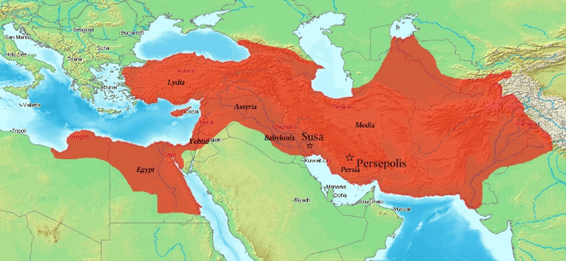
“This is what happened during the time of Xerxes,(Ahasuerus in Hebrew) the Xerxes who ruled over 127 provinces stretching from India to Cush(the Upper Nile Region): At that time King Xerxes reigned from his royal throne in the citadel of Susa, and in the third year of his reign he gave a banquet for all his nobles and officials. The military leaders of Persia and Media, the princes, and the nobles of the provinces were present.
For a full 180 days (6 months) he displayed the vast wealth of his kingdom and the splendor and glory of his majesty. When these days were over, the king gave a banquet, lasting seven days, in the enclosed garden of the king’s palace, for all the people from the least to the greatest who were in the citadel of Susa. The garden had hangings of white and blue linen, fastened with cords of white linen and purple material to silver rings on marble pillars. There were couches of gold and silver on a mosaic pavement of porphyry, marble, mother-of-pearl and other costly stones. Wine was served in goblets of gold, each one different from the other, and the royal wine was abundant, in keeping with the king’s liberality. By the king’s command each guest was allowed to drink with no restrictions, for the king instructed all the wine stewards to serve each man what he wished. (Some versions say “the drinking was not compulsory,” indicating that some rulers would force their guests to get drunk.) Queen Vashti also gave a banquet for the women in the royal palace of King Xerxes.
On the seventh day, when King Xerxes was in high spirits from wine, he commanded the seven eunuchs who served him—Mehuman, Biztha, Harbona, Bigtha, Abagtha, Zethar and Karkas—to bring before him Queen Vashti, wearing her royal crown, in order to display her beauty to the people and nobles, for she was lovely to look at. But when the attendants delivered the king’s command, Queen Vashti refused to come. (It’s possible that Xerxes wanted Vashti to be naked apart from her crown; he was drunk enough to do that!) Then the king became furious and burned with anger.
Since it was customary for the king to consult experts in matters of law and justice, he spoke with the wise men who understood the times and were closest to the king—Karshena, Shethar, Admatha, Tarshish, Meres, Marsena and Memukan, the seven nobles of Persia and Media who had special access to the king and were highest in the kingdom. “According to law, what must be done to Queen Vashti?” he asked. “She has not obeyed the command of King Xerxes that the eunuchs have taken to her.”
Then Memukan replied in the presence of the king and the nobles, “Queen Vashti has done wrong, not only against the king but also against all the nobles and the peoples of all the provinces of King Xerxes. For the queen’s conduct will become known to all the women, and so they will despise their husbands and say, ‘King Xerxes commanded Queen Vashti to be brought before him, but she would not come.’ This very day the Persian and Median women of the nobility who have heard about the queen’s conduct will respond to all the king’s nobles in the same way. There will be no end of disrespect and discord.
“Therefore, if it pleases the king, let him issue a royal decree and let it be written in the laws of Persia and Media, which cannot be repealed, that Vashti is never again to enter the presence of King Xerxes. Also let the king give her royal position to someone else who is better than she. Then when the king’s edict is proclaimed throughout all his vast realm, all the women will respect their husbands, from the least to the greatest.”
The king and his nobles were pleased with this advice, so the king did as Memukan proposed. He sent dispatches to all parts of the kingdom, to each province in its own script and to each people in their own language, proclaiming that every man should be ruler over his own household, using his native tongue.”
Talk about celebrating your achievements! King Xerxes has been celebrating himself and his empire for the last six months. There have been parades, military demonstrations, athletic games, horse races, and every other entertainment an immensely powerful ruler can imagine. Now Xerxes has given a final banquet lasting seven days for all the men in the kingdom. (What? You thought “people” referred to women? No way!) Xerxes himself has probably stayed drunk for much of that time, although he has allowed his guests to drink as much or as little as they wish. This fact is noted because in those days, some rulers would have forced their guests to become completely wasted. Gee, what a great guy! After drinking and feasting for seven days straight, Xerxes suddenly decides that Q ueen Vashti should appear in her royal crown – likely in her crown and nothing else – so that he can flaunt the fact that his queen is the most beautiful woman in the kingdom. Being sober and in her right mind, Vashti refuses. But this refusal infuriates Xerxes. Having spent the last six months celebrating himself and being thoroughly drunk, Xerxes is in no mood for refusals by anybody, especially a woman, no matter how beautiful she is.
Xerxes consults his seven advisers, who are probably just as drunk as he is. Thanks to some anonymous scribe, we even know the names of these men: “Karshena, Shethar, Admatha, Tarshish, Meres, Marsena and Memukan, the seven nobles of Persia and Media who had special access to the king and were highest in the kingdom.” These guys might be drunk, but they aren’t stupid, and they realize that their own positions depend on whether or not Xerxes accepts their advice. There are probably lots of other sages in the kingdom who would be more than happy to replace them. Given the reality of the situation and the unspoken threats from King Xerxes, the advisers have little choice but to suggest that Queen Vashti be retired to the royal harem, where she will spend the rest of her life in seclusion. Then Xerxes can find some new and even more gorgeous queen and women throughout the empire will be afraid to say anything against their husbands for fear of similar banishment. And to hide Xerxes’ embarrassment, the advisers send out a royal edict stating that “every man should be ruler over his own household” in all the various languages used throughout the various parts of the empire.
APPLICATION: The Book of Esther is quirky. Why preserve the account of a six-month long royal indulgence capped off by a seven-day long drunk and followed by a capricious royal edict? And yet….and yet God has allowed this small Book to be included for lots of reasons. Most of us have relatively little control over many of the circumstances of our lives. As the line from the song from Fiddler on the Roof says, “Life has a way of abusing us, blessing and bruising us!”
Through the years, God has used this small Book to encourage believers in all kinds of circumstances, including concentration camps, prisons, poverty, joblessness, etc. TODAY GOD WANTS YOU TO KNOW THAT HE IS ENGINEERING YOUR CIRCUMSTANCES, WEIRD AS THEY MIGHT SEEM! GOD WANTS YOU TO WATCH, BECAUSE HE IS GOING TO USE THE VERY THINGS THAT HURT AND CONFUSE YOU TO WORK OUT SOMETHING WONDERFUL!
Let’s pray.
PRAYER: Father God, thank You for loving us and for caring for us. Lord, many of us are bewildered by the chaos around us. Help us to realize that Your hand is never shortened and that You are never confused or bewildered and that You are a God of peace. Please send Your peace into the hearts of all who read these words. In the matchless Name of King Jesus. Amen.
We have mourned for two months, ever since losing our beloved kitty Mr. Cat. As conscientious and loving cat owners, we have mercilessly beat ourselves up-should we have gotten medical attention earlier? Did he die because we somehow neglected him, even though we thought we were doing everything correctly? It’s no exaggeration to say that the two of us have been reduced to tears on a daily basis.
Christmas morning, one of our friends came holding a small sack. When we asked him what was in the sack, he said, “A cat.” And there was a two-month-old male kitten, grey with dark stripes. We immediately named the cat Gabriel because he came bringing good news at Christmas.
Poor little Gabriel is still in shock. Just a day ago, he was running freely around our friend’s compound. Now we have confined him to a large cage, albeit with food, water, a litter box, and a box he can use as a den to hide in. For now, we are using the cage while we try for him to get used to us. Eventually, we hope he will have the run of the house, as well as the outdoors. We are offering him our fingers and hands to sniff, but we are not forcing ourselves on him.
Will we be able to tame Gabriel so that he will become a purring cuddly kitty? Who knows? Cats are always individuals, and you must respect their personalities. Forcing a cat only injures everyone. But when we picked Gabriel out of the sack, I picked him by the scruff of his neck and set him on my chest, where he promptly curled up without biting or scratching. I am hoping for good things in the future.
When it comes to loving God, we are all like feral cats. We want our freedom, and we aren’t interested in being tamed. We have no idea that God’s nature is love and that He only wants good things for us. Even when God provides everything for us, we are still like poor little Gabriel; we fear that this Great Being may harm us. But there is good news for all of us.
Romans 8:18-23 “For I consider that the sufferings of this present time are not worthy to be compared with the glory that is to be revealed to us. For the eagerly awaiting creation waits for the revealing of the sons and daughters of God. For the creation was subjected to futility, not willingly, but because of Him who subjected it, in hope that the creation itself also will be set free from its slavery to corruption into the freedom of the glory of the children of God. For we know that the whole creation groans and suffers the pains of childbirth together until now. And not only that, but also we ourselves, having the first fruits of the Spirit, even we ourselves groan within ourselves, waiting eagerly for our adoption as sons and daughters, the redemption of our body.”
There is one difference between Gabriel the kitty and us: As humans we have a sin problem. When sin entered the world, God was forced to subject the entire creation to futility because of the sins of mankind. Gabriel is part of the creation that waits for redemption. Gabriel does not need a Savior, but we humans do.
Jesus has promised that one day, he will return, not as a baby but as a conquering king. On that great day, all creation will be released from the consequences of human sin.
Isaiah 11:6-9 tells us, “The wolf also shall dwell with the lamb, The leopard shall lie down with the young goat, The calf and the young lion and the fatling together; And a little child shall lead them. 7 The cow and the bear shall graze; Their young ones shall lie down together; And the lion shall eat straw like the ox. 8 The nursing child shall play by the cobra’s hole, And the weaned child shall put his hand in the viper’s den. 9 They shall not hurt nor destroy in all My holy mountain, For the earth shall be full of the knowledge of the Lord As the waters cover the sea.”
In that day, none of us will act out of fear, for in that day, there will be no more feral cats. God’s love will unite us all in His Creation as He intended it from the beginning of time, for the knowledge of God and the peace of God will fill the earth as the waters cover the sea.
They’re burying one of our closest friends today, and we can’t be there. This is the part of missionary life that few people speak about, but it’s one of the toughest. Financial limitations? No problem! Both my husband and I grew up in families where money was a bit scarce. Devoting time to caring for others? Giving up luxury vacations to pay for blood, medicine, and food for patients? Sure, those are challenges, but anybody in any kind of ministry faces similar problems. There are many things we have sacrificed gladly for the sake of God’s calling on our lives. But once in a while, special events come along and remind us that our friends and loved ones are back in America and we are not. Funerals of close friends serve as one of those reminders.
Today as our friends gather at Getwell Church in Southaven, MS, we will be fortunate if we are able to watch the proceedings as they are streamed. But watching something doesn’t make up for being there and hugging people, sharing stories of the loved one, and yes-crying a bit with the family. While those attending the funeral will be treated to a gallery of photos and a video depicting Billy’s long life of 84 years and those whom he blessed during that time, all we will have is memories.
Jesus’ disciple Simon Peter was one of those guys who was forever asking the tough questions. I guess having spent years hauling fish out of the Sea of Galilee and battling those sudden storms left Peter with no patience for temporizing. When Peter had a question, he simply spat it out. And this particular day, Peter was worried.
Matthew tells the story in Matthew 19:16-29A rich young ruler approaches Jesus, asking what he has to do to gain eternal life. Jesus tells him to follow the Ten Commandments. When the man claims that he’s already doing that, Jesus advises him, “If you want to give it all you’ve got,” Jesus replied, “go sell your possessions; give everything to the poor. All your wealth will then be in heaven. Then come follow me.” The young man gulps hard and leaves dejected because he is very rich and very attached to his belongings. (But wait-there are some traditions that claim this young ruler was Mark, who later wrote one of the Gospels and who traveled with Paul and Barnabas.)
Peter and the other disciples have left their homes and their jobs to follow Jesus. Peter, his brother Andrew, and his friends James and John have walked away from thriving and businesses at Capernaum. All four have left their boats and their relatives to follow Jesus and are faithfully continuing to do so.
Matthew 19:27 Then Peter chimed in, “We left everything and followed you. What do we get out of it?”
28-30 Jesus replied, “Yes, you have followed me. In the re-creation of the world, when the Son of Man will rule gloriously, you who have followed me will also rule, starting with the twelve tribes of Israel. And not only you, but anyone who sacrifices home, family, fields—whatever—because of me will get it all back a hundred times over, not to mention the considerable bonus of eternal life. This is the Great Reversal: many of the first ending up last, and the last first.”
Now Peter is asking Jesus what he and the others will get out of the deal. Has this sacrifice all been for nothing? Not only have the disciples given up being with their families but they have also sacrificed sharing special celebrations-birthdays, feast days, weddings, and funerals. Led by the Holy Spirit, Jesus has crisscrossed the land, leaving the disciples wondering where they will go next. Jesus assures Peter that his followers will receive houses and lands and families, both in this life and in the next. But in the meantime, the disciples find themselves isolated from their families by the call on their lives.
We met Billy Proctor shortly after arriving in Memphis, TN, in late June 1983. I was the new pediatric surgery resident at LeBonheur Children’s Hospital. Billy and his wife Carla were members at Faith United Methodist Church, a charismatic congregation just over the line in Southaven, MS. Eventually, we joined Faith and became fast friends with Billy and Carla. If you look at photos of Billy during that time, you see a middle-aged guy with a grin that just won’t quit, a grin that draws you in to whatever he has going on. Billy had that grin for his entire life, and I’m sure that the day Billy graduated into heaven, when Jesus reached out his hand to Billy to pull him out of a failing body, Billy grinned more widely than he ever had before.
It’s impossible for me to enumerate all the different ways Billy and Carla have helped us over the years. The Proctors have sheltered us, advised us, encouraged us, and handled our stateside mail for us. Billy has handled our finances, helping invest our Social Security and whatever other monies have come in that have not been used for ministry expenses. Billy has also shared travel tips with us, tips on local restaurants, and some of his other passions.
We have watched the Proctors’ children reach adulthood, marry, and become parents and develop careers of their own. We have rejoiced over births and grieved over untimely deaths. We have cheered for all kinds of successes and admired photos. Our lives and those of the Proctor family have become interwoven.
I am completing this about an hour before the funeral will begin. We can only pray that our internet connection will remain stable, allowing us to watch, even if it’s at a distance of several thousand miles.
The next time you ask a missionary based overseas for their challenges, remember there are many things about which we might be hesitant to share. We don’t want to come off as whiners. But we can only rejoice that some day we will all be in heaven together. As the old Gospel song says, “When we all get to heaven, what a day of rejoicing that will be! When we all see Jesus, we’ll sing and shout the victory!”
“Now it happened in Iconium that they went together to the synagogue of the Jews, and so spoke that a great multitude both of the Jews and of the Greeks believed. But the unbelieving Jews stirred up the Gentiles and poisoned their minds against the brethren. Therefore, they stayed there a long time, speaking boldly in the Lord, who was bearing witness to the word of His grace, granting signs and wonders to be done by their hands.
But the multitude of the city was divided: part sided with the Jews, and part with the apostles. And when a violent attempt was made by both the Gentiles and Jews, with their rulers, to abuse and stone them, they became aware of it and fled to Lystra and Derbe, cities of Lycaonia, and to the surrounding region. And they were preaching the gospel there.
When you are acting for the Kingdom of God, there will always be opposition. And the more effective your ministry, the stronger the opposition. Here, Paul and Barnabas have been preaching and teaching and many people, both Jews and Greeks, have been streaming into the Kingdom of God. But traditional leaders whose commitment to their own power is greater than their commitment to God’s truth are doing everything they can to fight these men. Finally, Paul and Barnabas find themselves on the road again, fleeing to Lystra and Derbe and the surrounding region, preaching the gospel as they go.
While Paul and Barnabas are probably thinking only of escaping opposition, God has far bigger plans. For as these preachers are fleeing from one place to another, they are teaching people about Jesus wherever they go, lighting fires of hope in people’s hearts. Psalm 37;23 tells us that “The steps of a good man are ordered by the Lord, and He delights in his way.” While Paul and Barnabas might feel they are wandering aimlessly across the countryside, meanwhile, God is moving them into strategically important connections with spiritually hungry people ready to hear the gospel and accept it.
Acts 14:8-18 Idolatry at Lystra
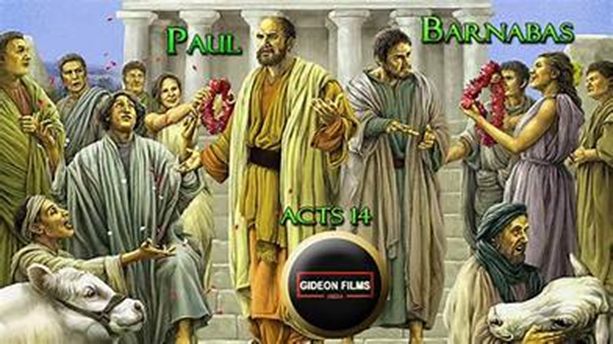
And in Lystra a certain man without strength in his feet was sitting, a cripple from his mother’s womb, who had never walked. This man heard Paul speaking. Paul, observing him intently and seeing that he had faith to be healed, said with a loud voice, “Stand up straight on your feet!” And he leaped and walked. Now when the people saw what Paul had done, they raised their voices, saying in the Lycaonian language, “The gods have come down to us in the likeness of men!” And Barnabas they called Zeus, and Paul, Hermes, because he was the chief speaker. Then the priest of Zeus, whose temple was in front of their city, brought oxen and garlands to the gates, intending to sacrifice with the multitudes.
But when the apostles Barnabas and Paul heard this, they tore their clothes and ran in among the multitude, crying out and saying, “Men, why are you doing these things? We also are men with the same nature as you, and preach to you that you should turn from these useless things to the living God, who made the heaven, the earth, the sea, and all things that are in them, who in bygone generations allowed all nations to walk in their own ways. Nevertheless, He did not leave Himself without witness, in that He did good, gave us rain from heaven and fruitful seasons, filling our hearts with food and gladness.” And with these sayings they could scarcely restrain the multitudes from sacrificing to them.”
The people of Lystra have been worshiping fake Grecian gods, even though the myths describe these beings as far from having any purity or holiness. When Paul and Barnabas speak to a man crippled from birth, he leaps up healed and whole. Local people are so thrilled that they can only conclude that their gods have descended and are favoring them. But now Paul and Barnabas have a new set of problems: the temptation to allow themselves to be worshiped as gods. Quite sensibly, Paul and Barnabas refuse, doing everything they can to convince these people that the God of heaven and earth has done this miracle and that they are only His agents.
The temptation to take glory reserved only for God continues to this day. Here in Ghana, it is quite common for those conducting crusades to spread posters portraying the evangelist and the dates of the crusade as widely as possible, advertising healing and deliverance. But without God, these people are nothing, powerless beings who can only mouth platitudes. The question is this: who is doing the healing and who should receive the glory? While God may work through men and women, He alone deserves the praise and the glory. People do get healed in these crusades; however, the healing comes through their faith in God and not because the evangelist has the power to heal. All power must come from the One True Living God. Paul and Barnabas know that God has healed this man in Lystra and they are doing everything they can to avoid being confused with traditional Greek gods. (Study Greek mythology, and you rapidly realize that the Greek gods are far from holy or pure!)
As God’s ambassadors, we must not take credit when all the glory belongs to God. There is a fictitious story about the donkey that carried Jesus on Palm Sunday feeling proud that all the adulation was for him; meanwhile, the donkey was only a means to an end. Like that donkey, we must allow God to use us but remember that He is the only One worthy of praise.
PRAYER: Father God, thank You for loving us and for caring for us. Lord, help us to continually point people to You, for You are the Source of light and life while we are only messengers. In the mighty and precious Name of King Jesus. Amen.
“And there were dwelling in Jerusalem Jews, devout men, from every nation under heaven. And when this sound occurred, the multitude came together, and were confused, because everyone heard them speak in his own language. Then they were all amazed and marveled, saying to one another, “Look, are not all these who speak Galileans? And how is it that we hear, each in our own language in which we were born? Parthians and Medes and Elamites, those dwelling in Mesopotamia, Judea and Cappadocia, Pontus and Asia, Phrygia and Pamphylia, Egypt and the parts of Libya adjoining Cyrene, visitors from Rome, both Jews and proselytes, Cretans and Arabs—we hear them speaking in our own tongues the wonderful works of God.” So they were all amazed and perplexed, saying to one another, “Whatever could this mean?”
Others mocking said, “They are full of new wine.”
All this time, the followers of Jesus have been praying together but otherwise trying to maintain a low profile. The last thing these folks want is to be arrested by either the religious authorities or the Romans. But God has other ideas. There are devout men from every nation under heaven living in Jerusalem, and now these men are rushing into the street as they hear those recently baptized with the Holy Spirit glorifying God in their heart languages. Nobody has ever heard anything like this.
But while these men are ecstatic over these manifestations, there are always nay-sayers ready to criticize. These guys are sure that these people must be drunk! Somebody needs to do something, and Peter steps up and preaches.
We’ll continue the story tomorrow, but look at Peter for a minute. Until now, Peter has always been a man of action, not a preacher or a teacher. There are other disciples with better educations and vocabularies, and Peter has a strong Galilean accent that marks him wherever he goes. Peter is not most people’s first choice for public speaking. And that is what is going to make Peter’s next move so remarkable, for Peter will be the one to preach.
One of the amazing things about the Holy Spirit is that the Holy Spirit empowers those willing to welcome Him. God does not play favorites, and He is interested in our availability, not in our ability. Remember that lesson as we continue to study the events of that thrilling day of Pentecost.
PRAYER: Father God, thank You for loving us and for caring for us. Lord, help us to be willing to be available and to trust that You will give us the strength and the courage to do Your perfect Will. In the mighty and precious Name of King Jesus. Amen.
“When the Day of Pentecost had fully come, they were all with one accord in one place. And suddenly there came a sound from heaven, as of a rushing mighty wind, and it filled the whole house where they were sitting. Then there appeared to them divided tongues, as of fire, and one sat upon each of them. And they were all filled with the Holy Spirit and began to speak with other tongues, as the Spirit gave them utterance.”
Who is the “they” being referred to here? In Acts 1 we learn that there are 120 people gathered together and praying. When Jesus was teaching his disciples on that final night, he promised that his Heavenly Father would send the Holy Spirit. But the disciples really weren’t sure what Jesus was talking about. Now they were remembering some of the things Jesus had told them.
John 14:15-21 Jesus Promises the Holy Spirit (John 16:5–16)
“If you love Me, you will keep My commandments. And I will ask the Father, and He will give you another Advocate f to be with you forever— the Spirit of truth. The world cannot receive Him, because it neither sees Him nor knows Him. But you do know Him, for He abides with you and will be in you.
I will not leave you as orphans; I will come to you. In a little while the world will see Me no more, but you will see Me. Because I live, you also will live. On that day you will know that I am in My Father, and you are in Me, and I am in you. Whoever has My commandments and keeps them is the one who loves Me. The one who loves Me will be loved by My Father, and I will love him and reveal Myself to him.”
John 15:26 “When the Advocate comes, whom I will send to you from the Father—the Spirit of truth who proceeds from the Father—He will testify about Me.”
“When the Day of Pentecost had fully come…” One of the wonderful and frustrating things about God is His timing. From the creation of the world, God has already planned the place when the Holy Spirit will descend and the timing of that descent down to the last second.
“And suddenly there came a sound from heaven, as of a rushing mighty wind, and it filled the whole house where they were sitting.” Although this account contains the first description of the coming of the Holy Spirit, there have been countless other incidences. In one of the Transformations series of videos produced by the Sentinel Organization, there is an actual video of the Holy Spirit descending on members of a church in a remote Alaskan village during a baptism. Those operating the sound system originally think their equipment is malfunctioning; however, the roaring of the Holy Spirit wind actually increases after they turned off all the sound equipment. Some of the church members are flat on their faces while others are leaping in praise of God.
“Then there appeared to them divided tongues, as of fire, and one sat upon each of them. And they were all filled with the Holy Spirit and began to speak with other tongues, as the Spirit gave them utterance.” John the Baptist promises those whom he is baptizing. “I baptize you with water for repentance, but after me will come One more powerful than I, whose sandals I am not worthy to carry. He will baptize you with the Holy Spirit and with fire.” (Matthew 3:11) Today is the day for that baptism of fire. But the baptism of the Holy Spirit also empowers those who receive it with the ability to speak in “new tongues.”
Why has God chosen these people, this time, and this place? Pentecost marks one of the major feasts, one for which people from all over the known world flock to Jerusalem.
Pentecost was the celebration of the beginning of the early weeks of harvest. In Palestine, there were two harvests each year. The early harvest came during the months of May and June; the final harvest came in the Fall. Pentecost was the celebration of the beginning of the early wheat harvest, which meant that Pentecost always fell sometime during the middle of the month of May or sometimes in early June.
There were several festivals, celebrations, or observances that took place before Pentecost. There was Passover, there was Unleavened Bread, and there was the Feast of Firstfruits. The Feast of Firstfruits was the celebration of the beginning of the barley harvest. Here’s the way you figured out the date of Pentecost.
According to the Old Testament, you would go to the day of the celebration of Firstfruits, and beginning with that day, you would count off 50 days. The fiftieth day would be the Day of Pentecost. So Firstfruits is the beginning of the barley harvest and Pentecost is the celebration of the beginning of the wheat harvest.”
God is a master showman and He sends the Holy Spirit when the maximum number of people are going to witness the results. Tomorrow we’ll examine what happens next, but consider something. How many times have you begged God to do something in your life, only to have to wait on His timing? And when you have waited, haven’t you been thankful that you were patient? As we study the Pentecost story, pay attention to the small details, for they will bless you.
PRAYER: Father God, thank You for loving us and for caring for us. Lord, help us to wait on Your timing, knowing that You arrange things perfectly. Help us to trust where we cannot see. In the mighty and precious Name of King Jesus. Amen.
“Dear Lord and Father of mankind, forgive our foolish ways; re-clothe us in our rightful mind, in purer lives thy service find, in deeper reverence praise.”
It’s June 1955, and I am sitting with my family in our usual spot, 6 rows from the front on the north side of Immanuel Lutheran Church in Altona, Illinois. It has been a tough spring for me. After years of fighting horrible bouts of tonsillitis compounded by ear infections and vertigo, I finally weathered a tonsillectomy two months ago. Now my throat has finally healed enough for me to swallow rough food without wincing, and I feel healthy for the first time in years.
Outside, birds are singing in the maple trees that surround our lovely church. Inside, I gaze on the triptych above the altar, one figure of Jesus the good shepherd on the left, Jesus praying in the Garden of Gethsemane on the right, and Jesus ascending into heaven in the biggest picture of all in the middle. I have no idea how many times I will gaze on those pictures through the years or how much they will come to mean to me. Even now in the stillness of the night, I meditate on those pictures and marvel at the goodness of my Lord. As I sit with my parents, I can hear my mother’s clear soprano reinforced by my dad’s tenor as we enter the second verse.
“In simple trust like theirs who heard, beside the Syrian sea, the gracious calling of the Lord, let us, like them, without a word rise up and follow thee.”
As I listen to these words, I have no inkling that God will call me into the mission field at age eleven, that I will commit my life to Christ at the age of fifteen, that I will train as a general and pediatric surgeon, or that I will come to northern Ghana, where I will spend the rest of my life. Have I ever regretted saying “Yes” to Jesus? NO! NO! A MILLION TIMES NO! Even if I knew all the suffering I would endure, I would never refuse. Jesus has blessed me beyond measure, and nothing is too much to give up for my Lord.
“O Sabbath rest by Galilee! O calm of hills above, where Jesus knelt to share with thee the silence of eternity, interpreted by love!”
My brothers and I feel loved and protected. Today, we will finish church and Sunday School and return home to a scrumptious home-made dinner. We have our own animals butchered and grow most of our own vegetables. My grandparents may join us, in which case, Grandma will bring her delicious butterhorn rolls, fit for the angels. The early strawberries are ready, and we are having strawberry pie for dessert. In the afternoon, my parents will visit and rest while we kids play ball in our large yard. We do not do farm work on Sundays, apart from caring for our animals.
“Drop thy still dews of quietness, till all our strivings cease; take from our souls the strain and stress, and let our ordered lives confess the beauty of thy peace.”
Our lives are ordered and quiet. Most of our trading is done in small towns no more than seven miles away; otherwise, we only go to town for church and school. We still have the same ancient phone system that was brought in fifty years ago, with the switchboard in Oscar Johnson’s house in Altona. I attend school in the same building from which my dad graduated from high school. Everybody in town knows everybody else, and while this might seem intrusive, we care about one another. A general line ring of four long rings will bring out help for any emergency. Social media is unknown and even movies are an infrequent treat. We spend much of our free time playing games or reading, and we keep a local library busy with our patronage.
“Breathe through the heats of our desire thy coolness and thy balm; let sense be dumb, let flesh retire; speak through the earthquake, wind, and fire, O still small voice of calm.’”
As we are singing this last verse, my family has no idea that in three short weeks our world will be turned upside down. My father will be severely injured in a near-fatal head-on collision at the Walnut Creek bridge just west of town. Dad’s injuries will be so severe that he will actually have a near-death experience in which he will see his grandparents and great-grandparents in heaven before being called back into his body by my mother’s fervent prayers. Dad will be bed-bound for several weeks and then remain on crutches for several months thereafter. We will get our first TV so Dad has something with which to entertain himself while he’s stuck in bed. The disruption of our lives will eventually convince my parents that my mother should return to school and complete her Bachelor’s degree so that she can teach and help stabilize the family income. We will also abandon our milking operation, retaining only one or two cows to provide milk for my grandparents and us.
I am remembering that Sunday as I return from rounds on the Children’s Ward and the NICU at the Hospital in Saboba. It’s far hotter here than it ever gets in Illinois, even in the depths of August. Rounds have kept me too long for me to make one of the local church services, so I sit here remembering and contemplating those magnificent words penned by the Quaker writer, John Greenleaf Whittier, so long ago. And once more I hear voices of all those church members in Altona, those in the choir and those beloved Sunday School teachers who humbly gave their Sundays to teach wiggly little kids and blaze teen-agers.
Nothing done in love for a child is ever wasted. I’m sure many of my Sunday School teachers went home from church wondering if they had made any impact on the kids they were teaching. The same thing might be said for those teaching vacation Bible school. While I can’t speak for anyone else, I will gladly stand before God and testify that I am eternally grateful for the sacrifices made by these teachers. Whether or not they realized it, they did find purer lives in the services they rendered. Whether or not these people realized it, they were agents of peace and servants of God. And I stand to bless every one of them. Now in my 77th year, I continue to pray the prayers embodied in these verses, and I say with Mr. Whittier, “Breathe through the heats of our desire thy coolness and thy balm; let sense be dumb, let flesh retire; speak through the earthquake, wind, and fire, O still small voice of calm.’”
Isaiah 40:9-11 O Zion, You who bring good tidings, get up into the high mountain; O Jerusalem, You who bring good tidings, Lift up your voice with strength, Lift it up, be not afraid; Say to the cities of Judah, “Behold your God!”
Behold, the Lord God shall come with a strong hand, And His arm shall rule for Him; Behold, His reward is with Him, And His work before Him.
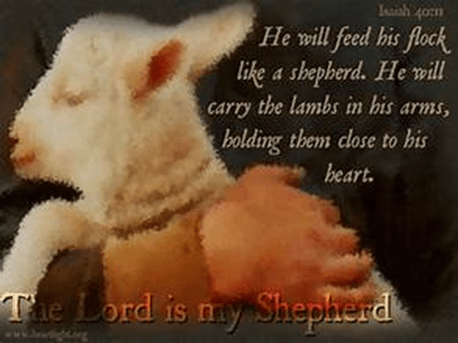
He will feed His flock like a shepherd; He will gather the lambs with His arm, And carry them in His bosom, And gently lead those who are with young.”
John 10:7-18Jesus the Good Shepherd
“Then Jesus said to them again, “Most assuredly, I say to you, I am the door of the sheep. All who ever came before Me are thieves and robbers, but the sheep did not hear them. I am the door. If anyone enters by Me, he will be saved, and will go in and out and find pasture. The thief does not come except to steal, and to kill, and to destroy. I have come that they may have life, and that they may have it more abundantly.
“I am the good shepherd. The good shepherd gives His life for the sheep. But a hireling, he who is not the shepherd, one who does not own the sheep, sees the wolf coming and leaves the sheep and flees; and the wolf catches the sheep and scatters them. The hireling flees because he is a hireling and does not care about the sheep. I am the good shepherd; and I know My sheep, and am known by My own. As the Father knows Me, even so I know the Father; and I lay down My life for the sheep. And other sheep I have which are not of this fold; them also I must bring, and they will hear My voice; and there will be one flock and one shepherd.
“Therefore My Father loves Me, because I lay down My life that I may take it again. No one takes it from Me, but I lay it down of Myself. I have power to lay it down, and I have power to take it again. This command I have received from My Father.”
When we read Jesus’ description of himself as the good shepherd, we might not realize how much that entails. Shepherds were responsible for every aspect of the care of their flocks. Shepherds had to lead the flocks to good safe pasture and to still clean water. If there were lambs who were hurt, the shepherd would carry them in his cloak next to his heart. When wild animals attacked, the shepherds had to kill them or drive them off, risking their own lives. Hireling shepherds would simply run away, leaving the sheep to their fate. David was willing to face Goliath with his slingshot because he had already killed many wild animals attacking his father’s sheep. (Slingshots were the ancient equivalent of long-range rifles, and most armies had soldiers who were deadly with slingshots in either hand.) Many ancient sheepfolds had high stone walls with a single door opening, and a doorkeeper who would only admit legitimate shepherds with their flocks.
At night, several flocks might be kept in a single sheepfold. At daybreak, the shepherd would call his sheep and they would follow him because they knew his voice. The sheep trusted the shepherd because he had already been kind to them.
When Jesus describes himself as the Good Shepherd, he is fulfilling the prophesy of Isaiah. What does this mean for us? Face it, folks, many of us are battered and bruised, while some of us are facing health challenges, financial challenges, and worries of all kinds. We need a shepherd, someone who will care for us, help us, make sure that we have what we need and that we are protected.
As we are preparing for Christmas, let’s remember that we are not simply preparing for a baby in a manger, but for Heaven’s King, the Messiah, the One who has conquered sin, death, and hell. We can trust Jesus to be our Shepherd because He has proven Himself worthy of all honor and praise and glory.
PRAYER: Father God, thank You for loving us and for caring for us. Lord, we desperately need you to be our Good Shepherd and to deliver us from ourselves. Please enter our trembling hearts and make Your home there. It’s in Your mighty and precious Name that we pray, King Jesus. Amen.







 Burunche's Blog