Posts Tagged ‘christmas’

A VERY DIFFERENT CHRISTMAS EVE-December 24, 1981

December 26, 2024

It was raining that December 24, 1981. Bob, my boyfriend-now my husband-was working as a fire fighter at Mount Pleasant, SC, while I was a Pediatric Surgery Fellow at Medical University of South Carolina. Bob was living in one of the fire stations while I had a small two-room apartment, really a converted garage, with one room downstairs and one room upstairs, plus a very small toilet/shower. (I might have had 800 square feet in the entire place, and I also had a large population of “palmetto bugs,” giant cockroaches large enough they should have had rabies tags.) Neither of us had very much money, but we were looking forward to spending Christmas together, at least as much as our work schedules would allow.

It was rainy and cool that day when Bob came to get me. One of Bob’s fellow fire fighters had a family crisis. Call this guy J.M. A day or so before, J.M.’s wife had taken off with a girlfriend, leaving his three children alone in their apartment. The oldest boy was bored and began entertaining himself by lighting matches; unfortunately, this had happened before and the landlord was evicting the family. J.M. had relatives in Charleston, but they refused to help him, fearing the kids would misbehave for them also.

I called around, but the only orphanage I located was for African American children, and they had no room anyway. Bob and I made a quick run to a box store, buying simple kid stuff and Christmas candy, and then we went to the apartment to collect the kids. Bob was working that night; however, J.M. was free. I got permission from my boss to send the kids to the Christmas Eve service at St. John’s Lutheran Church, and then we took them back to the apartment. I spent the rest of the night on call via beeper. The kids slept upstairs in my bedroom with me while J.M. slept on my couch downstairs.

The following morning, J.M. had to work; however, the kids enjoyed their Christmas stockings, and then I took them to a friend’s Christmas party, where they enjoyed lots of Christmas goodies. By that evening, J.M.’s relatives began feeling embarrassed and the kids were able to go stay with them. By December 27th, J.M.’s parents came up from Georgia to collect the kids and take them home to their house where they could receive loving care.

Bob and I have just spent our 43rd Christmas together. As it turns out, that Christmas Eve has set the tone for many of our shared Christmases since then. And there’s a moral to this story: God is not interested in how elaborately you have decorated or how extensive your selection of Christmas goodies. The only question God poses is this: Are you willing to share whatever you have, even if you have very little?

Those kids weren’t concerned about the lack of Christmas decorations-although I think I might have had a very small Christmas tree. What those kids needed was a safe place where people would love them, care for them, and try and make it a little special. Christmastime is not just for kids; it’s for everybody. But kids need to feel secure and comforted. The trinkets we bought at K-Mart were nothing fancy, but the kids were thrilled because they could keep them and take them with when they went to their grandparents’ place. And Bob and I were blessed. For on that Christmas Eve, we had the same opportunity as the inn keeper in Bethlehem, and God allowed us to make room, even if my apartment was only a few steps up from a stable. And we learned that no matter how little we had, there was always something we could share.

REMEMBERING CHRISTMAS 2010

December 25, 2024

The story begins in the 1950’s. It’s a summer evening, and a little girl rides in the pickup out to the hog pasture with her dad. As the girl’s father checks the feed and water, the little girl runs around the hog pasture, looking for any pigs that appear sick. Then that same girl runs back from the hog pasture for the sheer exhilaration of running.

Now it’s a winter evening, and the little girl is up in the haymow, throwing down hay and straw for the beef cattle and the milk cows. Later, the girl might help milk one of the cows by hand, straining the milk into a ten gallon can and then carrying that same can down the hill to the farm shop to await the coming of the milkman in the morning.

Now the girl is a few years older. It’s a bitterly cold winter morning, but the beef cattle need silage, so the girl and her brothers are chipping frozen silage out of a pit silo to feed the animals. No matter the time of year, those creatures depending on human help must be cared for regularly. No matter the time of year, the lesson remains the same: care for those depending on you, giving your best efforts, no matter the circumstances. And those lessons never fade…..

It was very snowy that Christmas of 2010. Although we had been back to America the previous year, I felt a sense of urgency to be home for the Christmas of 2010. That fall we had learned that my dad’s heart was beginning to fail, likely from scar tissue from an old injury he suffered during a car accident in 1955. So we came back to the U.S., spending Thanksgiving with family in Long Island and then moving to Illinois, where we stayed with friends. But when we attended the Christmas Eve service at Immanuel Lutheran Church, Dad suggested that we stay with my stepmother and him. It was snowing heavily and Dad and I wanted to attend the early morning Julotta service at the Colony Church in Bishop Hill once more.

At the Lutheran Church, Dad sang “Hosianna!”, a traditional Swedish Christmas hymn, while I also sang a solo. While I can’t remember what I sang, I will always remember Dad standing up before the congregation, his bright tenor voice now fading with age, (he turned 88 that Christmas Day), and singing to honor his Lord and Savior and all those relatives who had gone before him and who had worshiped at that church.

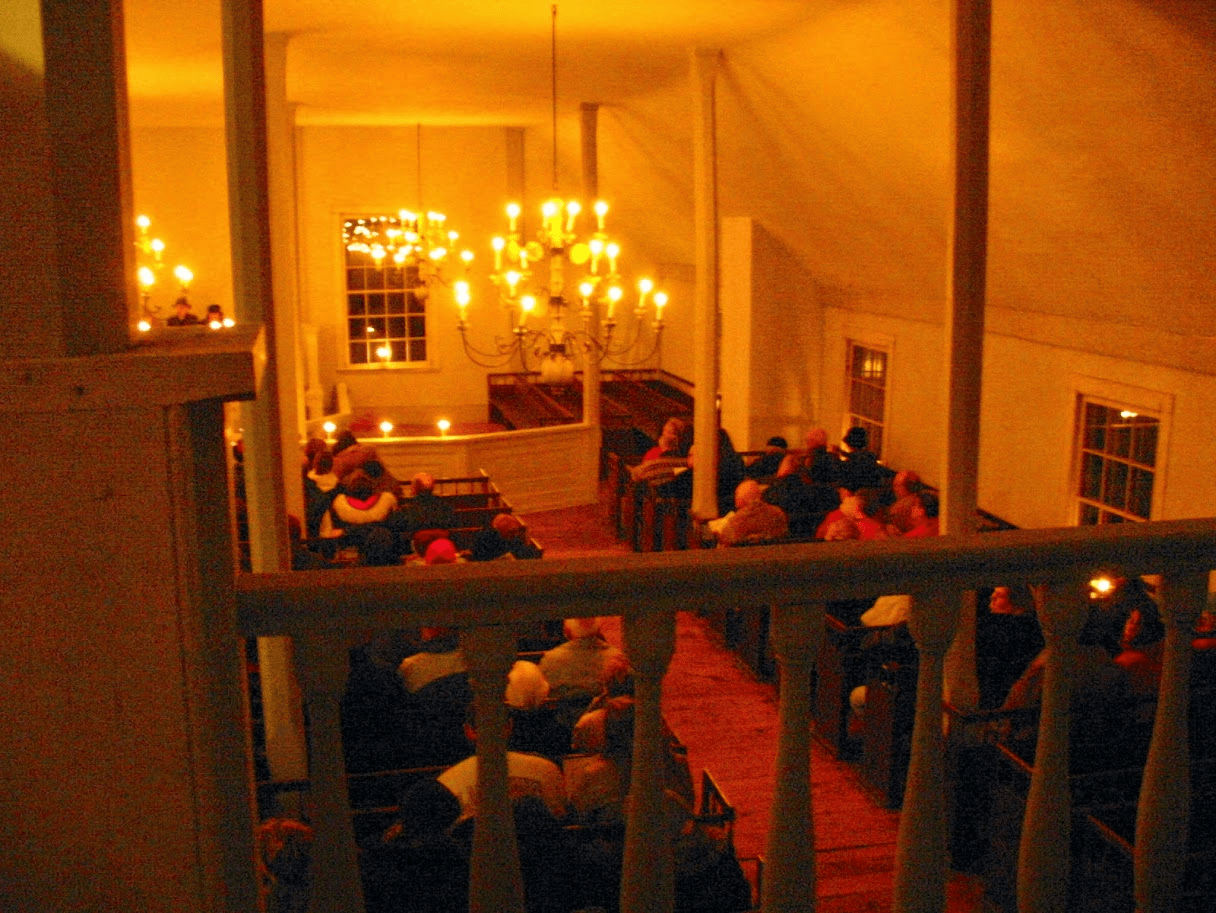
That Christmas Eve, my husband and I snuggled together as we slept in the room that had been my Grandpa Edmond’s when he was still with us. We accompanied Dad to Bishop Hill for Julotta service, the candles burning brightly at the Colony Church. I think Dad read the Christmas story in Swedish that year, as he had for so many times previously. And once more, we sang the glorious hymn “Naer Juldags Morgen Glimmar,” (When Christmas Morn is Dawning.) When the organist played “Hosianna” on the foot pedal organ, Dad and I both sang.

That Christmas was Dad’s last Christmas on earth. Dad died December 16, 2011. I didn’t return to the U.S. for the funeral because it was Christmas and I was the only doctor for the AG Hospital, Saboba. During Christmas, most of the district hospitals in our area that are manned by one doctor find themselves without a doctor as the doctors return to their home villages. I honored my commitment to my patients to honor the man who taught me that I should always care for those depending on me.

Now it is Christmas 2024, 14 years later. The house where we slept that night has been sold out of the family. Both Dad and my stepmother have been with Jesus for years, celebrating Christmas in heaven. The Colony Church is in dire need of renovation, and I pray for someone to help. We’re spending this Christmas in Saboba, as we have so many other Christmases. In a few hours, I will go to the hospital to check on the pediatric patients, who are my special joy and delight. This Christmas, we have three children, siblings from a single family who got burned when one of them played with matches too close to a pile of cotton. Their parents had gone to the farm, thinking all would be well. I sent T-shirts to the kids yesterday to help keep them warm. I will continue to pray for complete healing for the kids and for their parents, for this farming year, we suffered from droughts followed by floods and many farmers couldn’t harvest anything. We are already helping the parents buy food and medicines.

What would I say to Dad this Christmas if I could? “Dad, I’m still keeping the faith. I am still caring for those creatures God has sent me, and I will continue to do so as long as God gives me strength. Happy heavenly birthday, Dad! I love you! And Merry Christmas!”

https://www.youtube.com/watch?v=RaSw0ei26wg&t=83s (When Christmas Morn is Dawning)

https://www.youtube.com/watch?v=K3YsgUGZmr0 (Hosianna)

BEFORE THE BOX STORES RUINED CHRISTMAS

December 14, 2024

Back before the box stores came, small towns were full of small mom-and-pop businesses, the kind of places where you walked in and they already knew what you were likely to need. Those manning these stores were your friends, your neighbors, your fellow church members. You probably were in 4-H or Scouts or some other organization with their kids. Perhaps you rode the same school buses together or perhaps you sang together in the high school chorus or played in band together. Your parents were friends with the proprietors of these stores, having grown up together and graduated from high school together.

Christmastime in these small-town shops was something special. The local grocery stores-all members of the IGA-Independent Grocers Association-would display baking ingredients, nuts, candied fruit, and baking pans and utensils for making what we called “Spritz” cookies. (These are sometimes referred to as Danish butter cookies.) There would be hams studded with cloves at the meat counter. One local grocer in my home town made wonderful Swedish potatiskorv, potato baloney, an important part of our Christmas celebration. That same grocer also carried dried fruit, stick cinnamon, and pearl tapioca for making Swedish fruktsoppa-fruit soup, as well as rennet tablets for setting the curd for ost kaka (Swedish cheesecake.) We milked cows, so Mom always mixed the rennet tablets with milk to make the curd and then drain the liquid off the curd by tying the curd up in cheesecloth and hanging it over the kitchen sink. Of course, we also bought flour, yeast, sugar, cardamom, and all the other ingredients for our special Christmas treats.

Next were the five-and-dime stores, where things really did cost 5 and 10 cents. The brightly lit windows of these stores were wondrous. Those were the places where children could shop for small gifts for parents and parents would shop for stocking stuffers for children. For bigger presents, there were the dry goods stores selling clothing for men, women, and children. While many mothers ordered things from Sears and Roebuck or Montgomery Ward, some families bought Christmas clothing locally. In those days when men still wore hats, one men’s clothing store would sell you a small model hat in a small round hatbox. The recipient would then come to the store after Christmas to select his hat. While most of us simply wore our best shoes to church at Christmas, there were those wealthy enough to buy new shoes at the local shoe store, a place of wonder, heavily scented with the intoxicating smell of leather. We were also entranced by the modern convenience of x-raying our feet to see what shoe size we required. Only decades later would we realize that radiation exposure might lead to thyroid cancer.  

Every place of business had some kind of colored lights, even if it was only a single string. The days of elaborate Christmas displays with accompanying music were yet to arrive, but for those of us coming in from the country, the lights were enchanting. The local park would also have lights, and the town fathers would make sure there was some kind of Christmas banner or display hanging from every lamp post in town.

“Hmph!” you exclaim, “so far you haven’t described anything very impressive.” No. I haven’t, and for a good reason. We were much more easily impressed in those days. Television was in its infancy and many families still were without a TV. Our expectations were far more modest, so we were far more easily bedazzled. Our Christmas trees were lovely and divinely scented, whether we cut them ourselves or bought them from the local Jaycees or Scouts or whoever was selling trees that year. And many of those trees might sport hand-made ornaments that we had created at school and lovingly brought home on the bus. Our stashes of presents were smaller, and if we got oranges in our stockings and some chocolates, we were content. But what was important at Christmastime was the love and fellowship we felt wherever we went in town. Years ago, I wrote a Christas song that still applies.

Jesus, I’ve Searched For You Everywhere

Jesus, I’ve searched for You everywhere, and still not a trace do I see.

I’ve been through all the shops buying presents, all the things that I see on T.V.

But Christmas is only a few days away; I’m not ready for it to come now.

There must be a way I can find you, but Jesus, I don’t know how.

Chorus: It isn’t the presents, it isn’t the tree. It isn’t the things that you see on T.V.  

If you want to find out where Christmas must start, It’s not far-it begins in your heart.

I went to some great Christmas programs, thinking maybe that I’d find You there.
But all the songs were about winter,
and there wasn’t so much as a single prayer.

So I listened to carols on radio. It helped; it at least was a start.

But Jesus, I have a big problem: I’ve a God-sized hole in my heart.

Chorus: It isn’t the presents, it isn’t the tree. It isn’t the things that you see on T.V.  

If you want to find out where Christmas must start, It’s not far-it begins in your heart.

I mingled with Christmas shoppers, thinking maybe I’d find You with them.

All the people were angry and frightened – was it like this at Bethlehem?

They seemed to be fearful their families wouldn’t love them if there weren’t enough

Presents on Christmas morning, so they bought lots of meaningless stuff.

Chorus: It isn’t the presents, it isn’t the tree. It isn’t the things that you see on T.V.  

If you want to find out where Christmas must start, It’s not far-it begins in your heart.

Jesus, why did you come to us? Were You born just so that You could die?

You say all of our efforts aren’t good enough to make heaven no matter how hard we try?

Jesus, is this then the reason, that you came to free us from sin?

From our hardness of heart and our bitterness, so that we might enter in?

Chorus: It isn’t the presents, it isn’t the tree. It isn’t the things that you see on T.V.  

If you want to find out where Christmas must start, It’s not far-it begins in your heart. (Repeat chorus)

If you want to find out where Christmas must start, It’s not far-it begins in your heart.

(This Song Copywrited by Jean Young)

CHRISTMAS WITH GREAT-GRANDMA CHRISTMAS EVE 1954

December 23, 2023

(This memory has been requested by some of my cousins. I hope I can do it justice.)

The house is on the very edge of a small Midwestern village. You can tell this once was a working farm; there’s a small horse barn, a corn crib, and a chicken house, and possibly a small hog house as well. There’s a glider swing in the side yard, and all of these structures are all hidden under a blanket of snow. Someone has shoveled the drive way and the sidewalk leading up to the front porch and around to the south side of the house. The house lights are all on, and you can see a brightly lit Christmas tree in the front window of the dining room. The bubble lights transform the snow into fairy patterns.

It’s six o’clock, and relatives are beginning to arrive. Except for one or two families living in town, the rest of us all live on farms; to get here on time, we had to begin evening chores earlier than normal. For those of us on farms, this night represents a rare opportunity to get together. We spend most of our time isolated in the country, coming to town only to attend church, to go to school, to do grocery shopping, or to get feed for cattle and hogs ground at the local elevator. In such surroundings, even the visits of traveling salesmen selling spices and Fuller Brush supplies becomes an event to be celebrated with coffee and cookies.

America is still recovering from World War II, and the thrifty habits gained during rationing have not yet disappeared. To communicate information about tonight’s gathering, the ladies have had to call one another on party lines shared by several other families. The switchboard is still at Oscar Johnson’s house, and Oscar and his wife man it. We all know when we are receiving calls because the phone will ring differently for each subscriber on the line. Our ring is three longs. Four longs is a general line ring and is used for spreading information as quickly as possible in emergencies. This lack of privacy means that everybody in town knows we are gathering at Great Grandma’s place tonight. Grandma is hosting the get together because she is centrally located and because she has no vehicle and depends on friends and family members for long-distance transportation. Grandma can walk to Immanuel Lutheran Church and the downtown grocery stores belonging to Bob Olson and Howard Nelson, as well as the variety store run by the Larsons. Why travel out of town when you can get everything you need here, assuming that you have maintained a large garden and have canned fruits and vegetables throughout the summer? Grandma continues to use tools and equipment she has used for decades; planned obsolescence remains a thing of the future.

Family gatherings remain key parts of our social experience. Although Great Grandma was born in America, her parents, her husband, and her four brothers-in-law all came from Sweden. Our gathering tonight will definitely be bilingual and bi-cultural, with many family members switching back and forth from English to Swedish. Tonight is a big social occasion, and most of us welcome the chance to relax, eat, and visit; however, by 9 pm we must go back to our farms so we will be able to get up in the morning to continue our chores. Many of us will also attend the Julotta, early Christmas morning service at Immanuel Lutheran or one of the other local churches.

As our cars pull up, families emerge carrying covered dishes exuding intoxicating odors.  Although there will be some American favorites such as candied sweet potatoes topped with melted marshmallows, much of the food tonight will consist of traditional Swedish treats. We will feast on potatiskorv, potato baloney from Bob Olson’s store. Bob does his own butchering and most of the local families bring their animals to him to be slaughtered and turned into cuts of meat wrapped in white butcher paper and stored in the freezer locker at his store. Although we all have refrigerators, many of these fridges are small and home deep freezers have not yet become common.

We will have Oestkaka, Swedish cheese pudding, for which my mother buys rennet tablets from Bob, adding it to milk and allowing the milk to curdle. We then place those curds in cheese cloth and hang them over a basin so the liquid can drain out of them before we combine them with eggs, milk, vanilla, and cinnamon and bake the mixture in long pans. There will be Bon Ost, Swedish cheese laced with caraway seeds. There will be Sill, Swedish pickled herring with pepper corns in it, and Kottbullar, or Swedish meatballs, as well as ham. Spicing things up, we will also have pickled beets and other kinds of pickles the ladies canned last summer.

We will have thick creamy rice pudding and we will serve the pudding and the Oestkaka with lingonberries or raspberry jam. There will be spritz cookies, butter cookies the ladies have created using a hand press they fill with dough and then push out through a specially designed nozzle to give the desired shapes. There will also be snicker doodles. Whether or not these cookies are Swedish, they have become a big part of our celebration. And my Grandma Delphia will bring her amazing Butterhorn Rolls spiced with cardamom. When dripping with butter, those rolls are food for angels; Grandma is probably baking them in heaven for cherubs right now.  

One food item we will push around our plates is the Lutefisk. Lutefisk is a kind of white fish with a very mild flavor. Unfortunately, Lutefisk used to be imported in dried slabs; I remember seeing slabs of Lutefisk at Christmastime outside the Ericson Brothers grocery store in Galva, Illinois. Many cooks would soak this fish in lye to soften it, resulting in something that tasted and looked like slightly fishy library paste! Lutefisk was food for poor people, and our ancestors were poor. I never appreciated Lutefisk until my non-Swedish stepmom Mary discovered a wonderful recipe for Lutefisk in white wine sauce over toast. That recipe propelled Mary to the title of Lutefisk Queen of Bishop Hill and made her the go-to lady for doing the Lutefisk for all the Swedish Christmas events at Bishop Hill. (Google Bishop Hill, Illinois; it’s a charming village that has become a virtual living history museum.)

Although I have already mentioned Grandma’s rolls, I have not described her Limpa Rye bread. In Sweden, the poor ate bread made from unrefined rye flour, thus gaining useful vitamins, while the rich ate bread made from wheat flour that was mostly starch. Many of the cooks in our area would bake rye bread including small bits of grated orange or lemon peel, as well as cardamom. This was an age when many ladies baked their own bread, their own cookies, and their own coffee cakes and yeast rolls. As a treat on Christmas morning, my mother would make a braided yeast coffee cake, decorating it with maraschino cherries and powdered sugar icing.   

Before starting the meal, someone would pray in Swedish. We would then eat far too much far too rapidly. While the ladies were clearing the table and people were waiting for dessert, we kids would turn the dining room into our speedway, racing around the dining table, crawling under it, and chasing each other. If things became too boisterous, our mothers would order us to put on our warm clothes and go outside, where we would continue to chase one another until it was time for singing and presents. I’m not sure how we determined who would chase whom, but kids in those days were always chasing one another in a modified game of tag. Now it was time for presents and singing.

My dad once told an interviewer that everyone in his family sang; it was just that some people sang better than others. Most of my dad’s cousins could sing quite well, and in our immediate family we had 5-part harmony. We would gather around the Christmas tree, sing some carols with my mother leading us, and then open presents. Very few people had televisions at this point, so watching TV wasn’t even an option. In the 1950’s our expectations for presents were quite modest. Since this gathering involved close to 40 people, the adults would draw names among themselves and then make sure that each child likely to come would receive one gift. The one exception was Great Grandma; I think most families tried to make sure that she received something special. There was good reason for this.

Great Grandma Mamie had survived two world wars and the Great Depression. In retrospect, I think my Great Grandfather might have been bipolar, running off on financial tangents while my eminently practical Great Grandmother and her sons held things together. For many of the adults in that room, Grandma Mamie had been one of the rocks on which they could rely. Little wonder then, that they would want to specially honor her at Christmas.

By 9 PM people would be looking through the piles of coats in the spare bedroom and hunting up the dishes they had brought so they could get back to the farm. After all, the Julotta service was going to start at 5 AM, and they either had to do chores before or afterwards. Most of our relatives still had “Old Mc Donald” type farms with a variety of animals. Those cows weren’t going to milk themselves and those chickens weren’t going to parade into the house with their eggs.

In later years, I came to realize that family relationships were not nearly as simple as I had envisioned as a child. But that is true for all families, at all times, and in all places. What those gatherings did was to give us a sense of belonging, of rootedness, and of pride. Our fathers and mothers and grandfathers and grandmothers had come to America as hired men and hired girls, working for less than minimum wages. Now we could rejoice that the family was doing well. These facts called for celebration.

By today’s standards, that gathering was incredibly modest. We made the food, we brought ourselves, and we entertained ourselves by appreciating one another. Some of the kids there may even have been wearing clothing with patches sewed to cover defects. Others might have been wearing clothing or shoes handed down from some of the cousins. But in a world of Zoom meetings, there is still a crying need for human touch, for hugs, for laughter that is not transmitted over a computer or a cell phone, and for wonderful food prepared lovingly.

I can scarcely remember any of the presents I have received for Christmas, but I will treasure the love of that night forever. Never make the mistake of substituting form for substance. Some day your cell phone will die, and you can replace it and back it up from the cloud. But the day you lose a friend or loved one, there are no do-overs. Spend the time while you still have those close to you! Look them in the eyes, sit with them, listen to their heart cries. Those are the memories that will sustain you when other things fail.