Posts Tagged ‘jesus’

NOVEMBER 29 2024 HOW CAN WE POSSIBLY BE HOLY? #16 IT’S BLACK FRIDAY! I NEED PEACE AND I NEED IT NOW!

November 29, 2024

Galatians 5:22-23 “But the fruit of the Spirit is love, joy, peace, patience, kindness, goodness, faithfulness, gentleness, and self-control. Against such things there is no law.”

For many shoppers in America, this is the day when they camp out in front of department stores, waiting for the doors to open early so that they can rush in and grab bargains. It’s sort of like a roller derby without roller skates. The stated objective is to buy Christmas presents for friends and loved ones; however, as one comedian observed in her video, shoppers frequently wind up with things for themselves. How can you survive amid such chaos, let alone find peace?

Perhaps you’re not a shopper but someone who has worked on a project for a year, only to discover that the people for whom you have been struggling have chosen to abandon the project without informing you. How can you have peace?

Perhaps you are separated from those you love the most with no way to join them for Thanksgiving or Christmas. How can you have peace?

Perhaps you are facing health challenges that appear to multiply with each passing day. How can you have peace?

Perhaps you are not joining Christmas shoppers because you have lost your job or are facing other financial challenges that mean Christmas will be very modest this year. How can you have peace?

The good news is that true peace from God, “fruit of the Holy Spirit peace,” doesn’t depend on circumstances, health, finances, or anything else. Isaiah 26:3 tells us, “You will keep him in perfect peace, whose mind is stayed on You, because he trusts in You.” (New King James Version) The Message version says, “People with their minds set on you, you keep completely whole, Steady on their feet, because they keep at it and don’t quit. Depend on God and keep at it because in the Lord God you have a sure thing.”

Only God can give the peace of the Holy Spirit, and that’s great news because God isn’t worried about Christmas shopping or bills or health issues or any of the other things that worry us. The Creator of the Universe spoke the stars into existence, and He is all powerful, powerful enough to remove our fears and anxieties.

The prophet Jeremiah had the unenviable task of prophesying to the people of Jerusalem as the Babylonians were building siege mounds and preparing to take the city. False prophets were telling frightened idolaters what they wanted to hear-namely, that God would miraculously deliver them, even though they had abandoned Him. At this point, Jeremiah was in and out of prison and had critics watching him to see how they could destroy him. In the midst of this chaos, God moved one of Jeremiah’s relatives to sell him land as a sign that eventually land would again be bought and sold in Judah. When Jeremiah protested-after all, the Babylonians were literally at the gates-God spoke. “Then the word of the Lord came to Jeremiah, saying,“Behold, I am the Lord, the God of all flesh. Is there anything too hard for Me?” (Jeremiah 32:26-27)   

The prophet Isaiah whose words are quoted at the beginning of this devotional lived in difficult times and eventually was slaughtered by wicked King Manasseh; yet, through Isiah we have some of the most reassuring statements about God’s peace ever written.

We can have peace when we trust “the Lord, the God of all flesh” because that peace comes from God and not from our circumstances. But how do we achieve this peace? Isaiah 26 gives us the answer: “People with their minds set on you, you keep completely whole, Steady on their feet, because they keep at it and don’t quit. Depend on God and keep at it because in the Lord God you have a sure thing.”

Set your mind on God, on His power, His purposes, His goodness, and His holiness. When we keep our focus on God rather than on our problems, we WILL be “steady on our feet because we keep at it and don’t quit.” We can depend on God and keep at it because we KNOW that “in the Lord God we have a sure thing.”

As we end the Thanksgiving season and begin to prepare for Christmas, let us keep our minds focused on God and not on our problems. Find a Bible verse that speaks to you about peace, write it in your phone, put it on post it notes, doing anything you have to so that verse will be with you and ask God to reveal Himself to you through that verse. When you ask for such things, God the Good Father will be happy to teach you.

PRAYER: Father God, thank You for loving us and for caring for us. Lord, many of us are drowning in chaos. We desperately need Your Holy Spirit Peace. Please help us to seek You and Your Will and teach us about Your true Nature, for then we will definitely have lasting peace. In the mighty and precious Name of King Jesus. Amen.

NOVEMBER 23, 2024 HOW CAN WE POSSIBLY BE HOLY? #10 INSANITY IS REPEATING THE SAME BEHAVIOR OVER AND OVER AND EXPECTING DIFFERENT RESULTS!

November 23, 2024

Galatians 4: 8-20 “Formerly, when you did not know God, you were slaves to those who by nature are not gods. But now that you know God, or rather are known by God, how is it that you are turning back to those weak and worthless principles? Do you wish to be enslaved by them all over again? You are observing special days and months and seasons and years! I fear for you, that my efforts for you may have been in vain. I beg you, brothers, become like me, for I became like you. You have done me no wrong.

You know that it was because of an illness that I first preached the gospel to you. And although my illness was a trial to you, you did not despise or reject me. Instead, you welcomed me as if I were an angel of God, as if I were Christ Jesus Himself. What then has become of your blessing? For I can testify that, if it were possible, you would have torn out your eyes and given them to me. Have I now become your enemy by telling you the truth?

Those people are zealous for you, but not in a good way. Instead, they want to isolate you from us, so that you may be zealous for them. Nevertheless, it is good to be zealous if it serves a noble purpose—at any time, and not only when I am with you.

My children, for whom I am again in the pains of childbirth until Christ is formed in you, how I wish I could be with you now and change my tone, because I am perplexed about you.”

Paul continues to be frustrated. While traveling through Galatia, he developed some kind of problem, possibly a severe eye infection, that forced him to stop. Finding himself with people willing to listen and learn, Paul taught the Galatians about Jesus and they readily accepted Him. Previously, the Galatians had been following a host of various pagan religious, each of which demanded frequent sacrifices and all other kinds of rituals for “days, and months, and seasons, and years.” It was a positive relief when Paul was able to show the Galatians that they had been deceived and no longer needed to mess with such things.

But now idolatrous teachers have sneaked in, frustrated that their former disciples are no longer willing to slavishly follow their instructions. These people only want power and control over Paul’s converts and are willing to twist Paul’s statements as much as possible, if only they can regain their hold on the new believers. Paul is in so much pain spiritually that he feels as if he is a pregnant lady struggling with labor pains. Paul is several hundred miles away and can only beg God to deliver the Galatians from those who would victimize them.

There’s an old saying that “Insanity is repeating the same behavior over and over and expecting different results.” When Paul preached and taught in Galatia, the Galatians accepted the Gospel of Christ because it was so much superior to the religions they had previously observed. The Holy Spirit moved in the hearts of new believers, baptizing them and undoubtedly working miracles. Nothing like this had ever been seen before in Galatia! But now the Galatians are being tempted to return to rituals that never worked in the first place-truly insane.

If you study the interview in the Garden of Eden between Satan and Eve, you will notice that Satan begins questions by asking, “Did God REALLY…..” These false teachers who are attempting to sway the Galatians away from Christ and back to idols are undoubtedly using the same kind of argument. “Did Paul REALLY tell you_____? Are you REALLY sure of ____? Frankly, it’s a good thing that Paul is at a distance, for if he were physically present in Galatia, he might be tempted to get into a fist fight with these charlatans.

Paul knows that the Galatian converts are making great strides in their quest for holiness but that these false teachers can undo everything. What about us? Are we willing to trust God and His provision and His ways of working things into our lives, or are we tempted to indulge in just a few rituals in hopes of finding shortcuts to holiness?

The reality is that holiness is a lifelong process and that we continue to grow into holiness and holiness continues to grow in us the more we earnestly seek it. But there are no rituals we can follow that will instantly produce complete holiness in our lives. We must trust God and continue to grow in His grace. May we ask God daily to take over our lives, for He is the only One who can make anyone or anything holy.

PRAYER: Father God, thank You for loving us and for caring for us. Lord, sometimes we long for shortcuts so that we can instantly become holy. But You are the One who guides us and who guarantees that if we grow in grace, You will put Your holy nature in us. Thank You for doing this for us. In the mighty and precious Name of King Jesus. Amen.

NOVEMBER 21, 2024 HOW CAN WE POSSIBLY BE HOLY? #8 THE CHANGELESS PROMISE

November 21, 2024

Galatians 3:15-29 The Changeless Promise

“Brethren, I speak in the manner of men: Though it is only a man’s covenant, yet if it is confirmed, no one annuls or adds to it. Now to Abraham and his Seed were the promises made. He does not say, “And to seeds,” as of many, but as of one, “And to your Seed,” who is Christ. And this I say, that the law, which was four hundred and thirty years later, cannot annul the covenant that was confirmed before by God in Christ, that it should make the promise of no effect. For if the inheritance is of the law, it is no longer of promise; but God gave it to Abraham by promise.

Purpose of the Law

What purpose then does the law serve? It was added because of transgressions, till the Seed should come to whom the promise was made; and it was appointed through angels by the hand of a mediator. Now a mediator does not mediate for one only, but God is one.

Is the law then against the promises of God? Certainly not! For if there had been a law given which could have given life, truly righteousness would have been by the law. But the Scripture has confined all under sin, that the promise by faith in Jesus Christ might be given to those who believe. But before faith came, we were kept under guard by the law, kept for the faith which would afterward be revealed. Therefore the law was our tutor to bring us to Christ, that we might be justified by faith. But after faith has come, we are no longer under a tutor.

Sons and Heirs

For you are all sons of God through faith in Christ Jesus. For as many of you as were baptized into Christ have put on Christ. There is neither Jew nor Greek, there is neither slave nor free, there is neither male nor female; for you are all one in Christ Jesus. And if you are Christ’s, then you are Abraham’s seed, and heirs according to the promise.”

Wherever there are people, there are laws governing what they can and cannot do. Even in Paul’s day, there were religious laws and the Roman law that governed all the provinces, including Galatia. It’s a big mistake to assume that the Galatians were unsophisticated illiterates. Many of these people, particularly the upper classes, may have spoken and read  fluent Latin and Greek in addition to any local languages they learned as children. Living under Roman law would give any adult a great deal of information. But in addition to laws, there were also long-standing covenants that were recognized and honored by everyone involved.

Though it is only a man’s covenant, yet if it is confirmed, no one annuls or adds to it. Now to Abraham and his Seed were the promises made. He does not say, “And to seeds,” as of many, but as of one, “And to your Seed,” who is Christ. And this I say, that the law, which was four hundred and thirty years later, cannot annul the covenant that was confirmed before by God in Christ, that it should make the promise of no effect. For if the inheritance is of the law, it is no longer of promise; but God gave it to Abraham by promise.”

But before faith came, we were kept under guard by the law, kept for the faith which would afterward be revealed. Therefore the law was our tutor to bring us to Christ, that we might be justified by faith. But after faith has come, we are no longer under a tutor.”

Here Paul is contrasting laws versus covenants/promises. Before the Mosaic Law was ever given, God had already cut covenant with Abraham, making incredible promises. The Mosaic Law was given to teach people how God wanted them to live; however, the Law did not cancel the covenant agreement God had already made with Abraham.

“For you are all sons of God through faith in Christ Jesus. For as many of you as were baptized into Christ have put on Christ. There is neither Jew nor Greek, there is neither slave nor free, there is neither male nor female; for you are all one in Christ Jesus. And if you are Christ’s, then you are Abraham’s seed, and heirs according to the promise.”

Somebody in Galatia might say, “Yes, but Abraham was a Jew, and I’m not a Jew.” Paul has the answer: God was making the covenant, not only with Abraham, but Christ Jesus, for Christ Jesus was born of the Seed of Abraham. And by extension, all who believe in Christ Jesus become Abraham’s seed. What’s even more wonderful is that once someone believes and is baptized, he joins a new family, a family in which he/she is Abraham’s seed and an heir according to the promises God gave Abraham.

Unless we understand the culture in Paul’s day, we might not realize how revolutionary this pronouncement was. Many households had slaves or servants or foster children; however, if one was adopted, past histories didn’t matter. Once you were fully adopted into a family, you enjoyed all the rights and privileges any child born into that family would enjoy. Your inheritance would be equal to anyone else’s. If your adopted father was a Roman senator, you could even wear a distinctive purple band on your clothing, indicating that you belonged to a high-class family.

What does this have to do with holiness? Paul is advising the Galatians-and us-that as believers in Christ, we are candidates for holiness, not because we are so good but because God changes our nature to conform with His. This process of sanctification has two parts – God’s and ours. God stands more than willing to change us; we must agree to be changed. The more we agree with God, the more our lives will reflect God’s goodness and God’s glory.

PRAYER: Father God, thank You for loving us and for caring for us. Thank You for Your precious promises that assure us of eternal life if we will only believe and allow You to change us into Your image. Please change us and help us to continue to yield ourselves so that all of our natures will reflect You and only You. In the mighty and precious Name of King Jesus. Amen.

NOVEMBER 20, 2024 HOW CAN WE POSSIBLY BE HOLY? #7  THE CHANGELESS PROMISE

November 20, 2024

 Today’s lesson is borrowed from Oswald Chambers’ seminal book My Utmost for His Highest  and is the devotional reading for November 19th. In this reading, Chambers explains the idea of being convicted of sin far better than I can possibly do. Unless we become convicted of our sins, we will never repent and beg for God’s forgiveness and grace. And without that forgiveness and grace, we can never become holy or close to God.  

“When he comes, he will prove the world to be in the wrong about sin. —John 16:8

Very few of us know anything about the conviction of sin. We know what it feels like to be disturbed at having done something wrong, but we don’t know conviction. To be convicted of sin by the Holy Spirit is to have every earthly relationship blotted out and to stand alone with the heavenly Father, knowing fully whom we have wronged: “Against you, you only, have I sinned” (Psalm 51:4).

When we are convicted of sin in this way, we know with every power of our conscience that God dare not forgive us—not without a price being paid. If he did, it would mean that we have a stronger sense of justice than God. God’s forgiveness is the great miracle of his grace, but it cost him the breaking of his heart in the death of Christ. Only through this death is the divine nature able to forgive while remaining true to itself. It’s shallow nonsense to say that the reason God forgives us is that God is love. Once we’ve been convicted of sin, we’ll never say this again. The love of God means Calvary and nothing less. The love of God is written on the cross and nowhere else. Only on the cross is God’s conscience satisfied.

Forgiveness doesn’t mean only that I am saved from hell and made right for heaven. It means that I am forgiven into a new relationship; I am re-created and identified with God in Christ. The miracle of redemption is that God turns me, an unholy being, into the standard of himself, the Holy One. He does this by giving me a new disposition, the disposition of his Son, Jesus Christ.”

PRAYER: Father God, thank You for loving us and for caring for us. Lord, we bless You and praise Your Holy Name, that You will redeem anyone who comes to You and asks for Your forgiveness and grace. In the mighty and precious Name of King Jesus. Amen.

NOVEMBER 16, 2024 HOW CAN WE POSSIBLY BE HOLY? #3 GALATIANS 1:10-24 IS THERE ANY TEACHER AVAILABLE WITHOUT AN AGENDA?

November 16, 2024

Galatians 1:10-24 PAUL JUSTIFIES HIS AUTHORITY TO PREACH THE GOSPEL

For do I now persuade men, or God? Or do I seek to please men? For if I still pleased men, I would not be a bondservant of Christ.

Call to Apostleship

But I make known to you, brethren, that the gospel which was preached by me is not according to man. For I neither received it from man, nor was I taught it, but it came through the revelation of Jesus Christ.

For you have heard of my former conduct in Judaism, how I persecuted the church of God beyond measure and tried to destroy it. And I advanced in Judaism beyond many of my contemporaries in my own nation, being more exceedingly zealous for the traditions of my fathers.

But when it pleased God, who separated me from my mother’s womb and called me through His grace, to reveal His Son in me, that I might preach Him among the Gentiles, I did not immediately confer with flesh and blood, nor did I go up to Jerusalem to those who were apostles before me; but I went to Arabia, and returned again to Damascus.

Contacts at Jerusalem

Then after three years I went up to Jerusalem to see Peter, and remained with him fifteen days. But I saw none of the other apostles except James, the Lord’s brother. (Now concerning the things which I write to you, indeed, before God, I do not lie.)

Afterward I went into the regions of Syria and Cilicia. And I was unknown by face to the churches of Judea which were in Christ. But they were hearing only, “He who formerly persecuted us now preaches the faith which he once tried to destroy.” And they glorified God in me.”

Galatia is a long way from Jerusalem, Judea, or Galilee. Paul has made his way through Galatia, preaching the Gospel as he goes. But now others are coming in, trying to confuse the Galatians and insisting that they have to observe so many different rituals if they are REALLY going to be holy. Like it or not, Paul is going to have to justify his ministry to prove the truth of his teaching.

“For do I now persuade men, or God? Or do I seek to please men? For if I still pleased men, I would not be a bondservant of Christ. But I make known to you, brethren, that the gospel which was preached by me is not according to man. For I neither received it from man, nor was I taught it, but it came through the revelation of Jesus Christ.

For you have heard of my former conduct in Judaism, how I persecuted the church of God beyond measure and tried to destroy it. And I advanced in Judaism beyond many of my contemporaries in my own nation, being more exceedingly zealous for the traditions of my fathers.

But when it pleased God, who separated me from my mother’s womb and called me through His grace, to reveal His Son in me, that I might preach Him among the Gentiles, I did not immediately confer with flesh and blood, nor did I go up to Jerusalem to those who were apostles before me; but I went to Arabia, and returned again to Damascus.”

There has always been controversy as to whether the disciples were too hasty in replacing Judas Iscariot with Matthias. Perhaps Paul was actually the one Jesus wanted as Judas’ replacement. In the beginning, Paul didn’t look anything like a disciple; in fact, he was persecuting Christians and arranging for their deaths. Paul even held the coats for the men who stoned Stephen to death. But God had a plan for Paul.

Paul met Jesus on the road to Damascus as he was hurrying to that city to persecute more Christians. After being struck blind and then healed miraculously, Paul immediately began preaching about Jesus in Damascus, so much so that believers had to let him down in a basket from the city wall at night to get him out of town. So how did Paul learn so much about Jesus if he didn’t spend lots of time with the original disciples? Now Paul tells us that he went off to Arabia and Damascus for three years; during that time, Jesus revealed himself to Paul. WOW! Not bound by limitations of time or space, Jesus could reveal himself to Paul in ways he had not been able to do so for his disciples while he was still on earth.  

Then after three years I went up to Jerusalem to see Peter, and remained with him fifteen days. But I saw none of the other apostles except James, the Lord’s brother. (Now concerning the things which I write to you, indeed, before God, I do not lie.)

Afterward I went into the regions of Syria and Cilicia. And I was unknown by face to the churches of Judea which were in Christ. But they were hearing only, “He who formerly persecuted us now preaches the faith which he once tried to destroy.” And they glorified God in me.”

When the disciples, particularly Peter, heard about Paul’s miraculous conversion, they must have been gob-smacked! Here was this Pharisee of the Pharisees, this prize student of Gamaliel, one of the top teachers of the Law, and now he’s claiming that he’s seen Jesus and Jesus has called him to preach? Most of the disciples must have been waiting for things to fall apart and for Paul to revert to Phariseeism. But he didn’t. Paul conferred with Peter and James, Jesus’ brother, and then went into Syria and Cilicia to preach and teach. Back in Jerusalem, the disciples must have been shaking their heads and wondering if this guy was for real.

Why would Paul write these things to the Galatians? Paul wants to make sure the Galatians know the Authority who has sent him. All these other representatives of cults and Jewish sects have come with fake credentials; Paul wants the Galatians to know that he has the approval of Jesus Christ himself.

Paul has a number of things he needs to teach the Galatians, and travel is difficult and time-consuming. Paul’s efforts will be greatly multiplied if the Galatians will accept his authority and share this letter as widely as possible. To achieve that goal, Paul must convince the Galatians that he is really sharing what Jesus has given him.

Today we have emails, WhatsApps, SMS messages, PM’s, social media, and so many other means of communication apart from phone calls and video calls. For many of us it might be difficult to grasp the significance of receiving such a communication from a distant place. But for the Christians in Galatia, this letter must have been a wonderful gift. Here they are, surrounded by pagans. Paul has preached and taught and is now a long way away. No matter how carefully the Galatians remember Paul’s teaching, they must still be wondering if they are remembering correctly. And is Paul really someone they can trust?

How about us? How do we decide whom to trust? In an age when we are overwhelmed with information, much of it false, how do we choose the right sources? We must ask God for assistance. God has promised that He will never leave us or forsake us and that He will give wisdom to anyone who truly wants it. When we go to God in prayer, He will meet us and answer those prayers.

Sometimes we might wonder. After all, we are sinful. But God knows us better than we know ourselves and He wants to hear from us. When we open ourselves to God, He opens Himself to us as well. Hebrews 4:16 says, “Let us then with confidence draw near to the throne of grace, that we may receive mercy and find grace to help in time of need.” This is our guarantee; we can always come to the throne of grace. So today, no matter how confused you might be, come to God in prayer. He’s waiting for you.

PRAYER: Father God, thank You for loving us and for caring for us. Lord, help us to listen to You and to always seek guidance from You so that Your holiness will fill our hearts. In the mighty and precious Name of King Jesus. Amen.

NOVEMBER 8, 2024 SO YOU WANT TO BE A DISCIPLE? #100 BEING A DISCIPLE MAY LAND YOU IN COURT

November 8, 2024

Matthew 26:57-68 Jesus Faces the Sanhedrin

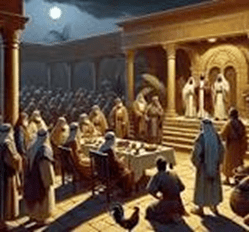
“And those who had laid hold of Jesus led Him away to Caiaphas the high priest, where the scribes and the elders were assembled. But Peter followed Him at a distance to the high priest’s courtyard. And he went in and sat with the servants to see the end.

Now the chief priests, the elders, and all the council sought false testimony against Jesus to put Him to death, but found none. Even though many false witnesses came forward, they found none. But at last two false witnesses came forward and said, “This fellow said, ‘I am able to destroy the temple of God and to build it in three days.’ ”

And the high priest arose and said to Him, “Do You answer nothing? What is it these men testify against You?” But Jesus kept silent. And the high priest answered and said to Him, “I put You under oath by the living God: Tell us if You are the Christ, the Son of God!”

Jesus said to him, “It is as you said. Nevertheless, I say to you, hereafter you will see the Son of Man sitting at the right hand of the Power, and coming on the clouds of heaven.”

Then the high priest tore his clothes, saying, “He has spoken blasphemy! What further need do we have of witnesses? Look, now you have heard His blasphemy! What do you think?”

They answered and said, “He is deserving of death.”

Then they spat in His face and beat Him; and others struck Him with the palms of their hands, saying, “Prophesy to us, Christ! Who is the one who struck You?”

“Now the chief priests, the elders, and all the council sought false testimony against Jesus to put Him to death, but found none. Even though many false witnesses came forward, they found none. But at last two false witnesses came forward and said, “This fellow said, ‘I am able to destroy the temple of God and to build it in three days.’”

Jesus has been hauled off for a mock trial before the religious authorities. It’s obvious from the beginning that Jesus is innocent; however, these men feel their positions are threatened and they are fighting for their existence. Under such circumstances, these men violate the very Mosaic Law they have sworn to uphold. When the high priest puts Jesus under oath, Jesus states that he is the Christ and that the high priest will see him at the right hand of God. Jesus is speaking the truth, but even the high priest twists his statements. Finally, two false witnesses claim Jesus has said he can destroy the temple of God and rebuild it in three days; meanwhile, they have twisted a statement Jesus has made regarding his death and resurrection. If you check the original statement, Jesus was not referring to the temple of God.

While we might think that Jesus’ sufferings only began during the beatings and crucifixion, being misunderstood and lied about are actually the beginnings of his sufferings. What a temptation that must have been when one of the crowds challenged Jesus to prophesy as to which men were striking him! Jesus could have given them names and lineages going all the way back to Adam, but he didn’t. Here Jesus is setting an example for his disciples, for there will always be times when we might be insulted or lied about.

Matthew 26:69-75 Peter Denies Jesus, and Weeps Bitterly

“Now Peter sat outside in the courtyard. And a servant girl came to him, saying, “You also were with Jesus of Galilee.”

But he denied it before them all, saying, “I do not know what you are saying.”

And when he had gone out to the gateway, another girl saw him and said to those who were there, “This fellow also was with Jesus of Nazareth.”

But again he denied with an oath, “I do not know the Man!”

And a little later those who stood by came up and said to Peter, “Surely you also are one of them, for your speech betrays you.” Then he began to curse and swear, saying, “I do not know the Man! “Immediately a rooster crowed. And Peter remembered the word of Jesus who had said to him, “Before the rooster crows, you will deny Me three times.” So he went out and wept bitterly.”

Oh Peter! So sure of yourself earlier and now you are doing the very thing you have sworn you would never do! We need to learn from Peter as well, for any one of us might make the same mistakes as Peter at any time. Oswald Chambers makes the point that we don’t generally fail at our weak spots, but at our strong ones. When we know we have weaknesses, we are far less likely to trust ourselves in those areas; however, we are more than willing to barge ahead without consulting God in areas where we feel self-assured. Those are the very places where failure is most likely. The predictable happens; Peter denies Jesus three times just as Jesus has said, and then weeps bitterly over his failures.

What can we learn from Jesus and Peter? Jesus sets the example for times when we are under interrogation or even torture. Later, Peter himself describes Jesus’ behavior. (1 Peter 2:21-25) “For to this you have been called, for Christ also suffered for us, leaving us an example that you should follow His steps. “Who committed no sin, nor was deceit found in His mouth”; who, when he was reviled, did not revile in return, when He suffered He did not threaten, but committed Himself to Him who judges righteously; who Himself bore our sins in His body on the tree, that we, having died to sins, might live for righteousness-by whose stripes you were healed. For you were like sheep going astray, but have now returned to the Sheperd and Overseer of your souls.”

Peter suffered for his self-assurance, but he also learned from that suffering. Forever after that night, Peter would never again trust himself as completely as he had before denying Jesus. And it’s likely that as Peter was uttering that final denial, Jesus looked at him with eyes of love with a look that pierced Peter’s very soul.

May we learn from both Jesus and Peter so that we will follow hard after Jesus as true disciples!

PRAYER: Father God, thank You for loving us and for caring for us. Lord, help us to trust You and not ourselves. Help us to remain humble, realizing that our strong points can become our points of greatest failure. In the mighty and precious Name of King Jesus. Amen.

NOVEMBER 5, 2024 SO YOU WANT TO BE A DISCIPLE? #97 CELEBRATION IN THE FACE OF PERSECUTION

November 5, 2024

Matthew 26:17-30 Jesus Celebrates Passover with His Disciples

“Now on the first day of the Feast of the Unleavened Bread the disciples came to Jesus, saying to Him, “Where do You want us to prepare for You to eat the Passover?”

And He said, “Go into the city to a certain man, and say to him, ‘The Teacher says, “My time is at hand; I will keep the Passover at your house with My disciples.” ’ ”

So the disciples did as Jesus had directed them; and they prepared the Passover.

 When evening had come, He sat down with the twelve. Now as they were eating, He said, “Assuredly, I say to you, one of you will betray Me.”

And they were exceedingly sorrowful, and each of them began to say to Him, “Lord, is it I?”

 He answered and said, “He who dipped his hand with Me in the dish will betray Me. The Son of Man indeed goes just as it is written of Him, but woe to that man by whom the Son of Man is betrayed! It would have been good for that man if he had not been born.”

Then Judas, who was betraying Him, answered and said, “Rabbi, is it I?”

He said to him, “You have said it.”

Jesus Institutes the Lord’s Supper

And as they were eating, Jesus took bread, blessed and broke it, and gave it to the disciples and said, “Take, eat; this is My body.”

 Then He took the cup, and gave thanks, and gave it to them, saying, “Drink from it, all of you. For this is My blood of the new covenant, which is shed for many for the remission of sins. But I say to you, I will not drink of this fruit of the vine from now on until that day when I drink it new with you in My Father’s kingdom.”

And when they had sung a hymn, they went out to the Mount of Olives.”

While the disciples are in total denial, Jesus is fully aware that his time on earth is drawing to a close. This one night is the last night Jesus will spend with his closest friends before he dies. Wanting every thing to be in order, Jesus has already prayed and God the Father has directed him to those who can help host the Passover meal, allowing the disciples to arrange things in a room two flights of stairs above the street.

At the supper, Jesus clearly announces that one of the disciples will betray him, and affirms to Judas that Jesus knows Judas is the traitor. The 13th Chapter of John tells us that when none of the disciples is willing to serve the others by washing their stinky dirty feet, Jesus will take on that task. Jesus even washes the feet of the man who is about to betray him, giving Judas yet another chance to repent. If Judas repents, Jesus will still be crucified; however, Judas will have saved himself. But Judas carries out his plans.

Jesus uses the occasion of the traditional Passover meal to teach his disciples a different meaning for the bread and the wine, likening them to his body and blood. What must the disciples be thinking at this point? Surely, the disciples realize that destruction is looming for Jesus and that their lives also might hang in the balance. Yet, Jesus calmly celebrates, instituting the Sacrament of Communion as he does so. Why? Jesus wants his followers to remember every single moment of this night so that they will never forget his last teachings and will follow them faithfully.

It’s likely that Jesus already anticipates what the disciples will do when his captors come to seize him. That desertion will also form part of the suffering Jesus has yet to endure. But Jesus continues to teach and celebrate anyway. You see, for Jesus, there is a time for everything, and now is the time to celebrate one of the holiest of festivals with his friends, a festival that prophesies of his sacrificial death for the sins of mankind as he sheds his blood. But is Jesus frowning and moping because of his impending fate? No! Jesus is laughing and joking and singing and hugging and being everything to these men he can possibly be for the few short hours that remain to him.

In 1963 Sydney Carter wrote the hymn Lord of the Dance. This hymn captures the brave and thrilling spirit of Jesus as few other hymns have done. Here are the words.”

“I danced in the morning when the world was begun,
And I danced in the moon and the stars and the sun,
And I came down from heaven and I danced on the earth:
At Bethlehem I had my birth.

Dance, then, wherever you may be,
I am the Lord of the dance, said he,
And I’ll lead you all, wherever you may be,
And I’ll lead you all in the dance, said he.

I danced for the scribe and the Pharisee,
But they would not dance and they wouldn’t follow me;
I danced for the fishermen, for James and John;
They came with me and the dance went on:

Dance, then, wherever you may be,
I am the Lord of the dance, said he,
And I’ll lead you all, wherever you may be,
And I’ll lead you all in the dance, said he.

I danced on the Sabbath and I cured the lame:
The holy people said it was a shame.
They whipped and they stripped and they hung me on high,
And they left me there on a cross to die:

Dance, then, wherever you may be,
I am the Lord of the dance, said he,
And I’ll lead you all, wherever you may be,
And I’ll lead you all in the dance, said he.

I danced on a Friday when the sky turned black;
It’s hard to dance with the devil on your back.
They buried my body and they thought I’d gone;
But I am the dance, and I still go on:

Dance, then, wherever you may be,
I am the Lord of the dance, said he,
And I’ll lead you all, wherever you may be,
And I’ll lead you all in the dance, said he.

They cut me down and I leapt up high;
I am the life that’ll never, never die.
I’ll live in you if you’ll live in me:
I am the Lord of the dance, said he.

Dance, then, wherever you may be,
I am the Lord of the dance, said he,
And I’ll lead you all, wherever you may be,
And I’ll lead you all in the dance, said he.”

There are many times in life when we must face grim realities. But we always have the opportunity to celebrate if we will only allow God to give us His joy and peace. Remember the last verse of that hymn: “They cut me down and I leapt up high; I am the life that’ll never, never die. I’ll live in you if you’ll live in me: I am the Lord of the dance, said he.” Let the Lord of the dance give you His Holy Spirit so that you can rejoice even in suffering.

PRAYER: Father God, thank You for loving us and for caring for us. Lord, please give us Your unshakeable joy and gladness, so that no matter what happens, we can continue to praise and worship You. In the mighty and precious Name of King Jesus. Amen.

OCTOBER 21, 2024 SO YOU WANT TO BE A DISCIPLE? #82 SOMETIMES YOU MUST CONFRONT LIES LOVINGLY

October 21, 2024

Matthew 21:28-32 The Parable of the Two Sons

“But what do you think? A man had two sons, and he came to the first and said, ‘Son, go, work today in my vineyard.’ He answered and said, ‘I will not,’ but afterward he regretted it and went. Then he came to the second and said likewise. And he answered and said, ‘I go, sir,’ but he did not go. Which of the two did the will of his father?”

They said to Him, “The first.”

Jesus said to them, “Assuredly, I say to you that tax collectors and harlots enter the kingdom of God before you. For John came to you in the way of righteousness, and you did not believe him; but tax collectors and harlots believed him; and when you saw it, you did not afterward relent and believe him.”

If the Scribes and Pharisees are already angry at Jesus, this story will simply make them even angrier. Obviously, the second son who promises but then reneges on his promise represents the religious authorities while the first son who eventually obeys represents those “sinners” whom the religious authorities have despised for all these years. To make matters even worse, Jesus is telling this story before a crowd of those same sinners, who are obviously chortling over the discomfort of these religious stuffed shirts. And to add insult to injury, Jesus proceeds to tell yet another story at the expense of his accusers.

The Parable of the Wicked Vinedressers

Matthew 21:33 “Hear another parable: There was a certain landowner who planted a vineyard and set a hedge around it, dug a winepress in it and built a tower. And he leased it to vinedressers and went into a far country. Now when vintage-time drew near, he sent his servants to the vinedressers, that they might receive its fruit. And the vinedressers took his servants, beat one, killed one, and stoned another. Again he sent other servants, more than the first, and they did likewise to them. Then last of all he sent his son to them, saying, ‘They will respect my son.’ But when the vinedressers saw the son, they said among themselves, ‘This is the heir. Come, let us kill him and seize his inheritance.’ So they took him and cast him out of the vineyard and killed him.

“Therefore, when the owner of the vineyard comes, what will he do to those vinedressers?”

They said to Him, “He will destroy those wicked men miserably, and lease his vineyard to other vinedressers who will render to him the fruits in their seasons.”

Jesus said to them, “Have you never read in the Scriptures:

‘The stone which the builders rejected
Has become the chief cornerstone.
This was the Lord’s doing,
And it is marvelous in our eyes’?

“Therefore I say to you, the kingdom of God will be taken from you and given to a nation bearing the fruits of it. And whoever falls on this stone will be broken; but on whomever it falls, it will grind him to powder.”

Now when the chief priests and Pharisees heard His parables, they perceived that He was speaking of them. But when they sought to lay hands on Him, they feared the multitudes, because they took Him for a prophet.”

In one well-told story, Jesus has turned the religious pride of centuries on its head! When the Jews wound up captives in Babylon, they could at least pride themselves on the fact that THEY were God’s chosen people. Of course, there was the tiny fact that the Jews had been captured and Jerusalem destroyed because of their disobedience, perversion, and idolatry. While God had chosen Israel, Israel had abandoned God. But once the Jews returned to Israel, they immediately began despising the mongrel people whose ancestors had been imported by the Babylonians so that the land would not lie fallow. Religious leaders whose ancestors had committed apostasy by allowing evil practices and idols in God’s temple were now snubbing those whom they called sinners. Now Jesus is reproaching these men for their self-righteousness and spiritual blindness.

Purporting to be on the lookout for the reincarnation of Elijah who proceeds the advent of the Messiah, the religious authorities have refused to comprehend the divine nature of John the Baptist’s ministry. Malachi 4:5-6 tells us, “Behold, I will send you Elijah the prophet before the coming of the great and dreadful day of the Lord. And he will turn the hearts of the fathers to the children, and the hearts of the children to their fathers, lest I come and strike the earth with a curse.” Jesus tells his followers that John has fulfilled this prophecy. Matthew 11:13-15 For all the prophets and the law prophesied until John. And if you are willing to receive it, he is Elijah who is to come. He who has ears to hear, let him hear!”

Entire books have been written discussing these two stories. For us as disciples, the important point is the fashion in which Jesus confronts the lies held by the religious leaders. These men are absolutely certain that if God sends a prophet, they will recognize that prophet, and yet, John has come and they have refused to acknowledge the validity of his ministry. In addition, these same men who claim to have been longing for the Messiah are anything but pleased when the Messiah appears in a form they don’t expect.

Jesus does not come out and call these men liars or fools for believing their own prejudices. Instead, Jesus employs stories to make his points while thoroughly refuting the lies on the basis of Scripture. What Jesus does not do is to ignore the lies in hopes that they will go away. Jesus is fully aware that the religious leaders will take umbrage at the stories; in fact, that is exactly the point. You see, Jesus has not just come to save those who are obviously sinners like the tax collectors and prostitutes, but Jesus has also come to save these men who are sneering at him. Only direct confrontation may get these men’s attention. Jesus is also employing the time-honored technique of telling stories to make a point, something these religious teachers do daily. Jesus loves these men who are trying to give him a hard time, loves them so much that he is telling stories with barbs in them, hoping that even after he has been crucified and has risen from the dead, these men will abandon their prejudices and come to true faith in God.

If we fail to understand the love of Jesus for these religious leaders, then we are missing a very important point. Jesus is not viewing these confrontations in an “Us versus them” fashion, even though the disciples probably are. Jesus wants these men to enter freely into the Kingdom of God, rather than hovering just outside the door, discouraging others from entering.

As disciples, we must know how to confront lies and therefore what Scripture teaches. We must learn enough about the beliefs of those promoting lies to understand why they believe such things. But we also must never lose sight of the love Jesus has for those who are attacking us, for Jesus has died for those people just as he has died for us. May God guide us as we confront lies lovingly and encourage those assailing us to find true faith in Jesus Christ!

PRAYER: Father God, thank You for loving us and for caring for us. Lord, help us to follow hard after You all the days of our lives and to be able to defend Your Word in a loving fashion, realizing that arguments without love may alienate those who need You. In the mighty and precious Name of King Jesus. Amen.

OCTOBER 16, 2024 SO YOU WANT TO BE A DISCIPLE? #77 YOU MUST OBEY GOD, EVEN WHEN HIS COMMANDS SEEM SILLY

October 16, 2024

Matthew 21:1-11 The Triumphal Entry

“Now when they drew near Jerusalem, and came to Bethphage, at the Mount of Olives, then Jesus sent two disciples, saying to them, “Go into the village opposite you, and immediately you will find a donkey tied, and a colt with her. Loose them and bring them to Me. And if anyone says anything to you, you shall say, ‘The Lord has need of them,’ and immediately he will send them.”

Well, Jesus has had the disciples doing some strange things, but this latest order is unreal. It was crazy enough when Jesus had Peter go fishing to get the money for the temple tax, but now the disciples are supposed to find a donkey with her colt and bring them to Jesus. Moreover, if anybody questions them, the disciples are simply supposed to say “The Lord has need of them,” and the owner will hand over the animals.

Many of us know the story of Jesus entering Jerusalem on Palm Sunday, riding on a donkey. But consider the disciples. Here they are collecting someone’s donkeys and hoping they won’t be accused of theft. When Jesus sits on that donkey colt, the disciples are expecting him to be bucked off immediately, but instead, the colt calmly trots down the road and into Jerusalem.

Writing about the incident afterwards, Matthew, the former Jewish tax collector, quotes the Scripture: “All this was done that it might be fulfilled which was spoken by the prophet, saying: “Tell the daughter of Zion, ‘Behold, your King is coming to you, lowly, and sitting on a donkey, a colt, the foal of a donkey.’” But while this event is happening, the disciples are obeying in fear and trembling. Only when the crowd begins to shout “Hosanna!” do the disciples breathe sighs of relief. Only when Jesus makes it all the way into Jerusalem do the disciples realize that they have had a part in fulfilling one of the important prophecies about the Messiah.

“So the disciples went and did as Jesus commanded them. They brought the donkey and the colt, laid their clothes on them, and set Him on them. And a very great multitude spread their clothes on the road; others cut down branches from the trees and spread them on the road. Then the multitudes who went before and those who followed cried out, saying:

“Hosanna to the Son of David!
‘Blessed is He who comes in the name of the Lord!’
Hosanna in the highest!”

And when He had come into Jerusalem, all the city was moved, saying, “Who is this?”

So the multitudes said, “This is Jesus, the prophet from Nazareth of Galilee.”

It’s a sad mistake to assume that all of God’s commandments are going to make perfect sense, for many times they do not. Years ago, we attended a church in a town that was about to have its first Spring Festival. Two weeks before the event, I was praying one morning when I felt God ordering for my husband and me to dress like clowns and to distribute “Jesus Loves You” balloons to the crowds at the festival. Amazingly enough, other church members were thrilled with the idea. Before we were through, the church sponsored a tent with entertainment, places to sit, and free cold water. Volunteers filled helium balloons and wrote “Jesus loves you” on them; then dressed as clowns, my husband and I went throughout the crowds carrying the balloons. My husband remained silent but pantomimed for people to accept the balloons while I wrote the names of those receiving them on the balloons. By the end of the day, we had distributed nearly 1,000 balloons, spreading the love of Jesus in the process.

When we were returning to Ghana in December 1992, we were unsure of what to do with the vehicle I had been driving. We learned that a fellow church member was in dire need of a vehicle to get to work. God prompted us to give that vehicle to our friend. Once our friend no longer needed the vehicle, he passed it on to someone else. We estimate that at least three different families were blessed by that vehicle. Had we sold the vehicle, we could have raised money to help return to Ghana; however, we trusted God to take care of us, and He did.

Think about the man who lent his donkeys to Jesus. For the rest of that man’s life, he could remember the day his donkey and its colt helped fulfill one of the important prophecies about the Messiah. He could be grateful that he did not hesitate but that he released the donkeys to the Lord.

Perhaps today God is urging you to step out and do something as silly as asking a stranger for the use of his donkeys. You aren’t sure if you are hearing God, and you really don’t want to look ridiculous. But go ahead. Take that step of faith, for when you do, God will bless you in ways you cannot even imagine.

PRAYER: Father God, thank You for loving us and for caring for us. Lord, help us to listen to You and to obey, even when we fear we might look silly. In the mighty and precious Name of King Jesus. Amen.

JUNE 21, 2024 JESUS IS TELLING STORIES-COME LISTEN! #7 HOW RIGHTEOUS DO YOU NEED TO GET INTO HEAVEN?

June 21, 2024

Well, Jesus’ audience is now scratching their heads! After several pungent illustrations drawn from daily village life, suddenly Jesus starts talking about the Law. Why is Jesus making these statements? It’s easy for us to forget that Jesus is actually an obedient and observant Jew, wearing a simple tunic with fringes on the hem, perhaps tying small scrolls on his arms as he prays, attending synagogue regularly and discussing the Law with the teachers. Jesus observes the Jewish feasts and Jewish dietary laws. Jesus wants his audience to realize that he is not bringing in a subversive teaching that will undermine the Law but he is teaching how the Kingdom of God should operate and that when the Kingdom of God fully arrives, the Law will be fulfilled completely.

But what does Jesus mean when he says, “unless your righteousness exceeds that of the scribes and Pharisees, you will never enter the kingdom of heaven.” Is Jesus demanding that his audience struggle to observe all the minutiae that have become part of the Law during the centuries since Moses? No. In the Law of Moses, God repeatedly expresses His concern for widows, orphans, and aged parents; however, the Pharisees have perfected a whole system of observing small edicts while neglecting the fundamental spirit of the Law. Later Jesus will criticize the Pharisees for tithing spices such as dill and mint and cumin while refusing to care for their parents because they have dedicated the resources that would sustain them to the temple.

One of the keys to Jesus’ life is his continued and persistent obedience to his Heavenly Father. When Jesus speaks of the Law, he is describing the will of his Heavenly Father, not just some words on a scroll. Jesus has such love and respect for that will that he reminds his listeners that even the smallest pen strokes, the jot and the tittle, must commend respect until the Kingdom of God arrives in its completeness.

What are we missing? No matter how carefully Matthew and Luke have recorded Jesus’ teachings, what we are missing is the presence of Jesus himself. We can only imagine Jesus’ smiles, his quick wit, and the love pouring forth from his eyes as he teaches. For that experience, we must ask Jesus to reveal himself to us as we study his words.

There are some people who are so loving and good that they literally radiate God’s presence. To be in the presence of one of these people is to feel completely safe. When I was a child, I knew three exemplary men who taught Sunday School to wiggly kids and teens. Each of these men genuinely loved children and deeply loved Jesus. Each of these men faithfully taught for years, encouraging their charges to trust God and to love His Word. Proverbs 10:7 says “The memory of the righteous is blessed.”

By ourselves, there is no way that we can earn our way into heaven. But praise God, Jesus has done what we cannot do. Jesus has given himself as the ultimate blood sacrifice for our sins. If we will confess our sins and believe in Jesus, we can rest assured that our sin debt has been paid.

PRAYER: Father God, thank You for loving us and for caring for us. Lord, we confess that we are sinners and that nothing we do is good enough to earn our way into heaven. Thank You for sending Jesus to pay our sin debt for us. In the mighty and precious Name of King Jesus. Amen.