Archive for March, 2026

MARCH 15, 2026 ORIGINALLY PUBLISHED MARCH 3, 2023 “WHO KNOWS BUT WHAT YOU HAVE COME TO THE KINGDOM FOR SUCH A TIME AS THIS?” #8 ESTHER 6:1-14 WHEN A TYRANT CAN’T SLEEP, GOD USES THE SCRATCHINGS OF A SCRIBE TO REALLY WAKE HIM UP!

March 15, 2026

Mordecai Is Honored

“That night, sleep escaped the king; so he ordered the book of records, the chronicles, to be brought in and read to him. And there it was found recorded that Mordecai had exposed Bigthana and Teresh, two of the eunuchs who guarded the king’s entrance, when they had conspired to assassinate King Xerxes.

The king inquired, “What honor or dignity has been bestowed on Mordecai for this act?”

“Nothing has been done for him,” replied the king’s attendants.

“Who is in the court?” the king asked.

Now Haman had just entered the outer court of the palace to ask the king to hang Mordecai on the gallows he had prepared for him. So the king’s attendants answered him, “Haman is there, standing in the court.”

“Bring him in,” ordered the king.

Haman entered, and the king asked him, “What should be done for the man whom the king is delighted to honor?”

Now Haman thought to himself, “Whom would the king be delighted to honor more than me?”

And Haman told the king, “For the man whom the king is delighted to honor, have them bring a royal robe that the king himself has worn and a horse on which the king himself has ridden—one with a royal crest placed on its head. Let the robe and the horse be entrusted to one of the king’s most noble princes. Let them array the man the king wants to honor and parade him on the horse through the city square, proclaiming before him, ‘This is what is done for the man whom the king is delighted to honor!’”

“Hurry,” said the king to Haman, “and do just as you proposed. Take the robe and the horse to Mordecai the Jew, who is sitting at the King’s Gate. Do not neglect anything that you have suggested.”

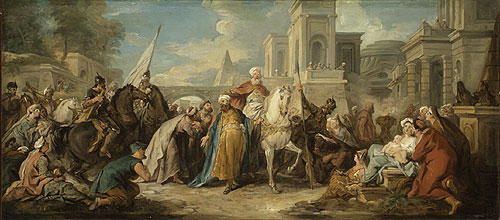
So Haman took the robe and the horse, arrayed Mordecai, and paraded him through the city square, crying out before him, “This is what is done for the man whom the king is delighted to honor!”

Then Mordecai returned to the King’s Gate. But Haman rushed home, with his head covered in grief.

Haman told his wife Zeresh and all his friends everything that had happened. His advisers and his wife Zeresh said to him, “Since Mordecai, before whom your downfall has begun, is Jewish, you will not prevail against him—for surely you will fall before him.”

While they were still speaking with Haman, the king’s eunuchs arrived and rushed him to the banquet that Esther had prepared.”

God really has a sense of humor! King Xerxes can’t sleep, so he asks for the chronicles of the kingdom to be read to him, no doubt assuming that they will be boring enough to put him to sleep easily! But wait, suddenly the king discovers a fascinating tidbit about the plot hatched by two of the eunuchs who were planning to assassinate him. Suddenly, Xerxes is wide awake! He has a fascinating new project, one that can’t possibly wait until morning. Here’s a new and glorious way in Xerxes can advertise his generosity and his magnificence.

Xerxes calls Haman in and puts a question to Haman. “What should be done for the man whom the king is delighted to honor?” Now Haman thought to himself, “Whom would the king be delighted to honor more than me?” And Haman told the king, “For the man whom the king is delighted to honor, have them bring a royal robe that the king himself has worn and a horse on which the king himself has ridden—one with a royal crest placed on its head. Let the robe and the horse be entrusted to one of the king’s most noble princes. Let them array the man the king wants to honor and parade him on the horse through the city square, proclaiming before him, ‘This is what is done for the man whom the king is delighted to honor!’”

By now, Haman is rubbing his hands with glee! This is working out even better than he had hoped. Take a quick ride through the city on a royal horse while he wears a royal robe, have his name announced in the city, and then return to secure Xerxes’ approval to hang Mordecai. “No problem!” thinks Haman. But Haman is wrong. That insignificant scribe who scratched out that chronicle on clay tablets has saved Mordecai, and it’s MORDECAI whom Xerxes wants to honor and NOT Haman! Haman can scarcely believe it, but he still has that invitation to Esther’s banquet to buoy up his spirits. So Haman finds Mordecai and puts the royal robe on Mordecai and then parades Mordecai through the streets of Susa, proclaiming loudly for all to hear, “This is what is done for the man whom the king is delighted to honor!” But there’s worse yet to come.

Haman rushes home, seeking comfort from his friends and his wife. But look what these people tell Haman: “Since Mordecai, before whom your downfall has begun, is Jewish, you will not prevail against him—for surely you will fall before him.” WHAT? Why would Haman’s most trusted advisers and his wife say such a thing? The answer lies in the history of the Jews. Even though many of the Jews have little regard for their God, the same is not true for those from surrounding nations. These people remember how God wiped out the Egyptian army and how He led the Israelites across the Red Sea and the Jordan River on dry ground. Ironically, these people may have more respect for the God of Israel than do many of the Jews. And now, there’s no time left. The palace eunuchs rush in and hustle Haman off to Esther’s banquet.

APPLICATION: Such a short story but so many fascinating lessons! The clerk who recorded Mordecai’s original report that saved Xerxes was probably bored out of his mind the day he wrote it; however, he did his work properly. Xerxes couldn’t sleep and figured that nothing could be no more soporific than listening to a reading of the royal chronicles, never dreaming how God was going to use that entry. Haman appeared in the outer court at precisely the wrong time because he was hoping to gain permission to hang Mordecai; instead, he wound up leading the royal horse through the streets of Susa, proclaiming Mordecai’s praises.

But the most surprising responses of all are the ones from Haman’s own family. Evidently, until now, Haman’s people have been unaware of Mordecai’s nationality. Suddenly, the same people who were counseling Haman to hang Mordecai on a 75-foot gallows so everyone in Susa would see the body are now predicting Haman’s fall. Are these people fully conscious of what they are saying or is God putting words in their mouths? After all, God has been known to allow a donkey to speak when necessary.

God can use the smallest details to work out His perfect Will. The same Creator who spoke the universe into existence with a single word is quite capable of moving clerks to work diligently and kings to suffer from insomnia. And that same God can also move villains to appear in royal courts just in time for their evil schemes to be thwarted. Psalm 147:4-6 tells us, “He determines the number of the stars and calls them each by name. Great is our Lord and mighty in power; his understanding has no limit. The Lord sustains the humble but casts the wicked to the ground.”

Perhaps today you feel your situation is hopeless. If you were in ancient Susa, you too would be mourning in sackcloth and ashes. But take heart! God has not forgotten you and He knows every detail of your situation. The same God who saved Mordecai from hanging is still running the universe and He can deliver you as well.

PRAYER: Father God, thank You for loving us and for caring for us. Lord, there are those reading these words who feel that their situations are hopeless. But You are the God of heaven and earth, and nothing is too difficult for You! Move in all our hearts, so that we may know Your love for us and may see Your deliverance. In the mighty and precious Name of King Jesus. Amen.
MARCH 14, 2026 ORIGINALLY PUBLISHED MARCH 2, 2023 “WHO KNOWS BUT WHAT YOU HAVE COME TO THE KINGDOM FOR SUCH A TIME AS THIS?” #7 ESTHER 5:1-14 WHEN YOU’RE GOING TO RISK IT ALL, MAKE SURE PEOPLE ARE PRAYING FOR YOU!  

March 14, 2026

Esther Approaches the King

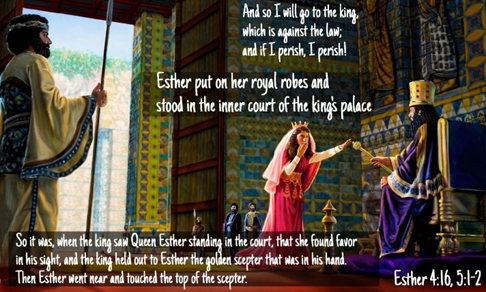
“On the third day, Esther put on her royal attire and stood in the inner court of the palace across from the king’s quarters. The king was sitting on his royal throne in the royal courtroom, facing the entrance. As soon as the king saw Queen Esther standing in the court, she found favor in his sight. The king extended the gold scepter in his hand toward Esther, and she approached and touched the tip of the scepter.

“What is it, Queen Esther?” the king inquired. “What is your request? Even up to half the kingdom, it will be given to you.” “If it pleases the king,” Esther replied, “may the king and Haman come today to the banquet I have prepared for the king.” “Hurry,” commanded the king, “and bring Haman, so we can do as Esther has requested.”

So the king and Haman went to the banquet that Esther had prepared. And as they drank their wine, the king said to Esther, “What is your petition? It will be given to you. What is your request? Even up to half the kingdom, it will be fulfilled.”

Esther replied, “This is my petition and my request: If I have found favor in the sight of the king, and if it pleases the king to grant my petition and fulfill my request, may the king and Haman come tomorrow to the banquet I will prepare for them. Then I will answer the king’s question.”

Haman’s Plot against Mordecai

That day Haman went out full of joy and glad of heart. At the King’s Gate, however, he saw Mordecai, who did not rise or tremble in fear at his presence. And Haman was filled with rage toward Mordecai. Nevertheless, Haman restrained himself and went home. And calling for his friends and his wife Zeresh, Haman recounted to them his glorious wealth, his many sons, and all the ways the king had honored and promoted him over the other officials and servants.

“What is more,” Haman added, “Queen Esther invited no one but me to join the king at the banquet she prepared, and I am invited back tomorrow along with the king. Yet none of this satisfies me as long as I see Mordecai the Jew sitting at the King’s Gate.”

His wife Zeresh and all his friends told him, “Have them build a gallows fifty cubits high,(75 feet high!) and ask the king in the morning to have Mordecai hanged on it. Then go to the banquet with the king and enjoy yourself.”

The advice pleased Haman, and he had the gallows constructed.”

Reading about Esther’s actions, we wonder what she can possibly be thinking! Here’s Haman, the arch-enemy of the Jews; yet, Esther is inviting him to a banquet along with King Xerxes. But Esther and her maids have been fasting and praying, and God is the One who has instructed Esther in how to proceed. Taking her courage in both hands, Esther enters the outer court, where King Xerxes sees her. King Xerxes extends the golden scepter, Esther touches it, and Xerxes makes a magnificent offer. Would Xerxes actually have given Esther half the kingdom at this point? Who knows? Perhaps Xerxes has been drinking again, but it’s far more likely that Xerxes has been keeping close tabs on Esther and has been receiving glowing reports about her kindness, her gentleness, and her sweet nature. Palace spy systems have always been very efficient, and the eunuchs serving Esther probably report to the king regularly.

Haman is stoked! Not only has Xerxes honored Haman above all the other princes, but now even Queen Esther has issued an exclusive invitation. As Haman is rushing home to share this latest honor with his family, he sees Mordecai just outside the King’s Gate. Mordecai is probably still wearing sackcloth and ashes and looks wretched; moreover, he refuses to rise or bow to Haman as Haman passes. “The very nerve of that abominable Jew!” Haman thinks. “I’ll settle with him as soon as possible.” Later, Haman’s wife and friends advise him to build a towering gallows seventy-five feet high and have Mordecai hanged on it before he goes off to Esther’s banquet. Things are looking black for Mordecai and the Jews.

APPLICATION: What could be more innocuous than a private banquet? A meeting with only King Xerxes and Haman ensures that King Xerxes will not be embarrassed and at the same time allows Esther to test the king’s emotional state at this point. Xerxes is well known for being a mean drunk; look what happened to Queen Vashti. Despite the king’s munificent statements offering Esther up to half his kingdom, Esther knows it’s far better to make modest requests and see what God will do with the situation.

Notice what Esther is NOT doing. Esther is not planning to poison Haman, although that option has probably been used at more than one royal banquet. Instead, Esther is offering her enemy hospitality. If we overlook the significance of this act, we are underestimating its importance. Purim is one of the traditional Jewish festivals and it is helpful to see what the Talmud says about it. Alan D. Corré, Emeritus Professor of Hebrew Studies, University of Wisconsin-Milwaukee has collected the following comments from the Talmud:

“Purim [The Feast of Lots] is a light-hearted festival, and we catch the Rabbis in a festive mood when they discuss in the Talmud this question: Why did Esther invite Haman to a banquet? Presumably, she had no liking for the man; moreover, could she not have persuaded the King to revoke his evil decree against the Jews without having the hated Haman to a banquet? The Rabbis give no less than twelve separate views on what Esther’s motive was.

Rabbi Elazar: Esther hoped that Haman would make some blunder at the banquets, thereby offending the King. Apparently this rabbi felt that there was some danger in accepting dinner invitations from ladies.

Rabbi Joshua: Esther was a religious young woman, and she simply followed the instructions in the book of Proverbs, 25.2 “If thine enemy be hungry, give him food to eat; and if he be thirsty, give him water to drink.” In other words, act the gentleman towards your enemies, and have confidence that God will ultimately right the wrong. Notice the difference in emphasis between these two views. In one, Esther herself is a practical schemer, fighting evil with the same; in the other she is a religious believer, relying on God’s mercies.

Rabbi Meir: He is reputed to be one of the cleverest of the Talmudic rabbis. According to him, Esther had an idea that Haman intended to overthrow the king, and set himself up as monarch. She felt that Haman’s star was in the ascendent and wanted to postpone what she thought would be a successful revolt. So she placated Haman by inviting him to a banquet.

Rabbi Judah

This was a ruse on Esther’s part to avoid recognition as a Jewess. She felt she could work better if no one knew her origin, and her invitation to Haman was a smoke screen, since obviously no Jewess would invite him.

Rabbi Nehemiah

His opinion is psychologically interesting. Esther invited Haman so that the Jews would not say: “We have a friend at the court” and thus not bother to seek God’s mercy. The rabbi knew that for most people God is the last resort. If they can rely on men, however fickle, they prefer it. Esther wanted the people to feel that God had saved them through her, not that she saved them.

Rabbi Jose

Esther wanted to get to know Haman better, and thereby discover his weak spots.

Rabbi Simon ben Menasya

Esther’s action was a very shocking one, which she did deliberately in order, as it were, to delude God into thinking that even Esther had joined Haman, and make him arise in anger and do something about it! Such an explanation seems incredibly naive to us, yet it shows to what degree God was a part of the lives of these people. He was like a friend, whom, when all else failed, you could irritate into doing something for you. Naive, but touching too.

Rabbi Joshua ben Korha

“Cherchez la femme!” He thinks that Esther wanted to give the king the impression that she was in love with Haman, and hence the king would, in best Persian style, do away with them both. No doubt Esther was ready to die for her people, but it is hard to believe that her strategem included her own death.

Rabban Gamliel

She wanted Haman there, so that when she denounced him, the king could point to him and order him executed before he had a chance to change his fickle and not too bright mind. This explanation is so simple that it will appeal only to the least romantic of us.

Rabbi Eliezer of Modin

Esther wanted to make the princes and the court jealous of Haman, whereupon they would arrange for him to be taken for a ride different from the one that, to his chagrin, he had to arrange for Mordecai. The great commentator Rashi cites this explanation with approval.

Rabba

“Pride comes before a fall.” Esther wanted to blow up Haman until he burst (which, of course, he did.)

Abbaye and Rava

A very common theme in literature is the downfall of the wicked while they are steeped in their orgies. Think of the destruction of the suitors in the Odyssey. Think of the death of Job’s sons, and especially the feast of Belshazzar who was too bleary-eyed to read the writing on the wall, and had to call in the sober Daniel to do if for him. Esther wanted to have a Belshazzar’s feast, in which Haman would be the victim.

What can we learn from this? First, there is more in Holy Writ than meets the eye. Second, the rabbis are very ingenious at explaining it. Third, Esther was a very clever young woman.

The end of the tale is this. One of the rabbis had a visitation from Elijah, who, in Jewish folklore, is the man who can answer all questions, a veritable quiz producer’s ideal. The rabbi asked: “Which opinion was right?” He answered: “They all were.” Apparently Esther was cleverer and the rabbis more ingenious even than we thought.”

I feel that God advised Esther to hold this banquet and the subsequent ones and that God knew exactly how He was going to resolve the issue. I also suspect that Esther was acting in accordance with God and going one day at a time. This situation was so precarious that scheming on Esther’s part might have caused the whole thing to fail.

Personally, I have found that God frequently tells me to take one step and then after I have made a start, He will direct the next step. But God rarely tells me His entire plan because I would probably be tempted to try to fix it and I would make a complete mess of the situation. So Esther and her maids planned the first banquet and Esther made the invitation in fear and trembling, setting an example for all of us who must follow God’s leading.

PRAYER:  Father God, thank You for loving us and for caring for us. Lord, thank You that even when we encounter problems that seem insurmountable, You still have perfect solutions. Help us to trust You and to take the first steps, knowing that You will give more guidance as we go along. In the mighty and precious Name of King Jesus. Amen.

MARCH 13, 2025 ORIGINALLY PUBLISHED MARCH 1, 2023 “WHO KNOWS BUT WHAT YOU HAVE COME TO THE KINGDOM FOR SUCH A TIME AS THIS?” #6 ESTHER 4:1-17 MORDECAI CHALLENGES ESTHER TO RISK HER LIFE FOR HER PEOPLE

March 13, 2026

Mordecai Appeals to Esther

“When Mordecai learned of all that had happened, he tore his clothes, put on sackcloth and ashes, and went out into the middle of the city, wailing loudly and bitterly. But he went only as far as the King’s Gate, because the law prohibited anyone wearing sackcloth from entering that gate. In every province to which the king’s command and edict came, there was great mourning among the Jews. They fasted, wept, and lamented, and many lay in sackcloth and ashes.

When Esther’s maidens and eunuchs came and told her about Mordecai, the queen was overcome with distress. She sent clothes for Mordecai to wear instead of his sackcloth, but he would not accept them. Then Esther summoned Hathach, one of the king’s eunuchs appointed to her, and she dispatched him to Mordecai to learn what was troubling him and why. So Hathach went out to Mordecai in the city square in front of the King’s Gate, and Mordecai told him all that had happened to him, including the exact amount of money that Haman had promised to pay into the royal treasury in order to destroy the Jews. (Haman promised to pay 10,000 talents, or approximately 377 tons or 342 metric tons of silver!)

Mordecai also gave Hathach a copy of the written decree issued in Susa for the destruction of the Jews, to show and explain to Esther, urging her to approach the king, implore his favor, and plead before him for her people.

So Hathach went back and relayed Mordecai’s response to Esther.

Then Esther spoke to Hathach and instructed him to tell Mordecai, “All the royal officials and the people of the king’s provinces know that one law applies to every man or woman who approaches the king in the inner court without being summoned—that he be put to death. Only if the king extends the gold scepter may that person live. But I have not been summoned to appear before the king for the past thirty days.”

When Esther’s words were relayed to Mordecai, he sent back to her this reply: “Do not imagine that because you are in the king’s palace you alone will escape the fate of all the Jews. For if you remain silent at this time, relief and deliverance for the Jews will arise from another place, but you and your father’s house will perish. And who knows if perhaps you have come to the kingdom for such a time as this?”

Then Esther sent this reply to Mordecai: “Go and assemble all the Jews who can be found in Susa, and fast for me. Do not eat or drink day or night for three days, and I and my maidens will fast as you do. After that, I will go to the king, even though it is against the law. And if I perish, I perish!” (Or if I am destroyed, then I will be destroyed.)

So Mordecai went and did all that Esther had instructed him.”

The crisis has come, and the Jews are distraught! An entire race is faced with extinction throughout the greatest empire of the time, unless God does a miracle. Rather than hide his nationality, Mordecai demonstrates it by wearing sackcloth and ashes into the middle of the city and wailing bitterly. Nobody in mourning can enter the King’s Gate, so Mordecai remains outside. Back in the palace, Esther is both anxious and embarrassed; what is her beloved uncle thinking of? Esther’s maidens and eunuchs quickly inform her of Mordecai’s behavior. Esther sends out clothing, hoping Mordecai will break off his mourning and enter the King’s Gate; however, Mordecai refuses to change.

Esther sends Hathach, one of the eunuchs and a trusted emissary, to Mordecai. Mordecai tells Hathach everything, giving him a copy of the decree and informing him of the staggering sum of money Haman has promised to pay into the royal treasury. (Note: It appears Haman has yet to deliver the money! Does he really have that much?) Mordecai also begs Esther to intercede with Xerxes to save the Jews.

Esther doesn’t know what to do. Even as the queen, Esther must wait until Xerxes sends for her; she can’t simply barge into the throne room. If Esther enters the inner court, and Xerxes fails to extend his golden scepter to her, she will die immediately. But when Esther sends this message to Mordecai, Mordecai doesn’t mince words. “Do not imagine that because you are in the king’s palace you alone will escape the fate of all the Jews. For if you remain silent at this time, relief and deliverance for the Jews will arise from another place, but you and your father’s house will perish. And who knows if perhaps you have come to the kingdom for such a time as this?”

Faced with this answer, Esther realizes what she must do. But Esther is wise enough to realize that she must have God’s help if she is to succeed. “Go and assemble all the Jews who can be found in Susa, and fast for me. Do not eat or drink day or night for three days, and I and my maidens will fast as you do. After that, I will go to the king, even though it is against the law. And if I perish, I perish!”

APPLICATION: Through the years, God has used these verses to call innumerable people to His service. Esther 4:14 is particularly meaningful to us because this was the verse God gave us when we were to come to Ghana our first time. In October 1987 I was working at City of Faith Hospital in Tulsa, Oklahoma, while my husband was out in western Oklahoma, organizing donated medical equipment. In late October 1987, I had the opportunity to speak to a seasoned veteran missionary who had visited the project to which we were being sent. This man spent several hours warning me of the pitfalls in the situation, concluding with the advice that we should refuse to enter it as long as those problems existed. That night I was in turmoil, praying far into the night for guidance. God had clearly led us to the group that was sending us and they wanted to send us to that project. What should we do? There was a strong possibility that the project might fail and that we would then be blamed for its failures. Essentially, we were being sent over Niagara Falls in a barrel. Finally, I fell asleep. But I awoke the next morning knowing two things: yes, we were being sent over Niagara Falls in a barrel and our sending agency would blame us for all failures, but God was in that barrel with us. And the verse God gave me to seal His Will in the situation was the question Mordecai put to Esther. “Who knows but what you have come to the kingdom for such a time as this?”

We arrived in Ghana and found that the veteran missionary had been spot-on with his information. We duly reported all the problems to our fledgling mission group; however, they did blame us for elements of the situation over which we had no control. But God was still in this situation. Because of our stand, the national church did get proper papers for the land and the building and subsequent missionaries had a far easier time than we did. And God wanted us in Ghana. During that first term, we traveled around Ghana, studied one of the most common languages in Ghana, and became well acquainted with the national church and a number of prominent physicians who have been of enormous help ever since. We also got initiated into spiritual warfare, something of which we were totally ignorant before coming to Ghana. Truly, God proved that He had brought us to Ghana “for such a time as this.”

The message of this chapter is clear: God may bring any one of us to the brink of disaster. I am Facebook friends with a couple who minister in Ukraine and who have persisted despite all the fighting there. God has brought them to Ukraine for such a time as this. But if God brings you to a crisis, He is also sufficient to take you through that crisis. God doesn’t play favorites; He helped Esther and He will help you.

PRAYER: Father God, thank You for loving us and for caring for us. Lord, many of us are at crisis points for various reasons. Thank You that You are sufficient for any problem and that You are the God of heaven and earth and nothing is too difficult for You. Please help all those who read these words to come to You and trust You as their Source of comfort and strength. In the mighty and precious Name of King Jesus. Amen.

IN MEMORIAM: BOBBY WALTERS

March 12, 2026

1 Corinthians 15:51-58

But let me reveal to you a wonderful secret. We will not all die, but we will all be transformed! It will happen in a moment, in the blink of an eye, when the last trumpet is blown. For when the trumpet sounds, those who have died will be raised to live forever. And we who are living will also be transformed. For our dying bodies must be transformed into bodies that will never die; our mortal bodies must be transformed into immortal bodies.

Then, when our dying bodies have been transformed into bodies that will never die, this Scripture will be fulfilled:

“Death is swallowed up in victory. O death, where is your victory? O death, where is your sting?”

For sin is the sting that results in death, and the law gives sin its power. But thank God! He gives us victory over sin and death through our Lord Jesus Christ.

So, my dear brothers and sisters, be strong and immovable. Always work enthusiastically for the Lord, for you know that nothing you do for the Lord is ever useless.

Sometimes, the men who are the most effective are also the quietest ones in the room. Our friend Bobby was one of the quiet ones, not because he had nothing to say but because he was thoughtful, considering every word before opening his mouth.

Bobby was a true gentleman in every sense of the word. Highly intelligent with a sharp sense of humor, Bobby was one of those men who wait until everyone else had said everything they were going to say and would then make a short telling comment that would be far more effective than all the verbiage that others had already produced.

Bobby was a man of great faith, and he needed that faith. During the more than forty years we have been friends, we have seen Bobby and his wife Cindy face all kinds of challenges, including health problems and family problems of various kinds. When Bobby’s grandson Christopher died tragically in a car accident, Bobby and Cindy found themselves struggling with their own grief as they comforted others. Wherever Bobby and Cindy attended church, Bobby could always be found helping, quietly serving.

Bobby was a fond grandfather whose grandchildren are now posting tributes indicating their love for him. Never underestimate the influence of godly, loving grandparents, for they can be mighty healers when life wounds.

Live long enough and your friends and loved ones begin leaving you to take their places in heaven. While it is true that Christians do not grieve as those who have no hope, it is equally true that we fear the pain of separation and the loneliness when a life partner is no longer there. As we remember Bobby, we also pray for his family and especially for Cindy, his wife. And we beg God to fill family homes with His Holy Spirit and send angels to watch over family members.

PRAYER: Father God, thank You for loving us and caring for us. Lord, we praise You for the life of Bobby Walters even as we mourn his passing. You are infinitely kind and infinitely wise, and You have all our lives in Your hands. Lord, help us to continue to trust You. In the mighty and precious Name of King Jesus. Amen.

PRECIOUS LORD, TAKE MY HAND MARCH 12, 2026

March 12, 2026

We just lost a wonderful friend from our days at Faith United Methodist in Southaven, MS, Bobby Walters. While posting condolence messages, I saw another post from a friend, urging church worship leaders to consider incorporating older worship songs into services. The post continued that those songs might minister to people for they might be the songs sung at the funeral of a close relative or the songs that were sung the night a man fell to his knees and accepted Jesus. I agree whole-heartedly and also urge worship leaders truly passionate about their calling to study hymns and praise songs far older than the ones referred to in that post.

Forty years ago, we were part of a wonderful Spirit-filled congregation at Faith United Methodist in Southaven, MS. The Holy Spirit moved in remarkable ways, and the prayer times at the end of church were not to be missed, for anointed ministry might continue for hours. It’s a sad mistake to cram a prayer time into the middle of a service, for inevitably, the pastor will be tempted to keep things short. Unfortunately, sometimes Holy Spirit ministry can take a long time, and ten minutes in the midst of a service is like demanding a cow only eat two blades of grass. The agreement at Faith was that whoever was the last one out of the building should lock up.

In addition to Sunday morning services, Faith also had Sunday night services, and the ministry and teaching were wonderful. Sunday night was a time when people could share special music, and it was quite common for several people to do solos. I had been asked to sing at one Sunday night service, and I was busily checking out the accompaniment tape options at the local Christian bookstore. (Notice: tapes, not CDs or MP3 downloads; this is the 1980’s.) But when I prayed, the only title God would give me was the Thomas A. Dorsey song “Precious Lord, Take My Hand.” The song is simple and can be sung with or without accompaniment. I argued with the Lord because I wanted to show off, demonstrating my vocal abilities on something more challenging, but He wasn’t budging. So that Sunday night in 1986, when I got up to sing, I introduced the song by explaining that God obviously meant this song for someone in the congregation and that they would know it was for them. I sang; the congregation applauded enthusiastically; and the service eventually ended. That was when the late Nancy Jolley, one of my friends, rushed up to me. Nancy was practically hopping up and down and vibrating with excitement.


“That song was for me!” Nancy exclaimed. Then Nancy explained that she had just returned from her father’s funeral in Illinois and was still grieving. The phrase “Precious Lord, Take My Hand” was the inscription chosen by the family for her father’s tombstone. Nancy went on to say that she had nearly stayed home that Sunday night but felt compelled to come to church. Now Nancy was in tears as she realized that God was already preparing that song just for her.

Since that night in Southaven, MS, I have sung that song several times at funerals, including the funerals of my father-in law and both brothers-in law. I never sing it without being moved.

Thomas Andrew Dorsey is considered the Father of Gospel Music. Dorsey wrote this song upon learning that his wife had just died in childbirth while he was out of town at a meeting. With nowhere else to turn, Dorsey began praying, “Precious Lord, take my hand,” and God gave him the rest of the song. For a great introduction to Dorsey as well as other Gospel musicians, check out the video “Say Amen, Somebody!”

The song lyrics are as follows:

Precious Lord, take my hand,
Lead me on, let me stand,
I am tired, I am weak, I am worn;
Through the storm, through the night,
Lead me on to the light:

Refrain

Take my hand, precious Lord,
Lead me home.

When my way grows drear,
Precious Lord, linger near,
When my life is almost gone,
Hear my cry, hear my call,
Hold my hand lest I fall:

Refrain

When the darkness appears
And the night draws near,
And the day is past and gone,
At the river, I stand,
Guide my feet, hold my hand:

Refrain

For a wonderful performance of this song, view Mahalia Jackson singing it at https://www.youtube.com/watch?v=as1rsZenwNc

So worship leaders, remember that while you might be thrilled by the latest and greatest Christian hits, ministry means you get yourself out of the way and let God work.

And Walters family-if you see this post, please let this song minister to you.

PRAYER: Father God, thank You for loving us and caring for us. Lord, as we reach out, please take our hands and lead us to our heavenly homes that You have prepared for us. In the mighty and precious Name of King Jesus. Amen.

MARCH 12, 2026 ORIGINALLY POSTED FEBRUARY 28, 2023 WHO KNOWS BUT WHAT YOU HAVE COME TO THE KINGDOM FOR SUCH A TIME AS THIS?#5 ESTHER 3:1-23 FEAR THOSE WITH EGOS THAT JUST WON’T QUIT!

March 12, 2026

Haman’s Plot against the Jews

“After these events, King Xerxes honored Haman son of Hammedatha, the Agagite, elevating him to a position above all the princes who were with him. All the royal servants at the King’s Gate bowed down and paid homage to Haman, because the king had commanded this for him. But Mordecai would not bow down or pay homage.

Then the royal servants at the King’s Gate asked Mordecai, “Why do you disobey the command of the king?” Day after day they warned him, but he would not comply. So they reported it to Haman to see whether Mordecai’s behavior would be tolerated, since he had told them he was a Jew.

When Haman saw that Mordecai would not bow down or pay him homage, he was filled with rage. And when he learned the identity of Mordecai’s people, he scorned the notion of laying hands on Mordecai alone. Instead, he sought to destroy all of Mordecai’s people, the Jews, throughout the kingdom of Xerxes.

In the twelfth year of King Xerxes, in the first month, the month of Nisan, the Pur (that is, the lot) was cast before Haman to determine a day and month. And the lot fell on the twelfth month, the month of Adar.

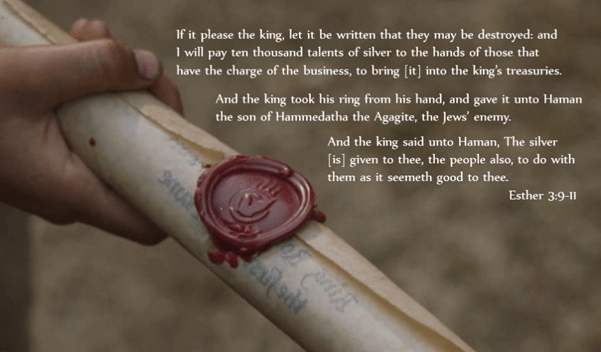
Then Haman informed King Xerxes, “There is a certain people scattered and dispersed among the peoples of every province of your kingdom. Their laws are different from everyone else’s, and they do not obey the king’s laws. So it is not in the king’s best interest to tolerate them. If it pleases the king, let a decree be issued to destroy them, and I will deposit ten thousand talents of silver into the royal treasury to pay those who carry it out.” (10,000 talents is approximately 377 tons or 342 metric tons of silver.) So the king removed the signet ring from his finger and gave it to Haman son of Hammedatha, the Agagite, the enemy of the Jews. “Keep your money,” said the king to Haman. “These people are given to you to do with them as you please.”

Esther 3:9-11 - Godly LadiesOn the thirteenth day of the first month, the royal scribes were summoned and the order was written exactly as Haman commanded the royal satraps, the governors of each province, and the officials of each people, in the script of each province and the language of every people. It was written in the name of King Xerxes and sealed with the royal signet ring.

And the letters were sent by couriers to each of the royal provinces with the order to destroy, kill, and annihilate all the Jews—young and old, women and children—and to plunder their possessions on a single day, the thirteenth day of Adar, the twelfth month.

A copy of the text of the edict was to be issued in every province and published to all the people, so that they would be ready for that day. The couriers left, spurred on by the king’s command, and the law was issued in the citadel of Susa. Then the king and Haman sat down to drink, but the city of Susa was in confusion.”

Consider Haman, son of Hammedatha, the Agagite. For some reason, King Xerxes chose to honor Haman above all the other princes, commanding that everyone, including the other princes, should bow whenever they saw Haman. It’s likely that Haman had made a timely donation to the royal coffers or had done some other personal favor for the king. Perhaps Haman had learned something about the king that he could use as blackmail. Evidently, Haman was also one of the king’s drinking buddies. At any rate, Haman’s ego was “in a gaseous state and ever expanding,as writers in an earlier age might have said.

As an observant Jew, Mordecai could only bow before God but not before Haman, despite repeated warnings from the royal servants at the King’s Gate. Remember that Mordecai frequented the King’s Gate so that he could get news of Esther, his beloved niece, and he might have made friends with many of the guards. In addition, the guards probably realized that Mordecai was the one who had tipped off the two guards who had conspired against the king.  On the other hand, some of the guards might have been friends to the two who had been arrested and executed. The politics of the royal court at Susa were as slippery as anything ever conceived anywhere or at any time. It might have been a guard who was a friend to those who had been executed who slipped the word to Haman about Mordecai.

Drunk with power as well as with the king’s wine, Haman decided to carry out genocide against all the Jews in the empire. When Haman mentioned the matter to the king, the king was intoxicated and easily persuaded; after all, there were so many different races and peoples in the Persian Empire. Why not gratify Haman’s wishes to demonstrate royal munificence? Meanwhile, the city of Susa was in confusion because each ethnic group rightly feared that they might be the next one targeted for annihilation. One can only speculate as to how many other capricious decisions King Xerxes may have made while drunk.

APPLICATION: Consulting Wikipedia, it appears that Haman’s threats were the first organized attempts at genocide for the Jews. While earlier invaders had destroyed the temple in Jerusalem and had killed or carried off much of the population of Judah and Israel, these actions were those of “normal” invasion and not specifically antisemitic. (https://en.wikipedia.org/wiki/Timeline_of_antisemitism) Unfortunately, as this excellent article points out, throughout the centuries there have been repeated attempts of various kinds to wipe out God’s chosen people-massacres, seizure of property, expulsion from various countries, isolation in ghettoes, etc. Many of the other races that were included in the ancient Persian Empire have since vanished; however, despite all this persecution, the Jews remain and the State of Israel continues to flourish.

What has made the difference for the Jews? God cut covenant with Abraham as described in Genesis 15. God made many promises to David regarding his descendants. Despite all the failings of the Israelites, God continued to promise a magnificent future. God is a covenant-keeping God. Even when humans fail, God remains faithful to His promises.    

Why didn’t Mordecai simply bow before Haman? King Xerxes had issued a royal command; why wouldn’t Mordecai honor that command? After all, everybody else in the kingdom was doing so.  Would Mordecai bow before Xerxes if he met Xerxes? Or did Mordecai refuse to bow to Haman because he knew Haman’s character so well? Mordecai worshiped the One True Living God; was it God who told Mordecai not to bow, thus provoking Haman’s wrath? Perhaps God had singled out Haman for destruction and Mordecai was to be the instrument of that destruction.

Although we might never face the threats of extinction of our entire nationality as did Mordecai, we might find ourselves facing similar difficult situations. What do you do if you are working for a corrupt boss and he/she makes totally unreasonable demands on your resources? If your boss is involved in shady dealings and you are asked to testify against him/her,  will you do so, knowing that it might cost you your job? One of our friends was sacked on totally fabricated grounds, forcing him and his family to suffer. To this day, he can only speculate that the individual responsible thought our friend had seen something wrong that person had done and was likely to testify against that person. (Our friend has no idea what he was supposed to have seen.)

There are many lessons to learn from this short book of Esther, but one of them is this: We must honor God above everyone else and trust that God will also help us. If we must suffer, let us suffer for righteousness’ sake.

PRAYER: Father God, thank You for loving us and for caring for us. Lord, help us to seek Your Will for our lives at all times and then to do Your Will, even when that course of action seems to lead to disaster. Help us to remember that we are not merely working for earthly rewards, but for heavenly ones. In the mighty and precious Name of King Jesus. Amen.
MARCH 11, 2026 ORIGINALLY PUBLISHED FEBRUARY 27, 2023 WHO KNOWS BUT WHAT YOU HAVE COME TO THE KINGDOM FOR SUCH A TIME AS THIS?#4 ESTHER 2:19-23 WHY BE LOYAL TO A PAGAN KING?

March 11, 2026

Mordecai Uncovers a Conspiracy

“When the virgins were assembled a second time, Mordecai was sitting at the king’s gate. But Esther had kept secret her family background and nationality just as Mordecai had told her to do, for she continued to follow Mordecai’s instructions as she had done when he was bringing her up.

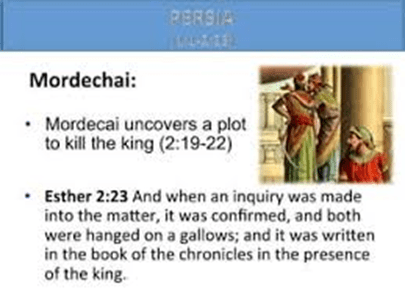
During the time Mordecai was sitting at the king’s gate, Bigthana and Teresh, two of the king’s officers who guarded the doorway, became angry and conspired to assassinate King Xerxes. But Mordecai found out about the plot and told Queen Esther, who in turn reported it to the king, giving credit to Mordecai. And when the report was investigated and found to be true, the two officials were impaled on poles. All this was recorded in the book of the annals in the presence of the king.”

“Who’s that old guy sitting there by the gate?” Bigthana asked Teresh as the two gate guards stood at the entry way to the court of King Xerxes in Susa. “Oh, that’s that wretched Jew Mordecai; he’s harmless. Mordecai walks by here every day and sometimes he sits in the gate with the other old men. He probably can’t even see or hear very well. Don’t worry about him; he’s no threat to us. But when do you think we can get rid of King Xerxes?” The position of gate guard was a very important one; only strong warriors who were trustworthy were selected for this work. We don’t know why these two guards began scheming to assassinate King Xerxes; however, ignoring Mordecai proved to be a fatal mistake. Mordecai was neither blind nor deaf and he evidently enjoyed a good reputation in the city of Susa. When Mordecai got wind of the assassination plot, he told Esther and Esther informed King Xerxes. Xerxes immediately investigated and summarily dealt with the two conspirators, putting them to death in a grisly fashion to discourage future threats. And some scribe sitting in a Persian office dutifully recorded Mordecai’s name and his acts for the records. Remember that scribe, because his records will prove to be vitally important.

Meanwhile, back in the palace, Esther was maintaining a low profile as far as her nationality was concerned. Xerxes didn’t care; he was enticed by Esther’s beauty and her lovely personality. The Persian Empire included thousands of different nationalities, so Esther’s origins were of little interest to the king.  Somehow, Mordecai and Esther were continuing to communicate, perhaps through Hegai, the head of the royal harem.

APPLICATION: Mordecai was an exile, “a stranger in a strange land.” Although Mordecai could have remained bitter about being carried off from his home country, he maintained a positive attitude. Why? The answers lie in a letter God had the prophet Jeremiah write to those in exile as recorded in Jeremiah 29:1-7.

This is the text of the letter that the prophet Jeremiah sent from Jerusalem to the surviving elders among the exiles and to the priests, the prophets and all the other people Nebuchadnezzar had carried into exile from Jerusalem to Babylon. (This was after King Jehoiachin and the queen mother, the court officials and the leaders of Judah and Jerusalem, the skilled workers and the artisans had gone into exile from Jerusalem.) He entrusted the letter to Elasah son of Shaphan and to Gemariah son of Hilkiah, whom Zedekiah king of Judah sent to King Nebuchadnezzar in Babylon. It said:

This is what the Lord Almighty, the God of Israel, says to all those I carried into exile from Jerusalem to Babylon: “Build houses and settle down; plant gardens and eat what they produce. Marry and have sons and daughters; find wives for your sons and give your daughters in marriage, so that they too may have sons and daughters. Increase in number there; do not decrease. Also, seek the peace and prosperity of the city to which I have carried you into exile. Pray to the Lord for it, because if it prospers, you too will prosper.” 

Given the fact that Mordecai was an observant Jew, he would certainly have known about Jeremiah’s message and would have respected it. It’s quite likely that as Mordecai was walking around Susa, he was praying for the city and especially for Esther and King Xerxes. Once Esther became queen, Mordecai needed to pray for Xerxes to have a long healthy reign. Were Xerxes to die, Esther might find herself relegated to the harem for the remainder of her life. For all of these reasons, Mordecai needed to report any threats to the king as quickly as possible.

APPLICATION: No matter where we live, we are all subject to governments which are fallible. Political parties rise and fall, economies can collapse, and nothing is certain. God’s advice through Jeremiah is as important for us today as it was to the Jews in the Persian Empire.

  1. Continue to pray for the government of the country in which you live.
  2. Pray for righteous leadership and pray for protection for the righteous.
  3. Seek the peace and prosperity of the country in which you live.
  4. Pray for your fellow citizens to know God.
  5. Remember that no matter how evil a ruler might be, God still loved that man or woman so much that He sent His Son Jesus Christ to die for their sins. There is nobody so evil that he or she is beyond the reach of God.

PRAYER:  Father God, thank You for loving us and for caring for us. Help us to pray for our towns and villages and for our countries. Help us to view all of our fellow citizens as people for whom Jesus died. In the mighty and precious Name of King Jesus. Amen.
MARCH 10, 2026 ORIGINALLY PUBLISHED FEBRUARY 26, 2023 “WHO KNOWS BUT WHAT YOU HAVE COME TO THE KINGDOM FOR SUCH A TIME AS THIS?#3 ESTHER 2:12-18 ESTHER WINS THE BEAUTY CONTEST BECAUSE OF HER MODESTY, NOT IN SPITE OF IT

March 10, 2026

Esther 2:12-18 “Before a young woman’s turn came to go in to King Xerxes, she had to complete twelve months of beauty treatments prescribed for the women, six months with oil of myrrh and six with perfumes and cosmetics. And this is how she would go to the king: Anything she wanted was given her to take with her from the harem to the king’s palace. In the evening she would go there and in the morning return to another part of the harem to the care of Shaashgaz, the king’s eunuch who was in charge of the concubines. She would not return to the king unless he was pleased with her and summoned her by name.

When the turn came for Esther (the young woman Mordecai had adopted, the daughter of his uncle Abihail) to go to the king, she asked for nothing other than what Hegai, the king’s eunuch who was in charge of the harem, suggested. And Esther won the favor of everyone who saw her. She was taken to King Xerxes in the royal residence in the tenth month, the month of Tebeth, in the seventh year of his reign.

Now the king was attracted to Esther more than to any of the other women, and she won his favor and approval more than any of the other virgins. So he set a royal crown on her head and made her queen instead of Vashti. And the king gave a great banquet, Esther’s banquet, for all his nobles and officials. He proclaimed a holiday throughout the provinces and distributed gifts with royal liberality.”

Twelve months! Twelve anxious months passed while Esther underwent the finest beauty treatments. Daily, Esther watched young women leave the harem to visit the king for one night, and daily she learned that yet another young woman had been sent to stay in the section of the harem reserved for the concubines. Daily, Mordecai continued casually walking past the courtyard of the harem in hopes of getting some word about Esther. The strain for both Mordecai and Esther must have been unthinkable. Daily, the two of them prayed for each other, begging God to bless and keep them and to one day unite them.

Esther watched as other young women carried all kinds of things with them from the harem to impress the king – jewelry, seductive clothing, special perfumes, musical instruments, and anything else the lady thought might make her stand out. Finally, Hegei informed Esther that it would be her turn tomorrow. “What should I take with me?” Esther asked Hegei. Hegei advised Esther, “Don’t worry about playing instruments or dancing, or making a big show. The king is really looking for someone loving, kind and virtuous, someone who will care about him and who can be counted on to be discrete. Your character, your grace, and your virtue shine from you, and those are the best things you can carry with you. For the rest of it, allow me to suggest the garments you should wear, for the king is searching for a queen, not for a prostitute. Rest assured, you have endeared yourself to all of us, and you will also endear yourself to the king.”

Esther listened and followed Hegei’s advice. Wearing a simple but striking gown, Esther came to the king without any gimmicks or strategies. Before entering the king’s presence, Esther prayed, “Lord God of Israel, help me!” And God did. Xerxes was enchanted by this lovely young woman who was well – spoken, kind, modest, and intelligent. The longer Xerxes spent in Esther’s presence, the more appealing he found her. “Finally,” thought Xerxes, “I have found my true queen!” Xerxes was so thrilled that he immediately crowned Esther and held a royal banquet in her honor. To celebrate the new queen, Xerxes distributed lavish gifts throughout all the provinces, celebrating Esther in a magnificent way.

APPLICATION: Esther won the heart of the most powerful king in her world, not through stratagems or tricks but by the obvious goodness of her heart and her character. Sadly, these days many young women are failing to follow her example.

In 1 Timothy 2:9 Paul advises Timothy to caution the women who are believers to “adorn themselves in modest apparel with propriety and moderation, not with braided hair or gold or pearls or costly clothing.” Evidently, there were controversies about dress 2000 years ago just as there are today. And some of the ladies of the early church had evidently adopted the “if you’ve got it, flaunt it!” philosophy. But showing off one’s wealth or one’s physical assets scarcely promotes worship. Recently, one famous Gospel musician here in Ghana stated that he would no longer sing special numbers during church offerings because some of the ladies of the church were dressing in such a provocative fashion that it distracted him from worshiping the Lord. Years ago, we lived in mid-town Memphis in a tough area where prostitutes were flagging down cars less than a block from our house. These days, some of the dresses young women are wearing to church remind us a great deal of the outfits worn by those prostitutes.

Does this mean that we are horrible old fuddy-duddies who are opposed to young people dressing nicely? Far from it! But when young women appear in church with dresses so tight that they can scarcely breathe and with extremely short skirts and extremely low-cut tops, such dress does not glorify God, nor will it attract young men of good character. Young men will definitely look; however, the question remains that if the young woman is willing to dress like this before marriage, will she change or will she continue to dress like that after marriage? And if she dresses like that after marriage, why should she dress in such a fashion? Will she remain faithful? Such dress is more likely to attract rapists rather than husbands!

1 Corinthians 6:19-20 tells us, “Do you not know that your body is a temple of the Holy Spirit, who is in you, whom you have received from God? You are not your own; you were bought at a price. Therefore honor God with your body.” If we claim to follow God, we must reflect His character, His holiness, His righteousness, His goodness, His purity. Esther won a crown and ultimately saved her people from annihilation by her character. Who knows what we might accomplish?

PRAYER: Father God, thank You for loving us and for caring for us. Lord, please help us to please You in our mode of dress and not merely to dress to attract attention. Help us to remember that others are watching us and judging us on the basis of our behavior, just as all in that harem watched Esther for those twelve months. Let these scriptures speak to the hearts of all who read them! In the matchless Name of King Jesus. Amen.

MARCH 9, 2026 ORIGINALLY PUBLISHED FEBRUARY 25, 2023 WHO KNOWS BUT WHAT YOU HAVE COME TO THE KINGDOM FOR SUCH A TIME AS THIS #2 ESTHER 2:1-11 WHEN YOU MUST WATCH YOUR CHILD ENTER AN UNCERTAIN SITUATION, WHAT DO YOU DO?

March 9, 2026

 “Later when King Xerxes’ fury had subsided, he remembered Vashti and what she had done and what he had decreed about her. Then the king’s personal attendants proposed, “Let a search be made for beautiful young virgins for the king. Let the king appoint commissioners in every province of his realm to bring all these beautiful young women into the harem at the citadel of Susa. Let them be placed under the care of Hegai, the king’s eunuch, who is in charge of the women; and let beauty treatments be given to them. Then let the young woman who pleases the king be queen instead of Vashti.” This advice appealed to the king, and he followed it.

Now there was in the citadel of Susa a Jew of the tribe of Benjamin, named Mordecai son of Jair, the son of Shimei, the son of Kish, who had been carried into exile from Jerusalem by Nebuchadnezzar king of Babylon, among those taken captive with Jehoiachin king of Judah. Mordecai had a cousin named Hadassah, whom he had brought up because she had neither father nor mother. This young woman, who was also known as Esther, had a lovely figure and was beautiful. Mordecai had taken her as his own daughter when her father and mother died.

When the king’s order and edict had been proclaimed, many young women were brought to the citadel of Susa and put under the care of Hegai. Esther also was taken to the king’s palace and entrusted to Hegai, who had charge of the harem. She pleased him and won his favor. Immediately he provided her with her beauty treatments and special food. He assigned to her seven female attendants selected from the king’s palace and moved her and her attendants into the best place in the harem.

Esther had not revealed her nationality and family background, because Mordecai had forbidden her to do so. Every day he walked back and forth near the courtyard of the harem to find out how Esther was and what was happening to her.”

Putting it bluntly, King Xerxes sobers up and suddenly realizes that he has banished Queen Vashti in a drunken rage. As a monarch with absolute power, Xerxes can’t apologize; nevertheless, he really needs a queen gorgeous enough and charming enough to match the splendor of his kingdom. Vashti is breath-takingly beautiful, but she is now out of Xerxes’ reach. What to do? Wiping their brows in relief that the king is now thinking logically, the advisors suggest that commissioners be appointed in every province and that a contest for “Persia’s Most Beautiful” be conducted. These commissioners  will seek out  the most beautiful young virgins and send them to the palace harem in the capital of Susa. The young lovelies will receive the finest beauty treatments and will be brought to Xerxes one by one. The lady who pleases Xerxes will become the new queen.

Living in Susa is a Jew from the tribe of Benjamin named Mordecai. Mordecai is a close relative to King Saul and he has been rearing his cousin Hadassah (Esther) because she is an orphan. As Esther has developed, Mordecai has probably cherished hopes of arranging an excellent marriage for Esther with an observant young Jewish man; however, now Esther has also joined the other virgins in the palace harem. Obviously a young woman of fine character, Esther has so impressed Hegai, the head of the harem, that he is providing beauty treatments, special food, seven attendants from the palace, and the best place in the harem. What the other virgins think about the special attention is best left to the imagination. It’s a mercy of God that some rival does not poison Esther out of spite!

Poor Mordecai! Mordecai loves Esther dearly; however, he has cautioned her to hide her nationality and family background for fear of antisemitic prejudice. All Mordecai can do is to walk daily near the courtyard of the harem, hoping for news of Esther, and he must be careful not to display undue interest, lest someone begin asking embarrassing questions. What if Esther fails to please the king? Will the king insist of keeping Esther in the harem as a concubine for the rest of her life? What if one of the other women tries to harm Esther? Everyone knows that harems are full of intrigue.

APPLICATION: Many times, we focus so much on the character of Esther in this short book that we fail to fully appreciate Mordecai, his character, his love for Esther, and his example for the rest of us. Mordecai has devoted his life to raising Esther to be a fine young woman of excellent character. It’s likely that if Esther did not have a good reputation, the commissioners wouldn’t have bothered to send her to the harem for the king’s consideration. Those commissioners undoubtedly know how to do background checks, and they have already eliminated several young women with fair faces but bad character. Esther’s candidacy is a tribute to Mordecai’s rearing. Until now, Mordecai has protected Esther, but now Esther has been removed from Mordecai’s protection. All Mordecai can do is to pray for God’ protection over Esther. Mordecai is in a precarious position, one that also puts Esther at risk. Mordecai is a known person in Susa, and his nationality is also well known. Esther’s connection with Mordecai needs to remain a secret for now, lest someone use that against Esther.

Mordecai is the example of every parent who has ever sent a child off to school or to work in a distant location. Few feelings are as helpless; any caring parent can tell you just how much they wind up praying for their children.  If that child becomes sick, you may not be able to help them. If the child dies, your feeling of helplessness only multiplies.

Our children are older and they live in America; however, we have many Ghanaian young people who are as close to us as if we had given birth to them. On Easter Sunday 2015, we were in our regional capital for a party for a friend. Before the party, we stopped to see Musah, one of our “sons” who was completing a two – year computer course. Musah mentioned that he had been ill and was taking malaria treatment. We prayed for him and then went to the party. Two hours later, our friends with whom Musah was staying called us in a panic because Musah had collapsed! Although our friends rushed Musah to a nearby hospital and although we joined them, there was nothing we could do. Musah died in my arms. We still grieve, although Musah was a Christian and we know one day we will see him again.

As you read today’s selection, think about Mordecai and then pray for all the young people you know who are going off to school or to new jobs or to war.

PRAYER: Father God, thank You for loving us and for caring for us. Lord, we lift up parents and children as these parents courageously allow their children to move forward with their lives. Be with both parents and children and help us to remember that You love these young people far more than we ever can. In the mighty and precious Name of King Jesus. Amen.

MARCH 8, 2026 ORIGINALLY PUBLISHED FEBRUARY 24, 2023 WHO KNOWS BUT WHAT YOU HAVE COME TO THE KINGDOM FOR SUCH A TIME AS THIS? ESTHER 1:1-22 GOD CAN EVEN USE A DRUNKEN DESPOT TO WORK OUT HIS WILL

March 8, 2026

In view of the Iranian conflict, I feel God wants me to re-post the series I originally wrote on the Book of Esther in 2023.

The Empire Has No Clothes (Esther 1:1–22) — Refuge ChurchQueen Vashti Deposed

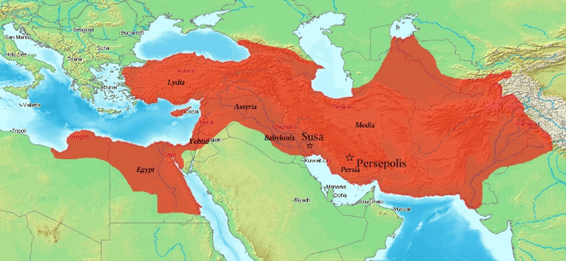
“This is what happened during the time of Xerxes,(Ahasuerus in Hebrew) the Xerxes who ruled over 127 provinces stretching from India to Cush(the Upper Nile Region):  At that time King Xerxes reigned from his royal throne in the citadel of Susa, and in the third year of his reign he gave a banquet for all his nobles and officials. The military leaders of Persia and Media, the princes, and the nobles of the provinces were present.

For a full 180 days (6 months) he displayed the vast wealth of his kingdom and the splendor and glory of his majesty. When these days were over, the king gave a banquet, lasting seven days, in the enclosed garden of the king’s palace, for all the people from the least to the greatest who were in the citadel of Susa. The garden had hangings of white and blue linen, fastened with cords of white linen and purple material to silver rings on marble pillars. There were couches of gold and silver on a mosaic pavement of porphyry, marble, mother-of-pearl and other costly stones. Wine was served in goblets of gold, each one different from the other, and the royal wine was abundant, in keeping with the king’s liberality. By the king’s command each guest was allowed to drink with no restrictions, for the king instructed all the wine stewards to serve each man what he wished. (Some versions say “the drinking was not compulsory,” indicating that some rulers would force their guests to get drunk.) Queen Vashti also gave a banquet for the women in the royal palace of King Xerxes.

On the seventh day, when King Xerxes was in high spirits from wine, he commanded the seven eunuchs who served him—Mehuman, Biztha, Harbona, Bigtha, Abagtha, Zethar and Karkas—to bring before him Queen Vashti, wearing her royal crown, in order to display her beauty to the people and nobles, for she was lovely to look at. But when the attendants delivered the king’s command, Queen Vashti refused to come. (It’s possible that Xerxes wanted Vashti to be naked apart from her crown; he was drunk enough to do that!) Then the king became furious and burned with anger.

Since it was customary for the king to consult experts in matters of law and justice, he spoke with the wise men who understood the times and were closest to the king—Karshena, Shethar, Admatha, Tarshish, Meres, Marsena and Memukan, the seven nobles of Persia and Media who had special access to the king and were highest in the kingdom. “According to law, what must be done to Queen Vashti?” he asked. “She has not obeyed the command of King Xerxes that the eunuchs have taken to her.”

Then Memukan replied in the presence of the king and the nobles, “Queen Vashti has done wrong, not only against the king but also against all the nobles and the peoples of all the provinces of King Xerxes. For the queen’s conduct will become known to all the women, and so they will despise their husbands and say, ‘King Xerxes commanded Queen Vashti to be brought before him, but she would not come.’ This very day the Persian and Median women of the nobility who have heard about the queen’s conduct will respond to all the king’s nobles in the same way. There will be no end of disrespect and discord.

“Therefore, if it pleases the king, let him issue a royal decree and let it be written in the laws of Persia and Media, which cannot be repealed, that Vashti is never again to enter the presence of King Xerxes. Also let the king give her royal position to someone else who is better than she. Then when the king’s edict is proclaimed throughout all his vast realm, all the women will respect their husbands, from the least to the greatest.”

The king and his nobles were pleased with this advice, so the king did as Memukan proposed. He sent dispatches to all parts of the kingdom, to each province in its own script and to each people in their own language, proclaiming that every man should be ruler over his own household, using his native tongue.”

Talk about celebrating your achievements! King Xerxes has been celebrating himself and his empire for the last six months. There have been parades, military demonstrations, athletic games, horse races, and every other entertainment an immensely powerful ruler can imagine. Now Xerxes has given a final banquet lasting seven days for all the men in the kingdom. (What? You thought “people” referred to women? No way!) Xerxes himself has probably stayed drunk for much of that time, although he has allowed his guests to drink as much or as little as they wish. This fact is noted because in those days, some rulers would have forced their guests to become completely wasted. Gee, what a great guy! After drinking and feasting for seven days straight, Xerxes suddenly decides that Q               ueen Vashti should appear in her royal crown – likely in her crown and nothing else – so that he can flaunt the fact that his queen is the most beautiful woman in the kingdom. Being sober and in her right mind, Vashti refuses. But this refusal infuriates Xerxes. Having spent the last six months celebrating himself and being thoroughly drunk, Xerxes is in no mood for refusals by anybody, especially a woman, no matter how beautiful she is.

Xerxes consults his seven advisers, who are probably just as drunk as he is. Thanks to some anonymous scribe, we even know the names of these men: “Karshena, Shethar, Admatha, Tarshish, Meres, Marsena and Memukan, the seven nobles of Persia and Media who had special access to the king and were highest in the kingdom.” These guys might be drunk, but they aren’t stupid, and they realize that their own positions depend on whether or not Xerxes accepts their advice. There are probably lots of other sages in the kingdom who would be more than happy to replace them. Given the reality of the situation and the unspoken threats from King Xerxes, the advisers have little choice but to suggest that Queen Vashti be retired to the royal harem, where she will spend the rest of her life in seclusion. Then Xerxes can find some new and even more gorgeous queen and women throughout the empire will be afraid to say anything against their husbands for fear of similar banishment. And to hide Xerxes’ embarrassment, the advisers send out a royal edict stating that “every man should be ruler over his own household” in all the various languages used throughout the various parts of the empire.   

APPLICATION: The Book of Esther is quirky. Why preserve the account of a six-month long royal indulgence capped off by a seven-day long drunk and followed by a capricious royal edict? And yet….and yet God has allowed this small Book to be included for lots of reasons. Most of us have relatively little control over many of the circumstances of our lives. As the line from the song from Fiddler on the Roof says, “Life has a way of abusing us, blessing and bruising us!”

Through the years, God has used this small Book to encourage believers in all kinds of circumstances, including concentration camps, prisons, poverty, joblessness, etc. TODAY GOD WANTS YOU TO KNOW THAT HE IS ENGINEERING YOUR CIRCUMSTANCES, WEIRD AS THEY MIGHT SEEM! GOD WANTS YOU TO WATCH, BECAUSE HE IS GOING TO USE THE VERY THINGS THAT HURT AND CONFUSE YOU TO WORK OUT SOMETHING WONDERFUL!

Let’s pray.

PRAYER: Father God, thank You for loving us and for caring for us. Lord, many of us are bewildered by the chaos around us. Help us to realize that Your hand is never shortened and that You are never confused or bewildered and that You are a God of peace. Please send Your peace into the hearts of all who read these words. In the matchless Name of King Jesus. Amen.