Archive for March, 2026

PRECIOUS LORD, TAKE MY HAND MARCH 12, 2026

March 12, 2026

We just lost a wonderful friend from our days at Faith United Methodist in Southaven, MS, Bobby Walters. While posting condolence messages, I saw another post from a friend, urging church worship leaders to consider incorporating older worship songs into services. The post continued that those songs might minister to people for they might be the songs sung at the funeral of a close relative or the songs that were sung the night a man fell to his knees and accepted Jesus. I agree whole-heartedly and also urge worship leaders truly passionate about their calling to study hymns and praise songs far older than the ones referred to in that post.

Forty years ago, we were part of a wonderful Spirit-filled congregation at Faith United Methodist in Southaven, MS. The Holy Spirit moved in remarkable ways, and the prayer times at the end of church were not to be missed, for anointed ministry might continue for hours. It’s a sad mistake to cram a prayer time into the middle of a service, for inevitably, the pastor will be tempted to keep things short. Unfortunately, sometimes Holy Spirit ministry can take a long time, and ten minutes in the midst of a service is like demanding a cow only eat two blades of grass. The agreement at Faith was that whoever was the last one out of the building should lock up.

In addition to Sunday morning services, Faith also had Sunday night services, and the ministry and teaching were wonderful. Sunday night was a time when people could share special music, and it was quite common for several people to do solos. I had been asked to sing at one Sunday night service, and I was busily checking out the accompaniment tape options at the local Christian bookstore. (Notice: tapes, not CDs or MP3 downloads; this is the 1980’s.) But when I prayed, the only title God would give me was the Thomas A. Dorsey song “Precious Lord, Take My Hand.” The song is simple and can be sung with or without accompaniment. I argued with the Lord because I wanted to show off, demonstrating my vocal abilities on something more challenging, but He wasn’t budging. So that Sunday night in 1986, when I got up to sing, I introduced the song by explaining that God obviously meant this song for someone in the congregation and that they would know it was for them. I sang; the congregation applauded enthusiastically; and the service eventually ended. That was when the late Nancy Jolley, one of my friends, rushed up to me. Nancy was practically hopping up and down and vibrating with excitement.


“That song was for me!” Nancy exclaimed. Then Nancy explained that she had just returned from her father’s funeral in Illinois and was still grieving. The phrase “Precious Lord, Take My Hand” was the inscription chosen by the family for her father’s tombstone. Nancy went on to say that she had nearly stayed home that Sunday night but felt compelled to come to church. Now Nancy was in tears as she realized that God was already preparing that song just for her.

Since that night in Southaven, MS, I have sung that song several times at funerals, including the funerals of my father-in law and both brothers-in law. I never sing it without being moved.

Thomas Andrew Dorsey is considered the Father of Gospel Music. Dorsey wrote this song upon learning that his wife had just died in childbirth while he was out of town at a meeting. With nowhere else to turn, Dorsey began praying, “Precious Lord, take my hand,” and God gave him the rest of the song. For a great introduction to Dorsey as well as other Gospel musicians, check out the video “Say Amen, Somebody!”

The song lyrics are as follows:

Precious Lord, take my hand,
Lead me on, let me stand,
I am tired, I am weak, I am worn;
Through the storm, through the night,
Lead me on to the light:

Refrain

Take my hand, precious Lord,
Lead me home.

When my way grows drear,
Precious Lord, linger near,
When my life is almost gone,
Hear my cry, hear my call,
Hold my hand lest I fall:

Refrain

When the darkness appears
And the night draws near,
And the day is past and gone,
At the river, I stand,
Guide my feet, hold my hand:

Refrain

For a wonderful performance of this song, view Mahalia Jackson singing it at https://www.youtube.com/watch?v=as1rsZenwNc

So worship leaders, remember that while you might be thrilled by the latest and greatest Christian hits, ministry means you get yourself out of the way and let God work.

And Walters family-if you see this post, please let this song minister to you.

PRAYER: Father God, thank You for loving us and caring for us. Lord, as we reach out, please take our hands and lead us to our heavenly homes that You have prepared for us. In the mighty and precious Name of King Jesus. Amen.

MARCH 12, 2026 ORIGINALLY POSTED FEBRUARY 28, 2023 WHO KNOWS BUT WHAT YOU HAVE COME TO THE KINGDOM FOR SUCH A TIME AS THIS?#5 ESTHER 3:1-23 FEAR THOSE WITH EGOS THAT JUST WON’T QUIT!

March 12, 2026

Haman’s Plot against the Jews

“After these events, King Xerxes honored Haman son of Hammedatha, the Agagite, elevating him to a position above all the princes who were with him. All the royal servants at the King’s Gate bowed down and paid homage to Haman, because the king had commanded this for him. But Mordecai would not bow down or pay homage.

Then the royal servants at the King’s Gate asked Mordecai, “Why do you disobey the command of the king?” Day after day they warned him, but he would not comply. So they reported it to Haman to see whether Mordecai’s behavior would be tolerated, since he had told them he was a Jew.

When Haman saw that Mordecai would not bow down or pay him homage, he was filled with rage. And when he learned the identity of Mordecai’s people, he scorned the notion of laying hands on Mordecai alone. Instead, he sought to destroy all of Mordecai’s people, the Jews, throughout the kingdom of Xerxes.

In the twelfth year of King Xerxes, in the first month, the month of Nisan, the Pur (that is, the lot) was cast before Haman to determine a day and month. And the lot fell on the twelfth month, the month of Adar.

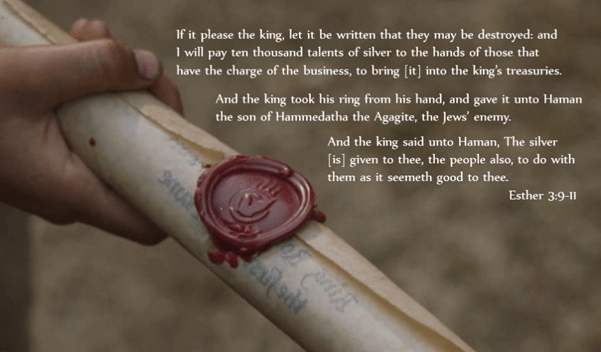
Then Haman informed King Xerxes, “There is a certain people scattered and dispersed among the peoples of every province of your kingdom. Their laws are different from everyone else’s, and they do not obey the king’s laws. So it is not in the king’s best interest to tolerate them. If it pleases the king, let a decree be issued to destroy them, and I will deposit ten thousand talents of silver into the royal treasury to pay those who carry it out.” (10,000 talents is approximately 377 tons or 342 metric tons of silver.) So the king removed the signet ring from his finger and gave it to Haman son of Hammedatha, the Agagite, the enemy of the Jews. “Keep your money,” said the king to Haman. “These people are given to you to do with them as you please.”

Esther 3:9-11 - Godly LadiesOn the thirteenth day of the first month, the royal scribes were summoned and the order was written exactly as Haman commanded the royal satraps, the governors of each province, and the officials of each people, in the script of each province and the language of every people. It was written in the name of King Xerxes and sealed with the royal signet ring.

And the letters were sent by couriers to each of the royal provinces with the order to destroy, kill, and annihilate all the Jews—young and old, women and children—and to plunder their possessions on a single day, the thirteenth day of Adar, the twelfth month.

A copy of the text of the edict was to be issued in every province and published to all the people, so that they would be ready for that day. The couriers left, spurred on by the king’s command, and the law was issued in the citadel of Susa. Then the king and Haman sat down to drink, but the city of Susa was in confusion.”

Consider Haman, son of Hammedatha, the Agagite. For some reason, King Xerxes chose to honor Haman above all the other princes, commanding that everyone, including the other princes, should bow whenever they saw Haman. It’s likely that Haman had made a timely donation to the royal coffers or had done some other personal favor for the king. Perhaps Haman had learned something about the king that he could use as blackmail. Evidently, Haman was also one of the king’s drinking buddies. At any rate, Haman’s ego was “in a gaseous state and ever expanding,as writers in an earlier age might have said.

As an observant Jew, Mordecai could only bow before God but not before Haman, despite repeated warnings from the royal servants at the King’s Gate. Remember that Mordecai frequented the King’s Gate so that he could get news of Esther, his beloved niece, and he might have made friends with many of the guards. In addition, the guards probably realized that Mordecai was the one who had tipped off the two guards who had conspired against the king.  On the other hand, some of the guards might have been friends to the two who had been arrested and executed. The politics of the royal court at Susa were as slippery as anything ever conceived anywhere or at any time. It might have been a guard who was a friend to those who had been executed who slipped the word to Haman about Mordecai.

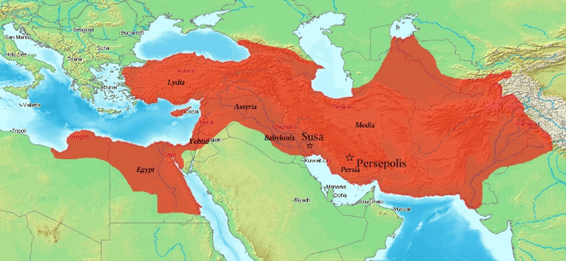
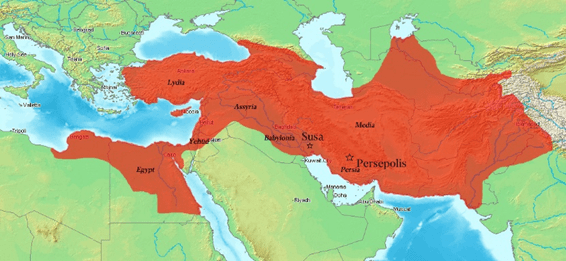
Drunk with power as well as with the king’s wine, Haman decided to carry out genocide against all the Jews in the empire. When Haman mentioned the matter to the king, the king was intoxicated and easily persuaded; after all, there were so many different races and peoples in the Persian Empire. Why not gratify Haman’s wishes to demonstrate royal munificence? Meanwhile, the city of Susa was in confusion because each ethnic group rightly feared that they might be the next one targeted for annihilation. One can only speculate as to how many other capricious decisions King Xerxes may have made while drunk.

APPLICATION: Consulting Wikipedia, it appears that Haman’s threats were the first organized attempts at genocide for the Jews. While earlier invaders had destroyed the temple in Jerusalem and had killed or carried off much of the population of Judah and Israel, these actions were those of “normal” invasion and not specifically antisemitic. (https://en.wikipedia.org/wiki/Timeline_of_antisemitism) Unfortunately, as this excellent article points out, throughout the centuries there have been repeated attempts of various kinds to wipe out God’s chosen people-massacres, seizure of property, expulsion from various countries, isolation in ghettoes, etc. Many of the other races that were included in the ancient Persian Empire have since vanished; however, despite all this persecution, the Jews remain and the State of Israel continues to flourish.

What has made the difference for the Jews? God cut covenant with Abraham as described in Genesis 15. God made many promises to David regarding his descendants. Despite all the failings of the Israelites, God continued to promise a magnificent future. God is a covenant-keeping God. Even when humans fail, God remains faithful to His promises.    

Why didn’t Mordecai simply bow before Haman? King Xerxes had issued a royal command; why wouldn’t Mordecai honor that command? After all, everybody else in the kingdom was doing so.  Would Mordecai bow before Xerxes if he met Xerxes? Or did Mordecai refuse to bow to Haman because he knew Haman’s character so well? Mordecai worshiped the One True Living God; was it God who told Mordecai not to bow, thus provoking Haman’s wrath? Perhaps God had singled out Haman for destruction and Mordecai was to be the instrument of that destruction.

Although we might never face the threats of extinction of our entire nationality as did Mordecai, we might find ourselves facing similar difficult situations. What do you do if you are working for a corrupt boss and he/she makes totally unreasonable demands on your resources? If your boss is involved in shady dealings and you are asked to testify against him/her,  will you do so, knowing that it might cost you your job? One of our friends was sacked on totally fabricated grounds, forcing him and his family to suffer. To this day, he can only speculate that the individual responsible thought our friend had seen something wrong that person had done and was likely to testify against that person. (Our friend has no idea what he was supposed to have seen.)

There are many lessons to learn from this short book of Esther, but one of them is this: We must honor God above everyone else and trust that God will also help us. If we must suffer, let us suffer for righteousness’ sake.

PRAYER: Father God, thank You for loving us and for caring for us. Lord, help us to seek Your Will for our lives at all times and then to do Your Will, even when that course of action seems to lead to disaster. Help us to remember that we are not merely working for earthly rewards, but for heavenly ones. In the mighty and precious Name of King Jesus. Amen.
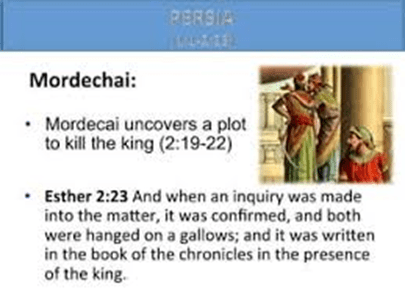
MARCH 11, 2026 ORIGINALLY PUBLISHED FEBRUARY 27, 2023 WHO KNOWS BUT WHAT YOU HAVE COME TO THE KINGDOM FOR SUCH A TIME AS THIS?#4 ESTHER 2:19-23 WHY BE LOYAL TO A PAGAN KING?

March 11, 2026

Mordecai Uncovers a Conspiracy

“When the virgins were assembled a second time, Mordecai was sitting at the king’s gate. But Esther had kept secret her family background and nationality just as Mordecai had told her to do, for she continued to follow Mordecai’s instructions as she had done when he was bringing her up.

During the time Mordecai was sitting at the king’s gate, Bigthana and Teresh, two of the king’s officers who guarded the doorway, became angry and conspired to assassinate King Xerxes. But Mordecai found out about the plot and told Queen Esther, who in turn reported it to the king, giving credit to Mordecai. And when the report was investigated and found to be true, the two officials were impaled on poles. All this was recorded in the book of the annals in the presence of the king.”

“Who’s that old guy sitting there by the gate?” Bigthana asked Teresh as the two gate guards stood at the entry way to the court of King Xerxes in Susa. “Oh, that’s that wretched Jew Mordecai; he’s harmless. Mordecai walks by here every day and sometimes he sits in the gate with the other old men. He probably can’t even see or hear very well. Don’t worry about him; he’s no threat to us. But when do you think we can get rid of King Xerxes?” The position of gate guard was a very important one; only strong warriors who were trustworthy were selected for this work. We don’t know why these two guards began scheming to assassinate King Xerxes; however, ignoring Mordecai proved to be a fatal mistake. Mordecai was neither blind nor deaf and he evidently enjoyed a good reputation in the city of Susa. When Mordecai got wind of the assassination plot, he told Esther and Esther informed King Xerxes. Xerxes immediately investigated and summarily dealt with the two conspirators, putting them to death in a grisly fashion to discourage future threats. And some scribe sitting in a Persian office dutifully recorded Mordecai’s name and his acts for the records. Remember that scribe, because his records will prove to be vitally important.

Meanwhile, back in the palace, Esther was maintaining a low profile as far as her nationality was concerned. Xerxes didn’t care; he was enticed by Esther’s beauty and her lovely personality. The Persian Empire included thousands of different nationalities, so Esther’s origins were of little interest to the king.  Somehow, Mordecai and Esther were continuing to communicate, perhaps through Hegai, the head of the royal harem.

APPLICATION: Mordecai was an exile, “a stranger in a strange land.” Although Mordecai could have remained bitter about being carried off from his home country, he maintained a positive attitude. Why? The answers lie in a letter God had the prophet Jeremiah write to those in exile as recorded in Jeremiah 29:1-7.

This is the text of the letter that the prophet Jeremiah sent from Jerusalem to the surviving elders among the exiles and to the priests, the prophets and all the other people Nebuchadnezzar had carried into exile from Jerusalem to Babylon. (This was after King Jehoiachin and the queen mother, the court officials and the leaders of Judah and Jerusalem, the skilled workers and the artisans had gone into exile from Jerusalem.) He entrusted the letter to Elasah son of Shaphan and to Gemariah son of Hilkiah, whom Zedekiah king of Judah sent to King Nebuchadnezzar in Babylon. It said:

This is what the Lord Almighty, the God of Israel, says to all those I carried into exile from Jerusalem to Babylon: “Build houses and settle down; plant gardens and eat what they produce. Marry and have sons and daughters; find wives for your sons and give your daughters in marriage, so that they too may have sons and daughters. Increase in number there; do not decrease. Also, seek the peace and prosperity of the city to which I have carried you into exile. Pray to the Lord for it, because if it prospers, you too will prosper.” 

Given the fact that Mordecai was an observant Jew, he would certainly have known about Jeremiah’s message and would have respected it. It’s quite likely that as Mordecai was walking around Susa, he was praying for the city and especially for Esther and King Xerxes. Once Esther became queen, Mordecai needed to pray for Xerxes to have a long healthy reign. Were Xerxes to die, Esther might find herself relegated to the harem for the remainder of her life. For all of these reasons, Mordecai needed to report any threats to the king as quickly as possible.

APPLICATION: No matter where we live, we are all subject to governments which are fallible. Political parties rise and fall, economies can collapse, and nothing is certain. God’s advice through Jeremiah is as important for us today as it was to the Jews in the Persian Empire.

  1. Continue to pray for the government of the country in which you live.
  2. Pray for righteous leadership and pray for protection for the righteous.
  3. Seek the peace and prosperity of the country in which you live.
  4. Pray for your fellow citizens to know God.
  5. Remember that no matter how evil a ruler might be, God still loved that man or woman so much that He sent His Son Jesus Christ to die for their sins. There is nobody so evil that he or she is beyond the reach of God.

PRAYER:  Father God, thank You for loving us and for caring for us. Help us to pray for our towns and villages and for our countries. Help us to view all of our fellow citizens as people for whom Jesus died. In the mighty and precious Name of King Jesus. Amen.

MARCH 10, 2026 ORIGINALLY PUBLISHED FEBRUARY 26, 2023 “WHO KNOWS BUT WHAT YOU HAVE COME TO THE KINGDOM FOR SUCH A TIME AS THIS?#3 ESTHER 2:12-18 ESTHER WINS THE BEAUTY CONTEST BECAUSE OF HER MODESTY, NOT IN SPITE OF IT

March 10, 2026

Esther 2:12-18 “Before a young woman’s turn came to go in to King Xerxes, she had to complete twelve months of beauty treatments prescribed for the women, six months with oil of myrrh and six with perfumes and cosmetics. And this is how she would go to the king: Anything she wanted was given her to take with her from the harem to the king’s palace. In the evening she would go there and in the morning return to another part of the harem to the care of Shaashgaz, the king’s eunuch who was in charge of the concubines. She would not return to the king unless he was pleased with her and summoned her by name.

When the turn came for Esther (the young woman Mordecai had adopted, the daughter of his uncle Abihail) to go to the king, she asked for nothing other than what Hegai, the king’s eunuch who was in charge of the harem, suggested. And Esther won the favor of everyone who saw her. She was taken to King Xerxes in the royal residence in the tenth month, the month of Tebeth, in the seventh year of his reign.

Now the king was attracted to Esther more than to any of the other women, and she won his favor and approval more than any of the other virgins. So he set a royal crown on her head and made her queen instead of Vashti. And the king gave a great banquet, Esther’s banquet, for all his nobles and officials. He proclaimed a holiday throughout the provinces and distributed gifts with royal liberality.”

Twelve months! Twelve anxious months passed while Esther underwent the finest beauty treatments. Daily, Esther watched young women leave the harem to visit the king for one night, and daily she learned that yet another young woman had been sent to stay in the section of the harem reserved for the concubines. Daily, Mordecai continued casually walking past the courtyard of the harem in hopes of getting some word about Esther. The strain for both Mordecai and Esther must have been unthinkable. Daily, the two of them prayed for each other, begging God to bless and keep them and to one day unite them.

Esther watched as other young women carried all kinds of things with them from the harem to impress the king – jewelry, seductive clothing, special perfumes, musical instruments, and anything else the lady thought might make her stand out. Finally, Hegei informed Esther that it would be her turn tomorrow. “What should I take with me?” Esther asked Hegei. Hegei advised Esther, “Don’t worry about playing instruments or dancing, or making a big show. The king is really looking for someone loving, kind and virtuous, someone who will care about him and who can be counted on to be discrete. Your character, your grace, and your virtue shine from you, and those are the best things you can carry with you. For the rest of it, allow me to suggest the garments you should wear, for the king is searching for a queen, not for a prostitute. Rest assured, you have endeared yourself to all of us, and you will also endear yourself to the king.”

Esther listened and followed Hegei’s advice. Wearing a simple but striking gown, Esther came to the king without any gimmicks or strategies. Before entering the king’s presence, Esther prayed, “Lord God of Israel, help me!” And God did. Xerxes was enchanted by this lovely young woman who was well – spoken, kind, modest, and intelligent. The longer Xerxes spent in Esther’s presence, the more appealing he found her. “Finally,” thought Xerxes, “I have found my true queen!” Xerxes was so thrilled that he immediately crowned Esther and held a royal banquet in her honor. To celebrate the new queen, Xerxes distributed lavish gifts throughout all the provinces, celebrating Esther in a magnificent way.

APPLICATION: Esther won the heart of the most powerful king in her world, not through stratagems or tricks but by the obvious goodness of her heart and her character. Sadly, these days many young women are failing to follow her example.

In 1 Timothy 2:9 Paul advises Timothy to caution the women who are believers to “adorn themselves in modest apparel with propriety and moderation, not with braided hair or gold or pearls or costly clothing.” Evidently, there were controversies about dress 2000 years ago just as there are today. And some of the ladies of the early church had evidently adopted the “if you’ve got it, flaunt it!” philosophy. But showing off one’s wealth or one’s physical assets scarcely promotes worship. Recently, one famous Gospel musician here in Ghana stated that he would no longer sing special numbers during church offerings because some of the ladies of the church were dressing in such a provocative fashion that it distracted him from worshiping the Lord. Years ago, we lived in mid-town Memphis in a tough area where prostitutes were flagging down cars less than a block from our house. These days, some of the dresses young women are wearing to church remind us a great deal of the outfits worn by those prostitutes.

Does this mean that we are horrible old fuddy-duddies who are opposed to young people dressing nicely? Far from it! But when young women appear in church with dresses so tight that they can scarcely breathe and with extremely short skirts and extremely low-cut tops, such dress does not glorify God, nor will it attract young men of good character. Young men will definitely look; however, the question remains that if the young woman is willing to dress like this before marriage, will she change or will she continue to dress like that after marriage? And if she dresses like that after marriage, why should she dress in such a fashion? Will she remain faithful? Such dress is more likely to attract rapists rather than husbands!

1 Corinthians 6:19-20 tells us, “Do you not know that your body is a temple of the Holy Spirit, who is in you, whom you have received from God? You are not your own; you were bought at a price. Therefore honor God with your body.” If we claim to follow God, we must reflect His character, His holiness, His righteousness, His goodness, His purity. Esther won a crown and ultimately saved her people from annihilation by her character. Who knows what we might accomplish?

PRAYER: Father God, thank You for loving us and for caring for us. Lord, please help us to please You in our mode of dress and not merely to dress to attract attention. Help us to remember that others are watching us and judging us on the basis of our behavior, just as all in that harem watched Esther for those twelve months. Let these scriptures speak to the hearts of all who read them! In the matchless Name of King Jesus. Amen.

MARCH 9, 2026 ORIGINALLY PUBLISHED FEBRUARY 25, 2023 WHO KNOWS BUT WHAT YOU HAVE COME TO THE KINGDOM FOR SUCH A TIME AS THIS #2 ESTHER 2:1-11 WHEN YOU MUST WATCH YOUR CHILD ENTER AN UNCERTAIN SITUATION, WHAT DO YOU DO?

March 9, 2026

 “Later when King Xerxes’ fury had subsided, he remembered Vashti and what she had done and what he had decreed about her. Then the king’s personal attendants proposed, “Let a search be made for beautiful young virgins for the king. Let the king appoint commissioners in every province of his realm to bring all these beautiful young women into the harem at the citadel of Susa. Let them be placed under the care of Hegai, the king’s eunuch, who is in charge of the women; and let beauty treatments be given to them. Then let the young woman who pleases the king be queen instead of Vashti.” This advice appealed to the king, and he followed it.

Now there was in the citadel of Susa a Jew of the tribe of Benjamin, named Mordecai son of Jair, the son of Shimei, the son of Kish, who had been carried into exile from Jerusalem by Nebuchadnezzar king of Babylon, among those taken captive with Jehoiachin king of Judah. Mordecai had a cousin named Hadassah, whom he had brought up because she had neither father nor mother. This young woman, who was also known as Esther, had a lovely figure and was beautiful. Mordecai had taken her as his own daughter when her father and mother died.

When the king’s order and edict had been proclaimed, many young women were brought to the citadel of Susa and put under the care of Hegai. Esther also was taken to the king’s palace and entrusted to Hegai, who had charge of the harem. She pleased him and won his favor. Immediately he provided her with her beauty treatments and special food. He assigned to her seven female attendants selected from the king’s palace and moved her and her attendants into the best place in the harem.

Esther had not revealed her nationality and family background, because Mordecai had forbidden her to do so. Every day he walked back and forth near the courtyard of the harem to find out how Esther was and what was happening to her.”

Putting it bluntly, King Xerxes sobers up and suddenly realizes that he has banished Queen Vashti in a drunken rage. As a monarch with absolute power, Xerxes can’t apologize; nevertheless, he really needs a queen gorgeous enough and charming enough to match the splendor of his kingdom. Vashti is breath-takingly beautiful, but she is now out of Xerxes’ reach. What to do? Wiping their brows in relief that the king is now thinking logically, the advisors suggest that commissioners be appointed in every province and that a contest for “Persia’s Most Beautiful” be conducted. These commissioners  will seek out  the most beautiful young virgins and send them to the palace harem in the capital of Susa. The young lovelies will receive the finest beauty treatments and will be brought to Xerxes one by one. The lady who pleases Xerxes will become the new queen.

Living in Susa is a Jew from the tribe of Benjamin named Mordecai. Mordecai is a close relative to King Saul and he has been rearing his cousin Hadassah (Esther) because she is an orphan. As Esther has developed, Mordecai has probably cherished hopes of arranging an excellent marriage for Esther with an observant young Jewish man; however, now Esther has also joined the other virgins in the palace harem. Obviously a young woman of fine character, Esther has so impressed Hegai, the head of the harem, that he is providing beauty treatments, special food, seven attendants from the palace, and the best place in the harem. What the other virgins think about the special attention is best left to the imagination. It’s a mercy of God that some rival does not poison Esther out of spite!

Poor Mordecai! Mordecai loves Esther dearly; however, he has cautioned her to hide her nationality and family background for fear of antisemitic prejudice. All Mordecai can do is to walk daily near the courtyard of the harem, hoping for news of Esther, and he must be careful not to display undue interest, lest someone begin asking embarrassing questions. What if Esther fails to please the king? Will the king insist of keeping Esther in the harem as a concubine for the rest of her life? What if one of the other women tries to harm Esther? Everyone knows that harems are full of intrigue.

APPLICATION: Many times, we focus so much on the character of Esther in this short book that we fail to fully appreciate Mordecai, his character, his love for Esther, and his example for the rest of us. Mordecai has devoted his life to raising Esther to be a fine young woman of excellent character. It’s likely that if Esther did not have a good reputation, the commissioners wouldn’t have bothered to send her to the harem for the king’s consideration. Those commissioners undoubtedly know how to do background checks, and they have already eliminated several young women with fair faces but bad character. Esther’s candidacy is a tribute to Mordecai’s rearing. Until now, Mordecai has protected Esther, but now Esther has been removed from Mordecai’s protection. All Mordecai can do is to pray for God’ protection over Esther. Mordecai is in a precarious position, one that also puts Esther at risk. Mordecai is a known person in Susa, and his nationality is also well known. Esther’s connection with Mordecai needs to remain a secret for now, lest someone use that against Esther.

Mordecai is the example of every parent who has ever sent a child off to school or to work in a distant location. Few feelings are as helpless; any caring parent can tell you just how much they wind up praying for their children.  If that child becomes sick, you may not be able to help them. If the child dies, your feeling of helplessness only multiplies.

Our children are older and they live in America; however, we have many Ghanaian young people who are as close to us as if we had given birth to them. On Easter Sunday 2015, we were in our regional capital for a party for a friend. Before the party, we stopped to see Musah, one of our “sons” who was completing a two – year computer course. Musah mentioned that he had been ill and was taking malaria treatment. We prayed for him and then went to the party. Two hours later, our friends with whom Musah was staying called us in a panic because Musah had collapsed! Although our friends rushed Musah to a nearby hospital and although we joined them, there was nothing we could do. Musah died in my arms. We still grieve, although Musah was a Christian and we know one day we will see him again.

As you read today’s selection, think about Mordecai and then pray for all the young people you know who are going off to school or to new jobs or to war.

PRAYER: Father God, thank You for loving us and for caring for us. Lord, we lift up parents and children as these parents courageously allow their children to move forward with their lives. Be with both parents and children and help us to remember that You love these young people far more than we ever can. In the mighty and precious Name of King Jesus. Amen.

MARCH 8, 2026 ORIGINALLY PUBLISHED FEBRUARY 24, 2023 WHO KNOWS BUT WHAT YOU HAVE COME TO THE KINGDOM FOR SUCH A TIME AS THIS? ESTHER 1:1-22 GOD CAN EVEN USE A DRUNKEN DESPOT TO WORK OUT HIS WILL

March 8, 2026

In view of the Iranian conflict, I feel God wants me to re-post the series I originally wrote on the Book of Esther in 2023.

The Empire Has No Clothes (Esther 1:1–22) — Refuge ChurchQueen Vashti Deposed

“This is what happened during the time of Xerxes,(Ahasuerus in Hebrew) the Xerxes who ruled over 127 provinces stretching from India to Cush(the Upper Nile Region):  At that time King Xerxes reigned from his royal throne in the citadel of Susa, and in the third year of his reign he gave a banquet for all his nobles and officials. The military leaders of Persia and Media, the princes, and the nobles of the provinces were present.

For a full 180 days (6 months) he displayed the vast wealth of his kingdom and the splendor and glory of his majesty. When these days were over, the king gave a banquet, lasting seven days, in the enclosed garden of the king’s palace, for all the people from the least to the greatest who were in the citadel of Susa. The garden had hangings of white and blue linen, fastened with cords of white linen and purple material to silver rings on marble pillars. There were couches of gold and silver on a mosaic pavement of porphyry, marble, mother-of-pearl and other costly stones. Wine was served in goblets of gold, each one different from the other, and the royal wine was abundant, in keeping with the king’s liberality. By the king’s command each guest was allowed to drink with no restrictions, for the king instructed all the wine stewards to serve each man what he wished. (Some versions say “the drinking was not compulsory,” indicating that some rulers would force their guests to get drunk.) Queen Vashti also gave a banquet for the women in the royal palace of King Xerxes.

On the seventh day, when King Xerxes was in high spirits from wine, he commanded the seven eunuchs who served him—Mehuman, Biztha, Harbona, Bigtha, Abagtha, Zethar and Karkas—to bring before him Queen Vashti, wearing her royal crown, in order to display her beauty to the people and nobles, for she was lovely to look at. But when the attendants delivered the king’s command, Queen Vashti refused to come. (It’s possible that Xerxes wanted Vashti to be naked apart from her crown; he was drunk enough to do that!) Then the king became furious and burned with anger.

Since it was customary for the king to consult experts in matters of law and justice, he spoke with the wise men who understood the times and were closest to the king—Karshena, Shethar, Admatha, Tarshish, Meres, Marsena and Memukan, the seven nobles of Persia and Media who had special access to the king and were highest in the kingdom. “According to law, what must be done to Queen Vashti?” he asked. “She has not obeyed the command of King Xerxes that the eunuchs have taken to her.”

Then Memukan replied in the presence of the king and the nobles, “Queen Vashti has done wrong, not only against the king but also against all the nobles and the peoples of all the provinces of King Xerxes. For the queen’s conduct will become known to all the women, and so they will despise their husbands and say, ‘King Xerxes commanded Queen Vashti to be brought before him, but she would not come.’ This very day the Persian and Median women of the nobility who have heard about the queen’s conduct will respond to all the king’s nobles in the same way. There will be no end of disrespect and discord.

“Therefore, if it pleases the king, let him issue a royal decree and let it be written in the laws of Persia and Media, which cannot be repealed, that Vashti is never again to enter the presence of King Xerxes. Also let the king give her royal position to someone else who is better than she. Then when the king’s edict is proclaimed throughout all his vast realm, all the women will respect their husbands, from the least to the greatest.”

The king and his nobles were pleased with this advice, so the king did as Memukan proposed. He sent dispatches to all parts of the kingdom, to each province in its own script and to each people in their own language, proclaiming that every man should be ruler over his own household, using his native tongue.”

Talk about celebrating your achievements! King Xerxes has been celebrating himself and his empire for the last six months. There have been parades, military demonstrations, athletic games, horse races, and every other entertainment an immensely powerful ruler can imagine. Now Xerxes has given a final banquet lasting seven days for all the men in the kingdom. (What? You thought “people” referred to women? No way!) Xerxes himself has probably stayed drunk for much of that time, although he has allowed his guests to drink as much or as little as they wish. This fact is noted because in those days, some rulers would have forced their guests to become completely wasted. Gee, what a great guy! After drinking and feasting for seven days straight, Xerxes suddenly decides that Q               ueen Vashti should appear in her royal crown – likely in her crown and nothing else – so that he can flaunt the fact that his queen is the most beautiful woman in the kingdom. Being sober and in her right mind, Vashti refuses. But this refusal infuriates Xerxes. Having spent the last six months celebrating himself and being thoroughly drunk, Xerxes is in no mood for refusals by anybody, especially a woman, no matter how beautiful she is.

Xerxes consults his seven advisers, who are probably just as drunk as he is. Thanks to some anonymous scribe, we even know the names of these men: “Karshena, Shethar, Admatha, Tarshish, Meres, Marsena and Memukan, the seven nobles of Persia and Media who had special access to the king and were highest in the kingdom.” These guys might be drunk, but they aren’t stupid, and they realize that their own positions depend on whether or not Xerxes accepts their advice. There are probably lots of other sages in the kingdom who would be more than happy to replace them. Given the reality of the situation and the unspoken threats from King Xerxes, the advisers have little choice but to suggest that Queen Vashti be retired to the royal harem, where she will spend the rest of her life in seclusion. Then Xerxes can find some new and even more gorgeous queen and women throughout the empire will be afraid to say anything against their husbands for fear of similar banishment. And to hide Xerxes’ embarrassment, the advisers send out a royal edict stating that “every man should be ruler over his own household” in all the various languages used throughout the various parts of the empire.   

APPLICATION: The Book of Esther is quirky. Why preserve the account of a six-month long royal indulgence capped off by a seven-day long drunk and followed by a capricious royal edict? And yet….and yet God has allowed this small Book to be included for lots of reasons. Most of us have relatively little control over many of the circumstances of our lives. As the line from the song from Fiddler on the Roof says, “Life has a way of abusing us, blessing and bruising us!”

Through the years, God has used this small Book to encourage believers in all kinds of circumstances, including concentration camps, prisons, poverty, joblessness, etc. TODAY GOD WANTS YOU TO KNOW THAT HE IS ENGINEERING YOUR CIRCUMSTANCES, WEIRD AS THEY MIGHT SEEM! GOD WANTS YOU TO WATCH, BECAUSE HE IS GOING TO USE THE VERY THINGS THAT HURT AND CONFUSE YOU TO WORK OUT SOMETHING WONDERFUL!

Let’s pray.

PRAYER: Father God, thank You for loving us and for caring for us. Lord, many of us are bewildered by the chaos around us. Help us to realize that Your hand is never shortened and that You are never confused or bewildered and that You are a God of peace. Please send Your peace into the hearts of all who read these words. In the matchless Name of King Jesus. Amen.

MARCH 8, 2026 ORIGINALLY PUBLISHED FEBRUARY 24, 2023 WHO KNOWS BUT WHAT YOU HAVE COME TO THE KINGDOM FOR SUCH A TIME AS THIS? ESTHER 1:1-22 GOD CAN EVEN USE A DRUNKEN DESPOT TO WORK OUT HIS WILL

March 8, 2026

In view of the Iranian conflict, I feel God wants me to re-post the series I originally wrote on the Book of Esther in 2023.

Queen Vashti Deposed

“This is what happened during the time of Xerxes,(Ahasuerus in Hebrew) the Xerxes who ruled over 127 provinces stretching from India to Cush(the Upper Nile Region):  At that time King Xerxes reigned from his royal throne in the citadel of Susa, and in the third year of his reign he gave a banquet for all his nobles and officials. The military leaders of Persia and Media, the princes, and the nobles of the provinces were present.

For a full 180 days (6 months) he displayed the vast wealth of his kingdom and the splendor and glory of his majesty. When these days were over, the king gave a banquet, lasting seven days, in the enclosed garden of the king’s palace, for all the people from the least to the greatest who were in the citadel of Susa. The garden had hangings of white and blue linen, fastened with cords of white linen and purple material to silver rings on marble pillars. There were couches of gold and silver on a mosaic pavement of porphyry, marble, mother-of-pearl and other costly stones. Wine was served in goblets of gold, each one different from the other, and the royal wine was abundant, in keeping with the king’s liberality. By the king’s command each guest was allowed to drink with no restrictions, for the king instructed all the wine stewards to serve each man what he wished. (Some versions say “the drinking was not compulsory,” indicating that some rulers would force their guests to get drunk.) Queen Vashti also gave a banquet for the women in the royal palace of King Xerxes.

On the seventh day, when King Xerxes was in high spirits from wine, he commanded the seven eunuchs who served him—Mehuman, Biztha, Harbona, Bigtha, Abagtha, Zethar and Karkas—to bring before him Queen Vashti, wearing her royal crown, in order to display her beauty to the people and nobles, for she was lovely to look at. But when the attendants delivered the king’s command, Queen Vashti refused to come. (It’s possible that Xerxes wanted Vashti to be naked apart from her crown; he was drunk enough to do that!) Then the king became furious and burned with anger.

Since it was customary for the king to consult experts in matters of law and justice, he spoke with the wise men who understood the times and were closest to the king—Karshena, Shethar, Admatha, Tarshish, Meres, Marsena and Memukan, the seven nobles of Persia and Media who had special access to the king and were highest in the kingdom. “According to law, what must be done to Queen Vashti?” he asked. “She has not obeyed the command of King Xerxes that the eunuchs have taken to her.”

Then Memukan replied in the presence of the king and the nobles, “Queen Vashti has done wrong, not only against the king but also against all the nobles and the peoples of all the provinces of King Xerxes. For the queen’s conduct will become known to all the women, and so they will despise their husbands and say, ‘King Xerxes commanded Queen Vashti to be brought before him, but she would not come.’ This very day the Persian and Median women of the nobility who have heard about the queen’s conduct will respond to all the king’s nobles in the same way. There will be no end of disrespect and discord.

“Therefore, if it pleases the king, let him issue a royal decree and let it be written in the laws of Persia and Media, which cannot be repealed, that Vashti is never again to enter the presence of King Xerxes. Also let the king give her royal position to someone else who is better than she. Then when the king’s edict is proclaimed throughout all his vast realm, all the women will respect their husbands, from the least to the greatest.”

The king and his nobles were pleased with this advice, so the king did as Memukan proposed. He sent dispatches to all parts of the kingdom, to each province in its own script and to each people in their own language, proclaiming that every man should be ruler over his own household, using his native tongue.”

Talk about celebrating your achievements! King Xerxes has been celebrating himself and his empire for the last six months. There have been parades, military demonstrations, athletic games, horse races, and every other entertainment an immensely powerful ruler can imagine. Now Xerxes has given a final banquet lasting seven days for all the men in the kingdom. (What? You thought “people” referred to women? No way!) Xerxes himself has probably stayed drunk for much of that time, although he has allowed his guests to drink as much or as little as they wish. This fact is noted because in those days, some rulers would have forced their guests to become completely wasted. Gee, what a great guy! After drinking and feasting for seven days straight, Xerxes suddenly decides that Q               ueen Vashti should appear in her royal crown – likely in her crown and nothing else – so that he can flaunt the fact that his queen is the most beautiful woman in the kingdom. Being sober and in her right mind, Vashti refuses. But this refusal infuriates Xerxes. Having spent the last six months celebrating himself and being thoroughly drunk, Xerxes is in no mood for refusals by anybody, especially a woman, no matter how beautiful she is.

Xerxes consults his seven advisers, who are probably just as drunk as he is. Thanks to some anonymous scribe, we even know the names of these men: “Karshena, Shethar, Admatha, Tarshish, Meres, Marsena and Memukan, the seven nobles of Persia and Media who had special access to the king and were highest in the kingdom.” These guys might be drunk, but they aren’t stupid, and they realize that their own positions depend on whether or not Xerxes accepts their advice. There are probably lots of other sages in the kingdom who would be more than happy to replace them. Given the reality of the situation and the unspoken threats from King Xerxes, the advisers have little choice but to suggest that Queen Vashti be retired to the royal harem, where she will spend the rest of her life in seclusion. Then Xerxes can find some new and even more gorgeous queen and women throughout the empire will be afraid to say anything against their husbands for fear of similar banishment. And to hide Xerxes’ embarrassment, the advisers send out a royal edict stating that “every man should be ruler over his own household” in all the various languages used throughout the various parts of the empire.   

APPLICATION: The Book of Esther is quirky. Why preserve the account of a six-month long royal indulgence capped off by a seven-day long drunk and followed by a capricious royal edict? And yet….and yet God has allowed this small Book to be included for lots of reasons. Most of us have relatively little control over many of the circumstances of our lives. As the line from the song from Fiddler on the Roof says, “Life has a way of abusing us, blessing and bruising us!”

Through the years, God has used this small Book to encourage believers in all kinds of circumstances, including concentration camps, prisons, poverty, joblessness, etc. TODAY GOD WANTS YOU TO KNOW THAT HE IS ENGINEERING YOUR CIRCUMSTANCES, WEIRD AS THEY MIGHT SEEM! GOD WANTS YOU TO WATCH, BECAUSE HE IS GOING TO USE THE VERY THINGS THAT HURT AND CONFUSE YOU TO WORK OUT SOMETHING WONDERFUL!

Let’s pray.

PRAYER: Father God, thank You for loving us and for caring for us. Lord, many of us are bewildered by the chaos around us. Help us to realize that Your hand is never shortened and that You are never confused or bewildered and that You are a God of peace. Please send Your peace into the hearts of all who read these words. In the matchless Name of King Jesus. Amen.

MARCH 7, 2026-GOD, ARE YOU REALLY CALLING ME? #35 WHO? ME? AN APOSTLE? SAY WHAT?!

March 7, 2026

Ephesians 4:11-13 Now these are the gifts Christ gave to the church: the apostles, the prophets, the evangelists, and the pastors and teachers. Their responsibility is to equip God’s people to do his work and build up the church, the body of Christ. This will continue until we all come to such unity in our faith and knowledge of God’s Son that we will be mature in the Lord, measuring up to the full and complete standard of Christ.

An apostle is fundamentally a “messenger” or “one who is sent out” (from the Greek apostolos), acting as an authorized ambassador or envoy. In Christianity, this refers to the twelve disciples chosen by Jesus to spread his teachings, as well as early leaders like Paul, focusing on mission-driven, pioneering ministry. 

Key Aspects of an Apostle:

  • Definition & Origin: Derived from the Greek apo (“from”) and stellein (“to send”), it implies a person sent with a specific, important commission, going beyond just a messenger to a delegate.
  • The Twelve Apostles: The primary, original group selected by Jesus to preach the gospel, which included Peter, Andrew, James, John, and others, with Matthias replacing Judas Iscariot.
  • Paul the Apostle: Often called the “Apostle to the Gentiles,” he was not part of the original twelve but considered an apostle due to his direct calling by Christ and his extensive missionary work.
  • Broader Meaning: The term can also refer to any early Christian missionary, a, leader who establishes a new church, or, in a non-religious context, an ardent supporter of a new cause or reform movement.
  • Distinction from Disciple: While a disciple is a “learner” or follower, an apostle is one sent forth to act with authority, notes Study.com

Well! As if the call to discipleship wasn’t strenuous enough, now we must consider possibly going even further, examining the call to become apostles. But if an apostle is “one sent forth to act with authority,” who does the sending? How do we know where to go? And what mission will we have?

The question is this: Should we be content with merely being disciples, or should we ask God if He wants us to become apostles in addition? Apostleship can take all kinds of forms, but God will generally send us to specific people groups. What is a people group? “For evangelization purposes, a people group is the largest group within which the Gospel can spread as a church planting movement without encountering barriers of understanding or acceptance” (Source: 1982 Lausanne Committee Chicago meeting.)

People groups can be defined in all kinds of ways, sometimes by ethnicity and other times by profession. During one missionary training school years ago, we met a couple who had become apostles to taxicab drivers in Hong Kong. Due to the exigencies of the work, many of these drivers had no homes, but basically lived in their cabs. This couple identified places where the cab drivers congregated and then met with them, teaching them about Jesus and giving them Christian literature and Bibles so that they could read while waiting for new customers.  

Apostleship is not limited to men. One missionary wife in Ghana found herself in a suburb with a number of wealthy Lebanese ladies who were bored and spiritually hungry. For several years, this lady led a very effective Bible study, showing the Bible study members the way to Jesus. At the same time, this lady also witnessed to other young mothers sending their children to the same schools her children attended, thus reaching two different people groups.

We have a young missionary friend who is an apostle to the Asheninka Indians in Peru. With his Peruvian wife Karla, our friend Isaiah travels extensively by canoe, preaching, teaching, and establishing churches. Some of Isaiah’s adventures sound as if they have come straight from the Book of Acts. But must apostleship be this dramatic?

Much of the most effective evangelism is carried out in quiet meetings with a few people. The Contagious Disciple Making movement teaches ordinary Christians how to reach their friends and neighbors in small meetings. In countries where churches might be attacked and Christians’ lives are at risk, small meetings under trees or on verandahs are far more effective than attempting large crusades. And while large crusades do have a place, if converts do not receive effective teaching after the crusade ends, little is gained.

My husband used to travel to villages with a team showing the Jesus Film in a local language. Part of the ministry of the Jesus Film project involves local churches committing to follow up after the film has been shown. Although a local church had promised to handle the follow-up in this village, they later refused, whining about the cost of fueling a motorcycle to send workers to the village, etc. When the team returned to show the film in that village a second time, a leader came to the team and said something very sad. “Last time, you came and showed the film, and we accepted Jesus. But nobody came to teach us. Before we saw the film, we were animists and Muslims. But without teaching, what are we now?”

Romans 10:14-15 tells us, “But how can they call on Him if they have not put their trust in Him? And how can they put their trust in Him if they have not heard of Him? And how can they hear of Him unless someone tells them? And how can someone tell them if he is not sent? The Holy Writings say, “The feet of those who bring the Good News are beautiful.”

God calls all of us to reach the people around us; however, not all of us are listening. When Isaiah received his calling as a prophet, there were others in the temple that same morning, but he was the only one watching and waiting for God to speak. Today, why not ask God to show you the person or persons to whom He is sending you? And then see the opportunities that God will present and begin to act on them. When you start with something small, God can use that and multiply it.

PRAYER: Father God, thank You for loving us and caring for us. Lord, please help all those who read these words to hear the call You are placing on their lives. Send forth Your apostles! In the mighty and precious Name of King Jesus. Amen.

MARCH 6, 2026-GOD, ARE YOU REALLY CALLING ME? #34 I NEVER KNEW DISCIPLESHIP WOULD BE THIS MUCH WORK!

March 6, 2026

13:1-5 Before the Passover celebration, Jesus knew that his hour had come to leave this world and return to his Father. He had loved his disciples during his ministry on earth, and now he loved them to the very end. It was time for supper, and the devil had already prompted Judas, son of Simon Iscariot, to betray Jesus. Jesus knew that the Father had given him authority over everything and that he had come from God and would return to God. So he got up from the table, took off his robe, wrapped a towel around his waist, and poured water into a basin. Then he began to wash the disciples’ feet, drying them with the towel he had around him.

NOTE: MUCH OF THE MATERIAL FROM YESTERDAY AND TODAY COMES FROM DOWNLINE MINISTRIES, WHICH HAS AN EXCELLENT WEBSITE, Downline Ministries

3. The Goal of Discipleship: To Present Everyone Mature in Christ.

Not only does the book of Colossians emphasize that Christ’s redeeming work saves His people, but it also teaches that through Christ’s redeeming work, believers grow in maturity. The goal of discipleship, therefore, is not only to make converts that make converts, but for all believers to become increasingly like Jesus. True discipleship involves investing in younger believers, walking through life with them, and shepherding them to Christian maturity.

Throughout Scripture, discipleship is compared to parenting. The two have amazing parallels. It is appropriate to view yourself as a sort of spiritual parent to those you disciple. Like a good mother, seek to nurture and love those you lead, and like a good father, seek to meet their needs and encourage them to live lives worthy of their calling (See 1 Thessalonians 2). However, don’t coddle them. Good parents don’t hand feed their children forever but train them to feed and take care of themselves. They have an ultimate goal of launching their children out. In spiritual parenting, we must think through the same lens.

Temptation to fight: Seeking fulfillment in being needed. Don’t allow those you disciple to be too dependent on you. Don’t be Jesus to them, point them to Jesus. One veteran disciple says, “I struggle with this one, because I like to feel needed. But it isn’t me that girls need, it’s Jesus. Like a young child, those we have the privilege to disciple will need more from us in the early stages of their faith, but as they grow and mature, they should become less and less dependent on us, especially for the fundamentals. Don’t let your own desire to be the hero keep you from challenging those you lead in the ways they truly need.”

Personal story: Years ago, three friends and I were in a twelve-step Bible study for co-dependency. While other groups in the same church worked through their material in the time allotted, somehow, our group leader kept finding reasons to delay completion of each of the units. Eventually we gave up, realizing that our group leader was dragging things out as long as possible because he needed the affirmation he was receiving by serving as group leader. We all agreed that the lesson material was excellent; however, we felt that we could learn more somewhere else. Through these misapprehensions, our group leader actually lost the very thing that he was most seeking.

4. The Cost of Discipleship: Toil and Struggle.

Discipleship is purposeful, fun, and rewarding. It is one of the greatest joys of a disciple’s life. However, like most valuable things, discipleship also requires energy, time, and hard work. It is costly.

In this description of his ministry, Paul uses the words “toil” and “struggle”. The Greek word which is translated as “toil” in this passage means “to grow weary, tired, exhausted”, or “to labor with wearisome effort”. And the word for “struggle” is often used to describe the strenuous exertion that goes into an athletic competition or a fight. Paul fought and labored to the point of exhaustion to present believers mature in Christ. Discipleship cost him greatly, and it should cost us as well.

Temptation to fight: Idolizing ease of life. Our culture loves comfort and ease of life. It teaches us to believe that if we are uncomfortable and strained, then something is wrong. If we function under this lie, it will lead to half-hearted discipleship. If our discipleship isn’t involving struggle and sacrifice, we should evaluate whether we have become too comfortable.

5. The Power of Discipleship: His Energy. 

Paul says that he toils and struggles, but he follows those words with a very important clause. He writes, “I toil, struggling with all His energy that He powerfully works within me.”

While discipleship takes a lot of energy, the good news is that the Lord gives us His. We toil and struggle, yet we have Him to depend on. No matter how experienced you are in discipleship, it is crucial that you are constantly coming to the Lord to ask for His energy and power. While we do exert our energy, it is not ultimately our energy that will do the work of transforming hearts and lives, but the power of God. We are simply instruments in His hands.

Temptation to fight: Dependence on self. As we grow in our discipleship and in our knowledge of God’s Word, we might become less aware of our need for the Lord in our spiritual leadership. But, the truth is that we never start needing Him less. It is not our knowledge or skill that will develop disciples, but the power of God working within us. We must constantly acknowledge that before Him, prayerfully depend on Him, and never fall prey to trusting in our own abilities.

By Downline Ministries

Do disciples continue to need discipling? Yes! Proverbs 27:17 tells us, “As iron sharpens iron, so a friend sharpens a friend.” We need fellowship with like-minded believers who will help set us straight when we veer off-course and will help us remain devoted solely to the ministry of Jesus Christ. While there are famous Bible teachers who seem to maintain their humility, most of us thrive far better in obscurity, far away from adulation.

One profoundly troubling practice that has crept into churches here in Ghana is for the church sign to feature a large color photo of the pastor, or the pastor and his wife, dressed in elegant clothing, as if they are the ones who can save people from their sins. Billboards and posters announcing miracle crusades are quite common. But where is God in the midst of this? Accept sufficient praise and soon you might feel that the adoration should go to you and not to God. And what of miracles? Miracles will only occur if the Holy Spirit shows up. Now God might use a preacher who is not humble simply because people are so spiritually hungry; after all, God spoke through Balaam’s donkey. But if the Holy Spirit stays away, the results will be meager.

There’s a story told about Pastor Elijah Namula Panka, the first national General Superintendent of the Assemblies of God Church, Ghana. Once this humble man of God knew that he had been chosen to head the church, his family reported that he went through the house singing, “Keep me true, Lord Jesus, keep me true.” As disciples, this should be our song as well.

PRAYER: Father God, thank You for loving us and caring for us. Lord, help each one of us to become a fervent disciple, more interested in spreading the news of Your Kingdom than we are of creating kingdoms for ourselves. In the mighty and precious Name of King Jesus. Amen.
MARCH 5, 2026-GOD, ARE YOU REALLY CALLING ME? #33 DISCIPLES DON’T GET TO BE PICKY ABOUT THE PEOPLE GOD SENDS THEM TO! 

March 5, 2026

Acts 10:34-36 Then Peter replied, “I see very clearly that God shows no favoritism. In every nation he accepts those who fear him and do what is right. This is the message of Good News for the people of Israel—that there is peace with God through Jesus Christ, who is Lord of all. 

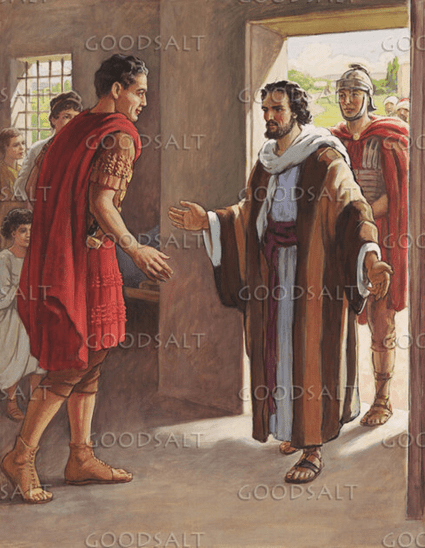
Simon Peter might be a fisherman, but he had always prided himself on separating himself from gentiles whenever possible. The last thing Peter wanted was for God to send him to minister to Cornelius, a Roman centurion. There’s a saying, “Tell God your plans and watch Him laugh!” And God was laughing heartily, for first He gave Peter a vision and then virtually pushed Peter out the door, sending him to Cornelius’ house. When Peter arrived at Cornelius’ house, he boldly stated his previous objections and then explained that God had caused him to change his mind. Before the whole thing was through, God even sovereignly baptized all those in Cornelius’ house in the Holy Spirit, without Peter even laying hands on them! Why? Because God knew that Peter hadn’t abandoned all his prejudices. If these people were to receive the Holy Spirit, God was going to have to do it without using Peter. And it was the very fact of this Holy Spirit baptism that helped convince Peter that the Gospel WAS for the gentiles as well as for the Jews.

Once we agree to become Jesus’ disciples, we must give up our rights to ourselves, to our prejudices, and to our assumptions about others. We might look at someone and judge them by their hairstyle, their tattoos, their piercings; meanwhile, that person might become a fiery evangelist to rival Saint Paul. David Wilkerson was a skinny young preacher from a small coal town in eastern Pennsylvania when God moved him to go to New York City to witness to gang members. One of Pastor Wilkerson’s converts was Nicky Cruz, a vicious gang leader whose Puerto Rican parents practiced witchcraft and beat Nicky regularly. Nicky became a leader in a murderous street gang in Brooklyn. But when David Wilkerson witnessed to Nicky and Nicky accepted Jesus as Savior and Lord, Nicky changed completely. For decades, Nicky Cruz has traveled the world, preaching and teaching about Jesus. Millions have heard about the saving power of Jesus Christ because David Wilkerson willingly witnessed to young gang members who could have killed him.

Many people have no idea what it means to be a disciple. Being a disciple is an enormous blessing; however, there are also pitfalls. Here are several practices disciples must carry out, along with the temptations that accompany them:

1. The Heart of Discipleship: Proclaiming Jesus.

“Him we proclaim.” First and foremost, discipleship is about proclaiming Jesus and making much of His name. A couple major themes of Colossians are that Christ is Lord over all creation, and that Christ is our redeemer.  It is within this context that Paul writes these powerful words. Just before these words, in verse 27, Paul reminds the Colossians that God has revealed the mystery of Christ to them and that Christ is personally present with them. This is wonderful news. We proclaim this wonderful news—both to the lost and to the saved.

Discipleship should be outward focused. We don’t invest in someone only for the sake of that individual, but we do so with the others they will impact in mind. We proclaim Jesus to men and women who will go on to proclaim Jesus to the world.

Temptation to fight: Proclaiming ourselves. Even if outwardly, we are “proclaiming Jesus” in how we do discipleship, we must make sure that inwardly, our motive is to make much of Him, rather than to make much of ourselves. Yet another temptation is to keep score as to how many converts we have made, how many people we have discipled. The Kingdom of God is not about score-keeping but love, joy, and peace in the Holy Spirit.

The concepts in the remainder of this article should fall under the umbrella of this first principle. The reason we devote ourselves to all the following principles is to bring fame and praise to the name of Jesus.

2. The Means of Discipleship: Teaching and Warning With Wisdom.

 Scripture has a lot more to say regarding how to make disciples, but Paul gives us some basics in this passage: “warning everyone and teaching everyone with all wisdom.” Teaching, or instruction, might seem like an obvious component of discipleship. We must train those we lead in the Word of God and show them how to live lives that glorify Him. But this passage reveals that our responsibility is not only to teach those we disciple the right way, but also to warn them when they are going the wrong way. Out of love for those we disciple, we must not be silent when they are living in opposition to the Scriptures.

Paul says that we teach and train everyone “with all wisdom”. James 1:5 says to ask God for wisdom, and this is so important. As we disciple others, we must continually seek the Lord’s wisdom and guidance. We must be spending regular time in the Word and in prayer. Any time we teach or warn, we must make sure we are doing so in submission to Him.

Temptations to fight: People-pleasing and harshness. Depending on your personality, you might be someone who tends to dodge conflict. For you, the temptation will be to avoid having hard conversations with those you lead out of a desire to please them. However, if you tend to like power and control, you might be more prone to be too harsh in your correction. Don’t forget that Scripture also says that this must be done in a spirit of gentleness (Galatians 6:1) and out of love. And as believers, we must bear with other people’s shortcomings.  Galatians 6:1-3 Dear brothers and sisters, if another believer is overcome by some sin, you who are godly should gently and humbly help that person back onto the right path. And be careful not to fall into the same temptation yourself. Share each other’s burdens, and in this way obey the law of Christ. If you think you are too important to help someone, you are only fooling yourself. You are not that important.

Finally, let’s remember the advice Paul gave the Roman Christians. Romans 15:5-9 May God, who gives this patience and encouragement, help you live in complete harmony with each other, as is fitting for followers of Christ Jesus. Then all of you can join together with one voice, giving praise and glory to God, the Father of our Lord Jesus Christ.

Therefore, accept each other just as Christ has accepted you so that God will be given glory. Remember that Christ came as a servant to the Jews to show that God is true to the promises he made to their ancestors. He also came so that the Gentiles might give glory to God for his mercies to them.

 May God, who has called all of us to become disciples, strengthen and encourage you, so that you may be willing to witness to anyone, at anytime, anywhere.

PRAYER: Father God, thank You for loving us and caring for us. Lord, give each of us a passion to become true disciples and to disciple others as well. In the mighty and precious Name of King Jesus. Amen.