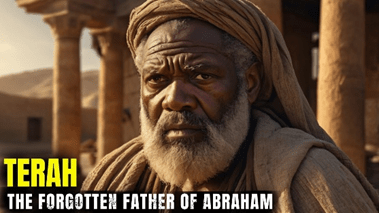
Genesis 11:31-32And Terah took his son Abram and his grandson Lot, the son of Haran, and his daughter-in-law Sarai, his son Abram’s wife, and they went out with them from Ur of the Chaldeans to go to the land of Canaan; and they came to Haran and dwelt there. So the days of Terah were two hundred and five years, and Terah died in Haran.
By the time Terah left Ur of the Chaldees, he was no longer a young man. Why did Terah leave Ur? An internet search reveals the following: According to Genesis 11:31, Terah took his family, including Abram and Lot, from Ur of the Chaldeans to move to Canaan, though the Bible does not explicitly state his specific motivation. Scholars and commentators suggest the move may have been driven by a divine prompting, a desire to leave a sinful region, or possibly as a response to the loss of a family member.
Key details regarding Terah’s journey:
The Original Plan: Terah set out for Canaan but settled in Haran along the way, where he died.
Call of God: While Abraham is known for receiving a call, some commentators suggest that God may have first spoken to Terah, prompting him to leave the idolatrous land of Ur.
The Move from Ur: The move was likely intended to be a complete relocation from a city known to be wicked.
The Halt in Haran: Terah is often portrayed as stopping in Haran due to a lack of faith or comfort, only going halfway on the journey. Perhaps Terah simply stays in Haran long enough to become comfortable; at that point, staying in a comfortable place might be very appealing. While God has spoken to Abraham, Terah might not be completely convinced.
There’s also another possibility: Terah is not a young man, and travel is arduous. Perhaps Terah succumbs to a combination of grief over the loss of his son Haran, plus exhaustion in addition to old age.
While Terah left to go to Canaan, his journey ended early at Haran, setting the stage for Abraham to complete the journey under a direct call from God. Terah, Abraham’s father, was grieving for his son Haran. Terah, it seems, decided to stay in the northern Mesopotamian “city of Haran,” (no connection with his son Haran) rather than continue the journey to Canaan, which was the family’s original intent. The family were in the city of Haran for five years. The people of Haran served the same moon god as the people in Terah’s former location, the southern Mesopotamian “city of Ur”. Terah, Jewish literature records, was a craftsman who made idols. So he may have found a blossoming trade in Haran.
This seems to be upheld by Scripture: “This is what the LORD, the God of Israel, says: ‘Long ago your ancestors, including Terah the father of Abraham and Nahor, lived beyond the Euphrates River and served other gods'” (Josh 24:2). The Hebrew word for “served” can also mean to “work,” hence the tradition that Terah was a craftsman who made idols. And later in the story Rachel, Terah’s great-great-granddaughter, does seem keen to hold on to the Teraphim (household idols) as if they were a family heirloom (Gen 31:19). And, it may be worth noting, we see the name “Terah” alluded to in the word “Teraphim”.
When Isaiah received his call while he was in the temple, there were probably many others there at the same time; however, Isaiah was the only one who saw the Lord. God might have called Terah, only for Terah to obey partially.
What can we learn from Terah? Terah remained in Haran and died there while Abraham risked everything, leaving for Canaan with his family, his flocks, and his herds. Terah might have had a comfortable old age, but he missed the Promised Land. Abraham took the risk and gained incredible blessings, as well as securing the Promised Land for his descendants.
The question for us is simple: Will we listen to God, even if it means risk, or will we settle for comfort? We can settle for comfort, but that will never result in our receiving God’s best for our lives. May God help us so that we will risk everything for His Will.
PRAYER: Father God, thank You for loving us and caring for us. Lord, help us to be willing to lay down our hopes and our dreams so that You can lead us into the futures you have for us. In the mighty and precious Name of King Jesus. Amen.
Zechariah 2:6 -9 “Up, up! Flee from the land of the north,” says the Lord; “for I have spread you abroad like the four winds of heaven,” says the Lord. 7 “Up, Zion! Escape, you who dwell with the daughter of Babylon.”
8 For thus says the Lord of hosts: “He sent Me after glory, to the nations which plunder you; for he who touches you touches the apple of His eye (the pupil of His eye.) 9 For surely I will shake My hand against them, and they shall become spoil for their servants. Then you will know that the Lord of hosts has sent Me.
What does the “apple of God’s eye” refer to? It refers to the pupil of God’s eye. Just as we protect our eyes because they are so precious, so God promises to treasure and protect Israel as if that small country is the pupil of His eye. For the next few days, we are going to look at Israel as God describes it in His Word.
In Genesis 15:18-21 God promises the land of Israel to Abraham. “On the same day the Lord made a covenant with Abram, saying: “To your descendants I have given this land, from the river of Egypt to the great river, the River Euphrates—the Kenites, the Kenezzites, the Kadmonites, the Hittites, the Perizzites, the Rephaim, the Amorites, the Canaanites, the Girgashites, and the Jebusites.”
Genesis 17:1-8 When Abram was ninety-nine years old, the Lord appeared to Abram and said to him, “I am Almighty God; walk before Me and be blameless. And I will make My covenant between Me and you, and will multiply you exceedingly.” Then Abram fell on his face, and God talked with him, saying: “As for Me, behold, My covenant is with you, and you shall be a father of many nations. No longer shall your name be called Abram, but your name shall be Abraham; for I have made you a father of many nations. I will make you exceedingly fruitful; and I will make nations of you, and kings shall come from you. And I will establish My covenant between Me and you and your descendants after you in their generations, for an everlasting covenant, to be God to you and your descendants after you. Also I give to you and your descendants after you the land in which you are a stranger, all the land of Canaan, as an everlasting possession; and I will be their God.”
In Deuteronomy 11:10-12 God describes the Promised Land. “For the land which you go to possess is not like the land of Egypt from which you have come, where you sowed your seed and watered it by foot, as a vegetable garden; but the land which you cross over to possess is a land of hills and valleys, which drinks water from the rain of heaven, a land for which the Lord your God cares; the eyes of the Lord your God are always on it, from the beginning of the year to the very end of the year.”
How big is Israel?
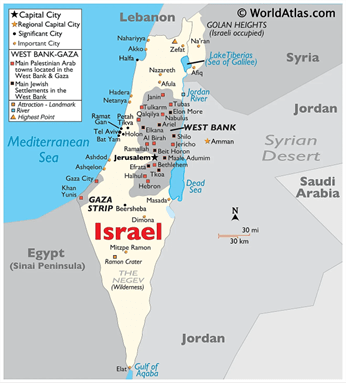
Israel is a small country covering approximately 22,000–22,145 square kilometers (8,500-8,600 square miles.) It is about 470 km (290 miles) long and very narrow, ranging from only 15 km to 114 km in width. It is often compared in size to the US state of New Jersey or the country of El Salvador. But was this God’s will for Israel originally? Not at all! God promised the Israelites a vast territory stretching from the Nile River in Egypt to the Euphrates River in modern-day Iraq, and from the Mediterranean Sea to the Jordan River. This included the land of Canaan, encompassing modern-day Israel, Palestine, Jordan, and parts of Syria and Lebanon.
Key details about the territory God intended for Israel include:
Boundaries: Defined as from the “river of Egypt to the great river, the Euphrates” (Genesis 15:18) and from the Mediterranean Sea east to the Euphrates.
The Land of Canaan: This was the core area intended for the 12 tribes, which they were instructed to conquer and inhabit, dividing it by lot.
Extent: It included lands occupied by the Hittites, Amorites, Canaanites, and others, stretching from the Negev in the south to the Lebanon mountains in the north.
Current Possession: Historically, Israel only reached this maximum extent during the reigns of David and Solomon, with many areas remaining unconquered during Joshua’s time.
Romans 11:29 tells us, “For the gifts and the calling of God are irrevocable.”When God gave the land of Israel to Abraham and his descendants, He didn’t make a mistake. Once God gives something, He does not take it back. As we continue to consider God’s Word about Israel, let’s ask God that He opens our minds and hearts to His will for Israel.
PRAYER: Father God, thank You for loving us and caring for us. Lord, open our minds and hearts to Your land of Israel and Your perfect Will for it. In the mighty and precious Name of King Jesus. Amen.
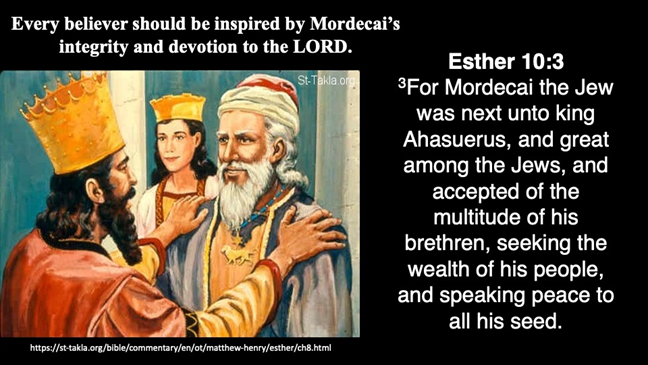
“King Xerxes imposed tribute throughout the empire, to its distant shores. And all his acts of power and might, together with a full account of the greatness of Mordecai, whom the king had promoted, are they not written in the book of the annals of the kings of Media and Persia? Mordecai the Jew was second in rank to King Xerxes, preeminent among the Jews, and held in high esteem by his many fellow Jews, because he worked for the good of his people and spoke up for the welfare of all the Jews.”
The old fairy tales that had been sanitized used to end with the words, “And they lived happily ever after.” Some of the original fairy tales were not that optimistic about life, but the thought is still a lovely one. Here the Esther story ends with wise discerning Mordecai as the second most powerful man in the entire Persian Empire of fifty million people and untold numbers of nationalities. Although these short sentences only mention Mordecai’s attention to his fellow Jews, it is more than likely that many other minority races also benefited greatly from Mordecai’s actions. Why?
Mordecai worshiped the God of Israel and was obviously a learned man. Mordecai probably knew the Torah well; that meant that Mordecai would care for widows and orphans and refugees and other disadvantaged groups, that he would handle slaves compassionately, and that he would not behave capriciously. Xerxes was a drinker and when drunk could make horrific decisions. With Mordecai in a position of prominence, it is likely that most if not all the Jews in the kingdom were copying him. Living justly according to the Law of Moses, the Jews would have had a major impact on their neighbors and would have comprised a force for righteousness, even though they were only one of thousands of nationalities in the empire.
APPLICATION: We never realize how many lives we may have touched or the people whom we have influenced. Last weekend my husband attended part of the funeral services for the son of one of our friends. This twenty – eight-year-old man had been killed tragically in a road traffic accident. But my husband and I were totally unprepared for the credit the parents gave me for saving him as a premature infant.
At the funeral, the parents mentioned that the man had been born prematurely and that his life had been saved because I taught them how to do “kangaroo mother care.” “Kangaroo mother care” is a simple method of keeping babies warm in which a person swaddles the infant next to his or her bare skin, using the body warmth of the adult to keep the baby warm. At the time this young man was born, there was no electricity in our area, making kangaroo care the best option for maintaining body heat for premature infants. I have personally done emergency kangaroo care for newborns until their body temperatures have come up to normal. On more than one occasion, I have poured hot water into a large glass bottle, swathed it in a towel, and placed that in a traditional basket with the baby, covering the basket and thus creating a simple incubator. (Now we have a NICU with an incubator.)
Not long ago, one of the young men who worked for us in our house while he was in school visited us. During that visit, it became obvious that this newly – minted teacher viewed us as a second set of parents. We were taken aback, for we felt we had done nothing extraordinary.
You never know who might be watching you or the influence you will have on those around you. You may be struggling with a grief so deep you feel as if you have fallen into a bottomless pit; meanwhile, your friends are taking courage from the fact that you are continuing to work and carry out your other duties for your family. You may have turned to volunteer work upon retirement simply as a means of maintaining your sanity, while those whom you are helping are taking enormous courage from your actions. Let me share an experience/suggestion.
During the one year I was doing an MPH program at Tulane University, I volunteered once a week for a reading program in an inner city school. The program was quite organized; I worked with fourth grade students who would read selected texts to me. Then the students got to pick three children’s stories from a large collection. We would snuggle together on a couch while I read to the kids. I frequently worked with two or three students at a time, and one of the highlights of my week was cuddling with those cute little girls while I shared their delight in the stories. The teacher for that class also ran after – school programs for children at her church in New Orleans’ Ninth Ward, the area most devastated by Hurricane Katrina. I hope the few efforts I was able to make helped those kids so that they are now reading to their children.
That program was quite low – tech, but its effects were far – reaching. The coordinator of the program later told the volunteers that she could track major improvements in the children’s school work, simply because someone took one hour a week to read to the kids. Several studies have demonstrated that children who are read to make far better grades than those who do not have this experience. If you are looking for something to do, why not see if your local school would be willing to start such a program?
Mordecai didn’t start out to become the second most powerful man in the Persian Empire. Mordecai was simply following God and doing His Will. It was God who promoted Mordecai for his faithfulness and righteousness. Until we reach heaven, we will never know how many people Mordecai saved and blessed. Until you reach heaven, you may never know either. So take heart! Don’t stop doing good. Continue to be faithful. Your actions today may bless far more people than you realize.
PRAYER: Father God, thank You for loving us and for caring for us. Lord, there are many of us who are becoming discouraged because we feel our actions are useless. Please strengthen and encourage all those who feel that way so that they will continue to fulfill Your perfect Will for their lives. In the matchless Name of King Jesus. Amen.
ESTHER 9:1-32 GOD TURNS THE TABLES ON THE ENEMIES OF THE JEWS
“On the thirteenth day of the twelfth month, the month of Adar, the edict commanded by the king was to be carried out. On this day the enemies of the Jews had hoped to overpower them, but now the tables were turned and the Jews got the upper hand over those who hated them. The Jews assembled in their cities in all the provinces of King Xerxes to attack those determined to destroy them. No one could stand against them, because the people of all the other nationalities were afraid of them. And all the nobles of the provinces, the satraps, the governors, and the king’s administrators helped the Jews, because fear of Mordecai had seized them. Mordecai was prominent in the palace; his reputation spread throughout the provinces, and he became more and more powerful.
The Jews struck down all their enemies with the sword, killing and destroying them, and they did what they pleased to those who hated them. In the citadel of Susa, the Jews killed and destroyed five hundred men. They also killed Parshandatha, Dalphon, Aspatha, Poratha, Adalia, Aridatha, Parmashta, Arisai, Aridai and Vaizatha, the ten sons of Haman son of Hammedatha, the enemy of the Jews. But they did not lay their hands on the plunder.
The number of those killed in the citadel of Susa was reported to the king that same day. The king said to Queen Esther, “The Jews have killed and destroyed five hundred men and the ten sons of Haman in the citadel of Susa. What have they done in the rest of the king’s provinces? Now what is your petition? It will be given you. What is your request? It will also be granted.”
“If it pleases the king,” Esther answered, “give the Jews in Susa permission to carry out this day’s edict tomorrow also, and let Haman’s ten sons be impaled on poles.” So the king commanded that this be done. An edict was issued in Susa, and they impaled the ten sons of Haman. The Jews in Susa came together on the fourteenth day of the month of Adar, and they put to death in Susa three hundred men, but they did not lay their hands on the plunder.
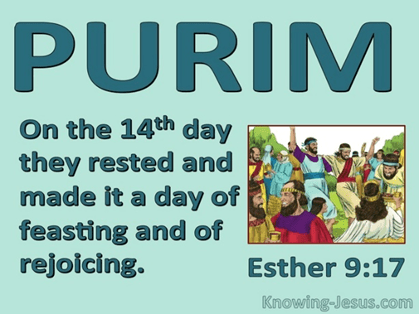
Meanwhile, the remainder of the Jews who were in the king’s provinces also assembled to protect themselves and get relief from their enemies. They killed seventy-five thousand of them but did not lay their hands on the plunder. This happened on the thirteenth day of the month of Adar, and on the fourteenth they rested and made it a day of feasting and joy. The Jews in Susa, however, had assembled on the thirteenth and fourteenth, and then on the fifteenth they rested and made it a day of feasting and joy. That is why rural Jews—those living in villages—observe the fourteenth of the month of Adar as a day of joy and feasting, a day for giving presents to each other.
Purim Established Mordecai recorded these events, and he sent letters to all the Jews throughout the provinces of King Xerxes, near and far, to have them celebrate annually the fourteenth and fifteenth days of the month of Adar as the time when the Jews got relief from their enemies, and as the month when their sorrow was turned into joy and their mourning into a day of celebration. He wrote them to observe the days as days of feasting and joy and giving presents of food to one another and gifts to the poor.
So the Jews agreed to continue the celebration they had begun, doing what Mordecai had written to them. For Haman son of Hammedatha, the Agagite, the enemy of all the Jews, had plotted against the Jews to destroy them and had cast the pur (that is, the lot) for their ruin and destruction. But when the plot came to the king’s attention, he issued written orders that the evil scheme Haman had devised against the Jews should come back onto his own head, and that he and his sons should be impaled on poles. (Therefore these days were called Purim, from the word pur.) Because of everything written in this letter and because of what they had seen and what had happened to them, the Jews took it on themselves to establish the custom that they and their descendants and all who join them should without fail observe these two days every year, in the way prescribed and at the time appointed. These days should be remembered and observed in every generation by every family, and in every province and in every city. And these days of Purim should never fail to be celebrated by the Jews—nor should the memory of these days die out among their descendants.
So Queen Esther, daughter of Abihail, along with Mordecai the Jew, wrote with full authority to confirm this second letter concerning Purim. And Mordecai sent letters to all the Jews in the 127 provinces of Xerxes’ kingdom—words of goodwill and assurance—to establish these days of Purim at their designated times, as Mordecai the Jew and Queen Esther had decreed for them, and as they had established for themselves and their descendants in regard to their times of fasting and lamentation. Esther’s decree confirmed these regulations about Purim, and it was written down in the records.”
75,800 people-that’s how many of their enemies the Jews slaughtered throughout the Persian Empire. In the capital of Susa, the Jews killed 800 men. While that figure sounds impressive, the population of the Persian Empire at that time stood at close to fifty million. That means that the percent of citizens killed by the Jews represented 0.15% of that population. Throughout the empire, the Jews refused to lay a hand on the plunder, leaving it for the families of their enemies. “No one could stand against them, because the people of all the other nationalities were afraid of them.And all the nobles of the provinces, the satraps, the governors, and the king’s administrators helped the Jews, because fear of Mordecai had seized them. Mordecai was prominent in the palace; his reputation spread throughout the provinces, and he became more and more powerful.”
Why were these people of other nationalities willing to help the Jews? The prophet Jeremiah had already sent the message to the exiles that they were to seek the peace and prosperity of the kingdoms to which they had been taken. The Jews weren’t trouble makers. There is compelling evidence to suggest that once the Jews were exiled, many of them actually became more serious about their religion than they had been before being captured. It was one thing to play with paganism in Israel where God was protecting the Jews and a different thing when dropped into a culture where paganism was the norm.
The people of other nationalities were also willing to help the Jews because they realized that Haman could just as easily have targeted them for destruction. Mordecai was obviously a wise man and a fair one and not given to making ridiculous decisions while drunk. God gave Mordecai favor and influence with all of these people, and his reputation spread throughout the empire.
APPLICATION: The story of Esther and Mordecai has so many wonderful parts to it. First, there is the obvious love and respect between Esther and Mordecai. Had Mordecai not raised Esther to be kind and virtuous, no amount of physical beauty would have helped. It was Esther’s gentleness, charm, and bright spirit that won her the admiration of the eunuchs who supervised the harem. It was those eunuchs who wisely advised Esther on how to dress and how to comport herself when she was brought to King Xerxes. It was likely those same eunuchs who continued to advise Esther as she navigated the challenges of queenship.
Mordecai was a man of great faith and integrity, well known to the other citizens of Susa. Long before Mordecai came to prominence, there were probably many people who respected him and trusted him as a man of his word. But the real star of the Esther story is the One True Living God of Israel. Mordecai worshiped God, and God arranged for Mordecai to raise Esther. God further arranged for Esther to be taken into the palace and to please the king so that he made her the new queen. Because Mordecai worshiped God, he refused to bow before Haman; evidently, Mordecai had no problems meeting King Xerxes. It was Haman’s irritation at Mordecai’s refusal to bow that led Haman to plot extermination for the Jews. Why Haman? Had Haman not risen to prominence, someone else would have likely attacked the Jews. By soundly and completely defeating Haman and wiping out his family, God sent a strong message throughout the Persian Empire that the Jews were His people and were to be left alone.
Remaining faithful to God can be very difficult, and there are many temptations to relax, give up, give in, etc. At such times, it is good to remember Mordecai, that righteous man who remained faithful even in the face of extreme persecution. We should also take heart! The Bible says that “God is no respecter of persons.” That means that God doesn’t play favorites. The same God who used Mordecai and Esther to deliver the Jews and to preserve other minorities in the Persian Empire is still on the throne of the universe today. And God continues to hear the prayers of those who trust Him.
PRAYER: Father God, thank You for loving us and for caring for us. Lord, help us to trust You even when things seem at their most hopeless. Help us to follow You even when we are not sure where You are leading us. And thank You that You can save and deliver us just as You did Mordecai and Esther and the Jews of the Persian Empire. In the mighty and precious Name of King Jesus. Amen.
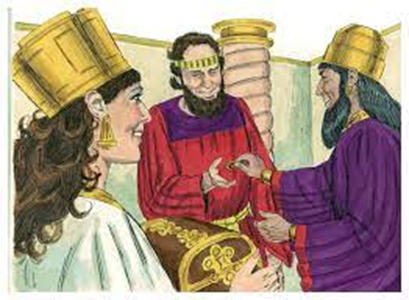
“That same day King Xerxes awarded Queen Esther the estate of Haman, the enemy of the Jews. And Mordecai entered the king’s presence because Esther had revealed his relation to her. The king removed the signet ring he had recovered from Haman and presented it to Mordecai. And Esther appointed him over the estate of Haman.
And once again, Esther addressed the king. She fell at his feet weeping and begged him to revoke the evil scheme of Haman the Agagite, which he had devised against the Jews.
The king extended the gold scepter toward Esther, and she arose and stood before the king.
“If it pleases the king,” she said, “and if I have found favor in his sight, and the matter seems proper to the king, and I am pleasing in his sight, may an order be written to revoke the letters that the scheming Haman son of Hammedatha, the Agagite, wrote to destroy the Jews in all the king’s provinces. For how could I bear to see the disaster that would befall my people? How could I bear to see the destruction of my kindred?”
The Decree of Xerxes
So King Xerxes said to Esther the Queen and Mordecai the Jew, “Behold, I have given Haman’s estate to Esther, and he was hanged on the gallows because he attacked the Jews. Now you may write in the king’s name as you please regarding the Jews, and seal it with the royal signet ring. For a decree that is written in the name of the king and sealed with the royal signet ring cannot be revoked.”
At once the royal scribes were summoned, and on the twenty-third day of the third month (the month of Sivan), they recorded all of Mordecai’s orders to the Jews and to the satraps, governors, and princes of the 127 provinces from India to Cush —writing to each province in its own script, to every people in their own language, and to the Jews in their own script and language.
Mordecai wrote in the name of King Xerxes and sealed it with the royal signet ring. He sent the documents by mounted couriers riding on swift horses bred from the royal mares.
By these letters the king permitted the Jews in each and every city the right to assemble and defend themselves, to destroy, kill, and annihilate all the forces of any people or province hostile to them, including women and children, and to plunder their possessions. The single day appointed throughout all the provinces of King Xerxes was the thirteenth day of the twelfth month, the month of Adar. (This was the same day on which the Jews were to be destroyed according to the edict written by Haman.)
A copy of the text, issued as law throughout every province, was distributed to all the peoples, so that the Jews would be prepared on that day to avenge themselves on their enemies. The couriers rode out in haste on their royal horses, pressed on by the command of the king. And the edict was also issued in the citadel of Susa.
Mordecai went out from the presence of the king in royal garments of blue and white, with a large gold crown and a purple robe of fine linen. And the city of Susa shouted and rejoiced.
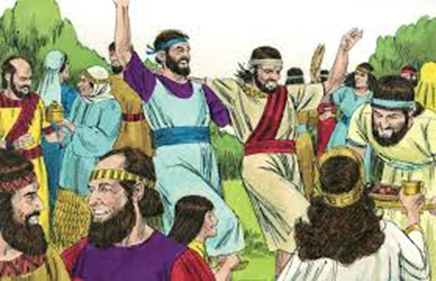
For the Jews it was a time of light and gladness, of joy and honor. In every province and every city, wherever the king’s edict and decree reached, there was joy and gladness among the Jews, with feasting and celebrating. And many of the people of the land themselves became Jews, because the fear of the Jews had fallen upon them.”
WOW! When God turns things around, he doesn’t waste time! First, King Xerxes orders Haman to be hanged, awarding his estate to Esther. Next, Esther formally introduces Mordecai to King Xerxes, and Xerxes gives Mordecai the signet ring he had earlier handed to Haman. That ring gives Mordecai absolute power to issue edicts.
Then Esther, who has remained relatively calm during this entire ordeal, collapses in tears at the feet of King Xerxes, begging him to revoke Haman’s evil pronouncement. But King Xerxes still has to extend the golden scepter to Esther before she can make her request. Even at this point, Esther may still be put to death, should Xerxes fail to extend the golden scepter.
The original edict cannot be rescinded; however, Mordecai issues orders that give the Jews permission to defend themselves. “By these letters the king permitted the Jews in each and every city the right to assemble and defend themselves, to destroy, kill, and annihilate all the forces of any people or province hostile to them, including women and children, and to plunder their possessions. The single day appointed throughout all the provinces of King Xerxes was the thirteenth day of the twelfth month, the month of Adar. (This was the same day on which the Jews were to be destroyed according to the edict written by Haman.)
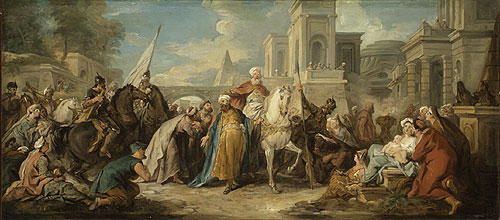
Suddenly, Mordecai becomes the second most important person in the kingdom and leaves the palace with a large gold crown and dressed as a prince in royal robes of blue and white with an over-robe of fine purple linen, a material reserved for royalty. When the citizens of Susa see Mordecai in these robes, they shout and rejoice because they know Mordecai is a man of God with good judgement. All the other minority ethnic groups in Susa who have been fearing for their lives are celebrating; after all, had Haman survived, whom might he have targeted next?
Throughout all the Persian Empire, the Jews hold massive celebrations and many others decide to become Jews to avoid extermination. It’s also possible that these recent converts also have become Jews because they have seen what the God of Israel can do; after all, their pagan gods have failed to help them. One of the most beautiful lines in this chapter is this one: “For the Jews it was a time of light and gladness, of joy and honor.”
APPLICATION: “A time of light and gladness, of joy and honor-which of us does not need such times? In the Persian Empire, the Jews went from being a despised minority to a highly respected one overnight. Not only has Esther saved her own people, but she has undoubtedly saved any number of other small ethnic groups from destruction. Those people groups are probably also celebrating their deliverance.
There might be another reason people are celebrating: Mordecai is not a drinking man. Reading the Book of Esther closely, you realize that Xerxes has been making many of his decisions through an alcoholic haze. Xerxes is the archetypical mean drunk, and nobody knows the next disastrous decision he might take.
Sometimes God delivers us from situations and sometimes God delivers us in the midst of situations. Obviously, we would far rather be delivered from trying circumstances. In the old TV show “Star Trek,” the star ship crew had a special means of instantly transporting people from one location to another. Scotty was the engineer on the Star Ship Enterprise. The captain was always requesting, “Beam me up, Scotty!” indicating that Scotty should activate that means of instant tele transport. Given the opportunity, who would not like to ask God to “beam me up” out of a bad situation?
Spoiler alert: Most of the time, God chooses to deliver us in our problems rather than from them. Most of us learn far more from suffering and mistakes than we do from pleasant circumstances. When our circumstances are pleasant, we blithely assume that we deserve comfort and leisure; we fail to recognize that God is giving us respite. Sadly, most of us are like the mule in the story that is told about a man who had a mule he wanted trained. When the trainer arrived, the first thing he did was to take a 2×4 board and whack the mule up alongside the head with it. “What are you doing?” cried the outraged mule owner. “Oh, that was just to get his attention,” replied the trainer.
God is also infinitely patient, and when we fail to learn our lessons the first time around, God brings us into similar circumstances again until we get it right. Moral: become a fast learner and suffer less!
May God help us to pay attention so that we don’t have to have the equivalent of a whack from a 2×4 before we will start learning the lessons God has for us. And may we too enjoy times of light and gladness and joy and honor.
PRAYER: Father God, thank You for loving us and for caring for us. Lord, give us teachable spirits so that You don’t have to do something drastic to get our attention. Help us to listen closely to Your blessed Holy Spirit and help us to follow hard after You all the days of our lives. In the mighty and precious Name of King Jesus. Amen.
“So the king and Haman went to dine with Esther the queen, and as they drank their wine on the second day, the king asked once more, “Queen Esther, what is your petition? It will be given to you. What is your request? Even up to half the kingdom, it will be fulfilled.”
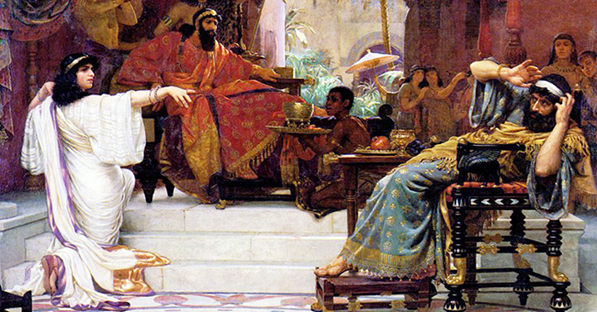
Then Queen Esther replied, “If I have found favor in your sight, O king, and if it pleases the king, grant me my life as my petition, and the lives of my people as my request. For my people and I have been sold out to destruction, death, and annihilation. If we had merely been sold as menservants and maidservants, I would have remained silent, because no such distress would justify burdening the king.”
Then King Xerxes spoke up and asked Queen Esther, “Who is this, and where is the one who would devise such a scheme?”
Esther replied, “The adversary and enemy is this wicked man—Haman!”
And Haman stood in terror before the king and queen.
The Hanging of Haman
In his fury, the king arose from drinking his wine and went to the palace garden, while Haman stayed behind to beg Queen Esther for his life, for he realized the king was planning a terrible fate for him. Just as the king returned from the palace garden to the banquet hall, Haman was falling on the couch where Esther was reclining. The king exclaimed, “Would he actually assault the queen while I am in the palace?” As soon as the words had left the king’s mouth, they covered Haman’s face.
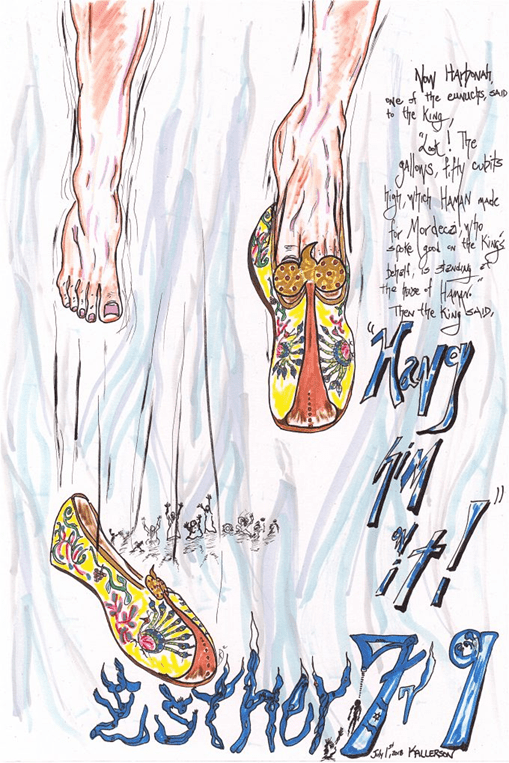
Then Harbonah, one of the eunuchs attending the king, said: “There is a gallows fifty cubits high (75 feet) at Haman’s house. He had it built for Mordecai, who gave the report that saved the king.” “Hang him on it!” declared the king. So they hanged Haman on the gallows he had prepared for Mordecai. Thenthe fury of the king subsided.”
It’s the arch-typical story of the triumph of good over evil, and at this point we want to stand up and cheer loudly! Mordecai is saved! Haman is hanged! But wait, because that edict against the Jews is still out there, and the laws of the Medes and Persians cannot be changed when once they have been issued. Esther might be all right and Mordecai is safe for now, but if actions are not taken swiftly, the Jews might still be wiped out as a people in all the corners of the empire.
Why is Harbonah, one of the eunuchs attending the king, so willing to tell the king about the gallows Haman has already erected? Remember that Haman has been lording it over everyone he meets, forcing them to rise and then to bow in his presence. Harbonah has worked in the palace long enough to know royalty when he sees it and also to recognize a villain when he sees one. It’s likely that Haman has demanding that all the palace servants not merely bow but literally plant their faces on the floor when he walks by. Perhaps Haman is also a mean drunk who has abused the palace servants while Xerxes and he were getting plastered together. Any abuse of a servant would be reported immediately to all the other servants; who knows who might be the next target of Haman’s arrogance? Haman is just that kind of guy. Now the day of pay-backs has come and Harbonah is more than willing to drop a word in the ear of King Xerxes, suggesting Haman be hanged on his own gallows. “Perfect!” thinks Xerxes. “What could be better than hanging Haman on a gallows in front of his own home so everyone can see his downfall?” Remember that Xerxes thinks Haman has attacked Esther, so no punishment is really sufficient for such dastardly behavior.
APPLICATION: Part of the charm and fascination of the Book of Esther is the way in which God turns a dreadful situation into a victorious one. One of my favorite African Gospel songs is entitled “I know that my God will turn it around!” Here are the lyrics: You can listen to the song at https://www.youtube.com/watch?v=CM8g78pkEJw
Are you weighed down by battles in life Are you thinking of quitting the race There is no need to give up on your journey Because I know my God will turn it around
I know my God will turn it around I have seen my God turn it around There are so many many many times in my life That I have seen my God turn it around
Have you suffered from disappointment Have some people turn their backs on you Just keep holding onto the one who cannot disappoint I know my God will turn it around
I know my God will turn it around I have seen my God turn it around There are so many many many times in my life That I have seen my God turn it around
Are you thinking that you’re alone Do you feel God has forsaken you He has promised to keep you to the end of the journey I know my God will turn it around
I know my God will turn it around I have seen my God turn it around There are so many many many times in my life That I have seen my God turn it around
I know my God will turn it around I have seen my God turn it around There are so many many many times in my life That I have seen my God turn it around There are so many many many times in my life That I have seen my God turn it around.
PRAYER: Father God, thank You for loving us and for caring for us. Lord, there are many of us caught in terrible situations and we need You to turn things around. Speak to our hearts, calm our minds, and help us to trust that You will help us and deliver us. In the mighty and precious Name of King Jesus. Amen.
“That night, sleep escaped the king; so he ordered the book of records, the chronicles, to be brought in and read to him. And there it was found recorded that Mordecai had exposed Bigthana and Teresh, two of the eunuchs who guarded the king’s entrance, when they had conspired to assassinate King Xerxes.
The king inquired, “What honor or dignity has been bestowed on Mordecai for this act?”
“Nothing has been done for him,” replied the king’s attendants.
“Who is in the court?” the king asked.
Now Haman had just entered the outer court of the palace to ask the king to hang Mordecai on the gallows he had prepared for him. So the king’s attendants answered him, “Haman is there, standing in the court.”
“Bring him in,” ordered the king.
Haman entered, and the king asked him, “What should be done for the man whom the king is delighted to honor?”
Now Haman thought to himself, “Whom would the king be delighted to honor more than me?”
And Haman told the king, “For the man whom the king is delighted to honor, have them bring a royal robe that the king himself has worn and a horse on which the king himself has ridden—one with a royal crest placed on its head. Let the robe and the horse be entrusted to one of the king’s most noble princes. Let them array the man the king wants to honor and parade him on the horse through the city square, proclaiming before him, ‘This is what is done for the man whom the king is delighted to honor!’”
“Hurry,” said the king to Haman, “and do just as you proposed. Take the robe and the horse to Mordecai the Jew, who is sitting at the King’s Gate. Do not neglect anything that you have suggested.”
So Haman took the robe and the horse, arrayed Mordecai, and paraded him through the city square, crying out before him, “This is what is done for the man whom the king is delighted to honor!”
Then Mordecai returned to the King’s Gate. But Haman rushed home, with his head covered in grief.
Haman told his wife Zeresh and all his friends everything that had happened. His advisers and his wife Zeresh said to him, “Since Mordecai, before whom your downfall has begun, is Jewish, you will not prevail against him—for surely you will fall before him.”
While they were still speaking with Haman, the king’s eunuchs arrived and rushed him to the banquet that Esther had prepared.”
God really has a sense of humor! King Xerxes can’t sleep, so he asks for the chronicles of the kingdom to be read to him, no doubt assuming that they will be boring enough to put him to sleep easily! But wait, suddenly the king discovers a fascinating tidbit about the plot hatched by two of the eunuchs who were planning to assassinate him. Suddenly, Xerxes is wide awake! He has a fascinating new project, one that can’t possibly wait until morning. Here’s a new and glorious way in Xerxes can advertise his generosity and his magnificence.
Xerxes calls Haman in and puts a question to Haman. “What should be done for the man whom the king is delighted to honor?” Now Haman thought to himself, “Whom would the king be delighted to honor more than me?” And Haman told the king, “For the man whom the king is delighted to honor, have them bring a royal robe that the king himself has worn and a horse on which the king himself has ridden—one with a royal crest placed on its head. Let the robe and the horse be entrusted to one of the king’s most noble princes. Let them array the man the king wants to honor and parade him on the horse through the city square, proclaiming before him, ‘This is what is done for the man whom the king is delighted to honor!’”
By now, Haman is rubbing his hands with glee! This is working out even better than he had hoped. Take a quick ride through the city on a royal horse while he wears a royal robe, have his name announced in the city, and then return to secure Xerxes’ approval to hang Mordecai. “No problem!” thinks Haman. But Haman is wrong. That insignificant scribe who scratched out that chronicle on clay tablets has saved Mordecai, and it’s MORDECAI whom Xerxes wants to honor and NOT Haman! Haman can scarcely believe it, but he still has that invitation to Esther’s banquet to buoy up his spirits. So Haman finds Mordecai and puts the royal robe on Mordecai and then parades Mordecai through the streets of Susa, proclaiming loudly for all to hear, “This is what is done for the man whom the king is delighted to honor!” But there’s worse yet to come.
Haman rushes home, seeking comfort from his friends and his wife. But look what these people tell Haman: “Since Mordecai, before whom your downfall has begun, is Jewish, you will not prevail against him—for surely you will fall before him.” WHAT? Why would Haman’s most trusted advisers and his wife say such a thing? The answer lies in the history of the Jews. Even though many of the Jews have little regard for their God, the same is not true for those from surrounding nations. These people remember how God wiped out the Egyptian army and how He led the Israelites across the Red Sea and the Jordan River on dry ground. Ironically, these people may have more respect for the God of Israel than do many of the Jews. And now, there’s no time left. The palace eunuchs rush in and hustle Haman off to Esther’s banquet.
APPLICATION: Such a short story but so many fascinating lessons! The clerk who recorded Mordecai’s original report that saved Xerxes was probably bored out of his mind the day he wrote it; however, he did his work properly. Xerxes couldn’t sleep and figured that nothing could be no more soporific than listening to a reading of the royal chronicles, never dreaming how God was going to use that entry. Haman appeared in the outer court at precisely the wrong time because he was hoping to gain permission to hang Mordecai; instead, he wound up leading the royal horse through the streets of Susa, proclaiming Mordecai’s praises.
But the most surprising responses of all are the ones from Haman’s own family. Evidently, until now, Haman’s people have been unaware of Mordecai’s nationality. Suddenly, the same people who were counseling Haman to hang Mordecai on a 75-foot gallows so everyone in Susa would see the body are now predicting Haman’s fall. Are these people fully conscious of what they are saying or is God putting words in their mouths? After all, God has been known to allow a donkey to speak when necessary.
God can use the smallest details to work out His perfect Will. The same Creator who spoke the universe into existence with a single word is quite capable of moving clerks to work diligently and kings to suffer from insomnia. And that same God can also move villains to appear in royal courts just in time for their evil schemes to be thwarted. Psalm 147:4-6 tells us, “He determines the number of the stars and calls them each by name. Great is our Lord and mighty in power; his understanding has no limit. The Lord sustains the humble but casts the wicked to the ground.”
Perhaps today you feel your situation is hopeless. If you were in ancient Susa, you too would be mourning in sackcloth and ashes. But take heart! God has not forgotten you and He knows every detail of your situation. The same God who saved Mordecai from hanging is still running the universe and He can deliver you as well.
PRAYER: Father God, thank You for loving us and for caring for us. Lord, there are those reading these words who feel that their situations are hopeless. But You are the God of heaven and earth, and nothing is too difficult for You! Move in all our hearts, so that we may know Your love for us and may see Your deliverance. In the mighty and precious Name of King Jesus. Amen.
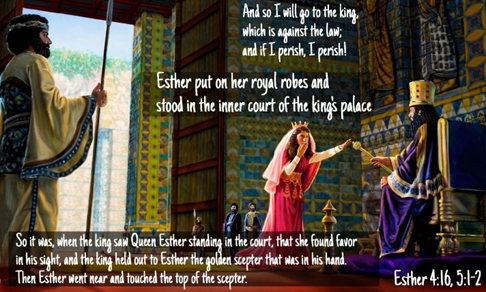
“On the third day, Esther put on her royal attire and stood in the inner court of the palace across from the king’s quarters. The king was sitting on his royal throne in the royal courtroom, facing the entrance. As soon as the king saw Queen Esther standing in the court, she found favor in his sight. The king extended the gold scepter in his hand toward Esther, and she approached and touched the tip of the scepter.
“What is it, Queen Esther?” the king inquired. “What is your request? Even up to half the kingdom, it will be given to you.” “If it pleases the king,” Esther replied, “may the king and Haman come today to the banquet I have prepared for the king.” “Hurry,” commanded the king, “and bring Haman, so we can do as Esther has requested.”
So the king and Haman went to the banquet that Esther had prepared. And as they drank their wine, the king said to Esther, “What is your petition? It will be given to you. What is your request? Even up to half the kingdom, it will be fulfilled.”
Esther replied, “This is my petition and my request: If I have found favor in the sight of the king, and if it pleases the king to grant my petition and fulfill my request, may the king and Haman come tomorrow to the banquet I will prepare for them. Then I will answer the king’s question.”
Haman’s Plot against Mordecai
That day Haman went out full of joy and glad of heart. At the King’s Gate, however, he saw Mordecai, who did not rise or tremble in fear at his presence. And Haman was filled with rage toward Mordecai. Nevertheless, Haman restrained himself and went home. And calling for his friends and his wife Zeresh, Haman recounted to them his glorious wealth, his many sons, and all the ways the king had honored and promoted him over the other officials and servants.
“What is more,” Haman added, “Queen Esther invited no one but me to join the king at the banquet she prepared, and I am invited back tomorrow along with the king. Yet none of this satisfies me as long as I see Mordecai the Jew sitting at the King’s Gate.”
His wife Zeresh and all his friends told him, “Have them build a gallows fifty cubits high,(75 feet high!) and ask the king in the morning to have Mordecai hanged on it. Then go to the banquet with the king and enjoy yourself.”
The advice pleased Haman, and he had the gallows constructed.”
Reading about Esther’s actions, we wonder what she can possibly be thinking! Here’s Haman, the arch-enemy of the Jews; yet, Esther is inviting him to a banquet along with King Xerxes. But Esther and her maids have been fasting and praying, and God is the One who has instructed Esther in how to proceed. Taking her courage in both hands, Esther enters the outer court, where King Xerxes sees her. King Xerxes extends the golden scepter, Esther touches it, and Xerxes makes a magnificent offer. Would Xerxes actually have given Esther half the kingdom at this point? Who knows? Perhaps Xerxes has been drinking again, but it’s far more likely that Xerxes has been keeping close tabs on Esther and has been receiving glowing reports about her kindness, her gentleness, and her sweet nature. Palace spy systems have always been very efficient, and the eunuchs serving Esther probably report to the king regularly.
Haman is stoked! Not only has Xerxes honored Haman above all the other princes, but now even Queen Esther has issued an exclusive invitation. As Haman is rushing home to share this latest honor with his family, he sees Mordecai just outside the King’s Gate. Mordecai is probably still wearing sackcloth and ashes and looks wretched; moreover, he refuses to rise or bow to Haman as Haman passes. “The very nerve of that abominable Jew!” Haman thinks. “I’ll settle with him as soon as possible.” Later, Haman’s wife and friends advise him to build a towering gallows seventy-five feet high and have Mordecai hanged on it before he goes off to Esther’s banquet. Things are looking black for Mordecai and the Jews.
APPLICATION: What could be more innocuous than a private banquet? A meeting with only King Xerxes and Haman ensures that King Xerxes will not be embarrassed and at the same time allows Esther to test the king’s emotional state at this point. Xerxes is well known for being a mean drunk; look what happened to Queen Vashti. Despite the king’s munificent statements offering Esther up to half his kingdom, Esther knows it’s far better to make modest requests and see what God will do with the situation.
Notice what Esther is NOT doing. Esther is not planning to poison Haman, although that option has probably been used at more than one royal banquet. Instead, Esther is offering her enemy hospitality. If we overlook the significance of this act, we are underestimating its importance. Purim is one of the traditional Jewish festivals and it is helpful to see what the Talmud says about it. Alan D. Corré, Emeritus Professor of Hebrew Studies, University of Wisconsin-Milwaukee has collected the following comments from the Talmud:
“Purim [The Feast of Lots] is a light-hearted festival, and we catch the Rabbis in a festive mood when they discuss in the Talmud this question: Why did Esther invite Haman to a banquet? Presumably, she had no liking for the man; moreover, could she not have persuaded the King to revoke his evil decree against the Jews without having the hated Haman to a banquet? The Rabbis give no less than twelve separate views on what Esther’s motive was.
Rabbi Elazar: Esther hoped that Haman would make some blunder at the banquets, thereby offending the King. Apparently this rabbi felt that there was some danger in accepting dinner invitations from ladies.
Rabbi Joshua: Esther was a religious young woman, and she simply followed the instructions in the book of Proverbs, 25.2 “If thine enemy be hungry, give him food to eat; and if he be thirsty, give him water to drink.” In other words, act the gentleman towards your enemies, and have confidence that God will ultimately right the wrong. Notice the difference in emphasis between these two views. In one, Esther herself is a practical schemer, fighting evil with the same; in the other she is a religious believer, relying on God’s mercies.
Rabbi Meir: He is reputed to be one of the cleverest of the Talmudic rabbis. According to him, Esther had an idea that Haman intended to overthrow the king, and set himself up as monarch. She felt that Haman’s star was in the ascendent and wanted to postpone what she thought would be a successful revolt. So she placated Haman by inviting him to a banquet.
Rabbi Judah
This was a ruse on Esther’s part to avoid recognition as a Jewess. She felt she could work better if no one knew her origin, and her invitation to Haman was a smoke screen, since obviously no Jewess would invite him.
Rabbi Nehemiah
His opinion is psychologically interesting. Esther invited Haman so that the Jews would not say: “We have a friend at the court” and thus not bother to seek God’s mercy. The rabbi knew that for most people God is the last resort. If they can rely on men, however fickle, they prefer it. Esther wanted the people to feel that God had saved them through her, not that she saved them.
Rabbi Jose
Esther wanted to get to know Haman better, and thereby discover his weak spots.
Rabbi Simon ben Menasya
Esther’s action was a very shocking one, which she did deliberately in order, as it were, to delude God into thinking that even Esther had joined Haman, and make him arise in anger and do something about it! Such an explanation seems incredibly naive to us, yet it shows to what degree God was a part of the lives of these people. He was like a friend, whom, when all else failed, you could irritate into doing something for you. Naive, but touching too.
Rabbi Joshua ben Korha
“Cherchez la femme!” He thinks that Esther wanted to give the king the impression that she was in love with Haman, and hence the king would, in best Persian style, do away with them both. No doubt Esther was ready to die for her people, but it is hard to believe that her strategem included her own death.
Rabban Gamliel
She wanted Haman there, so that when she denounced him, the king could point to him and order him executed before he had a chance to change his fickle and not too bright mind. This explanation is so simple that it will appeal only to the least romantic of us.
Rabbi Eliezer of Modin
Esther wanted to make the princes and the court jealous of Haman, whereupon they would arrange for him to be taken for a ride different from the one that, to his chagrin, he had to arrange for Mordecai. The great commentator Rashi cites this explanation with approval.
Rabba
“Pride comes before a fall.” Esther wanted to blow up Haman until he burst (which, of course, he did.)
Abbaye and Rava
A very common theme in literature is the downfall of the wicked while they are steeped in their orgies. Think of the destruction of the suitors in the Odyssey. Think of the death of Job’s sons, and especially the feast of Belshazzar who was too bleary-eyed to read the writing on the wall, and had to call in the sober Daniel to do if for him. Esther wanted to have a Belshazzar’s feast, in which Haman would be the victim.
What can we learn from this? First, there is more in Holy Writ than meets the eye. Second, the rabbis are very ingenious at explaining it. Third, Esther was a very clever young woman.
The end of the tale is this. One of the rabbis had a visitation from Elijah, who, in Jewish folklore, is the man who can answer all questions, a veritable quiz producer’s ideal. The rabbi asked: “Which opinion was right?” He answered: “They all were.” Apparently Esther was cleverer and the rabbis more ingenious even than we thought.”
I feel that God advised Esther to hold this banquet and the subsequent ones and that God knew exactly how He was going to resolve the issue. I also suspect that Esther was acting in accordance with God and going one day at a time. This situation was so precarious that scheming on Esther’s part might have caused the whole thing to fail.
Personally, I have found that God frequently tells me to take one step and then after I have made a start, He will direct the next step. But God rarely tells me His entire plan because I would probably be tempted to try to fix it and I would make a complete mess of the situation. So Esther and her maids planned the first banquet and Esther made the invitation in fear and trembling, setting an example for all of us who must follow God’s leading.
PRAYER: Father God, thank You for loving us and for caring for us. Lord, thank You that even when we encounter problems that seem insurmountable, You still have perfect solutions. Help us to trust You and to take the first steps, knowing that You will give more guidance as we go along. In the mighty and precious Name of King Jesus. Amen.
“When Mordecai learned of all that had happened, he tore his clothes, put on sackcloth and ashes, and went out into the middle of the city, wailing loudly and bitterly. But he went only as far as the King’s Gate, because the law prohibited anyone wearing sackcloth from entering that gate. In every province to which the king’s command and edict came, there was great mourning among the Jews. They fasted, wept, and lamented, and many lay in sackcloth and ashes.
When Esther’s maidens and eunuchs came and told her about Mordecai, the queen was overcome with distress. She sent clothes for Mordecai to wear instead of his sackcloth, but he would not accept them. Then Esther summoned Hathach, one of the king’s eunuchs appointed to her, and she dispatched him to Mordecai to learn what was troubling him and why. So Hathach went out to Mordecai in the city square in front of the King’s Gate, and Mordecai told him all that had happened to him, including the exact amount of money that Haman had promised to pay into the royal treasury in order to destroy the Jews. (Haman promised to pay 10,000 talents, or approximately 377 tons or 342 metric tons of silver!)
Mordecai also gave Hathach a copy of the written decree issued in Susa for the destruction of the Jews, to show and explain to Esther, urging her to approach the king, implore his favor, and plead before him for her people.
So Hathach went back and relayed Mordecai’s response to Esther.
Then Esther spoke to Hathach and instructed him to tell Mordecai, “All the royal officials and the people of the king’s provinces know that one law applies to every man or woman who approaches the king in the inner court without being summoned—that he be put to death. Only if the king extends the gold scepter may that person live. But I have not been summoned to appear before the king for the past thirty days.”
When Esther’s words were relayed to Mordecai, he sent back to her this reply: “Do not imagine that because you are in the king’s palace you alone will escape the fate of all the Jews. For if you remain silent at this time, relief and deliverance for the Jews will arise from another place, but you and your father’s house will perish. And who knows if perhaps you have come to the kingdom for such a time as this?”
Then Esther sent this reply to Mordecai: “Go and assemble all the Jews who can be found in Susa, and fast for me. Do not eat or drink day or night for three days, and I and my maidens will fast as you do. After that, I will go to the king, even though it is against the law. And if I perish, I perish!” (Or if I am destroyed, then I will be destroyed.)
So Mordecai went and did all that Esther had instructed him.”
The crisis has come, and the Jews are distraught! An entire race is faced with extinction throughout the greatest empire of the time, unless God does a miracle. Rather than hide his nationality, Mordecai demonstrates it by wearing sackcloth and ashes into the middle of the city and wailing bitterly. Nobody in mourning can enter the King’s Gate, so Mordecai remains outside. Back in the palace, Esther is both anxious and embarrassed; what is her beloved uncle thinking of? Esther’s maidens and eunuchs quickly inform her of Mordecai’s behavior. Esther sends out clothing, hoping Mordecai will break off his mourning and enter the King’s Gate; however, Mordecai refuses to change.
Esther sends Hathach, one of the eunuchs and a trusted emissary, to Mordecai. Mordecai tells Hathach everything, giving him a copy of the decree and informing him of the staggering sum of money Haman has promised to pay into the royal treasury. (Note: It appears Haman has yet to deliver the money! Does he really have that much?) Mordecai also begs Esther to intercede with Xerxes to save the Jews.
Esther doesn’t know what to do. Even as the queen, Esther must wait until Xerxes sends for her; she can’t simply barge into the throne room. If Esther enters the inner court, and Xerxes fails to extend his golden scepter to her, she will die immediately. But when Esther sends this message to Mordecai, Mordecai doesn’t mince words. “Do not imagine that because you are in the king’s palace you alone will escape the fate of all the Jews. For if you remain silent at this time, relief and deliverance for the Jews will arise from another place, but you and your father’s house will perish. And who knows if perhaps you have come to the kingdom for such a time as this?”
Faced with this answer, Esther realizes what she must do. But Esther is wise enough to realize that she must have God’s help if she is to succeed. “Go and assemble all the Jews who can be found in Susa, and fast for me. Do not eat or drink day or night for three days, and I and my maidens will fast as you do. After that, I will go to the king, even though it is against the law. And if I perish, I perish!”
APPLICATION: Through the years, God has used these verses to call innumerable people to His service. Esther 4:14 is particularly meaningful to us because this was the verse God gave us when we were to come to Ghana our first time. In October 1987 I was working at City of Faith Hospital in Tulsa, Oklahoma, while my husband was out in western Oklahoma, organizing donated medical equipment. In late October 1987, I had the opportunity to speak to a seasoned veteran missionary who had visited the project to which we were being sent. This man spent several hours warning me of the pitfalls in the situation, concluding with the advice that we should refuse to enter it as long as those problems existed. That night I was in turmoil, praying far into the night for guidance. God had clearly led us to the group that was sending us and they wanted to send us to that project. What should we do? There was a strong possibility that the project might fail and that we would then be blamed for its failures. Essentially, we were being sent over Niagara Falls in a barrel. Finally, I fell asleep. But I awoke the next morning knowing two things: yes, we were being sent over Niagara Falls in a barrel and our sending agency would blame us for all failures, but God was in that barrel with us. And the verse God gave me to seal His Will in the situation was the question Mordecai put to Esther. “Who knows but what you have come to the kingdom for such a time as this?”
We arrived in Ghana and found that the veteran missionary had been spot-on with his information. We duly reported all the problems to our fledgling mission group; however, they did blame us for elements of the situation over which we had no control. But God was still in this situation. Because of our stand, the national church did get proper papers for the land and the building and subsequent missionaries had a far easier time than we did. And God wanted us in Ghana. During that first term, we traveled around Ghana, studied one of the most common languages in Ghana, and became well acquainted with the national church and a number of prominent physicians who have been of enormous help ever since. We also got initiated into spiritual warfare, something of which we were totally ignorant before coming to Ghana. Truly, God proved that He had brought us to Ghana “for such a time as this.”
The message of this chapter is clear: God may bring any one of us to the brink of disaster. I am Facebook friends with a couple who minister in Ukraine and who have persisted despite all the fighting there. God has brought them to Ukraine for such a time as this. But if God brings you to a crisis, He is also sufficient to take you through that crisis. God doesn’t play favorites; He helped Esther and He will help you.
PRAYER: Father God, thank You for loving us and for caring for us. Lord, many of us are at crisis points for various reasons. Thank You that You are sufficient for any problem and that You are the God of heaven and earth and nothing is too difficult for You. Please help all those who read these words to come to You and trust You as their Source of comfort and strength. In the mighty and precious Name of King Jesus. Amen.
But let me reveal to you a wonderful secret. We will not all die, but we will all be transformed! It will happen in a moment, in the blink of an eye, when the last trumpet is blown. For when the trumpet sounds, those who have died will be raised to live forever. And we who are living will also be transformed. For our dying bodies must be transformed into bodies that will never die; our mortal bodies must be transformed into immortal bodies.
Then, when our dying bodies have been transformed into bodies that will never die, this Scripture will be fulfilled:
“Death is swallowed up in victory. O death, where is your victory? O death, where is your sting?”
For sin is the sting that results in death, and the law gives sin its power. But thank God! He gives us victory over sin and death through our Lord Jesus Christ.
So, my dear brothers and sisters, be strong and immovable. Always work enthusiastically for the Lord, for you know that nothing you do for the Lord is ever useless.
Sometimes, the men who are the most effective are also the quietest ones in the room. Our friend Bobby was one of the quiet ones, not because he had nothing to say but because he was thoughtful, considering every word before opening his mouth.
Bobby was a true gentleman in every sense of the word. Highly intelligent with a sharp sense of humor, Bobby was one of those men who wait until everyone else had said everything they were going to say and would then make a short telling comment that would be far more effective than all the verbiage that others had already produced.
Bobby was a man of great faith, and he needed that faith. During the more than forty years we have been friends, we have seen Bobby and his wife Cindy face all kinds of challenges, including health problems and family problems of various kinds. When Bobby’s grandson Christopher died tragically in a car accident, Bobby and Cindy found themselves struggling with their own grief as they comforted others. Wherever Bobby and Cindy attended church, Bobby could always be found helping, quietly serving.
Bobby was a fond grandfather whose grandchildren are now posting tributes indicating their love for him. Never underestimate the influence of godly, loving grandparents, for they can be mighty healers when life wounds.
Live long enough and your friends and loved ones begin leaving you to take their places in heaven. While it is true that Christians do not grieve as those who have no hope, it is equally true that we fear the pain of separation and the loneliness when a life partner is no longer there. As we remember Bobby, we also pray for his family and especially for Cindy, his wife. And we beg God to fill family homes with His Holy Spirit and send angels to watch over family members.
PRAYER: Father God, thank You for loving us and caring for us. Lord, we praise You for the life of Bobby Walters even as we mourn his passing. You are infinitely kind and infinitely wise, and You have all our lives in Your hands. Lord, help us to continue to trust You. In the mighty and precious Name of King Jesus. Amen.