Acts 18: Paul Meets Priscilla and Aquila in Corinth
1 Then Paul left Athens and went to Corinth. 2 There he became acquainted with a Jew named Aquila, born in Pontus, who had recently arrived from Italy with his wife, Priscilla. They had left Italy when Claudius Caesar deported all Jews from Rome. 3 Paul lived and worked with them, for they were tentmakers just as he was.
One of the things we’re likely to forget is that Paul was not merely a scholar and a preacher. Part of the rabbinic tradition was for rabbis to have a profession apart from teaching Scripture. In a day and age when tents were everywhere, and tent makers were in great need, Paul was a tent maker. Tent making was a highly portable profession, one Paul could easily practice wherever he found himself. Upon arrival in Corinth, Paul connected with a believing Jewish couple, Priscilla and Aquila. The expulsion of the Jews took place somewhere between AD 41-AD 50 and was due to a variety of issues. Christianity was sweeping through the Jewish community in Rome, and there was intense friction between traditional Jews and those accepting Jesus as Messiah. There may well have been an economic motive, for corrupt rulers have also been eager to expel Jews refusing to pay up.
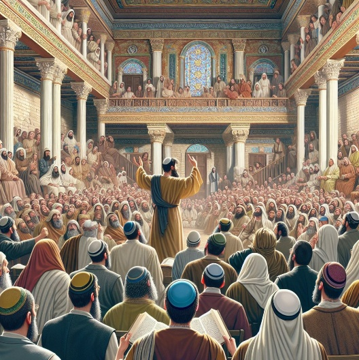
4 Each Sabbath found Paul at the synagogue, trying to convince the Jews and Greeks alike. 5 And after Silas and Timothy came down from Macedonia, Paul spent all his time preaching the word. He testified to the Jews that Jesus was the Messiah. 6 But when they opposed and insulted him, Paul shook the dust from his clothes and said, “Your blood is upon your own heads—I am innocent. From now on I will go preach to the Gentiles.”
7 Then he left and went to the home of Titius Justus, a Gentile who worshiped God and lived next door to the synagogue. 8 Crispus, the leader of the synagogue, and everyone in his household believed in the Lord. Many others in Corinth also heard Paul, became believers, and were baptized.
Wow! Wait a minute, Paul! Did you just shake the dust of the synagogue off your clothes? Do you remember what that signifies? After a lifetime of attending synagogues and speaking in them, Paul is turning his back on the practices of a lifetime, and doing it decisively. Jesus advised his disciples to shake the dust off their clothes when a group of people absolutely refused to receive their message. And now this Pharisee of the Pharisees turns his back on the traditional worship places of his own people, choosing to go to the Gentiles, people whom the Pharisees have previously disdained. True, Paul has been preaching to Gentiles for some time; however, he has also been visiting synagogues as much as possible. Is Paul refusing to testify to Jews? Absolutely not! Paul moves right next door to the synagogue, staying in the home of Titus Justus, a Gentile who worships God. Meanwhile, Crispus, the leader of the synagogue and EVERYONE IN HIS HOUSEHOLD believes in the Lord. Revival breaks out in Corinth. The Jewish leaders in the synagogue are probably chewing their beards in frustration.
9 One night the Lord spoke to Paul in a vision and told him, “Don’t be afraid! Speak out! Don’t be silent! 10 For I am with you, and no one will attack and harm you, for many people in this city belong to me.” 11 So Paul stayed there for the next year and a half, teaching the word of God.
If you were Paul and you had already endured being stoned and left for dead, and being beaten until your back was raw, you might be hesitant to speak out for Jesus. God knows Paul’s heart and understands his concerns. This is why God speaks to Paul, reassuring him that he should speak out. Ever since God spoke these words to Paul, these words have comforted and inspired pastors and missionaries throughout the world. Few things are more disheartening than isolation, feeling that you are totally alone, lacking anyone who understands your situation and your struggles. Later, Paul will write to the Romans, encouraging them.
Romans 8:31 What shall we say about such wonderful things as these? If God is for us, who can ever be against us? 32 Since he did not spare even his own Son but gave him up for us all, won’t he also give us everything else? 33 Who dares accuse us whom God has chosen for his own? No one—for God himself has given us right standing with himself. 34 Who then will condemn us? No one—for Christ Jesus died for us and was raised to life for us, and he is sitting in the place of honor at God’s right hand, pleading for us.
35 Can anything ever separate us from Christ’s love? Does it mean he no longer loves us if we have trouble or calamity, or are persecuted, or hungry, or destitute, or in danger, or threatened with death? 36 (As the Scriptures say, “For your sake we are killed every day; we are being slaughtered like sheep.”) 37 No, despite all these things, overwhelming victory is ours through Christ, who loved us.
38 And I am convinced that nothing can ever separate us from God’s love. Neither death nor life, neither angels nor demons, neither our fears for today nor our worries about tomorrow—not even the powers of hell can separate us from God’s love. 39 No power in the sky above or in the earth below—indeed, nothing in all creation will ever be able to separate us from the love of God that is revealed in Christ Jesus our Lord.
Acts 18:12 But when Gallio became governor of Achaia, some Jews rose up together against Paul and brought him before the governor for judgment. 13 They accused Paul of “persuading people to worship God in ways that are contrary to our law.”
14 But just as Paul started to make his defense, Gallio turned to Paul’s accusers and said, “Listen, you Jews, if this were a case involving some wrongdoing or a serious crime, I would have a reason to accept your case. 15 But since it is merely a question of words and names and your Jewish law, take care of it yourselves. I refuse to judge such matters.” 16 And he threw them out of the courtroom.
17 The crowd then grabbed Sosthenes, the leader of the synagogue, and beat him right there in the courtroom. But Gallio paid no attention.
Once more, these ultra-righteous religious leaders are more than willing to employ market rabble when they want to make a point. The “crowd” grabbing Sosthenes, the leader of the synagogue, is likely comprised of idle young men from the market place who hang around waiting to get into trouble. These guys are more than willing to stage a riot for a small monetary consideration. Meanwhile, the Jewish religious leaders can remain aloof, pretending they have nothing to do with this situation.
What about Gallio, the Roman governor of Achaia? Gallio is a smart cookie; he has seen this kind of thing before and knows it never ends well for outsiders. If the Jews want to punish Paul because of an infringement of one of their regulations, let them handle it themselves. Mother Roma is a great empire, and great empires don’t involve themselves in settling petty problems involving one particular religious sect.
When, if ever, are we justified in shaking the dust off our clothes against a particular place or group of people? Here Paul shakes the dust off his clothes as a sign that he will never preach in another synagogue. Paul continues to witness to all those around him, but he no longer frequents the synagogues as he has in the past. Why does God allow Paul to take such an action? Perhaps Paul must take a definite step to make a total break with his Pharisaic past. Jesus warned that the new wine of the Gospel could not be poured into the old dried-out wineskins of Judaism, for the new wine would ferment, bursting the old wineskins. This symbolic act is as necessary for Paul as for anyone else, for now he must turn his face to the Gentiles.
In studying Paul, we must remember that Paul has been raised in one of the strictest and most demanding sects of Judaism. Paul is a brilliant rabbinic scholar, a star pupil of Gamaliel, one of the most respected teachers at that time. Paul is a Roman citizen and a native of Tarsus, a city devoted to academics and a center of intellectualism. These attributes, wonderful as they are, can also become hindrances when Paul is trying to reach the Gentiles. In a very real sense, Paul has severed a religious umbilical cord and must now move forward depending solely on God rather than his background and training.
Are we ever justified in shaking the dust of a particular group off our clothing? Maybe. Sometimes groups do this for us. In 1996 we were trying to operate a small hospital in the middle of a tribal war when we suddenly received a starchy message from one supporting church indicating that we “no longer fit their missions’ program.” Later we learned that they wanted to focus on locations where they could indulge in missionary tourism. Well, there’s no doubt that we could not invite these people to come to our remote village that was then under military occupation. And missionary tourism would have been impossible. “Here, see the local technical school that has become a military camp? Sorry, but you can’t run a vacation Bible school because it might look suspicious. Oh, and when you hear gun fire in the morning, don’t worry. That’s only the military shooting off a few automatic weapons to let us know that they are large and in charge….unless the gun fire is from a traditional funeral. On the other hand, if you hear gun shots and then hear screams, you might need to rush to the Oti River and cross into Togo.” That was our reality in 1994-1996.
Another supporting church suddenly chose to eliminate all support for foreign missions, even though we had been friends with the pastor for nearly twenty years. God replaced that support; however, the church subsequently dwindled.
The take-away lesson is this: Be absolutely certain that God is leading you before you make a complete break with any individual or group. Remember that Paul returned to Lystra, even though people in Lystra had stoned him and had left him for dead. And remember that Timothy, Paul’s spiritual son, was from Lystra. In other words, “never say never.”
PRAYER: Father God, thank You for loving us and caring for us. Lord, help us to be sensitive to Your leading, realizing that You are the One who calls, who guides, and who provides. In the mighty and precious Name of King Jesus. Amen.


Leave a comment