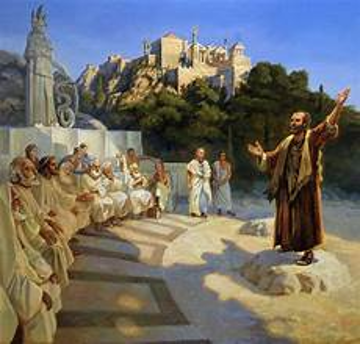
Acts 17:16-34 Paul Preaches in Athens
16 While Paul was waiting for them in Athens, he was deeply troubled by all the idols he saw everywhere in the city. 17 He went to the synagogue to reason with the Jews and the God-fearing Gentiles, and he spoke daily in the public square to all who happened to be there.
18 He also had a debate with some of the Epicurean and Stoic philosophers. When he told them about Jesus and his resurrection, they said, “What’s this babbler trying to say with these strange ideas he’s picked up?” Others said, “He seems to be preaching about some foreign gods.”
19 Then they took him to the high council of the city. “Come and tell us about this new teaching,” they said. 20 “You are saying some rather strange things, and we want to know what it’s all about.” 21 (It should be explained that all the Athenians as well as the foreigners in Athens seemed to spend all their time discussing the latest ideas.)
If you’ve ever studied ancient Greek mythology, you might wonder how any bunch of people as intelligent as the Greeks could possibly have fallen for such a line of codswallop. Encyclopedia Britannica summarizes the ancient Greek religion in this fashion:
Though the worship of the sky god Zeus began as early as the 2nd millennium by, Greek religion in the established sense began c. 750 by and lasted for over a thousand years, extending its influence throughout the Mediterranean world and beyond. The Greeks had numerous gods who controlled various natural or social forces (e.g., Poseidon the sea, Demeter the harvest, Hera marriage). Different deities were worshiped in different localities, but Homer’s epics helped create a unified religion, in which the major gods were believed to live on Mount Olympus under the rule of Zeus.
The Greeks also worshiped various gods of the countryside: Pan, nymphs, naiads, dryads, Nereids, and satyrs (see satyr and silenus), along with the Furies and the Fates. Heroes from the past, such as Heracles and Asclepius, were also venerated. Animal sacrifices were of great importance, usually made at a temple on the altar of the god. Other cultic activities included prayers, libations, processions, athletic contests, and divination, particularly through oracles and birds.
Great religious festivals included the City Dionysia at Athens and the festival of Zeus in the western Peloponnese that included the Olympic Games. Death was seen as a hateful state; the dead lived in the realm of Hades, and only heroes enjoyed Elysium. Great wrongdoers suffered in Tartarus. Mystery religions emerged to satisfy the desire for personal guidance, salvation, and immortality. Greek religion faded with the rise of Christianity and lost its last great advocate with the death of Julian in ad 363.
In an African context, we would have called these people fetish worshipers. Yes, these people were spiritually hungry and in their hunger were worshiping real spirits; however, these spirits were some of the demons who accompanied Lucifer when he fell from heaven. One third of the angels fell along with Lucifer, allowing for plenty of demons to populate the earth. Even though some of the ideals were lofty, at the end, believers would wind up in Hades, no matter how many sacrifices, prayers, libations, athletic contests, or other acts of worship they had carried out.
Athens was not a major trading center; in fact, Athens was much more an academic community. An AI summary tells us: Athens during Paul’s time was not a wealthy economic hub. Instead, it was more akin to an academic center, similar to modern university towns like Oxford or Harvard. While it had a rich history in philosophy, arts, and politics, the city was not experiencing economic growth like other cities such as Corinth or Ephesus. The focus in Athens was primarily on intellectual pursuits rather than commercial prosperity, which influenced its cultural and social dynamics.
So Paul, one of the brightest minds ever to grace the Christian church in any age, now found himself in Athens, a place where philosophers abounded, education was prized, and many men gathered in hopes of learning something that would make sense of their lives and give them hope. How could Paul possibly reach these people effectively?
22 So Paul, standing before the council, addressed them as follows: “Men of Athens, I notice that you are very religious in every way, 23 for as I was walking along I saw your many shrines. And one of your altars had this inscription on it: ‘To an Unknown God.’ This God, whom you worship without knowing, is the one I’m telling you about.
Immediately, Paul grabbed the attention of his listeners, complimenting them on their search for truth and referring to an altar that might have stood close to where he was speaking. Paul was establishing common ground, identifying with his audience. But why would anybody erect an altar to a god whom they didn’t know? AI tells us: According to the legend recorded by Diogenes Laërtius, during a plague, the Athenians released sacrificial sheep on the Areopagus. Wherever the sheep lay down, they built altars to the appropriate unknown god, believing this would appease the deity and end the plague.
While no intact altar with the exact inscription has been found, archaeological findings support the existence of altars dedicated to unnamed deities in ancient Athens, affirming the city’s religious practices. This altar exemplifies the Athenians’ desire to connect with the divine, even in uncertainty, and highlights the cultural and historical layers of their worship.
Paul was speaking to men who instinctively felt that their ancient Greek religion was lacking and who found it unsatisfying. Now Paul continued.
Acts 17:24 “He is the God who made the world and everything in it. Since he is Lord of heaven and earth, he doesn’t live in man-made temples, 25 and human hands can’t serve his needs—for he has no needs. He himself gives life and breath to everything, and he satisfies every need. 26 From one man he created all the nations throughout the whole earth. He decided beforehand when they should rise and fall, and he determined their boundaries.
27 “His purpose was for the nations to seek after God and perhaps feel their way toward him and find him—though he is not far from any one of us. 28 For in him we live and move and exist. As some of your own poets have said, ‘We are his offspring.’ 29 And since this is true, we shouldn’t think of God as an idol designed by craftsmen from gold or silver or stone.
Now Paul had the rapt attention of his audience, for he was proving that he was highly educated and conversant with traditional Greek literature. This was a direct quotation of Greek sources-likely Epimenides for the first phrase and Aratus (or possibly Cleanthes) for the second. Therefore, Paul’s usage reflects both his scholarly exposure to secular writings and his willingness to connect with his audience on common ground.
30 “God overlooked people’s ignorance about these things in earlier times, but now he commands everyone everywhere to repent of their sins and turn to him. 31 For he has set a day for judging the world with justice by the man he has appointed, and he proved to everyone who this is by raising him from the dead.”
32 When they heard Paul speak about the resurrection of the dead, some laughed in contempt, but others said, “We want to hear more about this later.” 33 That ended Paul’s discussion with them, 34 but some joined him and became believers. Among them were Dionysius, a member of the council, a woman named Damaris, and others with them.
Resurrection? What a novel idea! Remember that the Greeks believed that once dead, always dead, and that they would all wind up in Hades unless they did something incredibly heroic. Most of the audience were realistic enough to know that they were simply ordinary people. Now Paul was offering those ordinary people the opportunity for something remarkable, eternal life with a loving Father God who had sent His own son to die for their sins. No more animal sacrifices. No more speculations about one’s eventual fate after death. Even though many in the audience clung to their ancient beliefs, some began glimpsing a new future full of hope.
Notice what Paul did not do during this meeting. Paul did not condemn the Greeks or criticize their traditional religion. Paul simply created an intellectual bond and then described a better way.
“Bob, if you don’t accept Jesus, you’re going to burn in hell!” It was 1979 at a factory in a small town in western New York. My husband found himself confronted by a coworker he later described as a “pushy Baptist.” Several times a day, this man would get in my husband’s face, confronting him with his need for Jesus. Somehow, it worked. Bob’s story is much longer than that, for he first heard the Gospel in a Sunday School at age five and later encountered Bible-believing Christians several times. But it was the “in your face” style of witness that helped turn Bob’s life around. One morning, he found himself turning back to that man and asking, “___, how do I get the Lord in my life?” That morning was the turning point. Bob received Jesus as Savior and Lord, began attending a church where he was mentored, and eventually embarked on a journey that wound up in a small village in northeastern Ghana.
Why tell this story? Believers are as individual as their DNA or their finger prints. God tailors each salvation story to the individual experiencing it. The believers in Athens required a totally different approach from the one that turned Bob around. But God knows people’s hearts and God knows what will work in each situation. May God help each of us so that when we are called upon to witness, we will do so, looking to Him for guidance.
PRAYER: Father God, thank You for loving us and caring for us. Lord, help us to remember that we are surrounded by spiritually hungry people and that You are the One who can best direct our testimonies. In the mighty and precious Name of King Jesus. Amen.
Tags: ancient-greek-religion, bible, christianity, faith, god, jesus, philosophy


Leave a comment