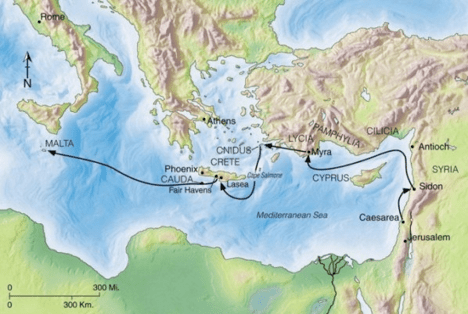
Acts 27 Paul Sails for Rome
27:1 When the time came, we set sail for Italy. Paul and several other prisoners were placed in the custody of a Roman officer named Julius, a captain of the Imperial Regiment. 2 Aristarchus, a Macedonian from Thessalonica, was also with us. We left on a ship whose home port was Adramyttium on the northwest coast of the province of Asia; it was scheduled to make several stops at ports along the coast of the province.
3 The next day when we docked at Sidon, Julius was very kind to Paul and let him go ashore to visit with friends so they could provide for his needs. 4 Putting out to sea from there, we encountered strong headwinds that made it difficult to keep the ship on course, so we sailed north of Cyprus between the island and the mainland. 5 Keeping to the open sea, we passed along the coast of Cilicia and Pamphylia, landing at Myra, in the province of Lycia. 6 There the commanding officer found an Egyptian ship from Alexandria that was bound for Italy, and he put us on board.
7 We had several days of slow sailing, and after great difficulty we finally neared Cnidus. But the wind was against us, so we sailed across to Crete and along the sheltered coast of the island, past the cape of Salmone. 8 We struggled along the coast with great difficulty and finally arrived at Fair Havens, near the town of Lasea. 9 We had lost a lot of time. The weather was becoming dangerous for sea travel because it was so late in the fall, and Paul spoke to the ship’s officers about it.
10 “Men,” he said, “I believe there is trouble ahead if we go on—shipwreck, loss of cargo, and danger to our lives as well.” 11 But the officer in charge of the prisoners listened more to the ship’s captain and the owner than to Paul. 12 And since Fair Havens was an exposed harbor—a poor place to spend the winter—most of the crew wanted to go on to Phoenix, farther up the coast of Crete, and spend the winter there. Phoenix was a good harbor with only a southwest and northwest exposure.
The remarkable thing about travel in Paul’s day is that people are traveling constantly. Ships are crisscrossing the Mediterranean Sea, carrying people, trade goods, armies, and everything else imaginable. The sea bottom of the Mediterranean is littered with ancient ship wrecks, and the variety of goods they were bearing at the time they sank is amazing. But sea voyages must be timed appropriately. The Mediterranean is a relatively shallow sea that can go from calm to raging in minutes, particularly once late fall arrives. As an experienced traveler, Paul is fully aware of these dangers and attempts to warn the officer in charge of the prisoners; however, the ship’s captain and the owner contradict him. Hoping to make more progress before having to harbor for the winter, the owner puts pressure on the captain, who supports the owner, despite any misgivings he might have personally. The officer in charge of the prisoners is a bluff military man. It’s also possible that the owner promises both the captain and the officer in charge money if they will agree to sailing to Phoenix and resting there for the winter. Too bad they’re never going to make it to Phoenix.
The story of Paul’s voyage and eventual shipwreck gives us a vivid glimpse into the lives of travelers in those days. When people prayed for someone to have travel mercies, they weren’t merely praying for a swift safe ride but also praying against all the terrible things that might happen on the way. Even today, travelers on the Mediterranean are vulnerable to violent storms, armed robberies, fall-out from wars, and other dangers. One site devoted to sailing lists dangers such as the fact that at around 2.5 million square kilometres, the Mediterranean is one of the world’s busiest inland seas. Every year, millions of leisure, fishing and commercial vessels pass through the sea routes between Europe, North Africa and the Middle East. These days, the combination of heavy traffic, local wind phenomena, narrow passages and tourist charter operations creates specific hazards.
Paul tries his best to warn authorities to break off the voyage; however, the owner hopes to reach a better harbor before stopping. This will prove to be one of the worst decisions of the owner’s life, for eventually the ship will fall apart during a terrible storm off the coast of Malta.
All the time the ship is maneuvering around the coast of Crete, Paul is conscious of impending doom. But Paul knows something nobody else on that ship knows: God wants Paul to make it to Rome; therefore, God is going to arrange that somehow. Not even Paul can predict what will happen next.

George Whitefield, the fiery preacher whose sermons reached 30,000 people at a time and who helped spark the first Great Awakening, was fond of saying that “We are immortal until our work on earth is done.” Sometimes, we find ourselves in situations we know are likely to result in disaster. We do our best to advise people, warning them; however, for various reasons, people refuse to listen. The only certainty on which we can rely is the knowledge that the same God who has called us can also keep us safe and deliver us.
PRAYER: Father God, thank You for loving us and caring for us. Lord, help us to trust You, no matter what forces threaten us. In the mighty and precious Name of King Jesus. Amen.
 Burunche's Blog
Leave a comment