
Acts 27:13-44 The Storm at Sea 13 When a light wind began blowing from the south, the sailors thought they could make it. So they pulled up anchor and sailed close to the shore of Crete. 14 But the weather changed abruptly, and a wind of typhoon strength (called a “northeaster”) burst across the island and blew us out to sea. 15 The sailors couldn’t turn the ship into the wind, so they gave up and let it run before the gale.
16 We sailed along the sheltered side of a small island named Cauda, where with great difficulty we hoisted aboard the lifeboat being towed behind us. 17 Then the sailors bound ropes around the hull of the ship to strengthen it. They were afraid of being driven across to the sandbars of Syrtis off the African coast, so they lowered the sea anchor to slow the ship and were driven before the wind.
18 The next day, as gale-force winds continued to batter the ship, the crew began throwing the cargo overboard. 19 The following day they even took some of the ship’s gear and threw it overboard. 20 The terrible storm raged for many days, blotting out the sun and the stars, until at last all hope was gone.
21 No one had eaten for a long time. Finally, Paul called the crew together and said, “Men, you should have listened to me in the first place and not left Crete. You would have avoided all this damage and loss. 22 But take courage! None of you will lose your lives, even though the ship will go down. 23 For last night an angel of the God to whom I belong and whom I serve stood beside me, 24 and he said, ‘Don’t be afraid, Paul, for you will surely stand trial before Caesar! What’s more, God in his goodness has granted safety to everyone sailing with you.’ 25 So take courage! For I believe God. It will be just as he said. 26 But we will be shipwrecked on an island.”
Until now, the sailors have paid little or no attention to Paul. Paul is an intellectual, a teacher, a Jew, and the crew members are a mongrel lot from every nation around the Mediterranean Sea. The ship is originally from Alexandria in Egypt; however, few of the sailors are Egyptian. Even though Paul has attempted to befriend the sailors, they have ignored him. But now the captain and the owner are panicking. Experienced sailors are throwing the cargo and much of the ship’s gear overboard. Those who work on the sea know its power and its savagery. In their desperation, these men have already called on all their gods with no results. Now in their desperation, these men are finally willing to give Paul a hearing. In this hour of crisis with lives in danger, these men listen as Paul assures them that God is going to deliver all of them, allowing them to be shipwrecked on an island. But which island? The storm has blown the ship so far off course, the crew has no idea where they are.
The Shipwreck
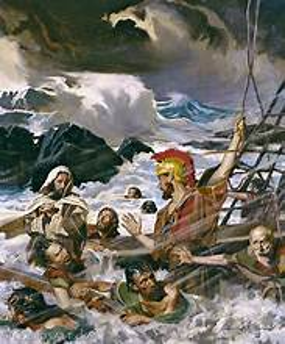
27 About midnight on the fourteenth night of the storm, as we were being driven across the Sea of Adria, the sailors sensed land was near. 28 They dropped a weighted line and found that the water was 120 feet deep. But a little later they measured again and found it was only 90 feet deep. 29 At this rate they were afraid we would soon be driven against the rocks along the shore, so they threw out four anchors from the back of the ship and prayed for daylight.
30 Then the sailors tried to abandon the ship; they lowered the lifeboat as though they were going to put out anchors from the front of the ship. 31 But Paul said to the commanding officer and the soldiers, “You will all die unless the sailors stay aboard.” 32 So the soldiers cut the ropes to the lifeboat and let it drift away.
33 Just as day was dawning, Paul urged everyone to eat. “You have been so worried that you haven’t touched food for two weeks,” he said. 34 “Please eat something now for your own good. For not a hair of your heads will perish.” 35 Then he took some bread, gave thanks to God before them all, and broke off a piece and ate it. 36 Then everyone was encouraged and began to eat— 37 all 276 of us who were on board. 38 After eating, the crew lightened the ship further by throwing the cargo of wheat overboard.
39 When morning dawned, they didn’t recognize the coastline, but they saw a bay with a beach and wondered if they could get to shore by running the ship aground. 40 So they cut off the anchors and left them in the sea. Then they lowered the rudders, raised the foresail, and headed toward shore. 41 But they hit a shoal and ran the ship aground too soon. The bow of the ship stuck fast, while the stern was repeatedly smashed by the force of the waves and began to break apart.
42 The soldiers wanted to kill the prisoners to make sure they didn’t swim ashore and escape. 43 But the commanding officer wanted to spare Paul, so he didn’t let them carry out their plan. Then he ordered all who could swim to jump overboard first and make for land. 44 The others held on to planks or debris from the broken ship. So everyone escaped safely to shore.
276 men all make it to shore safely, swimming or holding onto wreckage. All the prisoners are saved because the commanding officer wants to spare Paul. Why? Because throughout the voyage, Paul has been chatting with the commanding officer, describing his travels and sharing experiences. Paul has likely been telling the commander about Jesus and encouraging him to trust Jesus for his salvation. Who knows how many of the other sailors, prisoners, and passengers are now praising Paul’s God for their safe deliverance?
When we read this story, it’s tempting to focus on Paul, ignoring the other 275 men on the ship. But Jesus has shed his blood for those men just as much as for Paul. It’s likely that those soldiers and sailors would never have listened to Paul at any other time had their lives not been in danger. Now God has demonstrated His might and His saving grace in undeniable fashion. Now they are more than ready to listen to Paul’s testimonies.
Psalm 93:3-4 tells us, “You yourself are from the everlasting past. The floods have risen up, O Lord. The floods have roared like thunder; the floods have lifted their pounding waves. But mightier than the violent raging of the seas, mightier than the breakers on the shore—the Lord above is mightier than these!” As a scholar, Paul is very familiar with these verses, and now as he stands on the shore, he might be chanting, “Blessed art Thou, O Lord of the universe, who delivers us from pounding waves. Blessed art Thou, O Lord of the universe, You who art mightier than the violent raging of the seas, mightier than the breakers on the shore! Blessed art Thou, O Lord of the universe, Who delivers those who fear You!”
What can we learn from Paul? Paul is a persistent opportunist, taking every chance to demonstrate the love of Jesus. While someone lesser might be concerned only with his own safety, Paul has been interceding for the safety of all those on the ship as well as for their salvation. Now on the shore, Paul is going from one man to another, making sure they have not been injured and that they are all right. These prisoners, soldiers, and working men have never encountered a highly educated scholar willing to serve them before. Who knows how many of these men eventually become Christ followers?
When we are serving God, there are no coincidences, but only God-incidences. God can redeem any bad experience and use it for His glory. May we continue to look heavenward, so that we don’t waste any opportunity to serve those around us! PRAYER: Father God, thank You for loving us and caring for us. Lord, help us to remember that our lives are not our own but that all we are and all we have belong to You. Help us to serve You, no matter the circumstances. In the mighty and precious Name of King Jesus. Amen.


Leave a comment