Exodus 9 A Plague against Livestock
9 “Go back to Pharaoh,” the Lord commanded Moses. “Tell him, ‘This is what the Lord, the God of the Hebrews, says: Let my people go, so they can worship me. 2 If you continue to hold them and refuse to let them go, 3 the hand of the Lord will strike all your livestock—your horses, donkeys, camels, cattle, sheep, and goats—with a deadly plague. 4 But the Lord will again make a distinction between the livestock of the Israelites and that of the Egyptians. Not a single one of Israel’s animals will die! 5 The Lord has already set the time for the plague to begin. He has declared that he will strike the land tomorrow.’”
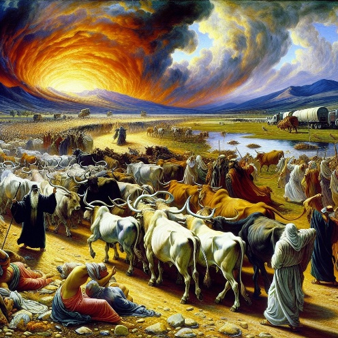
6 And the Lord did just as he had said. The next morning all the livestock of the Egyptians died, but the Israelites didn’t lose a single animal. 7 Pharaoh sent his officials to investigate, and they discovered that the Israelites had not lost a single animal! But even so, Pharaoh’s heart remained stubborn, and he still refused to let the people go.
This time, God warns Pharaoh and all the Egyptians of the next plague, describing it and giving them the time line. God is drawing a line, allowing Pharaoh time to repent and to release the Israelites. If Pharaoh will acknowledge the sovereignty of God over the Israelites and release them, all will be fine. But disaster will overtake Egypt if Pharaoh refuses again. Unfortunately, Pharoah believes that he is divine and refuses to acknowledge that God is much bigger and more powerful than he is.
Tragically, Pharaoh continues to harden his heart. Why? Pharaohs were raised to believe they were divine. This belief was rooted in ancient Egyptian religion, where pharaohs were seen as intermediaries between the gods and the people. They were thought to embody divine authority on Earth, with their rule legitimized by their connection to gods like Ra and Osiris. After death, pharaohs were believed to become divine themselves, continuing their role in the afterlife. This divine status was crucial for maintaining societal order and reinforcing their power. (AI Summary from internet)
David Guzak tells us: This plague was directed against the Egyptian god Hathor who was thought to be a mother goddess in the form of a cow. In addition, Egyptian religion considered cattle sacred and the cow was often a symbol of fertility. God shows Pharaoh and all of Egypt that He was mightier than this imagined pagan god.
Cole cites an ancient record of a battle the Egyptians lost because their enemies put a herd of cattle in front of their advancing troops. It worked because the Egyptian soldiers would not shoot at the opposing army for fear of accidentally killing what they considered to be the sacred cattle.
The poor Egyptians watch all their beloved animals die before their eyes while the Israelite animals remain healthy. The country of Egypt, once one of the most prosperous and powerful in the Middle East, is falling apart, but Pharaoh remains obdurate, unwilling to see how his people are suffering. And now the Egyptians themselves are about to suffer untold agonies.
A Plague of Festering Boils
8 Then the Lord said to Moses and Aaron, “Take handfuls of soot from a brick kiln, and have Moses toss it into the air while Pharaoh watches. 9 The ashes will spread like fine dust over the whole land of Egypt, causing festering boils to break out on people and animals throughout the land.”
10 So they took soot from a brick kiln and went and stood before Pharaoh. As Pharaoh watched, Moses threw the soot into the air, and boils broke out on people and animals alike. 11 Even the magicians were unable to stand before Moses, because the boils had broken out on them and all the Egyptians. 12 But the Lord hardened Pharaoh’s heart, and just as the Lord had predicted to Moses, Pharaoh refused to listen.
Once more, God orders Moses to bring on a plague without any warning. Moses is to throw soot from a brick kiln into the air while Pharoah watches, and boils will break out on people and any animals left after the previous plague.
How bad is this plague? Guzak tells us: a. The magicians could not stand before Moses because of the boils: This plague was probably directed against the Egyptian god Imhotep, who was said to be the god of medicine. Even those who were thought to be closest to the Egyptian gods (the court magicians) were stricken with this plague.
b. The LORD hardened the heart of Pharaoh: Here, for the first time, it is said that the LORD hardened the heart of Pharaoh. Previously, God announced that he would harden Pharaoh’s heart (Exodus 4:21, 7:3), and this was the fulfillment of it. Yet it is said at least six times before this that Pharaoh hardened his own heart (Exodus 7:13, 7:22, 8:15, 8:19, 8:32, 9:7). We see that God’s hardening of Pharaoh’s heart was the strengthening of what he already had set himself towards.
i. “This is the first occasion on which this form of words is used after an actual plague. Previously, the position has always been put from the other side: pharaoh has hardened his own heart. The moral would be that God hardens those who harden themselves.” (Cole)
ii. “‘Harden’ is the expression, not of the divine purpose but of the result of disobedience to the divine appeals. As a matter of fact, all the plagues were intended and calculated to soften, if Pharaoh had been willing to yield.” (Thomas)
By this point, Moses and Aaron are beginning to realize that God is bringing all of Egypt to its knees. God continues to systematically unmask the Egyptian deities as powerless, giving Moses and Aaron assurance and peace. The biggest difference in this plague is that God hardens Pharaoh’s heart, adding his influence to the choices Pharaoh has persisted in making. God is abandoning Pharoah to the results of his disastrous choices.
Pharoah is a tragic figure because at any point up to this time, he might have acknowledged God as sovereign, humbling himself, releasing the Israelites, and delivering his country from total destruction. But a combination of training, cultural imperatives, and personal arrogance are leading Pharaoh to a path that will result in catastrophe.
We read this account and preen ourselves that we would never make the fatal choices Pharaoh is making. But are we hardening our hearts and then making excuses? The path to peace of heart is humbling ourselves before God Almighty, allowing Him to change us into His likeness. When we insist on our individuality, placing more importance on that than on the perfect will of God for our lives, we are hardening our hearts. While God may give us a number of chances for repentance, at some point, God will allow our hearts to remain hard. Not only will we never know peace, but eventually we will be completely cut off from God and wind up in hell.
There’s a cliché that says “Know God, know peace. No God, no peace.” Pharaoh hardened his heart and the results were disastrous. Let’s pray.
PRAYER: Father God, thank You for loving us and caring for us. Lord, please let all who read these words humble themselves to You allowing You to change them into Your Likeness. In the mighty and precious Name of King Jesus. Amen.


Leave a Reply