Exodus 9 A Plague of Hail
13 Then the Lord said to Moses, “Get up early in the morning and stand before Pharaoh. Tell him, ‘This is what the Lord, the God of the Hebrews, says: Let my people go, so they can worship me. 14 If you don’t, I will send more plagues on you and your officials and your people. Then you will know that there is no one like me in all the earth. 15 By now I could have lifted my hand and struck you and your people with a plague to wipe you off the face of the earth. 16 But I have spared you for a purpose—to show you my power and to spread my fame throughout the earth. 17 But you still lord it over my people and refuse to let them go. 18 So tomorrow at this time I will send a hailstorm more devastating than any in all the history of Egypt. 19 Quick! Order your livestock and servants to come in from the fields to find shelter. Any person or animal left outside will die when the hail falls.’”
God is issuing a stern warning to Pharaoh, informing him that God could already have destroyed him. God knows that some Egyptian officials now fear Him, so God gives these people the chance to save their livestock and their servants.
20 Some of Pharaoh’s officials were afraid because of what the Lord had said. They quickly brought their servants and livestock in from the fields. 21 But those who paid no attention to the word of the Lord left theirs out in the open.
22 Then the Lord said to Moses, “Lift your hand toward the sky so hail may fall on the people, the livestock, and all the plants throughout the land of Egypt.”
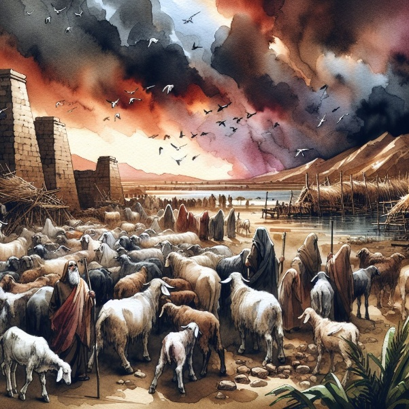
23 So Moses lifted his staff toward the sky, and the Lord sent thunder and hail, and lightning flashed toward the earth. The Lord sent a tremendous hailstorm against all the land of Egypt. 24 Never in all the history of Egypt had there been a storm like that, with such devastating hail and continuous lightning. 25 It left all of Egypt in ruins. The hail struck down everything in the open field—people, animals, and plants alike. Even the trees were destroyed. 26 The only place without hail was the region of Goshen, where the people of Israel lived.
27 Then Pharaoh quickly summoned Moses and Aaron. “This time I have sinned,” he confessed. “The Lord is the righteous one, and my people and I are wrong. 28 Please beg the Lord to end this terrifying thunder and hail. We’ve had enough. I will let you go; you don’t need to stay any longer.”
Wow! Pharoah sounds repentant. At this point, Moses might be hopeful that this whole ordeal is going to end peacefully.
29 “All right,” Moses replied. “As soon as I leave the city, I will lift my hands and pray to the Lord. Then the thunder and hail will stop, and you will know that the earth belongs to the Lord. 30 But I know that you and your officials still do not fear the Lord God.”
31 (All the flax and barley were ruined by the hail, because the barley had formed heads and the flax was budding. 32 But the wheat and the emmer wheat [spelt] were spared, because they had not yet sprouted from the ground.)
33 So Moses left Pharaoh’s court and went out of the city. When he lifted his hands to the Lord, the thunder and hail stopped, and the downpour ceased. 34 But when Pharaoh saw that the rain, hail, and thunder had stopped, he and his officials sinned again, and Pharaoh again became stubborn. 35 Because his heart was hard, Pharaoh refused to let the people leave, just as the Lord had predicted through Moses.
How unusual was this storm? Guzak tells us, “Rainfall comes so occasionally in Upper Egypt that the prediction of a severe hailstorm accompanied by a violent electrical storm must have been greeted with much skepticism.” (Kaiser)
a. There was hail, and fire mingled with the hail, so very heavy that there was none like it: This was perhaps the most frightening plague thus far. The Egyptians must have believed that the wrath of God was poured down from heaven in all severity.
i. So there was hail, and fire mingled with the hail: “A strange mixture; a miracle within a miracle, saith Rabbi Solomon. Fire and water made a peace betwixt themselves, that they might obey the will of their Creator.” (Trapp)
b. The hail struck throughout the whole land of Egypt: This plague was directed against several Egyptian gods. Notable among them was Nut, the sky goddess.
Whether or not Pharaoh respects God at this point, Moses, Aaron, the Israelites, and many of the Egyptians KNOW that this God is far mightier than any of the Egyptian deities. For the Israelites, each time God demonstrates his power over another part of His creation, that respect and awe continue to grow, along with a peace that this God can do anything He desires. The Egyptians, on the other hand, are undoubtedly distraught, for their cherished deities have proven powerless in the face of direct attacks against their attributes. So the Israelites continue to enjoy more peace while the Egyptians become increasingly fearful.
Studying God and His mighty power helps build our trust and leads to a deep abiding peace, the peace that passes understanding. But we need to meditate on God’s Word and His work, for a casual glance between text messages is totally insufficient. May God help us so that we will spend time contemplating God’s handiwork.
PRAYER: Father God, thank You for loving us and caring for us. Lord, help us to study Your work and meditate on Your Word, for then we will have peace. In the mighty and precious Name of King Jesus. Amen.
 Burunche's Blog
Leave a comment