
Exodus 13 Israel’s Wilderness Detour
17 When Pharaoh finally let the people go, God did not lead them along the main road that runs through Philistine territory, even though that was the shortest route to the Promised Land. God said, “If the people are faced with a battle, they might change their minds and return to Egypt.” 18 So God led them in a roundabout way through the wilderness toward the Red Sea.[Sea of Reeds] Thus the Israelites left Egypt like an army ready for battle.
In this day of the internet, rapid air travel, and interstate highways (motorways for those of you non-Americans), we are used to quick movements and quick answers. We fume if faced with delays of any kind. Even in ancient times, people wanted swift action. Undoubtedly, there were Israelites who felt that having been delivered from Egypt, they should take the quickest route to the Promised Land. But God knew better. God knew that He was dealing with people who were still used to being slaves and taking orders from overseers. Even if the Israelites hated their overseers for their cruelty, there was comfort in knowing that somebody else was making the major decisions. And although the Israelites were slaves, life was relatively comfortable and they knew what to expect.
How much were the Israelites suffering as slaves in Egypt? This website gives us the following information. https://www.historydefined.net/what-was-it-like-to-be-a-slave-in-ancient-egypt/
In ancient Egyptian society, slaves were often treated like other workers. While these workers didn’t have the freedoms that the upper class did, they were often highly-skilled workers with in-demand skills.
What was fascinating about ancient Egyptian society was that the slaves could assimilate into society quite easily. Their social status wasn’t stigmatized in the way it was in other cultures and civilizations.
An excellent example of their privilege is the idea that they weren’t seen as a separate social group despite the distinction. Often slaves voluntarily gave up their freedoms due to debt, their criminal history, or were prisoners of war.
Although their legal status wasn’t clear, they were still treated like ordinary citizens and even had access to owning private property. Dr. Cwiek also says that there were even cases of slaves marrying Egyptian women, which were said to have equal rights to men in ancient Egyptian society.
Archaeological evidence supports the idea that slaves were treated like average workers. For instance, the craftsman that built the pyramids often had to source stone blocks for building materials.
Slaves were sent to these teams of stone workers to assist in the process, but it doesn’t appear that they were ill-treated or forced into inhumane conditions. They also worked closely with the craftsman as private servants in their homes in Deir el-Medina, a village of workers that built the tombs in the Valley of Kings near Luxor.
It makes sense that the working-class craftsman and the slaves were treated the same because neither could move freely around the country. Usually, both individuals had strict social roles and were expected to perform their duties; if anything, this comprised the social structure of ancient Egyptian civilization.
Were the Hebrews mistreated under the Egyptians? As Moses and Aaron kept requesting Pharaoh to allow the Israelites to leave to make sacrifices, Pharoah retaliated by increasing the harshness of the conditions under which the Israelites were working. God allowed those harsh conditions because He knew that as long as the Israelites were comfortable, they would never leave. It’s quite likely that some of the Israelite men had married Egyptian women and were actively practicing Egyptian religions. While the Israelites were shocked and horrified by the sudden deaths of the firstborn men and animals in Egypt, that shock might move them out of Egypt but it would never be enough to get them all the way to the Promised Land.
19 Moses took the bones of Joseph with him, for Joseph had made the sons of Israel swear to do this. He said, “God will certainly come to help you. When he does, you must take my bones with you from this place.”
Moses kept the promise Joseph had exacted from his descendants, that his bones should be carried back to the land of his birth. There might even have been people criticizing Moses for having gone to this trouble, but Moses did it anyway.
20 The Israelites left Succoth and camped at Etham on the edge of the wilderness. 21 The Lord went ahead of them. He guided them during the day with a pillar of cloud, and he provided light at night with a pillar of fire. This allowed them to travel by day or by night. 22 And the Lord did not remove the pillar of cloud or pillar of fire from its place in front of the people.
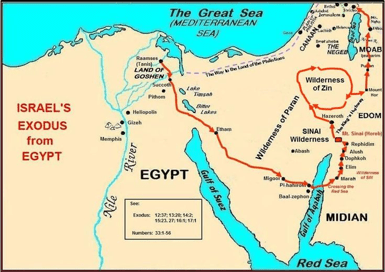
Now the people are on the edge of the wilderness. Enthusiasm is still running high as the Israelites remember all the treasures their Egyptian neighbors have forced on them, demanding for them to leave immediately. So far, things are going all right; however, God knows that Pharaoh is going to have a change of heart very soon. God is guiding His people so that they can travel both by night and day thanks to the pillar of cloud and fire. But God is sending them on a round about route. Why?
God knows that if He sends these people straight up the coast into Canaan, they will crumple as soon as the Philistine armies attack them. While these men might be strong from their slave labor, they still have a slave mentality and are likely to turn and run if attacked. God is protecting the Israelites and also gradually preparing them for life in the wilderness.
Delays are not denials. Centuries later, the prophet Habakkuk complains to God because he wants God to ACT NOW!!! God comforts Habakkuk by saying, “This vision is for a future time. It describes the end, and it will be fulfilled. If it seems slow in coming, wait patiently, for it will surely take place. It will not be delayed.”
Most of us are quite impatient. We want what we want when we want it, and we want peace now, not later! But part of the life of faith is learning to trust in God’s delays and to practice peace when the longed-for results seem to be hanging somewhere. God wants us to have peace even when things don’t seem to be working the way we desire, for practicing that peace demonstrates our faith that He can bring perfect solutions even when things appear disastrous.
PRAYER: Father God, thank You for loving us and caring for us. Lord, help us to trust when we cannot see and to accept Your peace even when You seem to be sending us on detours. In the mighty and precious Name of King Jesus. Amen.


Leave a comment