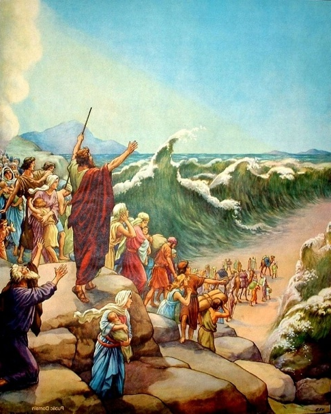
Exodus 14 Then the Lord gave these instructions to Moses: 2 “Order the Israelites to turn back and camp by Pi-hahiroth between Migdol and the sea. Camp there along the shore, across from Baal-zephon. 3 Then Pharaoh will think, ‘The Israelites are confused. They are trapped in the wilderness!’ 4 And once again I will harden Pharaoh’s heart, and he will chase after you. I have planned this in order to display my glory through Pharaoh and his whole army. After this the Egyptians will know that I am the Lord!” So, the Israelites camped there as they were told.
Throughout Egypt, the firstborn sons and animals have died at midnight. Terrified, the Egyptians have loaded their Hebrew neighbors with all their precious possessions, demanding they leave as soon as possible. God has led the Israelites out into the wilderness; however, God is not yet through dealing with Pharaoh. God knows that Pharaoh will still change his mind and try to annihilate the Israelites. In addition, God still wants to display His glory through Pharaoh and his army, so that all of Egypt will have no doubts that they are dealing with the One True Living God. The Israelites have no idea what is about to happen, for they are about to witness a miracle that will dwarf anything God has already done.
The Egyptians Pursue Israel
5 When word reached the king of Egypt that the Israelites had fled, Pharaoh and his officials changed their minds. “What have we done, letting all those Israelite slaves get away?” they asked. 6 So Pharaoh harnessed his chariot and called up his troops. 7 He took with him 600 of Egypt’s best chariots, along with the rest of the chariots of Egypt, each with its commander. 8 The Lord hardened the heart of Pharaoh, the king of Egypt, so he chased after the people of Israel, who had left with fists raised in defiance. 9 The Egyptians chased after them with all the forces in Pharaoh’s army—all his horses and chariots, his charioteers, and his troops. The Egyptians caught up with the people of Israel as they were camped beside the shore near Pi-hahiroth, across from Baal-zephon.
10 As Pharaoh approached, the people of Israel looked up and panicked when they saw the Egyptians overtaking them. They cried out to the Lord, 11 and they said to Moses, “Why did you bring us out here to die in the wilderness? Weren’t there enough graves for us in Egypt? What have you done to us? Why did you make us leave Egypt? 12 Didn’t we tell you this would happen while we were still in Egypt? We said, ‘Leave us alone! Let us be slaves to the Egyptians. It’s better to be a slave in Egypt than a corpse in the wilderness!’”
Things look black for the Israelites as they see Pharaoh’s chariots approaching. Predictably, these people who were so willing to throw off slavery a few hours ago are now equally prepared to return to slavery if they can only save their lives. And of course, they begin blaming Moses as if they had not willingly participated in Passover and had not packed all their belongings and virtually danced out of Egypt.
When we consider this story, we might overlook how quickly Moses begins catching blame from the very people whom he is helping. Sometime between 1596 and 1599, William Shakespeare wrote his play “Henry IV, Part 2.” This line is spoken by King Henry IV in Act III, Scene I, reflecting the burdens and anxieties of leadership. Anybody who has ever led a group of people can readily identify with that statement! All that’s necessary for a group of people to begin complaining is a few soreheads with big mouths; before you know it, half the group might be weeping and wailing.
13 But Moses told the people, “Don’t be afraid. Just stand still and watch the Lord rescue you today. The Egyptians you see today will never be seen again. 14 The Lord himself will fight for you. Just stay calm.” The New King James Translation says, “13 And Moses said to the people, “Do not be afraid. Stand still, and see the salvation of the Lord, which He will accomplish for you today. For the Egyptians whom you see today, you shall see again no more forever. 14 The Lord will fight for you, and you shall hold your peace.”
While some translations read “stay calm,” I feel that’s too weak. I prefer the version that reads, “For the Egyptians whom you see today, you shall see again no more forever. 14 The Lord will fight for you, and you shall hold your peace.” So many times, in the course of ministry, we have faced seemingly insurmountable odds. People and organizations have failed us, funds have not arrived, staff whom we have sponsored have deserted at critical moments, we have faced health challenges or have lost loved ones and supporters in ministry, and it’s tempting to believe that all is completely lost. That’s when these two verses have assumed the greatest importance, for God has used these scriptures to both encourage us that He remains our Helper and rebuke us for our failing to trust Him fully.
Jeremiah 32:17 tells us, “Ah, Sovereign LORD, you have made the heavens and the earth by your great power and outstretched arm. Nothing is too hard for you.” Deuteronomy 33:26-27 says, “There is no one like the God of Jeshurun, Who rides the heavens to help you, and in His excellency on the clouds. 27 The eternal God is your refuge, and underneath are the everlasting arms; He will thrust out the enemy from before you, and will say, ‘Destroy!’”
What does it mean “to hold your peace?” The phrase may have originated in 16th century England, where it referred to marriage ceremonies or court cases. In such matters, witnesses were enjoined to speak up if they had any new evidence or reason that a marriage should not take place or that the evidence in court was not correct. Here Moses is ordering the Israelites to stand still, stop complaining, and watch God work.
In this age of flourishing social media, holding one’s peace appears to be a lost art. Those complaining or publishing half-truths or complete lies sound off at will while those who actually know more remain silent rather than engage in useless arguments. Putting one’s mouth in gear before engaging the brain is an age-old problem. Proverbs 10:19: “In the multitude of words there wanteth not sin: but he that refraineth his lips is wise.” Proverbs 17:28: “Even a fool is considered wise if he keeps silent, and discerning when he holds his tongue.”
Do you feel caught in an unsolvable dilemma? Ask God for help and then hold your peace. Let God work, for His solutions always work while our attempts can fail miserably.
PRAYER: Father God, thank You for loving us and caring for us. Lord, please help us to trust You and hold our peace, realizing that You work in ways beyond our imaginings. In the mighty and precious Name of King Jesus. Amen.


Leave a Reply