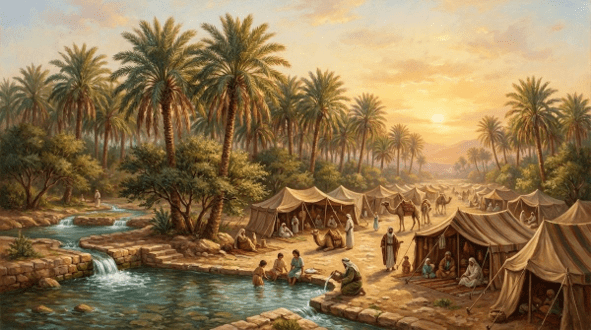
Exodus 15: 22 So Moses brought Israel from the Red Sea; then they went out into the Wilderness of Shur. And they went three days in the wilderness and found no water. 23 Now when they came to Marah, they could not drink the waters of Marah, for they were bitter. Therefore, the name of it was called Marah. 24 And the people complained against Moses, saying, “What shall we drink?” 25 So he cried out to the Lord, and the Lord showed him a tree. When he cast it into the waters, the waters were made sweet….27 Then they came to Elim, where there were twelve wells of water and seventy palm trees; so they camped there by the waters.
Two million people-three days-no water! And then the water they find is so bitter they can’t drink it. To say the Israelites are frustrated is a gross understatement. And of course, they begin taking out their frustrations on Moses.
Notice that Moses has never promised these people that everything would be easy. All Moses has done is to confront Pharaoh, delivering God’s messages and then obey God when He has commanded Moses to instruct the Israelites on the initiation of the Passover. Moses could never have dreamt up the Red Sea deliverance on his own; that was all God. And while Moses might be acting as leader, he has no control over the pillar of cloud leading the Israelites that turns to fire in the night. Again, these manifestations are all God’s doing, even though the Israelites really want to blame Moses.
The problem is that God has far more in mind than simply transporting the Israelites from point A to point B, for He knows the hearts of these people. At present, the Israelites spiritually are a ragtag bunch, with some of them vaguely remembering the tales about Abraham, Isaac, and Jacob while others have become so imbued with Egyptian religion that they are carrying figurines of various Egyptian deities, amulets, and other charms in their baggage. The ten plagues God has sent on Egypt have only served to convince the Israelites that they are special, but they have no understanding of their own sad spiritual state. Most of these people have no appreciation for the lessons God needs to teach them; instead, they really feel that they are good people and they are fine, thank you very much.
So, this crowd of people winds up at Marah with its bitter water representing the first great disappointment the Israelites will experience. And predictably, the Israelites explode in anger. After all, God has already proven that they are His favorites, so why is He troubling them this way? Centuries later, Paul will write to the Hebrews, spelling out the need for God’s discipline for His children: “My son, do not despise the chastening of the Lord, nor be discouraged when you are rebuked by Him; 6 For whom the Lord loves He chastens, and scourges every son whom He receives.”
7 If you endure chastening, God deals with you as with sons; for what son is there whom a father does not chasten? 8 But if you are without chastening, of which all have become partakers, then you are illegitimate and not sons. 9 Furthermore, we have had human fathers who corrected us, and we paid them respect. Shall we not much more readily be in subjection to the Father of spirits and live? 10 For they indeed for a few days chastened us as seemed best to them, but He for our profit, that we may be partakers of His holiness. 11 Now no chastening seems to be joyful for the present, but painful; nevertheless, afterward it yields the peaceable fruit of righteousness to those who have been trained by it.” (Hebrews 12:5-6)
It’s amazing but true that we learn far more from suffering than we do from peaceful easy situations. Suffering, if endured correctly, causes us to examine ourselves in the light of God’s holiness, allowing Him to teach us and correct us. When we are not facing problems, we presume we are fine by our own efforts, not realizing that God is the One who can give us true peace of heart and mind.
When I was growing up, I had a foster sister who came to live with us when she was sixteen after living for five years in an orphanage. One day, we were shopping when my sister pulled some stupid stunt. As we walked down the sidewalk, my mother began swatting my sister on her bottom-not hard, but repeatedly. When we stopped to cross the street, my sister looked at my mother in amazement and said, “You really love me, don’t you?” My mother replied, “Well, of course I do. Why are you asking?” My sister replied, “Well, up until now, you have disciplined your own children, but this is the first time you have disciplined me.” I am certain that my mother had told my sister she loved her many times previously; however, it was only when my sister was disciplined that she truly believed she was loved because someone cared enough to correct her.
God loves each one of us so much that He refuses to allow us to wallow in our own messes without correction. Proverbs 13:24 tells us, “Those who spare the rod of discipline hate their children. Those who love their children care enough to discipline them.” Note what God does during the middle of the Marah incident: God has Moses throw some branches into the water that sweetens it and then tells the Israelites, “If you diligently heed the voice of the Lord your God and do what is right in His sight, give ear to His commandments and keep all His statutes, I will put none of the diseases on you which I have brought on the Egyptians. For I am the Lord who heals you.”
God wants to make sure the Israelites understand the necessity of strict obedience, not obedience when they feel like it. Notice God’s conditions:
- If you diligently heed the voice of the Lord your God
- do what is right in His sight
- give ear to His commandments
- keep all His statutes
God is not giving the Israelites a free pass to sin but a road map to salvation. And it all starts with obedience. If you count the Israelites complying with the commands regarding Passover, this is the second major lesson in obedience that they are facing. But God knows there will be countless other such lessons before His people are ready to enter Canaan.
Could the Egyptians have avoided the plagues? Yes. Had Pharaoh relented, had he obeyed God and allowed the Israelites to leave, Egypt would never have been devastated, nor would all the firstborn sons and animals have died. Had Pharaoh taken the effort to inquire from Moses about the God who was ordering them to go worship, he might have found his way spiritually to worship the One True Living God. But Pharaoh had been raised to believe that he himself was divine, and he was not about to acknowledge any God who might displace him.
What is the lesson of Elim? Once the Israelites have endured the divine teaching moment at Marah, God gives them grace by allowing them to camp at Elim with its fresh water and palm trees. God does not test us forever, but gives us periods of divine rest if we will only obey Him. May God help us to patiently endure lessons in obedience so that we can reach the Elims in our lives!
PRAYER: Father God, thank You for loving us and caring for us. Lord, we praise You for Your lessons in obedience, for these lessons prove that we are Your beloved children and You are correcting us for our own good. We also praise You for giving us Elims, times of rest and refreshing. In the mighty and precious Name of King Jesus. Amen.


Leave a Reply