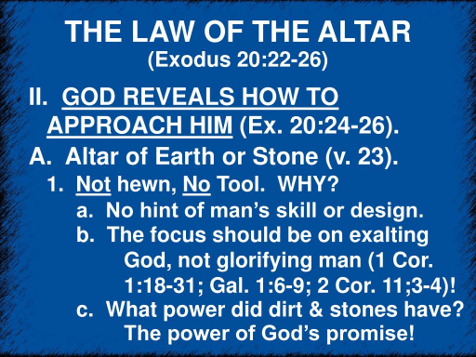
Exodus 20:22-26 Idols and Altars
22 Then the Lord said to Moses, “Tell the Israelites this: ‘You have seen for yourselves that I have spoken to you from heaven: 23 Do not make any gods to be alongside me; do not make for yourselves gods of silver or gods of gold.
24 “‘Make an altar of earth for me and sacrifice on it your burnt offerings and fellowship offerings, your sheep and goats and your cattle. Wherever I cause my name to be honored, I will come to you and bless you. 25 If you make an altar of stones for me, do not build it with dressed stones, for you will defile it if you use a tool on it. 26 And do not go up to my altar on steps, or your private parts may be exposed.’
The Israelites are huddled at the base of Mount Sinai, quivering in their sandals. The mountain has erupted with fire and smoke and the blaring noise of divine trumpets. Nothing the Israelites have previously experienced has prepared them for this! Now that God has laid out the Ten Commandments, He is giving rules for the fashion in which He is to be worshiped, and it’s not like anything the Israelites have ever seen before.
Sure, the Israelites have seen plenty of altars before in Egypt, and they figure that’s how altars are supposed to look like. Now God is totally changing the rules.
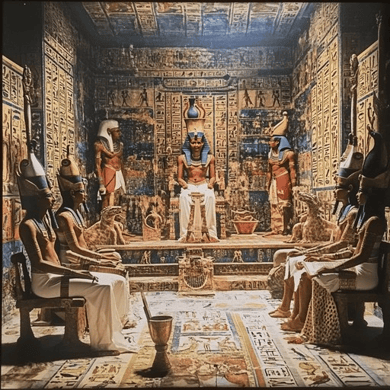
The Israelites are used to elaborate Egyptian altars with inscriptions, carved bas relief figures on the walls, altars inlaid with gold and precious stones, and figures representing the sun, moon, and stars, animals, and even reptiles. Stunningly beautiful altars invite worshipers to worship them as well as the deities being honored.
In some mid-eastern cultures, altars are approached by long flights of stairs, and priests climbing those stairs reveal their genitalia as they climb. Depending on the deity being worshipped, in some countries, priests might not wear undergarments, although Egyptian priests wear linen breeches beneath their other robes.
God wants the Israelites to do things as simply and cleanly as possible so that they will worship Him and not an altar or a statue or any other deity. God also knows that people become what they worship, and He wants to be the sole focus of their worship. God demands that the Israelites either build altars from earth or from undressed stones. No carved images. No gold inlays. Eventually, God will order the Israelites to create a simple bronze altar that they can carry as part of the furnishings of the tabernacle. Solomon’s temple will also contain a cedar wood altar overlayed with gold, but still quite plainly designed although skillfully crafted.
In Deuteronomy 27 Moses gives God’s commands about the way in which the Israelites are to worship him in the Promised Land. 11 That same day Moses also gave this charge to the people: 12 “When you cross the Jordan River, the tribes of Simeon, Levi, Judah, Issachar, Joseph, and Benjamin must stand on Mount Gerizim to proclaim a blessing over the people. 13 And the tribes of Reuben, Gad, Asher, Zebulun, Dan, and Naphtali must stand on Mount Ebal to proclaim a curse.
What happens later when the Israelites begin straying from God? After King Solomon dies, his foolish son Rehoboam loses most of his kingdom by threatening the Israelites that he will use and abuse them even more than his father has. The prophet Ahijah has already prophesied that God will give Jeroboam ten of the twelve tribes to lead. Ahijah continues to promise that if Jeroboam will remain faithful, God will found a dynasty for Jeroboam as lasting as that of David’s. Jeroboam leads a rebellion, and ten of the twelve tribes split off, leaving Rehoboam only the tribes of Judah and Benjamin. Sadly, Jeroboam is faithless and refuses to believe God. Jeroboam goes on to mess up by creating his own religion so his people will desert the worship services God has commanded to take place in Jerusalem.
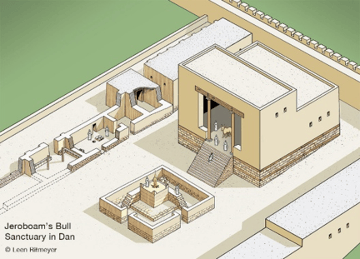
1 Kings 12:25-33 Golden Calves at Bethel and Dan
25 Then Jeroboam fortified Shechem in the hill country of Ephraim and lived there. From there he went out and built up Peniel.
26 Jeroboam thought to himself, “The kingdom will now likely revert to the house of David. 27 If these people go up to offer sacrifices at the temple of the Lord in Jerusalem, they will again give their allegiance to their lord, Rehoboam king of Judah. They will kill me and return to King Rehoboam.”
28 After seeking advice, the king made two golden calves. He said to the people, “It is too much for you to go up to Jerusalem. Here are your gods, Israel, who brought you up out of Egypt.” 29 One he set up in Bethel, and the other in Dan. 30 And this thing became a sin; the people came to worship the one at Bethel and went as far as Dan to worship the other.
The golden calf is often associated with the Egyptian god Apis. In ancient Egyptian religion, Apis was a sacred bull worshiped in the Memphis region, considered a manifestation of the god Ptah and linked to fertility and strength. Even though Jeroboam KNOWS God has delivered the Israelites, he listens to his fears and his pride, trading on the Israelites’ knowledge of Egyptian deities. And worse is to come.
31 Jeroboam built shrines on high places and appointed priests from all sorts of people, even though they were not Levites. 32 He instituted a festival on the fifteenth day of the eighth month, like the festival held in Judah, and offered sacrifices on the altar. This he did in Bethel, sacrificing to the calves he had made. And at Bethel he also installed priests at the high places he had made. 33 On the fifteenth day of the eighth month, a month of his own choosing, he offered sacrifices on the altar he had built at Bethel. So he instituted the festival for the Israelites and went up to the altar to make offerings.
By refusing to believe God and trust Him and then instituting his own religious, Jeroboam cursed his family. Rather than God establishing a forever dynasty for Jeroboam, only four generations of his family ruled before being eliminated.
Even later, King Ahaz of Judah imports an altar from Damascus during his reign, specifically noted in 2 Kings 16:10-16. This event occurs after he visits Damascus to meet with Tiglath-Pileser, the king of Assyria. An idolater who has already sacrificed a son as a burnt offering to Molech, Ahaz s is impressed by the altar he has seen there and orders a replica to be constructed for the Jerusalem Temple, replacing the original bronze altar. Ahaz commits other desecrations in the temple, all of which are faithfully recorded in 2 Kings 16.
How are we to worship God? During his encounter with the Samaritan woman at the well, Jesus told her, “But the time is coming—indeed it’s here now—when true worshipers will worship the Father in spirit and in truth. The Father is looking for those who will worship him that way. For God is Spirit, so those who worship him must worship in spirit and in truth.” (John 4:23-24)
These days, some churches are going in for light shows and special effect such as smoke machines during worship in hopes of encouraging adrenaline-fueled enthusiasm. But what happens when special effects become the highlight of the service, rather than the Word of God? In an article entitled “Can the Holy Spirit Inhabit Smoke Machines in the Sanctuary?” Manuel Luz takes a critical but loving look at such practices. Luz writes, “But there are pitfalls and tripwires all around these issues of which we must be acutely aware. As A.W. Tozer warned, “Worship is no longer worship when it reflects the culture around us more than the Christ within us.”
At the crux of all these trends is the desire to help worshipers worship, to meet God in a transcendent and transformative way, and to give God glory. And that’s a good thing. The holes in our hearts can be filled only by God, and it is the calling of the church to help people become heart-filled and soul-alive.” This article is part of the first chapter of Luz’s book Honest Worship: From False Self to True Praise and can be found on https://churchleaders.com/worship/worship-articles/334799-can-the-holy-spirit-inhabit-smoke-machines-in-the-sanctuary.html/2.
Earlier generations might have gotten caught up in the use of pipe organs, orchestras, incense, and glittering vestments for the choir. In some churches, the congregation is still encouraged to dress as richly as possible while in others, anything goes including very short shorts worn by kids lighting the candles on the altar. But Tozer’s comment is the best one: “Worship is no longer worship when it reflects the culture around us more than the Christ within us.”
May God help us so that we will always worship Christ and not become distracted by special effects of any kind. Only then will we enjoy God’s peace.
PRAYER: Father God, thank You for loving us and caring for us. Lord, help us to worship You in spirit and in truth. In the mighty and precious Name of King Jesus. Amen.


Leave a Reply