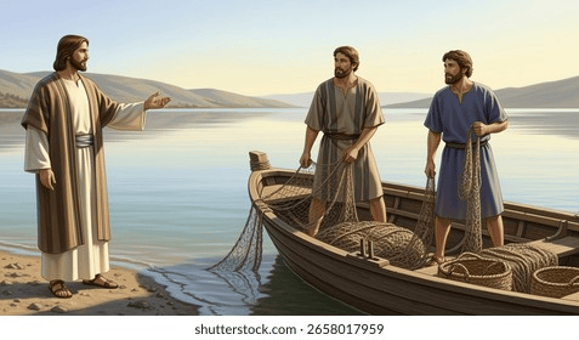
Matthew 4:18-22 The First Disciples
18 One day as Jesus was walking along the shore of the Sea of Galilee, he saw two brothers—Simon, also called Peter, and Andrew—throwing a net into the water, for they fished for a living. 19 Jesus called out to them, “Come, follow me, and I will show you how to fish for people!” 20 And they left their nets at once and followed him.
21 A little farther up the shore he saw two other brothers, James and John, sitting in a boat with their father, Zebedee, repairing their nets. And he called them to come, too. 22 They immediately followed him, leaving the boat and their father behind.
So, Jesus has been baptized and God has confirmed his position as His beloved Son. Jesus has endured a prolonged fast, culminating in Satan attempting to lure him away from his God-given purpose. And Jesus has begun quietly preaching and teaching and baptizing. There’s no doubt that Jesus needs helpers, but look at the first helpers he calls!
Later on, Mark interviews Peter, who gives him a first-hand account of this scene. Mark 1:20 tells the same story. 16 One day as Jesus was walking along the shore of the Sea of Galilee, he saw Simon and his brother Andrew throwing a net into the water, for they fished for a living. 17 Jesus called out to them, “Come, follow me, and I will show you how to fish for people!” 18 And they left their nets at once and followed him.
19 A little farther up the shore Jesus saw Zebedee’s sons, James and John, in a boat repairing their nets. 20 He called them at once, and they also followed him, leaving their father, Zebedee, in the boat with the hired men.
Although Andrew and Peter and James and John worked in their family fishing businesses, how wealthy were fishermen at that time? The Bible Odyssey website gives this answer:
Fishing was a fundamental part of the embedded agrarian economy of first-century Galilee. This region was ruled by Herod Antipas; a client king of the Romans. An “embedded” economy was one in which questions of production, processing, trade, and their regulation could not be separated from politics, religion, and family or village life. There was no free market that functioned independently from other dimensions of society, and little if any upward mobility. Most peasant fishing families were poor and lived at subsistence level, while a small minority of elites held the bulk of wealth and power. Fishing licenses were required for access to certain areas, and fishers needed various raw materials such as wood for their boats and flax for their nets. Evidently, families had to occasionally hire day laborers for assistance with the haul (Mark 1:19-20). Fish processors and distributors were required to pay taxes for the product and tolls for its transport. A reference to processed fish, opsarion, appears in John 6: 9-11. https://www.bibleodyssey.org/articles/fishing-economy-in-the-sea-of-galilee/
These four fishermen were young and strong; however, they were likely peasants living close to a subsistence level. In addition, these men likely had had only a rudimentary education, with their fathers pulling them out of school as soon as they were big and strong enough to help in the fishing business. While fishermen would be quite wise about weather, water conditions, and anything else pertaining to their trade, they would be considered uneducated by the scribes and teachers. But these men were far from stupid, and they were spiritually hungry.
So, if Jesus was looking for disciples, why was it that the first four men he called were poorly educated fishermen? The answer is simple: God told him to do so. There’s this amazing thing about God; He isn’t impressed by social status, education, wealth, or by any human standards of success. When God sent Samuel to Jesse’s family in Bethlehem to anoint a new king, Samuel looked at Jesse’ seven strong handsome sons and assumed that God would select one of them, but God didn’t. Instead, God selected David, the eighth son, the youngest and smallest. 1 Samuel 16:6-7 explains God’s reasoning: 6 When they arrived, Samuel saw Eliab and thought, “Surely the Lord’s anointed stands here before the Lord.”
7 But the Lord said to Samuel, “Do not consider his appearance or his height, for I have rejected him. The Lord does not look at the things people look at. People look at the outward appearance, but the Lord looks at the heart.”
God knew the hearts of Andrew, Peter, James, and John. Later, John will give more information in his Gospel. Evidently, Andrew had become a disciple of John the Baptist. When John the Baptist pointed out Jesus as the Messiah, Andrew and another of John’s disciples engaged Jesus in conversation all that day. John 1:41 The first thing Andrew did was to find his brother Simon and tell him, “We have found the Messiah” (that is, the Christ). 42 And he brought him to Jesus.
Jesus looked at him and said, “You are Simon son of John. You will be called Cephas” (which, when translated, is Peter [Rock]).
Eventually, Jesus would select disciples from varying walks of life, including Matthew, a well-educated local tax collector. The women who followed Jesus included Joanna the wife of Chuza, the manager of Herod’s household as well as many others who helped support the ministry out of their own resources. But Jesus began with four tough, stubborn, loyal fishermen. Eventually, Peter, James, and John would accompany Jesus to the Mount of Transfiguration as well as the Garden of Gethsemane. These men would also become leaders in the early church. James, son of Zebedee and faithful to the end, would become the first disciple martyred for his faith by Herod Agrippa in 44 A.D.
Why is this story so important for us? Why should it encourage us? Remember what God told Samuel? God looks at hearts, not social position, wealth, or success in any form. Jeremiah 29:13 tells us, “You will seek me and find me when you seek me with all your heart.” God calls each one of us to Himself, and He can use anyone who will seek Him with all their heart. Today, God wants you to know that you are His special treasure and that He is calling you as surely as Jesus called those fishermen on the sea shore. Why not let God into your heart? You will never regret it, for you will never be the same.
PRAYER: Father God, thank You for loving us and caring for us. Lord, we do long for You and we want Your love, Your joy, Your peace in our hearts. Please forgive us our sins and help us to follow hard after You all the days of our lives. In the mighty and precious Name of King Jesus. Amen.


Leave a Reply