We are studying Jesus’ early ministry and the events that took place leading up to the Sermon on the Mount. One of the confusing things about the four Gospels is the parts where the writers agree and then the parts they leave out. The time lines are different, depending on which Gospel you read. An AI summary gives us this insight:
The four Gospels—Matthew, Mark, Luke, and John—offer distinct perspectives on the life and teachings of Jesus Christ. Each Gospel has unique themes, audiences, and styles, contributing to a fuller understanding of Jesus’ message.
Overview of Each Gospel
- Matthew: Written primarily for a Jewish audience, it emphasizes Jesus as the fulfillment of Old Testament prophecies. It includes the Sermon on the Mount and focuses on Jesus’ teachings and parables.
- Mark: The shortest Gospel, Mark presents a fast-paced narrative of Jesus’ ministry, highlighting His actions and miracles. It portrays Jesus as the suffering servant and emphasizes His humanity.
- Luke: Known for its detailed accounts and emphasis on compassion, Luke addresses a Gentile audience. It includes unique parables like the Good Samaritan and emphasizes social justice and the role of women.
- John: Distinct in style and content, John focuses on the divinity of Christ, using symbolic language and deep theological insights. It includes the famous “I am” statements and emphasizes the relationship between Jesus and the Father.
Comparative Themes
- Miracles: All Gospels recount miracles, but the nature and number vary. Mark emphasizes action, while John focuses on the significance behind the miracles.
- Teachings: Matthew and Luke share many parables, while John presents more extended discourses.
- Passion Narrative: All Gospels detail the events leading to Jesus’ crucifixion, but the accounts differ in emphasis and detail.
Conclusion
The four Gospels, while telling the same story, provide a rich tapestry of perspectives that enhance the understanding of Jesus’ life and mission.
Luke 4:31-37 Jesus Drives Out an Impure Spirit
31 Then he went down to Capernaum, a town in Galilee, and on the Sabbath, he taught the people. 32 They were amazed at his teaching, because his words had authority.
33 In the synagogue there was a man possessed by a demon, an impure spirit. He cried out at the top of his voice, 34 “Go away! What do you want with us, Jesus of Nazareth? Have you come to destroy us? I know who you are—the Holy One of God!”
35 “Be quiet!” Jesus said sternly. “Come out of him!” Then the demon threw the man down before them all and came out without injuring him.
36 All the people were amazed and said to each other, “What words these are! With authority and power, he gives orders to impure spirits and they come out!” 37 And the news about him spread throughout the surrounding area.
Before Jesus spoke in the synagogue at Nazareth, frustrating the home town crowd, he was already healing people and delivering them from demons. Now Luke describes some of these incidents. Even though there are strict rules about who can enter the synagogue and who cannot, a demon-possessed man has joined the congregation. Why is this possible?
Before working in Ghana, we had encountered an occasional demon-possessed person on the streets of New York City. We would walk down the street, only for a street person to suddenly begin verbally attacking us. When we described the problem to Christian friends, they informed us that those individuals were likely demon-possessed and they were responding to the Holy Spirit in us. Then we began work in Ghana. One of the chief people with whom we worked during our first missionary term was a poor fellow who had been dedicated to a powerful fetish from his mother’s womb. We soon learned that the demons would hide, allowing the man to appear perfectly harmless, convincing some fellow missionaries that we were sadly mistaken. At other times when we were alone with this man, the demons would manifest themselves, causing him to go into rages, shrieking at us. It’s likely that the demon-possessed man in Capernaum appeared quite normal as he entered the synagogue, only for the demons to later react to the Holy Spirit in Jesus. Jesus took authority over the demon, freeing the man. Next, Luke describes Jesus healing people.
Luke 4:38-44 Jesus Heals Many
38 Jesus left the synagogue and went to the home of Simon. Now Simon’s mother-in-law was suffering from a high fever, and they asked Jesus to help her. 39 So he bent over her and rebuked the fever, and it left her. She got up at once and began to wait on them.
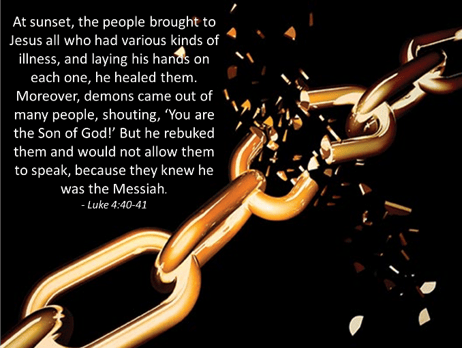
40 At sunset, the people brought to Jesus all who had various kinds of sickness, and laying his hands on each one, he healed them. 41 Moreover, demons came out of many people, shouting, “You are the Son of God!” But he rebuked them and would not allow them to speak, because they knew he was the Messiah.
42 At daybreak, Jesus went out to a solitary place. The people were looking for him and when they came to where he was, they tried to keep him from leaving them. 43 But he said, “I must proclaim the good news of the kingdom of God to the other towns also, because that is why I was sent.” 44 And he kept on preaching in the synagogues of Judea.
Nothing like these healings and deliverances had ever been seen before. Despite the disappointment and frustration of the Nazarenes, Jesus kept on preaching in the synagogues of Judea. Wherever Jesus went, people begged him to stay-after all, why not? Nobody had ever spoken to them as Jesus was doing. Nobody had demonstrated the love of God so clearly. Undoubtedly, there were people crying, “Jesus, don’t leave us!” But Jesus knew he was called to as many cities as possible, and he kindly refused and went on to the next town.
We have a blessing that those people could not enjoy. Because Jesus went to the cross on Calvary and because he died and rose from the dead, God has sent His Holy Spirit into the world to be with us. John 14:15-21 tells us, 15 “If you love me, keep my commands. 16 And I will ask the Father, and he will give you another advocate to help you and be with you forever— 17 the Spirit of truth. The world cannot accept him, because it neither sees him nor knows him. But you know him, for he lives with you and will be in you. 18 I will not leave you as orphans; I will come to you. 19 Before long, the world will not see me anymore, but you will see me. Because I live, you also will live. 20 On that day you will realize that I am in my Father, and you are in me, and I am in you. 21 Whoever has my commands and keeps them is the one who loves me. The one who loves me will be loved by my Father, and I too will love them and show myself to them.”
A favorite worship chorus says, “Because He lives, I can face tomorrow.” Because Jesus lives, because God’s Holy Spirit is with us, we can face whatever might come. As we pray, as we study God’s Word, and as we seek to do His Will, the Holy Spirit will help us.
PRAYER: Father God, thank You for loving us and caring for us. Lord, thank You for sending Your Holy Spirit to be with us. Help us to remain in contact with You as we pray. In the mighty and precious Name of King Jesus. Amen.


Leave a Reply