Luke 4:14-30 Then Jesus returned to Galilee, filled with the Holy Spirit’s power. Reports about him spread quickly through the whole region. 15 He taught regularly in their synagogues and was praised by everyone.
16 When he came to the village of Nazareth, his boyhood home, he went as usual to the synagogue on the Sabbath and stood up to read the Scriptures. 17 The scroll of Isaiah the prophet was handed to him. He unrolled the scroll and found the place where this was written:
18 “The Spirit of the Lord is upon me, for he has anointed me to bring Good News to the poor. He has sent me to proclaim that captives will be released, that the blind will see, that the oppressed will be set free, 19 and that the time of the Lord’s favor has come.”
20 He rolled up the scroll, handed it back to the attendant, and sat down. All eyes in the synagogue looked at him intently. 21 Then he began to speak to them. “The Scripture you’ve just heard has been fulfilled this very day!”
22 Everyone spoke well of him and was amazed by the gracious words that came from his lips. “How can this be?” they asked. “Isn’t this Joseph’s son?”
23 Then he said, “You will undoubtedly quote me this proverb: ‘Physician, heal yourself’—meaning, ‘Do miracles here in your hometown like those you did in Capernaum.’ 24 But I tell you the truth, no prophet is accepted in his own hometown.
25 “Certainly, there were many needy widows in Israel in Elijah’s time, when the heavens were closed for three and a half years, and a severe famine devastated the land. 26 Yet Elijah was not sent to any of them. He was sent instead to a foreigner—a widow of Zarephath in the land of Sidon. 27 And many in Israel had leprosy in the time of the prophet Elisha, but the only one healed was Naaman, a Syrian.”
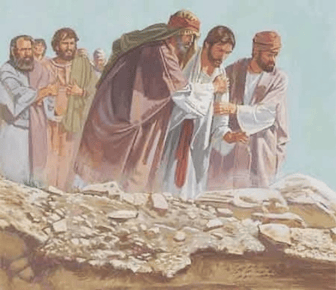
28 When they heard this, the people in the synagogue were furious. 29 Jumping up, they mobbed him and forced him to the edge of the hill on which the town was built. They intended to push him over the cliff, 30 but he passed right through the crowd and went on his way.
Well! If Jesus wanted to start his ministry with a bang, he’s certainly succeeded. Jesus enters the synagogue wearing all the right garments, and the rulers of the synagogue honor him by requesting he read from the Haftorah. God has arranged it so the Haftorah portion is from Isaiah 61:1-2 and 58:6. So far, so good. Everyone is basking in the words of a well-loved prophet, even if he was originally martyred for his prophecies. Now if Jesus will just give a standard commentary on these verses, the service can conclude and everyone can go home to enjoy a Sabbath meal. And that’s when things go sideways.
Finley Peter Dunne was a Chicago newspaper columnist writing political commentary in the early part of the twentieth century. To make his sharp observations palatable, Dunne spoke through the voice of Mr. Dooley, a fictional Irish bar tender, whose pungent remarks delighted millions of readers. In 1902, Dunne had Mr. Dooley remark that “The newspaper does everything for us. It runs the police force and the banks, commands the militia, controls the legislature, baptizes the young, marries the foolish, comforts the afflicted, afflicts the comfortable, buries the dead and roasts them afterward.” Finley Peter Dunne was not solemnly describing the duties of a newspaper; instead, he was comically outlining the comprehensive power of newspapers of that era. Today, we might say the same thing about social media in all its hydra-headed forms.
This sermon Jesus gave in the synagogue at Nazareth is the first recorded message we have, and Jesus certainly is not mincing words. This is not the first sermon Jesus has given, for Luke indicates that he’s been traveling throughout the Galilee preaching and teaching in synagogues and “being praised by everyone.” The elders at Nazareth feel they should be in for a treat; after all, this is their home town boy. Surely, Jesus will give his friends and relatives something special. Instead, Jesus comforts the afflicted and afflicts the comfortable.
Jesus gives the listeners at the Nazareth synagogue something special alright; however, by the time he is done, they’re so incensed that they want to drag him out and throw him off a cliff. Jesus first scandalizes his listeners by claiming he is the Messiah. The men in the synagogue gasp! Wait a minute! These guys know Jesus’ entire family. How can he claim to be Messiah? And where did this man get the eloquence and authoritative manner in which he speaks? Didn’t they all attend the same temple school? This guy is a carpenter, not a scribe. But what really incenses these men is Jesus’ refusal to perform any miracles. Sure, today is the Sabbath, but what about tomorrow? Can’t Jesus just promise to do a few miracles tomorrow? Heal a few lepers? Deliver a few people from demons? This is ridiculous! Everyone in Nazareth has already heard of the marvelous healings and deliverances Jesus has accomplished in Capernaum. Capernaum, for goodness’ sake! If Jesus can do all those great things somewhere else, what fantastic things might he do in Nazareth? Doesn’t Jesus think the people whom he has known for years deserve something special? “Come on, Jesus! Show us what you’ve got!”
Instead of miracles, Jesus rebukes the crowd, quoting a long-standing proverb that no prophet is accepted in his home town. Say what? Jesus has already heard the muttering and mumbling from the congregation, and he knows this bunch will be the last people to believe in his true calling. Jesus wants them to know that his ministry is not for sale, neither is it for show.
The congregation turns into a mob, seething for action. The strongest men seize Jesus and drag him out to the top of a cliff, now roughly 2 km from the modern city center. But just as the mob is about to throw Jesus off, something happens. Suddenly the men holding Jesus release him and he simply walks right through the crowd and out of town. Centuries earlier, Isaiah would prophesy, “He was despised and rejected—a man of sorrows, acquainted with deepest grief. We turned our backs on him and looked the other way. He was despised, and we did not care.” Later, John, the disciple who becomes closest to Jesus will write, “He came to his own people, and even they rejected him.”
Even before coming to Nazareth, Jesus knows his own people will not listen, so why choose Nazareth as the place at which to reveal himself as Messiah? What we must remember is that Jesus is taking orders from his Heavenly Father. The people of Capernaum love Jesus, so common sense might dictate that Jesus should have made this announcement in Capernaum. But Jesus is also bound to fulfill Scripture. The full quote from Isaiah 53:1-6 says this:
1 Who has believed our message? To whom has the Lord revealed his powerful arm?
2 My servant grew up in the Lord’s presence like a tender green shoot, like a root in dry ground. There was nothing beautiful or majestic about his appearance, nothing to attract us to him.
3 He was despised and rejected—a man of sorrows, acquainted with deepest grief. We turned our backs on him and looked the other way. He was despised, and we did not care.
4 Yet it was our weaknesses he carried; it was our sorrows that weighed him down. And we thought his troubles were a punishment from God, a punishment for his own sins!
5 But he was pierced for our rebellion, crushed for our sins. He was beaten so we could be whole. He was whipped so we could be healed.6 All of us, like sheep, have strayed away. We have left God’s paths to follow our own. Yet the Lord laid on him the sins of us all.
Jesus comes to Nazareth, already knowing that he will be rejected. But Jesus is obeying his Heavenly Father. Jesus has already faced temptation in the wilderness; now he must face a different kind of temptation: the temptation to temper his message to remain popular. Jesus succeeds in overcoming this temptation as well, even to the point of nearly being killed. But today is not Jesus’ day to die, and at some point, God confuses his captors, allowing Jesus to simply walk through the crowd and go elsewhere.
This story should serve as a cautionary tale for those of us claiming to spread the Gospel. Are we sticking to the teachings of Jesus, or are we watering things down in hopes of gaining more followers? We must always remember that we are presenting Jesus and not ourselves and allow his teachings to shine forth.
PRAYER: Father God, thank You for loving us and caring for us. Lord, help us to remain true to You, no matter the cost. In the mighty and precious Name of King Jesus. Amen.


Leave a Reply