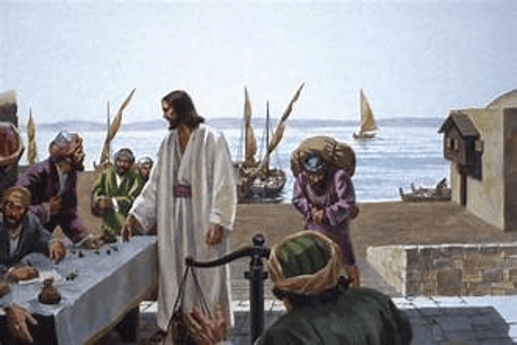
Matthew 9 Jesus Calls Matthew
9 As Jesus was walking along, he saw a man named Matthew sitting at his tax collector’s booth. “Follow me and be my disciple,” Jesus said to him. So Matthew got up and followed him.
These few verses seem to tell such a simple story, unless we realize who Matthew was, what he was, and what it meant for him to simply get up and follow Jesus. The website learnreligions.com gives the following information: We first meet Matthew in Capernaum, in his tax booth on the main highway. He was collecting duties on imported goods brought by farmers, merchants, and caravans. Under the Roman Empire’s system, Matthew would have paid all the taxes in advance and then collected from the citizens and travelers to reimburse himself.
Tax collectors were notoriously corrupt because they extorted far and above what was owed, to ensure their personal profit. Because their decisions were enforced by Roman soldiers, no one dared object.
Despite his sinful past, Matthew was uniquely qualified to be a disciple. He was an accurate record keeper and keen observer of people. He captured the smallest details. Those traits served him well when he wrote the Gospel of Matthew some 20 years later.
By surface appearances, it was scandalous and offensive for Jesus to pick a tax collector as one of his closest followers since they were widely hated by the Jews. Yet of the four Gospel writers, Matthew presented Jesus to the Jews as their hoped-for Messiah, tailoring his account to answer their questions.
Matthew 9:10 Later, Matthew invited Jesus and his disciples to his home as dinner guests, along with many tax collectors and other disreputable sinners. 11 But when the Pharisees saw this, they asked his disciples, “Why does your teacher eat with such scum?”
12 When Jesus heard this, he said, “Healthy people don’t need a doctor—sick people do.” 13 Then he added, “Now go and learn the meaning of this Scripture: ‘I want you to show mercy, not offer sacrifices. ’For I have come to call not those who think they are righteous, but those who know they are sinners.”
Glancing at this account, we might conclude that Jesus has lousy taste in the men he’s calling to become disciples. First, Jesus calls some poorly-educated fishermen. Now Jesus is calling a tax collector, a man most Jews feel is a corrupt tool of the despised Roman government. The religious authorities are practically chewing their beards. But Jesus knows that Matthew is spiritually starving and desperately wants a real experience of God. All the Pharisees see when they look at Matthew is scum; meanwhile, Matthew is bright, well-educated, and observant.
It’s amazing that the first thing Matthew does after leaving his tax collecting booth is to throw a big party for Jesus and his disciples as well as the local tax collectors and “many other disreputable sinners.” Jesus didn’t care about the social standing of his fellow dinner guests, but he was intensely concerned about sharing the good news of the Kingdom of God. And what better setting to reach these men than a dinner party where they would be relaxed and open to listening to Jesus?
Centuries later, Reverend William Booth would pursue a similar course. Soon after beginning his ministerial career in England in 1852, William Booth abandoned the concept of the traditional church pulpit in favor of taking the gospel of Jesus Christ directly to the people. Walking the streets of London, he preached to the poor, the homeless, the hungry, and the destitute.
When fellow clergymen disagreed with Booth’s unconventional approach, he and his wife, Catherine, withdrew from the church to train evangelists throughout England. The couple returned to the East End of London in 1865, where many followers joined their fight for the souls of lost men and women. Within 10 years, their organization, operating under the name “The Christian Mission.” had over 1,000 volunteers and evangelists.
Thieves, prostitutes, gamblers, and drunkards were among their first converts to Christianity. And soon, those converts were also preaching and singing in the streets as living testimonies to the power of God. (https://www.salvationarmyusa.org/about-us/our-history/)
Jesus frequented Capernaum, so he probably already knew Matthew and his unsavory reputation. But Jesus had spent long nights in prayer, seeking guidance from his Heavenly Father as to whom he was to call as disciples. And timing is everything. It’s possible that the morning Jesus called Matthew, Matthew was already fed up with his position, the public shame, and the fact that each day he collected money, he was giving up increasing parts of his soul. That morning, as Jesus walked by, Matthew looked up, and the love he saw in Jesus’ eyes compelled him to agree when Jesus called him. Suddenly, Matthew knew that this part of his life was over. He held one last party for Jesus and his disciples and for his fellow tax collectors and other friends. Then Matthew left everything and followed Jesus.
It’s possible that Matthew didn’t start out to become a tax collector. Perhaps a family financial crisis forced him into that situation and then he remained, promising himself that someday he would become the scholar he had wanted to be. But temporary solutions have a way of becoming permanent, trapping us. Then Jesus called, and Matthew saw that call as a means of escape, and seized it.
Today, Jesus continues to call us to leave our messes behind and come to him. Don’t worry about cleaning yourself up; God does far better cleanup jobs than we ever can. Just come.
PRAYER: Father God, thank You for loving us and caring for us. Lord, we confess that we are sinners who have messed up our lives and are unable to free ourselves. Please take us as Your children, clean us up, make us wholly Yours, and help us to follow hard after You the rest of our lives. In the mighty and precious Name of King Jesus. Amen.
Tags: bible, christianity, discipleship, faith, god, jesus


Leave a Reply