Archive for the ‘Uncategorized’ Category

JULY 18, 2025 WHEN TRAGEDY STRIKES, HOW DO WE RESPOND #1 INTRODUCTION TO THE BOOK OF JOB

July 18, 2025

Well, you never know what God is going to do! After completing the Pilgrim Psalms, I thought God wanted me to write about the fruits of the Spirit. But floods are raging in Texas, Oklahoma, Iowa, Illinois, and North Carolina. A huge fire has destroyed National Park Service Headquarters and several other buildings at the Grand Canyon. Photos of those lost in the Texas floods are dominating many news feeds. While we are demanding to know where God is in all these disasters, it’s time to take another look at the Book of Job. Pastor Chuck Swindoll in his Insight for Living teaching gives us this introduction to this complicated but important book. https://www.insight.org/resources/bible/the-wisdom-books/job

Who wrote the book?

The author of the book of Job is unknown. Several suggestions have been put forth as plausible authors: Job himself, who could have best recalled his own words; Elihu, the fourth friend who spoke toward the end of the story; various biblical writers and leaders; or many editors who compiled the material over the years. While there is no definitive answer, it was most likely an eyewitness who recorded the detailed and lengthy conversations found in the book. In Old Testament times, authors sometimes referred to themselves in the third person, so Job’s authorship is a strong possibility.

Who was Job? This wealthy landowner and father is one of the best-known biblical heroes. But we know little more than that he was stripped of everything, without warning, and that his faith was severely tested.

Where are we?

Though the text does not directly identify its setting, internal clues indicate that Job lived during the time of the patriarchs, approximately 2100 to 1900 BC. According to Job 42:16, Job lived an additional 140 years after his tragedies occurred, perhaps to around 210 years total. His long lifespan generally corresponds to that of Terah (Abraham’s father), Abraham, Isaac, and Jacob. Also, Job’s wealth was measured in livestock (Job 1:3; 42:12), as was Abraham’s (Genesis 12:16). Like the patriarchs, Job used God’s unique title “El Shaddai” (God Almighty). The book of Job does not mention the Mosaic Law; indeed, Job’s daughters were equal heirs with his sons, and Job himself, though not a priest, offered sacrifices—things not possible under the Law (Leviticus 4:10; Numbers 27:8). Though we cannot be certain, Job may have lived during the time of Jacob or shortly thereafter.

Job lived in the land of Uz (Job 1:1), but no one really knows where Uz was located. Scholars believe it was outside of Canaan, near the desert because “the customs, vocabulary, and references to geography and natural history relate to northern Arabia.”

Why is Job so important?

The Israelites categorized Job within their wisdom literature. The book includes language from ancient legal proceedings, laments, and unique terms not found elsewhere in the Bible. In addition, the majority of Job is written in parallel lines which are indicative of poetry.

The book delves into issues near to the heart of every human who experiences suffering. The prologue provides a fascinating peek into the back story—why God allowed Satan to afflict Job with such pain and turmoil. Then, through a series of dialogues and monologues arranged in a pattern of threes, human wisdom attempts to explain the unexplainable, until finally God Himself speaks.

The final chapters of Job record God’s masterful defense of His majesty and unique “otherness”—of God’s eternal transcendence above creation—in contrast with Job’s humble and ignorant mortality. “Where were you when I laid the foundation of the earth? / Tell Me, if you have understanding” (Job 38:4).

What’s the big idea?

Job’s plight of undeserved suffering compels us to ask the age-old question, “Why do bad things happen to good people?” The answer given to Job may or may not satisfy the reader. God allows pain for good reason, but He may never reveal those reasons.

Job did not reject God, but Job did challenge and accuse Him. The Almighty quieted Job decisively when He finally thundered His own perspective on the situation. God did not answer Job’s question of “Why?”—He instead overwhelmed Job and his friends with the truth of His majesty and sovereignty. Job came away with a deeper sense of God’s power and splendor, trusting Him more:

“I have heard of You by the hearing of the ear;
But now my eye sees You;
Therefore I retract,
And I repent in dust and ashes.” (
Job 42:5–6) 

How do I apply this?

Pain inevitably afflicts each one of us. Suffering is unavoidable in this life. Will your relationship with God be enough when trials come? Will you trust Him through your suffering? Read Job 38–42. Spend time with the Almighty. Pray for a stronger faith in the powerful Creator described in those chapters. Pray for a right perspective of Him so that you might see your situation through His eyes.

Instead of asking where God is in the midst of your pain, the book of Job affirms God’s control and asks us, “Where are we in our pain? Are we trusting our Creator, even though we cannot understand our circumstances?”

Job is neither a simple book nor an easy one, but there are lessons we need to learn from it. So, come to the Land of Uz, where we are about to meet a very wealthy landowner, even a prince, named Job.

PRAYER: Father God, thank You for loving us and for caring for us. Lord, help us to learn as much as we can from the Book of Job, knowing that there will always be more for us to gain as we continue with You. We ask this in the mighty Name of King Jesus. Amen.

JULY 17, 2025 WE’RE ALL PILGRIMS HEADED SOMEWHERE #15 WHAT’S KEEPING YOU UP AT NIGHT?

July 17, 2025

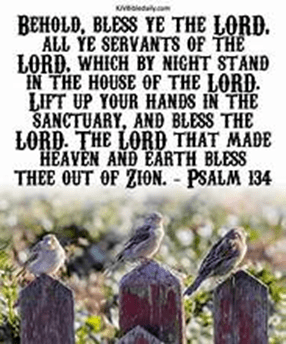
Psalm 134 Praise to God in His Temple

A song for pilgrims ascending to Jerusalem.

“Oh, praise the Lord, all you servants of the Lord, you who serve at night in the house of the Lord.
Lift your hands toward the sanctuary, and praise the Lord.

May the Lord, who made heaven and earth, bless you from Jerusalem.”

Consider the priests on duty at the temple in Jerusalem. Obviously, these men were organized into shifts, including priests to offer prayers, singers, musicians, etc. Now think about what it was like in the temple during the daytime.

During the day, the temple would be packed with worshipers praying, making offerings and sacrifices, and meeting and greeting one another.Anyone working the day shift could look forward to an interesting and stimulating time. But what about night in the temple?

Once the evening prayers and sacrifices had been offered, things would be very quiet. There were lights that were to be kept burning at all times, and night workers would be responsible for ensuring that these lights were supplied with purest oil, that the wicks were properly trimmed, and that everything was in its place. But none of these duties would take very long, so what were the temple workers to do for the rest of the night? This psalm tells us that they were to “praise the Lord,” and that they were to “lift their hands toward the sanctuary and praise the Lord.”

We might imagine that even though music would have been softer than in the daytime, musicians would still have been playing, singers singing, and those assigned to special prayer would be praying.

There are several important things about this psalm. First, worship is to continue even when there’s no audience. These days, much of what passes for worship in many churches has actually become performance. Sadly, many lead singers behave as if they are auditioning for Christian music videos, not leading people into the throne room of God.  

Next, worship and prayer at night are particularly important. During the daytime, many of us are so distracted that even when we repeat prayers, we may be doing it by rote rather than by heart. But at night when things are quiet, it’s much easier to pray effectively and also much easier to hear the Holy Spirit. While the Holy Spirit may come as a rushing wind on occasion, it’s far more common for the Holy Spirit to speak very softly. Daytime events can make it impossible to hear the Holy Spirit. Remember that prayer is a two-way conversation, not a recitation. If all we are doing is dumping our problems and grievances on God without listening for His answers, we have accomplished nothing.

Yet another reason for nighttime prayer and worship is the spiritual danger many people find themselves in at night. When we are tired, Satan can appeal to our fatigue to lead us into self-pity, a useless endeavor that precludes hearing from God. Those wishing to hurt us may try to attack us in dreams. There have been many occasions when God has awakened me and ordered me to pray for people. Sometimes I eventually get feedback but many times, I do not. No matter. God is the One handing out prayer assignments. My job is to obey, not to argue.

When I can’t sleep, I do my devotional reading for the next day, assuming that I might be called out for a medical emergency at the time I would normally be doing devotions.

How can we hear from God at night? The prayer Eli told the boy Samuel to pray gives us the answer. “Speak, Lord, for your servant is listening.” We can also ask God to help quiet our hearts and minds so that we will hear His still small voice speaking in our minds.

Very few believers ever hear God speaking in an audible voice. I was once in a Bible study where several believers were testifying, saying, “God told me…..” After several of these testimonies, one sweet lady broke down and wept, saying, “You keep saying ‘God told me’ but God never tells me anything!” Sadly, this lady was legally blind and yet bravely took two different city buses to and from work each day. Obviously, God had to be guiding her, but she misunderstood our enthusiasm to mean that God was speaking to the rest of us audibly. It took quite a bit of time that night to let this lady see that she was receiving just as much guidance from God as the rest of us were.

There’s a meme that says, “If you can’t sleep, don’t count sheep. Talk to the Shepherd.” Find a quiet place. Spend time with God and ask Him to speak to you. Even if you don’t feel as if God has said anything to you, you will still find you have peace and you can go to sleep.

Psalm 4:8 tells us, “In peace I will lie down and sleep,
    for you alone, O Lord, will keep me safe.”
Come bless the Lord, lifting up your hands in worship. And then go to sleep, knowing that the Shepherd is keeping watch.

PRAYER Father God, thank You for loving us and caring for us. Lord, many of us feel helpless, confused, conflicted and exhausted. Please speak to the hearts of all who read these words, comforting them and letting them know that You are with them and that You will never leave them or forsake them. In the mighty and precious Name of King Jesus. Amen.

JULY 16, 2025 WE’RE ALL PILGRIMS HEADED SOMEWHERE #14 “GENTLEMEN, EITHER WE MUST ALL HANG TOGETHER OR WE WILL ALL HANG SEPARATELY!”

July 16, 2025

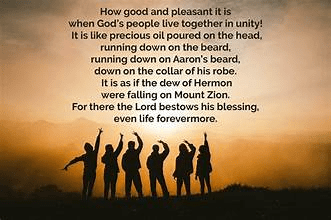
Psalm 133 Brotherly Fellowship and Unity

A song for pilgrims ascending to Jerusalem. A psalm of David.

“How wonderful and pleasant it is when brothers live together in harmony!
For harmony is as precious as the anointing oil that was poured over Aaron’s head, that ran down his beard and onto the border of his robe.
Harmony is as refreshing as the dew from Mount Hermon that falls on the mountains of Zion.”
And there the Lord has pronounced his blessing, even life everlasting.”

It was 1776 and in Philadelphia, representatives of the thirteen colonies were arguing over the Declaration of Independence. Finally, Benjamin Franklin, fed up with his fellow delegates told the assembly, “Gentlemen, either we must all hang together or we will all hang separately!” Faced with the reality possibility of dying at the hands of the British, delegates eventually signed, pledging “our lives, our fortunes, and our sacred honor.” Who were these individuals? What happened to the 56 men who signed the Declaration of Independence? What kind of men were they? Here is the information from https://ultimateflags.com/blog/56-men-pledge-our-lives-our-fortunes-and-our-sacred-honor/

The men were lawyers, jurists, merchants, farmers, large plantation owners; men of means, well educated. But they signed the Declaration of Independence knowing full well what they were putting at risk. They were British subjects at the time, and knew that the penalty for treason was death by hanging.

They were not wild-eyed, rabble-rousers, but mostly soft-spoken men of means and education. They had security, but valued liberty more. Each one surely had more to lose from revolution than he had to gain by it. But they stood tall, and unwavering and pledged:  

“For the support of this declaration, with firm reliance on the protection of the divine providence, we mutually pledge to each other, our lives, our fortunes, and our sacred honor.”

Here are the fates of the signers:

Nine fought and died from wounds or hardships during the war. Five were captured by the British, charged with treason, and were tortured before they died. Twelve had their homes ransacked and burned. Two lost their sons serving in the Revolutionary Army. Another had two sons captured. Several lost wives, sons, or entire families. One lost his 13 children. Two wives were brutally treated. All were at one time or another the victims of manhunts and driven from their homes. Seventeen lost everything they owned. Yet not one of them defected or went back on his pledged word.

Of note is the New Jersey Signer, Abraham Clark. He had two sons serving in the Revolutionary Army . They were captured and sent to the infamous British prison boat known as the hell ship “Jersey” in New York Harbor where 11,000 Americans were to die.

The sons received extra brutal treatment because of their father. One was in solitary and given no food. With the war almost over and won, no one could have blamed Abraham Clark if he had accepted the British offer of sparing his sons’ lives if he would recant and come out for the King and Parliament. Certainly, with utter despair and anguish in his heart and soul, his answer was “No.” The 56 signers of the Declaration of Independence proved by their every deed that they made no idle boast when they composed` that magnificent pledge. They ultimately gave us a free and independent America whose liberties should never be taken for granted.”

Galatians 5:22-23 tells us, “But the Holy Spirit produces this kind of fruit in our lives: love, joy, peace, patience, kindness, goodness, faithfulness,gentleness, and self-control. There is no law against these things!” No organization or corporation can function properly when members or workers are fighting and arguing. As soon as one faction begins speaking out, other factions will also begin complaining. Before long, petty grievances that have lain dormant for years are suddenly being aired.

The same thing can happen in families. As a physician, I must be extremely careful in the way I handle families losing a loved one. Any failure to communicate properly may result in some family members forming factions against others. I once cared for an elderly chief with a life-threatening condition who was recovering. But a struggle erupted between the traditionalists who believed the man was dying and were demanding he return to the village to die there and the educated members who realized the man might recover and who wanted him to remain in the hospital. Negotiating this situation strained every bit of my poor talents as a diplomat!

“For harmony is as precious as the anointing oil that was poured over Aaron’s head, that ran down his beard and onto the border of his robe.” The anointing oil was made from very precious ingredients and its recipe guarded so closely that anybody foolish enough to duplicate the recipe could be put to death. That anointing oil carried a wonderful fragrance that penetrated every part of Aaron’s body as well as his garments. For the rest of his days, Aaron would carry that fragrance with him. When we are people of peace, we carry the fragrance of peace with us, and others will sense that peace as well.

“Harmony is as refreshing as the dew from Mount Hermon that falls on the mountains of Zion.” Dew falls on Mount Hermon and then forms streams that flow down the mountainside and then come together to form the River Jordan. In a country where water is very precious, such dew will refresh and encourage all fortunate enough to experience it.

When we encounter people of peace, we find ourselves refreshed and relaxed. May God help us so that we ourselves will become people of peace!

PRAYER: Father God, thank You for loving us and caring for us. Lord, help us to become people of peace and to seek peace and pursue it. In the mighty and precious Name of King Jesus. Amen.

JULY 15, 2025 WE’RE ALL PILGRIMS HEADED SOMEWHERE #13 GOD IS WITH US!

July 15, 2025

Psalm 132 God’s Sovereign Plans for His People

A song for pilgrims ascending to Jerusalem.

“Lord, remember David and all that he suffered. He made a solemn promise to the Lord. He vowed to the Mighty One of Israel, “I will not go home; I will not let myself rest. I will not let my eyes sleep nor close my eyelids in slumber until I find a place to build a house for the Lord, a sanctuary for the Mighty One of Israel.”

“We heard that the Ark was in Ephrathah; then we found it in the distant countryside of Jaar. Let us go to the sanctuary of the Lord; let us worship at the footstool of his throne.

Arise, O Lord, and enter your resting place, along with the Ark, the symbol of your power. May your priests be clothed in godliness; may your loyal servants sing for joy.
For the sake of your servant David, do not reject the king you have anointed. The Lord swore an oath to David with a promise he will never take back: “I will place one of your descendants on your throne. If your descendants obey the terms of my covenant and the laws that I teach them, then your royal line will continue forever and ever.”

“For the Lord has chosen Jerusalem; he has desired it for his home. “This is my resting place forever,” he said. “I will live here, for this is the home I desired. I will bless this city and make it prosperous; I will satisfy its poor with food. I will clothe its priests with godliness; its faithful servants will sing for joy. Here I will increase the power of David; my anointed one will be a light for my people. I will clothe his enemies with shame, but he will be a glorious king.”

“Lord, remember David and all that he suffered. He made a solemn promise to the Lord. He vowed to the Mighty One of Israel, “I will not go home; I will not let myself rest. I will not let my eyes sleep nor close my eyelids in slumber until I find a place to build a house for the Lord, a sanctuary for the Mighty One of Israel.” If you remember the story of the Ark of the Covenant, the Israelites insisted on taking it into battle, only for the Philistines to defeat the Israelites and capture the Ark. But capturing is not the same as keeping, and after several incidents of divine wrath, including bubonic plague, the Philistines return the Ark to Israel on a cart pulled by milk cows who cry for their calves, even as they head to Israel. The Ark winds up being kept by a family in Kiriath Jearim and later by a man named Obed Edom until David studies God’s commandments and then arranges for the Ark to be brought into Jerusalem carried by priests as Moses has commanded.

“We heard that the Ark was in Ephrathah; then we found it in the distant countryside of Jaar. Let us go to the sanctuary of the Lord; let us worship at the footstool of his throne.”  

1 Chronicles 16 describes King David bringing the Ark to Jerusalem, with singing, dancing, and blowing of trumpets. One of the songs David wrote for the musicians to sing was this: “Arise, O Lord, and enter your resting place, along with the Ark, the symbol of your power. May your priests be clothed in godliness; may your loyal servants sing for joy.”

“For the sake of your servant David, do not reject the king you have anointed. The Lord swore an oath to David with a promise he will never take back: “I will place one of your descendants on your throne. If your descendants obey the terms of my covenant and the laws that I teach them, then your royal line will continue forever and ever.” When Jesus Christ came as Messiah, being borne in the lineage of David, these verses literally came true.

“For the Lord has chosen Jerusalem; he has desired it for his home. “This is my resting place forever,” he said. “I will live here, for this is the home I desired. I will bless this city and make it prosperous; I will satisfy its poor with food. I will clothe its priests with godliness; its faithful servants will sing for joy. Here I will increase the power of David; my anointed one will be a light for my people. I will clothe his enemies with shame, but he will be a glorious king.” Was this psalm written during David’s reign or after the Israelites returned from Babylon? We don’t know; all we know is that God has definitely chosen Jerusalem as a holy city.

You might read this psalm and ask, “So what? What does this psalm have to do with me?” First, God knows all our suffering, our fears, our trials, and our failures. But praise God, He has not forgotten us, nor is He indifferent to all our trials. Second, David has set all of us an example, for David began making promises to God back when King Saul was still chasing David all over Israel. David didn’t wait until he was safe before he began serving God; David began as a teenager herding sheep. Third, David completely fulfilled his promises to God, regardless of the cost to himself.

Why does this psalm rate as a psalm of pilgrimage? Pilgrims are focused, traveling to Jerusalem, working toward a goal. No matter what time we are born in, we are all pilgrims headed somewhere. If God has called us to set out on pilgrimage, He will protect us and help us to complete our pilgrimage. When John Wesley, founder of the Methodist Church, was dying, he is quoted as having said, “The best of all is, God is with us.” And He is.

PRAYER: Father God, thank You for loving us and caring for us. Lord, help us to trust that You are leading us and guiding us. Help us to follow hard after You all the days of our lives. In the mighty and precious Name of King Jesus. Amen.
JULY 14, 2025 WE’RE ALL PILGRIMS HEADED SOMEWHERE #12 ARE YOU A WEANED CHILD OR ARE YOU STILL CRYING FOR MILK?

July 14, 2025

Psalm 131 Surrender as a child to the Lord

A song for pilgrims ascending to Jerusalem. A psalm of David.

“Lord, my heart is not proud; my eyes are not haughty. I don’t concern myself with matters too great or too awesome for me to grasp.
Instead, I have calmed and quieted myself, like a weaned child who no longer cries for its mother’s milk. Yes, like a weaned child is my soul within me.

O Israel, put your hope in the Lord—now and always.”

“Lord, my heart is not proud; my eyes are not haughty. I don’t concern myself with matters too great or too awesome for me to grasp.” These verses might be daunting for some people addicted to social media to handle. Past generations emphasized keeping one’s opinions private; however, now people are likely to spout off on Facebook, Instagram, TikTok, YouTube, and any other social media they can find. Never mind whether or not the information these people are spreading is valid; the idea is to publicize as much as possible as quickly as possible. These same people are likely to assess their own value based on the number of followers they have garnered.

While following news coverage on the recent flooding in Texas, I have noticed conspiracy theory proponents blaming all sorts of groups for this flooding. But responsible meteorologists have testified that local weather authorities did warn about flash floods. The scope of these floods simply exceeded all predictions. When warnings were sent out to people’s phones, many disregarded the warnings, assuming that authorities were becoming excited for nothing. There were also those who assumed that because they had weathered previous floods without incident, they would survive this one as well. Sadly, many of those people paid with their lives for their complacency. Then there were others whose only warning came when flood waters inundated their cabins or RV’s. In the face of such overwhelming tragedy, blaming and shaming has no place. Far better to realize that matters about this flood are far greater and more awesome than we can grasp.

“Instead, I have calmed and quieted myself, like a weaned child who no longer cries for its mother’s milk. Yes, like a weaned child is my soul within me.” Ask any mother how difficult it can be to wean a child off breast feeding. Here in Ghana, breast feeding is encouraged until the age of two, although mothers begin home foods at six months. During the weaning process, there are plenty of times when mothers must turn a deaf ear to their children’s cries, knowing that these children must become independent. But in times of stress, many three-or four-year-olds instinctively reach for their mothers’ breasts for comfort, confident that those mothers will soothe and protect them.

A weaned child knows that mother remains as a source of comfort, for the mother-child bond is one that lasts a lifetime. Agatha Christie has been quoted as saying, “A mother’s love for her child is like nothing else in this world. It knows no law, no pity. It dares all things and crushes down remorselessly all that stands in its path.” No matter a child’s age, a mother will still want to comfort them. God is the One who has given mothers this passion for their children; His passion for us is far far greater.

When we are new believers, we demand as much of God’s attention as possible. As we grow in our faith, we continue to be aware of God’s presence; however, we no longer need dramatic proofs of His Love. This does not mean that God will not do miracles for older believers but that older believers no longer require miracles to bolster their faith. The longer we walk with God, the more we see of His great provision and watch-care, so the more our faith grows.

“O Israel, put your hope in the Lord—now and always.”  Nations who put their hope in the Lord will never be disappointed. The problem is that most nations trust in something else-money, power, military might. Even in America where “In God we trust” is on all the money, many people are only giving lip service to that idea.

During the recent Texas floods, some survivors admitted that when they received alerts about flooding on their phones, they disregarded the messages, assuming that authorities were over-reacting. National governments might also feel the same way about warnings to hope in God, feeling that their might, their wealth, and their power are sufficient for any challenge. But natural disasters can humble the most arrogant of men and God, the Creator of the Universe, remains unimpressed by those who think they can make it on their own.

Don’t make the same mistake those people who disregarded those flood alerts made! God wants each of us to turn to Him, repent of our sins, and follow Him for the rest of our lives. When we hope in the Lord, we are trusting the only One who can deliver us from every evil so we can be with Him in heaven. “O Israel, put your hopes in the Lord!”

PRAYER: Father God, thank You for loving us and caring for us. Lord, thank You, that You are a God of hope. You have promised in Romans 15:13 that if we trust in You, you will fill us with joy and peace as we trust in You and that we will overflow with hope. Forgive our sins and help us to hope in You. In the mighty and precious Name of King Jesus. Amen.

JULY 13, 2025 WE’RE ALL PILGRIMS HEADED SOMEWHERE #11 WHEN YOU’RE FEELING LOWER THAN A DITCH DIGGER’S BOOTS, THIS PSALM IS FOR YOU!

July 13, 2025

Psalm 130 A Plea for God’s Help

A song for pilgrims ascending to Jerusalem. “From the depths of despair, O Lord, I call for your help. Hear my cry, O Lord. Pay attention to my prayer.

Lord, if you kept a record of our sins, who, O Lord, could ever survive? But you offer forgiveness, that we might learn to fear you.

I am counting on the Lord; yes, I am counting on him. I have put my hope in his word. I long for the Lord more than sentries long for the dawn, yes, more than sentries long for the dawn.

O Israel, hope in the Lord; for with the Lord there is unfailing love. His redemption overflows. He himself will redeem Israel from every kind of sin.”

“From the depths of despair, O Lord, I call for your help. Hear my cry, O Lord. Pay attention to my prayer.” There are times when we find ourselves in situations that seem hopeless. No matter which way we turn, we see no way out of the mess we’re in. There’s nobody who can help us and there might not even be anyone who knows where we are or the mess we are in. That’s the situation in which Aron Lee Ralston found himself.

On April 26, 2003, during a solo descent of Bluejohn Canyon in southeastern Utah, he dislodged a boulder, pinning his right wrist to the side of the canyon wall. After five days, he had to break his decomposing forearm, amputate it with a dull pocket knife to break free, make his way through the rest of the canyon, rappel down a 65-foot (20 m) drop, and hike 7 miles (11 km) to safety. Ralston was found by hikers, who gave him water, dressed his wound, and called emergency services.

While we might not find ourselves in such dire straits physically, emotional crises, financial crises, and losses of family and friends can hit any of us. Currently, I have been viewing videos of the flooding in the Texas Hill Country. Watching these scenes of devastation, I can scarcely wrap my mind around the pain these people are feeling. As emergency workers, volunteers, and family members speak of the tragic losses, I find myself praying, begging God to comfort, to encourage, to strengthen and to heal all those involved. Truly, only God can properly heal these people.

“Lord, if you kept a record of our sins, who, O Lord, could ever survive? But you offer forgiveness, that we might learn to fear you.” People are great for keeping score of every little hurt and insult. But God is amazing. Micah 7:18-19 tells us, “Who is a God like you, who pardons sin and forgives the transgression of the remnant of his inheritance? You do not stay angry forever but delight to show mercy. You will again have compassion on us; you will tread our sins underfoot and hurl all our iniquities into the depths of the sea.” Psalm 103:11-12 tells us, “For as high as the heavens are above the earth, so great is his love for those who fear him; as far as the east is from the west, so far has he removed our transgressions from us.”

“I am counting on the Lord; yes, I am counting on him. I have put my hope in his word. I long for the Lord more than sentries long for the dawn, yes, more than sentries long for the dawn.”  Consider the old-time watchmen on the walls of ancient cities. These men had to remain awake and attentive all night long; little wonder then, that these men would long for sunrise so that they could go off duty and go home to sleep. When you’re in a mess, all you want is hope and relief. The longer you continue with no change in your problems, the more desperate you are for help. The great thing about God is that God hears us, God sees us, and God will not abandon us.

“O Israel, hope in the Lord; for with the Lord there is unfailing love. His redemption overflows. He himself will redeem Israel from every kind of sin.” Because of God’s unfailing love, we can be redeemed from every kind of sin. When we repent, God will forgive us.

1 John 1:8-9 says, “If we claim to be without sin, we deceive ourselves and the truth is not in us.If we confess our sins, he is faithful and just and will forgive us our sins and purify us from all unrighteousness.” God’s promises are sure and He never fails. Today, give your mess to the Lord and let Him sort it out. But make sure that there is no sin that you need to confess. There’s no point in trying to cover up sin, for God already knows what you have done. Simply follow John’s advice: confess and receive forgiveness!

PRAYER: Father God, thank You for loving us and caring for us. Lord, we confess that we have failed to do Your will. Please forgive our sins and help us to change so that we will glorify You in our lives. Thank You for redeeming us and for giving us hope. In the mighty and precious Name of King Jesus. Amen.

JULY 12, 2025 WE’RE ALL PILGRIMS HEADED SOMEWHERE #10 WHEN GOD DELIVERS YOU, PASS THE BLESSING ON TO OTHERS

July 12, 2025

Psalm 129 A Cry for Help to the Lord

A song for pilgrims ascending to Jerusalem.

“From my earliest youth my enemies have persecuted me. Let all Israel repeat this: From my earliest youth my enemies have persecuted me, but they have never defeated me.
My back is covered with cuts, as if a farmer had plowed long furrows.

But the Lord is good; he has cut me free from the ropes of the ungodly.

May all who hate Jerusalem be turned back in shameful defeat. May they be as useless as grass on a rooftop, turning yellow when only half grown, ignored by the harvester, despised by the binder. And may those who pass by refuse to give them this blessing: “The Lord bless you; we bless you in the Lord’s name.”

“From my earliest youth my enemies have persecuted me. Let all Israel repeat this: From my earliest youth my enemies have persecuted me, but they have never defeated me. My back is covered with cuts, as if a farmer had plowed long furrows. But the Lord is good; he has cut me free from the ropes of the ungodly.”

In case you have thought that ancient pilgrims had it easy, this psalm should convince you otherwise. This writer has faced opposition his entire life and he wants you to know about it! Here in Ghana, there’s a common slogan painted on small buses, “Kae me bre!” “Remember my suffering!” This psalmist wants you to know that he has SUFFERED!!!

I came of age as a general surgeon in the 1970’s when female surgeons were far less common than they are now. I can testify that I have endured prejudice, gas lighting, and all kinds of verbal and emotional abuse in my quest to become a competent surgeon. There were times when I felt as if I had visible cleat marks on my back. During those times, this psalm became one of my favorites, one I would read repeatedly for comfort.  

It’s not difficult to find yourself in the same position as this psalmist. Work hard, behave with honesty and integrity, and you too will find enemies on the attack. When you try to do everything right, your enemies still leave you with long deep furrows on your back. But there’s hope.

“But the Lord is good; he has cut me free from the ropes of the ungodly.” Here is the secret ofthe psalmist’s salvation. Each time enemies think they have captured this man, God sets him free. God is all-powerful and all-seeing; God never becomes fed up with delivering us from those who would destroy us. Even when we find ourselves caught in cleverly designed traps, God already has made ways of escape for us.

“May all who hate Jerusalem be turned back in shameful defeat. May they be as useless as grass on a rooftop, turning yellow when only half grown, ignored by the harvester, despised by the binder.” These verses give us a fascinating glimpse into ancient Israeli culture. What good is grass on a flat house top? This grass is “volunteer, “springing up by itself but unfit for any good use. Of course, this grass will turn yellow, drying out in the relentless sun. And what harvester or binder would bother with such grass? So all enemies will be turned back in shameful defeat, worthless as dried up grass on a housetop.

“And may those who pass by refuse to give them this blessing: “The Lord bless you; we bless you in the Lord’s name.” Evidently, in ancient Israel, when travelers would pass those harvesting a crop, they would automatically pronounce blessings on the crops and the workers. “The Lord bless you; we bless you in the Lord’s name.”  Children would grow up listening to their parents blessing the neighbors in the fashion, so blessings would spread throughout an entire area. How wonderful! I grew up on a farm, but I don’t recall ever hearing anyone blessing us in this fashion.

But do we need to merely regard this blessing as a fascinating cultural insight? What if we were to bless workers each time we see them working? Again, here in Ghana, most tribal languages have a phrase meaning “How’s work?” Those raised to regard traditional courtesies will greet workers in this fashion wherever they see them. We have learned several of these phrases and those we greet in this fashion are always charmed and flattered when we acknowledge their work in their own language.

God knows the way you have suffered, but God also is the Healer. Trust God to deliver you from enemies, and while you’re waiting for deliverance, bless all those around you. Who knows? God might use you to deliver someone else.

PRAYER: Father God, thank You for loving us and caring for us. Lord, help us to trust Your deliverance and to remain faithful, even when things are difficult. And help us to be a blessing to all those around us. In the mighty and precious Name of King Jesus. Amen.

JULY 11, 2025 WE’RE ALL PILGRIMS HEADED SOMEWHERE #9 DOES GOD ALWAYS BLESS US?

July 11, 2025

Psalm 128 Joy for those who follow God’s ways

A song for pilgrims ascending to Jerusalem.

“How joyful are those who fear the Lord—all who follow his ways!
You will enjoy the fruit of your labor. How joyful and prosperous you will be!
Your wife will be like a fruitful grapevine, flourishing within your home. Your children will be like vigorous young olive trees as they sit around your table.
That is the Lord’s blessing for those who fear him.

May the Lord continually bless you from Zion. May you see Jerusalem prosper as long as you live.
May you live to enjoy your grandchildren. May Israel have peace!”

“How joyful are those who fear the Lord—all who follow his ways! You will enjoy the fruit of your labor. How joyful and prosperous you will be!”

It was 4th of July weekend, and up and down the Guadelupe and Medina Rivers, campers of all kind had gathered on the river banks to celebrate the holiday. Both rivers were normally tame delightful streams, perfectly suited for floating in inner tubes or boats and swimming. Campsites were full of RV’s, tents, boats, and vehicles of all kinds. At the height of summer, many of the children’s camps were full of children from 8 onwards, with teen-age counselors helping. As everyone went to bed on Thursday July 3, 2025, both rivers were flowing gently.

But this picture changed radically in the early hours of Friday July 4th. Due to catastrophically heavy rainfall in the watersheds feeding these rivers, a flood surge developed. The Guadelupe River rose 26 feet in 45 minutes. Those people fortunate enough to be awake at 1-3 AM received alerts and evacuated; however, many others were sound asleep, having no idea that they were about to be inundated. Camp Mystic, a Christian camp that had existed for 99 years, sat right in the way of the storm surge, with the youngest campers occupying cabins closest to the Guadelupe River. When the flood waters hit, many of those little girls were swept away by the water. Dick Eastland, the camp director, lost his life heroically trying to save as many of these girls as possible. At this time, 27 girls and counselors have died; however, 850 people have been safely evacuated.

Those camping in riverside parks were swept away, with many winding up in trees or being saved by rescue swimmers and emergency crews. Towns along the river have also been devastated, with riverside homes floating away until they have been reduced to splinters by the force of the water.

Why am I re-telling this story that has occupied international news media for several days? When disasters happen, the first question many people ask is, “Where is God in all this? If God is all-powerful, why do we suffer from floods, fires, earthquakes, tornadoes, and hurricanes?” At this point, at least 82 people are known to have drowned in floods in various parts of the Texas Hill Country and more people are missing. Why has God allowed this to happen? How can we believe in the message of this psalm when facing such disasters?

We must remember that we live in a fallen sinful world. Weather disasters are part of the consequences of the Garden of Eden. Putting it bluntly, bad things can happen-and do happen-to good people. But should we allow tragedies to mar our faith? No! Because of sin, God allows tragedies; however, God remains on the throne and remains a Rewarder of those who fear Him and follow His ways.

Viewing the photos of campers and counselors who have drowned is heart-wrenching. So much brightness and so much promise-how can God possibly have allowed these young lives to be snuffed out? As a physician, there are many times through the years when I have argued strenuously with the Lord as to WHY He has allowed certain people to die while others have survived. And each time, God has reminded me that the day an individual is born, God already knows the day that person will die. There is not a one of those precious little girls who drowned who has been lost to God.

“You will enjoy the fruit of your labor. How joyful and prosperous you will be! Your wife will be like a fruitful grapevine, flourishing within your home. Your children will be like vigorous young olive trees as they sit around your table. That is the Lord’s blessing for those who fear him.” Notice something: God does not tell us how long any of us will live to enjoy our families.

Two local teachers and their families have become flood victims; God knows them and knows where their bodies are. Nobody is guaranteed how long he/she is going to live or how long their children will live either. But if we can enjoy our families as long as we have them, we remain blessed.

“May the Lord continually bless you from Zion. May you see Jerusalem prosper as long as you live. May you live to enjoy your grandchildren. May Israel have peace!”  As of July 6, 2025, more than 850 people have been rescued, many from roof tops or even from trees. At least 165 of those rescues have been accomplished using helicopters. While we might mourn those who have died, we should also celebrate the heroism of rescuers who have saved so many. While these people have lost everything apart from their lives, they can rebuild and there has already been an outpouring of support from all parts of America. Ultimately, many of these people will live to enjoy their grandchildren.

Finally, the psalmist adjures pilgrims to continue to pray for the peace of Israel, something all of us should pray for. In fact, all of us should pray for peace, not only for Israel, but also for ourselves and our families.

PRAYER: Father God, thank You for loving us and for caring for us. Lord, help us to praise You, even when disasters overtake us. Help us to trust You and be grateful for every day of our lives. In the matchless and precious Name of King Jesus. Amen.

JULY 10, 2025 WE’RE ALL PILGRIMS HEADED SOMEWHERE #8  GYE NYAME! TRUST GOD!

July 10, 2025

Psalm 127 If God doesn’t help us, we’re lost!

A song for pilgrims ascending to Jerusalem. A psalm of Solomon.

“Unless the Lord builds a house, the work of the builders is wasted. Unless the Lord protects a city, guarding it with sentries will do no good.
It is useless for you to work so hard from early morning until late at night, anxiously working for food to eat; for God gives rest to his loved ones.

Children are a gift from the Lord; they are a reward from him. Children born to a young man are like arrows in a warrior’s hands. How joyful is the man whose quiver is full of them! He will not be put to shame when he confronts his accusers at the city gates.”

This symbol is the Gye Nyame Adinkra symbol, one of the most popular Adinkra symbols in all Ghana. “Gye Nyame” is Twi for “except God,” or “unless God” and is a symbol of the fact that all of us are reliant on God.  

““Unless the Lord builds a house, the work of the builders is wasted. Unless the Lord protects a city, guarding it with sentries will do no good.” When the Twin Towers were erected in New York City, they were hailed as architectural marvels; yet, strikes by two fuel-laden airplanes caused both of them to implode and collapse. Fire fighters are now warning people in America that the fire-retardant materials previously used in construction have been cheapened and weakened. Thirty years ago, those in a house fire had about 17 minutes to escape; now that time has shrunk to 3-4 minutes, and the Red Cross states it’s actually only 2 minutes.

Even as security systems proliferate, plans to evade or disable those systems continue to keep pace as well. There’s a slogan on small Ghanaian buses that reads “Nowhere cool!” Truly, no place is truly secure.

There have been all kinds of doomsday plots for attacking major cities, including destroying or contaminating the water supply, spreading anthrax spores in the air, and other vile schemes. Consider the fact that railroads carrying hazardous materials travel through the heart of most American cities. An accident with such materials could devastate a huge area within moments.

“It is useless for you to work so hard from early morning until late at night, anxiously working for food to eat; for God gives rest to his loved ones.” This quote from Randy Armstead says it all. Worrying takes away peace without taking away troubles. Psalm 37:8 tells us, “Refrain from anger and abandon wrath; do not fret—it can only bring harm.” All that worry does is to constrict the blood vessels to our hearts, cause increased acidity and stomach irritation, and reduce our bodies’ abilities to fend off infections.

Psalm 4:8 tells us, “In peace I will lie down and sleep, for you alone, O Lord, will keep me safe.” When we are worried, we can claim this promise, leave our worries to the Lord, and go to sleep!

“Children are a gift from the Lord; they are a reward from him. Children born to a young man are like arrows in a warrior’s hands. How joyful is the man whose quiver is full of them! He will not be put to shame when he confronts his accusers at the city gates.” In Bible times, men congregated at the city gates, where leaders would sit to give judgements and opinions and men would do business deals. If a man could appear in these gatherings accompanied by bright industrious sons, his status as a man of substance would be assured. Not only could such a man confront his accusers, but his sons could also speak on his behalf, confounding accusers. Even a humble man would garner respect when accompanied by several handsome articulate sons.

But what if a man is unfortunate enough not to have fathered sons? Or what about a man whose sons have died or whose sons live at a distance? Some men have such a strong fatherly nature that they attract young men hungry for father figures. None of our children live with us in Ghana; yet, my husband has many young men who view him as a father. These young men visit us when they can and maintain close communications with us. We are truly blessed by the care these young men offer us.

May God bless each of you, so that you can trust God, sleep soundly, and be blessed by loving young people!

PRAYER: Father God, thank You for loving us and caring for us. Lord, help us to trust that You know our needs better than we do. Help us to stop worrying and leave our cares in Your Hands. In the mighty and precious Name of King Jesus. Amen.

JULY 9, 2025 WE’RE ALL PILGRIMS HEADED SOMEWHERE #7 KEEP TRUSTING AND SOWING!

July 9, 2025

Psalm 126 The Lord has done great things-A song for pilgrims ascending to Jerusalem.

“When the Lord brought back his exiles to Jerusalem, it was like a dream!
We were filled with laughter, and we sang for joy. And the other nations said, “What amazing things the Lord has done for them.”
Yes, the Lord has done amazing things for us! What joy!

Restore our fortunes, Lord, as streams renew the desert.
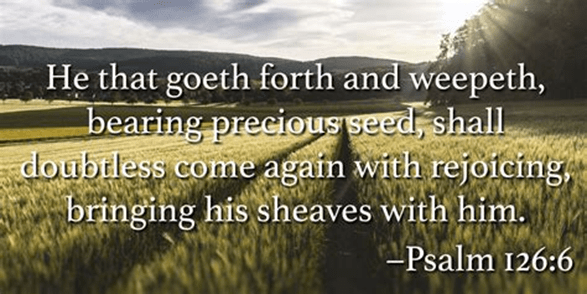
Those who plant in tears will harvest with shouts of joy. They weep as they go to plant their seed, but they sing as they return with the harvest.”

If you have ever found yourself in what seems to be a no-win situation, this psalm is for you. Sometimes, through no faults of our own, we may do our very best, sacrificing time, energy, and resources to an organization, only to have our efforts spurned, scorned, or even criticized. We have contributed as much as possible, practically pouring out our heart’s blood; meanwhile, others have slid in to take credit for our efforts or to complain that we should have done things differently or done even more. No feeling compares to going from despair to jubilation when we feel everything is lost, only to find that God has delivered us.

“When the Lord brought back his exiles to Jerusalem, it was like a dream! We were filled with laughter, and we sang for joy. And the other nations said, “What amazing things the Lord has done for them. Yes, the Lord has done amazing things for us! What joy!”  This is a psalm for pilgrims, so the captivity mentioned here might either refer to David’s exile during Absalom’s persecution or to the return of the captives under Ezra and Nehemiah. No matter which exile is referred to here, either one still represents a miracle. Both returns represented triumphs of survival against overwhelming odds.

David was a very popular king; however, Absalom stole the people’s affections by undermining his father, claiming that he was the only one who could really address the nation’s problems. Absalom was young, handsome, and charismatic, attracting many supporters, including David’s trusted counselor Ahithophel. David prayed that God would cause Absalom to ignore advice that would have resulted in death and destruction for David and his followers. Ultimately, David triumphed and returned to Jerusalem with great festivities.

Centuries later, the Babylonians carried many people from Judea to Babylon, where they lived for seventy years. When King Cyrus ordered the temple in Jerusalem to be re-built, groups under Ezra and later under Nehemiah returned to Jerusalem, erecting a modest temple and the city walls. The trip between Babylon and Jerusalem was dangerous, extending several hundred miles, leaving travelers open to attack by marauders. When Nehemiah re-dedicated the temple and the city wall, it really was a time for celebration with parades, dancing, singing, and blowing of temple trumpets. Not everybody was happy about this successful reconstruction, for there were many surrounding countries more than happy to leave Judah in ruins.

“Restore our fortunes, Lord, as streams renew the desert.” As I am writing this, social media is full of horrific videos of the flooding in Texas that has taken more than 51 lives and devastated untold numbers of communities. Many streams in the Texas hill country are small and insignificant, until catastrophic rainfall causes incredible flooding. The Guadelupe River at Ingram, Texas, rose from 0-26 feet in 45 minutes.

Israel has many stream beds that are dry for much of the year, until rains in higher elevations cause floods. When this psalm was written, farmers depended on the water and the silt from these floods to help renew desert lands so that crops would be successful. In modern times, Israel has led the world in the development of drip irrigation, a method in which water hoses with small holes at intervals precisely deliver water to individual plants, saving water and allowing deserts to bloom.

“Those who plant in tears will harvest with shouts of joy. They weep as they go to plant their seed, but they sing as they return with the harvest.” God wants us to know that no matter how gloomy things appear right now, we must remain faithful. If we continue to do God’s will, He will give us success and multiply our efforts.

So, take heart! God is still on the throne and God is all-seeing, all-knowing, and all-powerful. God will not allow His servants to fail, for He can fill in the gaps when our efforts and our energy prove insufficient. You can pray this psalm over your life, knowing that God will honor His Word. Romans 15:13 tells us, “I pray that God, the source of hope, will fill you completely with joy and peace because you trust in him. Then you will overflow with confident hope through the power of the Holy Spirit.” May God give you His Hope!

PRAYER: Father God, thank You for loving us and caring for us. Lord, help us to continue even when things appear hopeless, knowing that You are the God of Hope. In the mighty and precious Name of King Jesus. Amen.