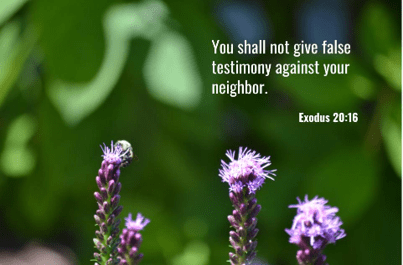
Exodus 20:16 “You must not testify falsely against your neighbor.”
Sometimes we assume that the Israelites had no frame of reference regarding sin before the Ten Commandments; however, that is far from true. Look at the Egyptian culture, one with which the Israelites had lived for 400 years.
Ancient Egyptians viewed bearing false witness as a serious offense, deeply intertwined with their legal and moral systems.
Legal Consequences
- In ancient Egyptian courts, the integrity of testimony was paramount. A plaintiff was required to produce three witnesses to confirm the authenticity of a claim, and false testimony could lead to severe penalties, including losing the case.
Moral Implications
- Bearing false witness was not only a legal issue but also a moral one. It was believed to invoke divine wrath, as the oaths taken in court included invocations against perjury.
- The act of lying in court was seen as a violation of natural law, reflecting a broader moral principle that transcended cultures.
Spiritual Consequences
- The consequences of false witness extended beyond earthly justice; it was considered a sin that could have spiritual repercussions.
In summary, ancient Egyptians regarded bearing false witness as a grave offense with both legal and moral ramifications, emphasizing the importance of truth in their society.
The Egyptians weren’t the only nation to have strict laws prohibiting false witness. The Code of Hammurabi originated in ancient Babylon around 1753 BC. It was created during the reign of Hammurabi, the sixth king of the First Dynasty of Babylon. The Code of Hammurabi imposes severe penalties for bearing false witness. Specifically, it states that if a person accuses another of a crime but fails to prove the accusation, particularly in cases involving life, the accuser shall be put to death. This reflects the code’s emphasis on justice and the protection of individuals from unfounded claims. Additionally, in some interpretations, the punishment for false testimony could include mutilation, such as the removal of an eye or ear.
The Bible strongly condemns bearing false witness, emphasizing the importance of truthfulness.
Key Verses
- Exodus 20:16 states, “You shall not bear false witness against your neighbor.” This commandment highlights the moral obligation to speak truthfully about others.
- Proverbs 19:5 warns that a false witness will not go unpunished, indicating serious consequences for dishonesty.
Importance of Truth
- Bearing false witness can lead to significant harm, damaging relationships and communities. It undermines trust and unity.
- The New Testament also reinforces this principle, encouraging believers to focus on honesty and integrity in their interactions.
Consequences
- The Bible teaches that dishonesty can lead to divine judgment and societal repercussions. False testimony is seen as a serious offense against God.
How are people damaged by someone bearing false witness? Bearing false witness can cause significant harm to individuals and society. The repercussions include:
Personal Damage
- Reputation: False accusations can ruin a person’s reputation, leading to social ostracism and loss of trust among peers.
- Emotional Distress: Victims often experience anxiety, depression, and stress due to the false claims made against them.
- Relationships: Trust is eroded in personal and professional relationships, leading to isolation and conflict.
Legal Consequences
- Defamation Lawsuits: Individuals may pursue legal action against those who bear false witness, resulting in costly legal battles.
- Employment Issues: False allegations can lead to job loss or difficulties in finding new employment due to damaged credibility.
Societal Impact
- Erosion of Trust: Widespread false witness can undermine trust in institutions, such as the media and legal systems, affecting community cohesion.
- Miscarriage of Justice: False testimonies can lead to wrongful convictions or other legal injustices, impacting not just individuals but the integrity of the justice system.
What about reneging on contracts? This too is a form of false witness. For years, our hospital sponsored a young man through medical school and the two years of housemanship, anticipating that he would return to serve our patients. At the time this fellow was completing his housemanship, we really needed his help, for two of our three doctors were out with injuries, throwing an enormous burden on the third doctor. At the beginning of this man’s training, he had signed a bond form, promising to serve the hospital for five years. Suddenly, at the end of the housemanship, this man wrote, claiming that he was “traumatized” at the idea of being bonded for five years and demanding a cancellation of the agreement “by mutual consent.” (He was certainly NOT traumatized while receiving money.) Despite all efforts on the part of senior hospital staff to encourage him that the bond period could be modified, he deserted our facility for another one with richer funding.
By ignoring the bond, this young man essentially bore false witness against our facility, claiming that we had somehow manipulated him. In fact, the bonding process was quite transparent and his family and friends had agreed to the bond.
This sad story serves to illustrate the fact that breaking longstanding agreements comprises a form of bearing false witness. Those breaking their agreements are demonstrating that they originally lied when they first entered into them; meanwhile, they are quite likely to shift blame onto the party suffering from their perfidy.
Ephesians 4:15 tells us, “Instead, speaking the truth in love, we will grow to become in every respect the mature body of him who is the head, that is, Christ.” When we bear false witness, we sin against God Almighty. God is just and pure and holy, faithful and true. We violate God’s nature when we lie. May God help us to remain truthful in all our dealings.
PRAYER: Father God, thank You for loving us and caring for us. Lord, help us to remain truthful in all we say and do, refusing to lie about others. In the mighty and precious Name of King Jesus. Amen.
 Burunche's Blog