Teaching about Prayer and Fasting
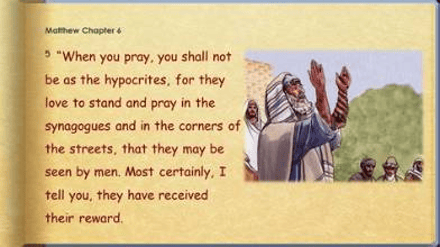
5 “When you pray, don’t be like the hypocrites who love to pray publicly on street corners and in the synagogues where everyone can see them. I tell you the truth, that is all the reward they will ever get. 6 But when you pray, go away by yourself, shut the door behind you, and pray to your Father in private. Then your Father, who sees everything, will reward you.
It’s a common sight in many churches. When a prayer time is announced, suddenly each member of the audience begins shouting as loudly as possible, speaking as rapidly as possible. Some people will claim they are doing this because they are waging spiritual warfare while others seem to believe that God is deaf and needs to be shouted at. Meanwhile, God the Heavenly Father, is waiting patiently for His people to be quiet so that He can speak to them. Sadly, much of the time, it’s nearly impossible to hear God’s still small voice because of the din. At the end of the prayer time, many worshipers might feel that they have really accomplished something; meanwhile, all they have done is to contribute a great deal of noise without giving God any opportunity to speak to them at all.
In Jesus’ day there were many people who longed to be complimented on their piety. These people might stand on street corners, shouting long prayers or standing in the center of the synagogue where everyone could see and hear them as they chanted in hopes of impressing others with their dedication. Some of those listening to Jesus assumed that these people were truly holy; now Jesus was turning that idea on its head. What was wrong?
Too many people assume that prayer is a monologue rather than a dialogue, that they should do all the talking without giving God a chance to weigh in. In fact, the opposite is the case. When God was calling Samuel as a young boy, Levi advised him to answer, “Speak, Lord, for your servant is listening.” (1 Samuel 3:10) Samuel’s entire life was spent listening to God and then sharing His Word with those around him.
Years ago, J. B. Phillips wrote a book entitled Your God is Too Small. When many of us pray, we don’t really think we are approaching the Creator of the Universe, the One True Living God. We behave as if God is deaf or stupid or both. We assume that God is as limited as we are and we must instruct him. We might even try to manipulate God in hopes of gaining favors we don’t deserve. God knows our hearts and God knows the end from the beginning; that’s why we need to quiet our hearts, compose ourselves, and LISTEN.
Later, Jesus will tell a story about two men praying in the temple. The Pharisee spends all his time boasting to God while the tax collector beats his breast in agony and begs God to be merciful to him because he is a sinner. In the story, the tax collector leaves justified by God while the Pharisee leaves without any spiritual gain.
6 But when you pray, go away by yourself, shut the door behind you, and pray to your Father in private. If at all possible, find someplace where you can be quiet before God so that you can listen to Him. But what if that’s impossible? John Wesley’s mother, Susanna Wesley, had nineteen children. Susanna trained her children so that if she sat down and pulled her long apron over her head, her children would play quietly, knowing that she was praying. Years ago, when I was a harried pediatric surgery resident, I prayed while walking a long corridor between the ICU and the rest of the wards. The place is not important; your heart attitude is.
Then your Father, who sees everything, will reward you. How does God reward us? First, God gives us His Holy Spirit and the hallmark of the Holy Spirit is peace. When we connect with God, God gives us peace, even when things appear to be falling apart. Next, God gives us guidance. Many times, God only gives us sufficient light for the next step because if He shows us the big picture, we would mess things up trying to force our will rather than His. And when we pray, God changes us into His likeness so that our lives will glorify Him.
By now, Jesus’ audience is becoming concerned. If they aren’t supposed to copy the religious leaders, how should they pray? That’s when Jesus gives the teaching we now know as the Lord’s Prayer. But before giving us what many believe to be a guide for prayers, Jesus warns his listeners.
7 “When you pray, don’t babble on and on as the Gentiles do. They think their prayers are answered merely by repeating their words again and again. 8 Don’t be like them, for your Father knows exactly what you need even before you ask him! God knows our needs but He wants us to come to Him and spend time with Him. God knows our hearts even before we begin to approach Him, so there’s no point in yammering on at Him. If we are speaking with a friend, we aren’t going to begin haranguing as soon as we are near. If you wouldn’t do this to a human, don’t disrespect God by doing it to Him.
We’ll look at the Lord’s Prayer tomorrow, but for now, ask yourself the following: Have I been ignoring God and simply dumping needs on Him without listening? Have I confused noise with devotion? How big do I really think God is?
PRAYER: Father God, thank You for loving us and caring for us. Lord, help us to approach you quietly and reverently, remembering that You already know our needs and are waiting for us to listen to You. We love You and adore You. In the mighty and precious Name of King Jesus. Amen.