Archive for the ‘Uncategorized’ Category

JUNE 8, 2025 FOLLOWING JESUS IN A POST-ASCENSION WORLD #45 WHEN THE GOSPEL COLLIDES WITH MONEY-MAKING, WATCH OUT!

June 8, 2025


Acts 19:21-41 The Riot at Ephesus

“When these things were accomplished, Paul purposed in the Spirit, when he had passed through Macedonia and Achaia, to go to Jerusalem, saying, “After I have been there, I must also see Rome.” So he sent into Macedonia two of those who ministered to him, Timothy and Erastus, but he himself stayed in Asia for a time.

And about that time there arose a great commotion about the Way. For a certain man named Demetrius, a silversmith, who made silver shrines of Diana, brought no small profit to the craftsmen. He called them together with the workers of similar occupation, and said: “Men, you know that we have our prosperity by this trade. Moreover, you see and hear that not only at Ephesus, but throughout almost all Asia, this Paul has persuaded and turned away many people, saying that they are not gods which are made with hands. So not only is this trade of ours in danger of falling into disrepute, but also the temple of the great goddess Diana may be despised and her magnificence destroyed, whom all Asia and the world worship.”

Now when they heard this, they were full of wrath and cried out, saying, “Great is Diana of the Ephesians!” So the whole city was filled with confusion, and rushed into the theater with one accord, having seized Gaius and Aristarchus, Macedonians, Paul’s travel companions. And when Paul wanted to go in to the people, the disciples would not allow him. Then some of the officials of Asia, who were his friends, sent to him pleading that he would not venture into the theater. Some therefore cried one thing and some another, for the assembly was confused, and most of them did not know why they had come together. And they drew Alexander out of the multitude, the Jews putting him forward. And Alexander motioned with his hand, and wanted to make his defense to the people. But when they found out that he was a Jew, all with one voice cried out for about two hours, “Great is Diana of the Ephesians!”

And when the city clerk had quieted the crowd, he said: “Men of Ephesus, what man is there who does not know that the city of the Ephesians is temple guardian of the great goddess Diana, and of the image which fell down from Zeus? Therefore, since these things cannot be denied, you ought to be quiet and do nothing rashly. For you have brought these men here who are neither robbers of temples nor blasphemers of your goddess. Therefore, if Demetrius and his fellow craftsmen have a case against anyone, the courts are open and there are proconsuls. Let them bring charges against one another. But if you have any other inquiry to make, it shall be determined in the lawful assembly. For we are in danger of being called in question for today’s uproar, there being no reason which we may give to account for this disorderly gathering.” And when he had said these things, he dismissed the assembly.”

Things have been going quite well with the ministry, and Paul is beginning to plan to visit Jerusalem and Rome. Paul is still in Ephesus, but he sends Timothy and Erastus back to Macedonia to encourage believers there. But problems are about to erupt.

Ephesus is the seat of worship for the goddess Diana, also known as Artemis. Who is this Diana/Artemis whose towering temple dominates the city of Ephesus? Wikipedia tells us, “In ancient Greek religion and mythology, Artemis (/ˈɑːrtɪmɪs/Ancient Greek: Ἄρτεμις) is the goddess of the hunt, the wilderness, wild animals, transitions, naturevegetationchildbirthcare of children, and chastity… patron and protector of young children, especially young girls. Artemis was worshipped as one of the primary goddesses of childbirth and midwifery along with Eileithyia and Hera. She was also a patron of healing and disease, particularly among women and children, and believed to send both good health and illness upon women and children.”

David Guzik in his Enduring Word Bible Commentary tells us this about Ephesus:” This tremendous temple to Diana (also known as Artemis) in Ephesus was regarded as one of the seven wonders of the ancient world. It was supported by 127 pillars, each 60 feet high, and was decorated with great sculptures. It was lost to history until it was discovered in 1869, and its main altar was unearthed in 1965.

i. “The epicenter of Artemis worship was a black meteorite that either resembled or had been fashioned into a grotesque image of a woman. The lower part was wrapped like a mummy…the idol was covered with breasts, symbolizing fertility.” (Hughes)

ii. “The Temple of Artemis was also a major treasury and bank of the ancient world, where merchants, kings, and even cities made deposits, and where their money could be kept safe under the protection of deity.” (Longenecker) https://enduringword.com/bible-commentary/acts-19/

Throughout human history, women have always searched for some kind of divine assistance that would ensure fertility, safe pregnancies, easy child births, and healthy children. Lacking any knowledge of the One True Living God, it’s no wonder that Diana/Artemis would be a highly popular deity. Women likely beg their husbands who are doing business in Ephesus to bring back a small shrine. But worship of Diana also confers financial benefits as well. Evidently, the temple of Diana is functioning as a huge international bank with deposits under the divine protection of the goddess.

The city fathers of Ephesus have every incentive to make sure that nothing disturbs devotion to Diana in any form. Clearly, Christianity might pose a threat, for worshipers of Jesus have no need to worship Diana in addition. When Demetrius, one of the chief silver smiths, realizes the threat, he immediately organizes a mob scene. Many people flock into the local theater with no idea of what’s going on, only to find themselves caught up in a crowd chanting, “Great is Diana, of the Ephesians!”

But the city clerk is a brave man with a cool head. Addressing the crowd, the city clerk points out the fact that Demetrius’ accusations are baseless, that the courts are open to hear complaints, and that the Ephesians are in danger of attracting undue attention from their Roman rulers. Letting off steam is one thing; however, the Romans take a very dim view of rabble rousers of any stripe. If the crowd does not disperse swiftly and quietly, the local Roman legion might appear, and the situation might become very dangerous to all those in the theater. The city clerk dismisses the crowd.

Why are these rioters willing to listen to the city clerk and even obey him? The city clerk is obviously a man of great authority and power because after two hours of screaming themselves hoarse, the Ephesians come to their senses and leave the scene as quietly as possible.

The Encyclopedia of the Bible gives this information: “The town clerk, or grammateus, occupied a position of considerable importance in city administration. His initial duties consisted of keeping the records of the city, taking the minutes of the council and assembly, caring for official correspondence, receiving the edicts of emperors and governors, plus a great mass of miscellaneous documents, then filing and publishing these, as required. He publicly read decrees, put up temporary notices for the people to read, and those of permanent importance were inscribed on stone. This clerk of the Greek towns served a number of boards, and was the normal officer of the council; and, as indicated, was charged with many details of the administration of the city, in addition to supervising its archives. His work load was therefore heavy; hence he normally had a staff of assistants.

By the Antonine age, the grammateus had attained considerable importance in city leadership, and became a dominant political figure, who filled the highest magistracy the Roman colony had to offer. He enrolled new citizens in some towns, and occasionally the priesthood was combined with his office. Since his work necessitated such broad and specialized knowledge, the office was sometimes held for a long period of time, and exercised great influence in city affairs. He might also on occasion be a member of the Asiarchs, who seem to have been elected officers of importance, and who were drawn from the ranks of the wealthy and influential.

At Ephesus the town clerk was president of the assembly and probably of Roman aristocracy. He was frequently named on the coins and inscriptions of the city. Roman records show that he annually distributed money from the public treasury (evidently to the poor and needy), on the occasion of Antoninus’ birthday. This was authorized by both the council and the assembly (the town clerk had charge of the endowment for doles to be given to the citizens). Another record shows his distribution to the councilors of money presented by Vibius Salutaris.”

Religious fervor, greed, political intrigue-the mess at Ephesus has it all. But in the midst of the chaos, God sends a wise man to calm the crowds and bring sense to the situation. And the church in Ephesus continues to grow. It’s even possible that the controversy stirred up by Demetrius attracts even more people to consider the claims of Christianity. God can redeem any situation to His glory.

PRAYER: Father God, thank You for loving us and for caring for us. Lord, help us to trust You, even when things appear to be falling apart, knowing that You can bring glory out of chaos. In the mighty and precious Name of King Jesus. Amen.

JUNE 7, 2025 FOLLOWING JESUS IN A POST-ASCENSION WORLD #44 WHEN THE HOLY SPIRIT MOVES, NOBODY CAN STAND AGAINST HIM!

June 7, 2025

Acts 19:1-10 Paul at Ephesus

“And it happened, while Apollos was at Corinth, that Paul, having passed through the upper regions, came to Ephesus. And finding some disciples he said to them, “Did you receive the Holy Spirit when you believed?”

So they said to him, “We have not so much as heard whether there is a Holy Spirit.”

And he said to them, “Into what then were you baptized?”

So they said, “Into John’s baptism.”

Then Paul said, “John indeed baptized with a baptism of repentance, saying to the people that they should believe on Him who would come after him, that is, on Christ Jesus.”

When they heard this, they were baptized in the name of the Lord Jesus. And when Paul had laid hands on them, the Holy Spirit came upon them, and they spoke with tongues and prophesied. Now the men were about twelve in all.

And he went into the synagogue and spoke boldly for three months, reasoning and persuading concerning the things of the kingdom of God. But when some were hardened and did not believe, but spoke evil of the Way before the multitude, he departed from them and withdrew the disciples, reasoning daily in the school of Tyrannus. And this continued for two years, so that all who dwelt in Asia heard the word of the Lord Jesus, both Jews and Greeks.

Apollos has moved from Ephesus to Corinth; however, before leaving Ephesus, he has baptized a number of people for repentance from sins, copying John the Baptist. Evidently, these events have occurred prior to Priscilla and Aquila teaching him about the Holy Spirit. Now Paul arrives, baptizing them in the name of the Lord Jesus. When Paul lays hands on these men, they receive the Holy Spirit, speaking in tongues and prophesying.

Paul returns to the synagogue at Ephesus and teaches there for three months until religious leaders begin trying to undermine his teachings. At this point, Paul withdraws to a local gathering place, the school of Tyrannus, where he teaches daily for two years. It’s likely that Tyrannus is presiding over a lecture hall, rather than a formal school. Such places are common at this time and afford anyone interested the chance to hear philosophers of various persuasions. Paul’s two years of teaching there indicates his popularity. Ephesus is a major trading center and a communications hub, so both Jews and Greeks have the opportunity to hear the Gospel during those two years.

Acts 19:11-20 Miracles Glorify Christ

“Now God worked unusual miracles by the hands of Paul, so that even handkerchiefs or aprons were brought from his body to the sick, and the diseases left them and the evil spirits went out of them. Then some of the itinerant Jewish exorcists took it upon themselves to call the name of the Lord Jesus over those who had evil spirits, saying, “We exorcise you by the Jesus whom Paul preaches.” Also there were seven sons of Sceva, a Jewish chief priest, who did so.

And the evil spirit answered and said, “Jesus I know, and Paul I know; but who are you?”

Then the man in whom the evil spirit was leaped on them, overpowered them, and prevailed against them, so that they fled out of that house naked and wounded. This became known both to all Jews and Greeks dwelling in Ephesus; and fear fell on them all, and the name of the Lord Jesus was magnified. And many who had believed came confessing and telling their deeds. Also, many of those who had practiced magic brought their books together and burned them in the sight of all. And they counted up the value of them, and it totaled fifty thousand pieces of silver. So the word of the Lord grew mightily and prevailed.”

God is allowing major miracles to occur on the streets of Ephesus, for the Holy Spirit is graciously using handkerchiefs and aprons that have touched Paul’s body to deliver those suffering illnesses or demonic oppression. Although we might think such events have been limited to the days of Paul, there are Christians in many parts of the world who continue to be used by God in this fashion. Unfortunately, there are also would-be miracle workers who sell items that have allegedly been anointed, giving this practice a bad name. But the Holy Spirit continues to work, and people continue to be healed.

Evidently, there are itinerant Jewish exorcists attempting to cast out evil spirits. Why these men have had any success at all is a mystery, for they don’t have the power of God backing them. Now these men are calling on the Name of the Lord Jesus “whom Paul preaches.” One such group, the seven sons of a Jewish priest named Sceva, are humiliated when they try this tactic on a demon-possessed man, only for the demon to say, ““Jesus I know, and Paul I know; but who are you?” Then the demoniac attacks these men, beating them and stripping them so they flee naked and bleeding. There’s no room for fakery in the spirit world.

We might think that this incident is simply a small disaster, but it has wide-reaching effects. “This (the incident with the sons of Sceva) became known both to all Jews and Greeks dwelling in Ephesus; and fear fell on them all, and the name of the Lord Jesus was magnified. And many who had believed came confessing and telling their deeds. Also, many of those who had practiced magic brought their books together and burned them in the sight of all. And they counted up the value of them, and it totaled fifty thousand pieces of silver. So the word of the Lord grew mightily and prevailed.”

Look at the enormous number of people who have been practicing magic, now coming to confess under the convicting power of the Holy Spirit. Not only have these people repented, but they are also bringing their books of magic to be burned at a time when books of any kind are both rare and expensive. Magicians copy incantations from these books, giving out small slips of parchment or paper of some kind to their clients for success in business, athletics, love, etc. There is even an ancient complaint about an athletic contest in which one wrestler was winning until close inspection revealed that he had incantations bound around his heels. When the incantations were removed, the opponent triumphed.  It is vitally important that these instruments of magic are burned rather than being buried or preserved where someone else can get hold of them. What is the value of these books? One source claims that 50,000 pieces of silver would represent 150 years’ wages for a working man. Other sources vary arguing as to the origin of the coins, whether Jewish or Roman. But the lowest estimate for the value of this silver is several hundred British pounds sterling. (https://www.studylight.org/commentary/acts/19-19.html)

“So the word of the Lord grew mightily and prevailed.” Consider the amount of evil previously concentrated in Ephesus. Revival among the Ephesian magicians paves the way for explosive church growth as those previously blinded by these people now learn the truth of Jesus Christ.

Make no mistake; magic is nothing to be toyed with. Wiji boards, Tarot cards, chanting slogans in hopes of summoning spirits, or playing “Mary Worth” in which the practitioner looks in a mirror and summons a spirit named Mary Worth-all these things are dangerous. I recall one Sunday in our Children’s Church in Southaven, MS, when a thirteen-year-old girl tearfully confessed how frightened she had become the night before. Evidently, this young lady was at a sleep-over with several other girls when someone initiated the “Mary Worth” game. But it quickly turned into something more frightening when a face actually appeared in the mirror and began talking to the participants. We prayed with this girl and counseled her about the power of Jesus to protect her from the evil to which she had innocently been exposed.

Here in Ghana, it is common for those leading people out of witchcraft to have them burn their equipment as a demonstration of repentance. We also advise tourists to be careful when buying souvenirs, particularly carvings. When we returned from Ghana in 1990, we found a carving of a drummer with a strange hairstyle among the things we had shipped. Neither of us could remember receiving this carving. We began feeling very uncomfortable in the presence of this carving, as if the eyes were following us around the room. We moved the carving from our living room into my office; however, eventually, my husband beat the thing into pieces and burned it, giving us a sense of extreme relief.

Dean Sherman, who has taught spiritual warfare for YWAM for years, declares that “There is more power in one drop of the blood of Jesus than in all the forces of hell.” But we must be wise and not bring something associated with those forces into our homes. May God give us discernment and wisdom as we live for Him! PRAYER: Father God, thank You for loving us and for caring for us. Lord, help us to follow hard after You and not to become involved in anything having to do with the occult. In the mighty and precious Name of King Jesus. Amen.

JUNE 6, 2025 FOLLOWING JESUS IN A POST-ASCENSION WORLD #43 LOOK FOR THE HELPERS!

June 6, 2025

Acts 18:18-23  Paul Returns to Antioch

“So Paul still remained a good while (in Corinth.) Then he took leave of the brethren and sailed for Syria, and Priscilla and Aquila (his partners in tent making) were with him. He had his hair cut off at Cenchrea, (near Corinth) for he had taken a vow. And he came to Ephesus, and left them there (Priscilla and Aquila); but he himself entered the synagogue and reasoned with the Jews. When they asked him to stay a longer time with them, he did not consent, but took leave of them, saying, “I must by all means keep this coming feast in Jerusalem; but I will return again to you, God willing.” And he sailed from Ephesus.

And when he had landed at Caesarea, and gone up and greeted the church, he went down to Antioch. After he had spent some time there, he departed and went over the region of Galatia and Phrygia in order, strengthening all the disciples.

Acts 18:24-28 Ministry of Apollos

“Now a certain Jew named Apollos, born at Alexandria, an eloquent man and mighty in the Scriptures, came to Ephesus. This man had been instructed in the way of the Lord; and being fervent in spirit, he spoke and taught accurately the things of the Lord, though he knew only the baptism of John. So he began to speak boldly in the synagogue. When Aquila and Priscilla heard him, they took him aside and explained to him the way of God more accurately. And when he desired to cross to Achaia, the brethren wrote, exhorting the disciples to receive him; and when he arrived, he greatly helped those who had believed through grace; for he vigorously refuted the Jews publicly, showing from the Scriptures that Jesus is the Christ.”

After remaining in Corinth for at least 18 months, Paul leaves for Ephesus, taking Priscilla and Aquila, his tent making friends, with him. Paul immediately enters the synagogue at Ephesus and receives a courteous reception, his listeners being so fascinated that they beg him to remain. But Paul has taken a vow and wants to celebrate an upcoming feast in Jerusalem, so he sails from Ephesus for Caesarea, leaving Priscilla and Aquila behind to help instruct new believers. Paul returns to Antioch and then travels throughout the provinces of Galatia and Phrygia, encouraging believers.

How does Paul know where to go or what to say? Very simply, the Holy Spirit continues to guide Paul so that he will make the right connections at the right time. Presumably, Silas and Timothy accompany Paul on these journeys. Meanwhile, back in Ephesus, a new evangelist named Apollos appears. Apollos is a Jewish Christian from Alexandria in Egypt, a major seat of learning, and is a talented speaker and well versed in the Scriptures. Somehow, Apollos has learned about Jesus, but knows only the baptism of John without knowing about the Holy Spirit. Impressed, Priscilla and Aquila take Apollos aside and help fill in the gaps in his knowledge. Apollos takes up where Paul has left off, teaching in the synagogues and using the Jewish Scriptures to prove that Jesus is the Christ. When Apollos desires to travel to Achaia, the province containing Athens and Corinth, the disciples in Ephesus are delighted to recommend him, and he continues to minister there. Eventually, Apollos will spend much of his time working with the church in Corinth.

We have no record of Paul’s initial reaction upon learning of the coming of Apollos. Personally, were I Paul, I would be relieved. Paul has a generous spirit and he must realize that God will raise up more talented church leaders; moreover, Paul has already been stoned and left for dead, beaten and thrown in prison, and chased out of several towns. If God is raising up another significant evangelist to help in the work, so much the better. Paul also is a realist, knowing that at any moment someone might report him to authorities who may then throw him into prison. While fervent, Apollos may be more diplomatic and thus remain free to travel to all the new churches. Paul is a pupil of Gamaliel’s, and Gamaliel has undoubtedly trained Paul to realize that truth is not limited to a very few people; therefore, Paul would be predisposed to welcome Apollos.

Although Priscilla and Aquila are mentioned, we need to pay more attention to their ministry. The beloved star of children’s television, Mr. Rogers, always encouraged viewers to look for the helpers, and Priscilla and Aquila are helpers. As tent makers, this couple are considered middle class craftsmen. Their position in the community does not threaten anybody, and their trade is one that is always welcome in any community, for they probably mend things in addition to making tents. While Paul is busy engaging religious leaders in synagogues in fiery arguments, Priscilla and Aquila are quietly instructing new believers in simple language easy for them to understand. Given the fact that this couple originally were in Rome, they likely speak fluent Latin as well as Greek and several other dialects. Someone can sit with this couple as they work and ask questions without any social stigma, for onlookers will assume that any visitors are customers discussing an order. As a couple, Priscilla and Aquila are flexible; after all, they have been forced out of Rome by Emperor Claudius, only to wind up in Corinth, and now they have followed Paul to Ephesus. Blessedly, tent making is a profession that is highly portable.

There’s also another reason to study Priscilla and Aquila. Very few of us are called to have ministries such as those of Paul or Apollos; however, we can all be helpers. Experienced pastors will tell you that helpers are always in short supply, with most of the work in any congregation being done by about 10% of its members. Generally, you will find the same people parking cars, sweeping the church, cleaning up the Sunday School rooms, or teaching Sunday School. The helpers are the ones with a “ministry of hugs.” At one point in my life, I found myself in a terrible working situation, the kind of thing that had to be endured no matter what. Each Sunday morning, one friend would hug me after church, asking me how things were going. There were months in which hugging me must have been no more rewarding than hugging a block of wood; however, eventually I thawed out and was able to return the hug. I kept returning to that church just so I could get those loving hugs.   

Why not ask God if He is calling you to a ministry of helping? The rewards are enormous and the risks are few. And God blesses those who humble themselves enough to do necessary but menial jobs. You might not have the eloquence of a Paul or Apollos, but you can always help, even if it’s just hugging people.

PRAYER: Father God, thank You for loving us and for caring for us. Lord, help us to remember that there are no small places in the Kingdom of Heaven, and that You call each of us for different tasks. In the mighty and precious Name of King Jesus. Amen.

JUNE 5, 2025 FOLLOWING JESUS IN A POST-ASCENSION WORLD #42 WHEN GOD SENDS YOU, HE PROTECTS YOU UNTIL YOU’VE DELIVERED THE MESSAGE!

June 5, 2025

Acts 18:1-17 Ministering at Corinth

“After these things Paul departed from Athens and went to Corinth. And he found a certain Jew named Aquila, born in Pontus, who had recently come from Italy with his wife Priscilla (because Claudius had commanded all the Jews to depart from Rome); and he came to them. So, because he was of the same trade, he stayed with them and worked; for by occupation, they were tentmakers. And he reasoned in the synagogue every Sabbath, and persuaded both Jews and Greeks.

When Silas and Timothy had come from Macedonia, Paul was compelled by the Spirit, and testified to the Jews that Jesus is the Christ. But when they opposed him and blasphemed, he shook his garments and said to them, “Your blood be upon your own heads; I am clean. From now on I will go to the Gentiles.” And he departed from there and entered the house of a certain man named Justus, one who worshiped God, whose house was next door to the synagogue. Then Crispus, the ruler of the synagogue, believed on the Lord with all his household. And many of the Corinthians, hearing, believed and were baptized.”

“Now the Lord spoke to Paul in the night by a vision, “Do not be afraid, but speak, and do not keep silent; for I am with you, and no one will attack you to hurt you; for I have many people in this city.” And he continued there a year and six months, teaching the word of God among them.

When Gallio was proconsul of Achaia, the Jews with one accord rose up against Paul and brought him to the judgment seat, saying, “This fellow persuades men to worship God contrary to the law.”

And when Paul was about to open his mouth, Gallio said to the Jews, “If it were a matter of wrongdoing or wicked crimes, O Jews, there would be reason why I should bear with you. But if it is a question of words and names and your own law, look to it yourselves; for I do not want to be a judge of such matters.” And he drove them from the judgment seat. Then all the Greeks took Sosthenes, the ruler of the synagogue, and beat him before the judgment seat. But Gallio took no notice of these things.”

The Romans have never quite known what to do about the Jews, that troublesome race that insists on monotheism and refuses to worship either Greek or Roman deities. Some time around AD 49-50, Emperor Claudius bans all Jews from Rome, perhaps partially because traditional Jews are organizing meetings against Christians, worrying authorities in the process. One tent-making couple, Priscilla and Aquila, have settled in Corinth and are plying their trade there. After the confrontations at the Areopagus, Paul leaves Athens for Corinth and soon connects with Priscilla and Aquila. Even though Paul is a scholar, he has also learned tent-making as a means of supporting himself. Tent-making also gives Paul yet another means of preaching the Gospel, for some people will chat with a tent maker who will never enter any place of worship. Paul is content; during the week he’s witnessing to customers at the tent making business and on the Sabbath, he’s speaking in synagogues, convincing many people to follow Jesus.

“When Silas and Timothy had come from Macedonia, Paul was compelled by the Spirit, and testified to the Jews that Jesus is the Christ. But when they opposed him and blasphemed, he shook his garments and said to them, “Your blood be upon your own heads; I am clean. From now on I will go to the Gentiles.”  It seems that until Silas and Timothy arrive, Paul has been doing foundational teaching. With the advent of Paul’s colleagues, the Holy Spirit compels Paul to testify clearly that Jesus is the Christ. This news thrills some Jews and incenses others, who immediately begin hurling all kinds of insults. This blasphemous opposition convinces Paul that he must focus his efforts on Gentiles rather than on Jews, painful as this decision is.

Paul stalks out of the synagogue and goes next door to the house of a believer named Justus. But even Crispus, the ruler of the synagogue, and his entire family believe in Jesus. Many other Corinthians also believe and are baptized.

Shocked and hurt by the vicious attacks leveled by some members of the synagogue, Paul might be wondering if coming to Corinth has really been a good idea or not. But one night, God sends Paul a vision. “Now the Lord spoke to Paul in the night by a vision, “Do not be afraid, but speak, and do not keep silent; for I am with you, and no one will attack you to hurt you; for I have many people in this city.” And he continued there a year and six months, teaching the word of God among them.”

But the Corinthian Jews aren’t through with Paul yet. “When Gallio was proconsul of Achaia, the Jews with one accord rose up against Paul and brought him to the judgment seat, saying, “This fellow persuades men to worship God contrary to the law.” Paul is facing yet another trumped-up charge, but these men hope that the Roman rulers will be easily manipulated. Too bad, because proconsul Gallio is far sharper than Paul’s accusers. When these men try to haul Paul before Gallio, Gallio refuses to get involved, discerning that this is a purely religious argument with no bearing on his rule as proconsul. Even when Paul’s accusers become so desperate that they beat the ruler of the synagogue before the judgement seat, Gallio remains unmoved.

Few things are more painful than being denounced publicly, particularly when the lies simply balloon and become wilder and wilder. God assures Paul of His watch care before the Jews haul Paul off to face Gallio so that Paul will be able to remain calm. As a polished public speaker and a seasoned teacher, Paul undoubtedly preserves a cheerful demeanor, appearing as relaxed as possible under the circumstances. “Never let them see you sweat” is likely Paul’s motto. Paul may even go so far as to smile encouragingly at those hurling insults.

Paul’s behavior under criticism serves as an example for all of us. We have no control over people’s response to our actions as Christians. Our goal must remain to be light and salt, to behave as lovingly and as winsomely as possible. If we can control ourselves and our language while our accusers are becoming enraged, we will definitely gain the upper hand.

God’s message to Paul also applies to us. God always has a people who are following Him. When we continue to speak faithfully and graciously, God will bless our efforts and bring us assistance when we need it. May all of us remember these things, so that we can remain calm and unruffled in the face of adversity.

PRAYER: Father God, thank You for loving us and for caring for us. Lord, help us to remember that when we behave graciously and calmly under criticism, You will come to our aid as You did to Paul. In the mighty and precious Name of King Jesus. Amen.

JUNE 4, 2025 FOLLOWING JESUS IN A POST-ASCENSION WORLD #41 HOW DO YOU HANDLE SCOFFERS?

June 4, 2025

Acts 17:22-34 Addressing the Areopagus “Then Paul stood in the midst of the Areopagus and said, “Men of Athens, I perceive that in all things you are very religious; for as I was passing through and considering the objects of your worship, I even found an altar with this inscription: TO THE UNKNOWN GOD.

Therefore, the One whom you worship without knowing, Him I proclaim to you: God, who made the world and everything in it, since He is Lord of heaven and earth, does not dwell in temples made with hands. Nor is He worshiped with men’s hands, as though He needed anything, since He gives to all life, breath, and all things. And He has made from one blood every nation of men to dwell on all the face of the earth, and has determined their preappointed times and the boundaries of their dwellings, so that they should seek the Lord, in the hope that they might grope for Him and find Him, though He is not far from each one of us; for in Him we live and move and have our being, as also some of your own poets have said, ‘For we are also His offspring.’ Therefore, since we are the offspring of God, we ought not to think that the Divine Nature is like gold or silver or stone, something shaped by art and man’s devising. Truly, these times of ignorance God overlooked, but now commands all men everywhere to repent, because He has appointed a day on which He will judge the world in righteousness by the Man whom He has ordained. He has given assurance of this to all by raising Him from the dead.”

And when they heard of the resurrection of the dead, some mocked, while others said, “We will hear you again on this matter.” So Paul departed from among them. However, some men joined him and believed, among them Dionysius the Areopagite, a woman named Damaris, and others with them.”

Ever since Paul first uttered these words in the Areopagus on Mars Hill in Athens, people have studied this discourse for the way God leads Paul to catch the attention of these jaded Athenian philosophers.

“Men of Athens, I perceive that in all things you are very religious; for as I was passing through and considering the objects of your worship, I even found an altar with this inscription: TO THE UNKNOWN GOD.” Paul begins by complimenting the Athenians on their persistent search for God. Paul does not begin by criticizing the Athenians for polytheism, idolatry, or a host of other bad practices, for Paul realizes that he is speaking to people who are searching for holiness without realizing it. The Athenians have filled their city with altars to various deities in hopes that one of them is the correct one; in fact, there’s even an altar to an unknown God.

Where did these altars entitled “To The Unknown God” come from? Guzik tells us, “Athens was filled with statues dedicated TO THE UNKNOWN GOD. Six hundred years before Paul, a terrible plague came on the city and a man name Epimenides had an idea. He let loose a flock of sheep through the town, and wherever they lay down, they sacrificed that sheep to the god that had the nearest shrine or temple. If a sheep lay down near no shrine or temple, they sacrificed the sheep TO THE UNKNOWN GOD.”

Therefore, the One whom you worship without knowing, Him I proclaim to you: God, who made the world and everything in it, since He is Lord of heaven and earth, does not dwell in temples made with hands. Nor is He worshiped with men’s hands, as though He needed anything, since He gives to all life, breath, and all things.” Paul builds on practices the Athenians are already observing. Rather than telling the Athenians that they are wrong, Paul simply explains that he is an ambassador for the Unknown God whom the Athenians have honored for centuries. Paul presents himself as someone bringing incredibly good news.

“And He has made from one blood every nation of men to dwell on all the face of the earth, and has determined their preappointed times and the boundaries of their dwellings, so that they should seek the Lord, in the hope that they might grope for Him and find Him, though He is not far from each one of us; for in Him we live and move and have our being, as also some of your own poets have said, ‘For we are also His offspring.’” Here Paul is acknowledging the multicultural aspects of Athens and encouraging his listeners. But what is the source of this quote?

 “For in Him we live and move and have our being” is actually a quote from Epimenides of Crete, the same man who sent all those sheep wandering through Athens, causing Athenians to erect altars to an unknown God. By quoting Epimenides, Paul aligns himself with Athenian culture and Athenian tradition, indicating that even centuries earlier, the ancestors of these people were searching for God without knowing Him.

’” Therefore, since we are the offspring of God, we ought not to think that the Divine Nature is like gold or silver or stone, something shaped by art and man’s devising. Truly, these times of ignorance God overlooked, but now commands all men everywhere to repent, because He has appointed a day on which He will judge the world in righteousness by the Man whom He has ordained. He has given assurance of this to all by raising Him from the dead.”

“And when they heard of the resurrection of the dead, some mocked, while others said, “We will hear you again on this matter.” So Paul departed from among them. However, some men joined him and believed, among them Dionysius the Areopagite, a woman named Damaris, and others with them.”

Until now, many of the Athenians are listening with interest but not particularly concerned. After all, there are new speakers appearing daily and Paul is interesting but scarcely revolutionary. But when Paul mentions Jesus being raised from the dead, suddenly the complexion of the situation changes completely. Those scoffers who have no interest in being changed but only in being entertained swiftly dismiss Paul as a crazy babbler. But there are others in the crowd who listen and believe and follow Paul to hear more.

Steve Jobs has been quoted as having said, “If you want to be popular, sell ice cream.” Whenever we speak the truth about Jesus, there will always be those who mock or ignore while others will grasp the teachings and believe. Even when pastors preach Holy Spirit-inspired messages to their congregations, some people will remain unmoved because their hearts are hard. But we must remember something a pastor friend used to say repeatedly, “We are only in advertising. God is in management.” We are responsible for proclaiming the truth about Jesus Christ as the Way of salvation. God is the only One who can move in people’s hearts. May God help us so that we remain faithful, persistent, and loyal to the One who has shed His blood for our sins!

PRAYER: Father God, thank You for loving us and for caring for us. Lord, help us to follow hard after You, refusing to become discouraged at those who scoff or mock. In the mighty and precious Name of King Jesus. Amen.

JUNE 3, 2025 FOLLOWING JESUS IN A POST-ASCENSION WORLD #40 WHEN PHILOSOPHERS LONG FOR SOMETHING REAL!

June 3, 2025

Acts 17:16-21 The Philosophers at Athens

“Now while Paul waited for them at Athens, his spirit was provoked within him when he saw that the city was given over to idols. Therefore, he reasoned in the synagogue with the Jews and with the Gentile worshipers, and in the marketplace daily with those who happened to be there. Then certain Epicurean and Stoic philosophers encountered him. And some said, “What does this babbler want to say?” Others said, “He seems to be a proclaimer of foreign gods,” because he preached to them Jesus and the resurrection.

And they took him and brought him to the Areopagus, saying, “May we know what this new doctrine is of which you speak? For you are bringing some strange things to our ears. Therefore, we want to know what these things mean.” For all the Athenians and the foreigners who were there spent their time in nothing else but either to tell or to hear some new thing.”

After being run out of Thessalonica and Berea, Paul has now arrived in Athens, one of the intellectual centers of this time. As a serious scholar, Paul has heard about Athens for years and has longed to see it. But reality is failing to match expectations, for Paul finds Athens to be a city drenched in idolatry, its philosophers suffering a mental disconnect from reality as they attempt to justify their allegiance to these morally inferior deities. Athens is covered up with altars of every kind dedicated to every deity ever dreamt of.

Well! Paul is rubbing his hands in anticipation as he begins preaching about Jesus in synagogues to Jewish and Gentile believers and in the market place to anybody who will listen. It doesn’t take long before local intellectuals hear about Paul; in fact, Paul’s reputation gained at Thessalonica and Berea may have even preceded him. Epicurean and Stoic philosophers are fascinated and want to hear more.

Who are these Epicurean philosophers? David Guzik in his Enduring Word Bible Commentary tells us, “The Epicureans pursued pleasure as the chief purpose in life, and valued most of all the pleasure of a peaceful life, free from pain, disturbing passions and superstitious fears (including the fear of death). They did not deny the existence of gods, but believed that they had nothing to do with man.” The Epicureans feel that some god might have gotten the world going, but now the gods have left for parts unknown. Their ideal is to float through life with as little suffering as possible. Years ago, Bette Midler popularized a song that said, “God is watching us from a distance.” Today, large numbers of people throughout the world are behaving like Epicureans, whether or not they realize it.

Epicureanism is a highly selfish philosophy, with its proponents continually looking inward to ensure that they are as comfortable as possible. Don’t look for help from one of these guys, because unless he shares your problems with you, he won’t care. Epicureans aren’t looking for a holy, pure, righteous God to worship because in effect, they feel they are in charge of their own lives. An Epicurean might buy the idea of a god of love, as long as that god promises the Epicurean comfort and peace. Selling an Epicurean on the concept of sin is a tough proposition. And without the knowledge of sin and the conviction of sin, how can anyone value the need for a Savior?

Who are the Stoics? Again, Guzik tells us, “The Stoics were pantheists who put great emphasis on moral sincerity and a high sense of duty. They cultivated a spirit of proud dignity, and believed that suicide was better than a life lived with less dignity. The Stoics believed that everything was god, and god was in everything. So they believed that all things, good or evil, were from “god,” and so nothing should be resisted, and they believed there was no particular direction or destiny for mankind.”

Imagine being an Epicurean or a Stoic philosopher lacking any belief in a holy God who loves mankind and cares about men’s lives. Suddenly, you are confronted by this fiery Jewish preacher speaking fluent Greek and telling of a supreme God who loves men and wants to redeem them from their sins by the ultimate blood sacrifice of his Son Jesus Christ. Such teaching is setting all your cherished beliefs on their ears, and you can’t decide whether to be fascinated or furious. The best thing to do with this troublesome fellow is to bring him to the Areopagus on Mars Hill, where your fellow intellectuals can interrogate him thoroughly. But even at the Areopagus, things don’t go quite as the philosophers have intended.

Why has God sent Paul to Athens? Just look at Paul’s Curriculum Vitae. Paul is from Tarsus, the chief city and capital of the Roman Province of Cilicia located in the eastern part of Asia Minor. Tarsus is known for its wealth and schools of learning. Not only does Paul have a strong academic background from his home city, but he is also a pupil of Gamaliel, one of the foremost Jewish teachers of this day. Paul is undoubtedly an excellent linguist, handling Aramaic, Hebrew, Latin, Greek, Coptic and possibly several other languages in addition. Some sources claim Paul might speak as many as 14 different languages, an invaluable help when confronting philosophers in a cosmopolitan city such as Athens. As a polyglot, Paul can quote proverbs in these languages with devastating effect.

Despite its decline as a world political power, of all the major cities at this time, Athens remains one of the centers of philosophy and learning. Athens has a large population of learned men with sufficient means to spend much of their time in discussion and debate. Why are these men anxious to hear new things?

Whether or not the Athenians realize it, they are spiritually hungry. Study Roman and Greek mythology and you swiftly realize that the Roman and Greek deities are anything but pure, holy, or righteous. Whether or not these men realize it, they long for a religion that will bring holiness.

The famous eighteenth century American preacher Jonathan Edwards (1793-1758) has said that “Holiness appeared to me to be of a sweet, pleasant, charming, serene, calm nature; which brought an inexpressible purity, brightness, peacefulness, and ravishment to the soul.”

Even though these supercilious intellectuals are trying as hard as possible to hold Paul at arm’s length, they are about to have an encounter with a man speaking by the power of the Holy Spirit. Athens will never be the same again!

PRAYER: Father God, thank You for loving us and for caring for us. Lord, empower us so that when we speak, people hear You and not us. Help us to love You and to worthily magnify You, no matter where we are or what we are doing. In the mighty and precious Name of King Jesus. Amen.

JUNE 2, 2025 FOLLOWING JESUS IN A POST-ASCENSION WORLD #39 SOMETIMES A SUCCESSFUL MINISTRY MEANS GETTING OUT OF TOWN AHEAD OF A MOB!

June 2, 2025

Acts 17:1-4 Preaching Christ at Thessalonica

“Now when they had passed through Amphipolis and Apollonia, they came to Thessalonica, where there was a synagogue of the Jews. Then Paul, as his custom was, went in to them, and for three Sabbaths reasoned with them from the Scriptures, explaining and demonstrating that the Christ had to suffer and rise again from the dead, and saying, “This Jesus whom I preach to you is the Christ.” And some of them were persuaded; and a great multitude of the devout Greeks, and not a few of the leading women, joined Paul and Silas.

When it comes to preaching, Paul is an amazing apologist. For three Sabbaths, Paul preaches in synagogues convincing “a great multitude of the devout Greeks and not a few of the leading women.” While Paul is preaching, Silas is praying for people and counseling them. It’s a great combination. But trouble is brewing.

Acts 17:5-9 Assault on Jason’s House

“But the Jews who were not persuaded, becoming envious, took some of the evil men from the marketplace, and gathering a mob, set all the city in an uproar and attacked the house of Jason, and sought to bring them out to the people. But when they did not find them, they dragged Jason and some brethren to the rulers of the city, crying out, “These who have turned the world upside down have come here too. Jason has harbored them, and these are all acting contrary to the decrees of Caesar, saying there is another king—Jesus.” And they troubled the crowd and the rulers of the city when they heard these things. So when they had taken security from Jason and the rest, they let them go.”

Notice that Jews who refuse to listen to Paul must go to the marketplace to organize evil men into a mob. Storming through the streets, this mob sets the entire city in an uproar and attacks the house where they think Paul is staying. When this group of rabble rousers can’t find Paul, they drag Jason, the householder, and some other Christians to city rulers, claiming they are advocating rebellion against Caesar.

What is fascinating is that even though the Christian movement has only been going for a short time, this description is completely accurate. In a short time, the truths about Jesus Christ have shown pagan religions for the shams and scams that they actually are. These Jews are banking on the venality of the city leaders plus their healthy fear of the Romans to sway things in their favor.

Acts 17:10-15 Ministering at Berea

“Then the brethren immediately sent Paul and Silas away by night to Berea. When they arrived, they went into the synagogue of the Jews. These were more fair-minded than those in Thessalonica, in that they received the word with all readiness, and searched the Scriptures daily to find out whether these things were so. Therefore, many of them believed, and also not a few of the Greeks, prominent women as well as men. But when the Jews from Thessalonica learned that the word of God was preached by Paul at Berea, they came there also and stirred up the crowds. Then immediately the brethren sent Paul away, to go to the sea; but both Silas and Timothy remained there. So those who conducted Paul brought him to Athens; and receiving a command for Silas and Timothy to come to him with all speed, they departed.”

After having to deal with an angry mob, believers in Thessalonica wait until dark and then send Paul, Timothy, and Silas on to Berea. Paul might be protesting all the way, arguing that he can still persuade more of the citizens of Thessalonica; meanwhile, other believers are relieved to allow Paul to go to Berea. In Berea, Paul preaches more fiery sermons, converting many people until Jews from Thessalonica show up, creating problems. The Bereans realize that Paul is too controversial for them, so Silas and Timothy remain in Berea while Paul leaves for Athens.

It is said that Maimonides, a famous Jewish scholar of the twelfth century, has said, “Tell the truth, and see the world.” From Thessalonica to Berea to Athens, Paul is telling the truth and preaching the Gospel; meanwhile, God keeps moving him just ahead of angry mobs. But each time a mob gathers, more people ask about Paul’s teachings. While Paul is fleeing these enemies, Silas and Timothy quietly remain to teach people the truth about Jesus Christ. Paul might draw all the attention, but his companions are conducting effective ministry.

Ministry takes all kinds of people. Some people are very vocal like the Apostle Paul. Others are quieter, like Silas and Timothy. While Paul raises all kinds of controversy, his colleagues answer questions and explain, backing up their beliefs with Scripture.

Recently, I read a piece about “Ineffective missionaries.” The writer described a missionary who had spent decades in a country, allegedly without making any disciples. But the writer continued to point out that these perceptions might be totally wrong. Many times, the Gospel is not so much taught as it is caught. When Christians live out their beliefs on a daily basis, those around them notice the difference and begin asking perceptive questions. Sometimes we influence people without realizing it. One lady friend got saved out of drug abuse and alcoholism; the night she accepted Jesus, she thought about some Christians she knew and prayed, “God, what ever those people have, I want it!”

May God help us, so that all those around us will see Jesus in us!

PRAYER: Father God, thank You for loving us and for caring for us. Lord, help us to follow so hard after You that people will see our witness and be attracted to You. In the mighty and precious Name of King Jesus. Amen.

JUNE 1, 2025 FOLLOWING JESUS IN A POST-ASCENSION WORLD #38 WHEN THE HOLY SPIRIT SHOWS UP, CHAINS FALL APART AND LOCKED DOORS OPEN!

June 1, 2025

Acts 16:25-34 The Philippian Jailer Saved

“But at midnight Paul and Silas were praying and singing hymns to God, and the prisoners were listening to them. Suddenly there was a great earthquake, so that the foundations of the prison were shaken; and immediately all the doors were opened and everyone’s chains were loosed. And the keeper of the prison, awaking from sleep and seeing the prison doors open, supposing the prisoners had fled, drew his sword and was about to kill himself. But Paul called with a loud voice, saying, “Do yourself no harm, for we are all here.”

Then he called for a light, ran in, and fell down trembling before Paul and Silas. And he brought them out and said, “Sirs, what must I do to be saved?”

So, they said, “Believe on the Lord Jesus Christ, and you will be saved, you and your household.” Then they spoke the word of the Lord to him and to all who were in his house. And he took them the same hour of the night and washed their stripes. And immediately he and all his family were baptized. Now when he had brought them into his house, he set food before them; and he rejoiced, having believed in God with all his household.”

It’s midnight in the inky depths of a Roman prison. Two Christian prisoners are sitting in stocks, their hands and feet encased so they can scarcely move. If either one of them wants to itch his nose, he can’t. Although there are many men in the prison, it’s so dark they can’t see one another; only their breathing gives their presence away. But what are these two men doing? Rather than complaining, these guys are singing praises to God while the other prisoners listen raptly. Suddenly, a tremendous earthquake shakes the prison, shattering the stocks and causing all the prisoners’ chains to fall apart. When another shock hits, the prison doors fly open as well. The prisoners are so amazed that they can only stand there; meanwhile, the jailer rushes to the prison, certain that all the prisoners have escaped and that he might as well kill himself before the Romans do it for him.

“But Paul called with a loud voice, saying, “Do yourself no harm, for we are all here.”

Then he called for a light, ran in, and fell down trembling before Paul and Silas. And he brought them out and said, “Sirs, what must I do to be saved?” The jailor is a man of experience, but he has never witnessed anybody like Paul and Silas. Immediately recognizing the presence of servants of a holy God, the jailor accepts Jesus as Savior along with all of his family. The jailor leads Paul and Silas to his own home, where he washes their wounds and feeds them. Then Paul and Silas baptize the jailor and his family, and everyone rests well for the remainder of the night.

Acts 16:35-40 Paul Refuses to Depart Secretly

“And when it was day, the magistrates sent the officers, saying, “Let those men go.”

So, the keeper of the prison reported these words to Paul, saying, “The magistrates have sent to let you go. Now therefore depart, and go in peace.”

But Paul said to them, “They have beaten us openly, uncondemned Romans, and have thrown us into prison. And now do they put us out secretly? No indeed! Let them come themselves and get us out.” And the officers told these words to the magistrates, and they were afraid when they heard that they were Romans. Then they came and pleaded with them and brought them out, and asked them to depart from the city. So, they went out of the prison and entered the house of Lydia; and when they had seen the brethren, they encouraged them and departed.”

It’s always a good idea to get your facts straight before acting dramatically. After tearing the clothes off Paul and Silas and beating them publicly, throwing them in the deepest part of the prison to suffer in the stocks all night without food or water, now the city officials are having second thoughts and are hoping to get these trouble makers to leave town quietly. Big mistake! Now Paul confronts these men.

“And when it was day, the magistrates sent the officers, saying, “Let those men go.”

So, the keeper of the prison reported these words to Paul, saying, “The magistrates have sent to let you go. Now therefore depart, and go in peace.”

But Paul said to them, “They have beaten us openly, uncondemned Romans, and have thrown us into prison. And now do they put us out secretly? No indeed! Let them come themselves and get us out.” After this major embarrassment, Paul and Silas return to Lydia’s home, greet the people there and then leave town.

An article from Bible hub delineates the advantages of Roman citizenship: “Roman citizenship in the first century A.D. was a privileged status that conferred a variety of legal rights and protections. This status is significant in the context of the New Testament, as it provides insight into the Apostle Paul’s interactions with Roman authorities and his missionary journeys.

Legal Rights of Roman Citizens-Roman citizens enjoyed several legal rights that distinguished them from non-citizens. These rights included the ability to vote, marry legally, and engage in commerce. More importantly, Roman citizens were entitled to a fair trial and were protected from certain forms of punishment. For instance, they could not be subjected to torture or crucifixion, a method of execution reserved for non-citizens and slaves. Roman citizens also had the right to appeal to the Emperor in legal matters, a privilege that Paul exercised during his ministry.

Paul’s Roman Citizenship-The Apostle Paul, originally known as Saul of Tarsus, was a Roman citizen by birth. This status is mentioned explicitly in the Book of Acts, where it plays a crucial role in his ministry and legal encounters. In 
Acts 22:25-29 , Paul reveals his citizenship to a Roman centurion to avoid being flogged: “But as they stretched him out to strap him down, Paul said to the centurion standing there, ‘Is it lawful for you to flog a Roman citizen without a trial?’ On hearing this, the centurion went and reported it to the commander. ‘What are you going to do?’ he said. ‘This man is a Roman citizen.’ The commander went to Paul and asked, ‘Tell me, are you a Roman citizen?’ ‘Yes,’ he answered. ‘I paid a high price for my citizenship,’ said the commander. ‘But I was born a citizen,’ Paul replied.”

Paul’s citizenship provided him with protection and facilitated his missionary work. In 
Acts 16:37-39 , after being unjustly imprisoned in Philippi, Paul asserts his rights: “But Paul said to the officers, ‘They beat us publicly without a trial, even though we are Roman citizens, and they threw us into prison. And now do they want to send us away secretly? Certainly not! Let them come themselves and escort us out.’ The officers reported this to the magistrates, who were afraid when they heard that Paul and Silas were Roman citizens. They came to appease them and escorted them out, requesting them to leave the city.”

Implications for the Early Church-Roman citizenship had significant implications for the spread of Christianity. It allowed Paul and other early Christians to travel more freely across the Roman Empire, which was crucial for the dissemination of the Gospel. The legal protections afforded to citizens also provided a measure of safety and legitimacy in a time when Christians often faced persecution.

The Apostle Paul’s strategic use of his Roman citizenship exemplifies the early Church’s navigation of the complex socio-political landscape of the Roman Empire. His ability to invoke his rights not only protected him but also advanced the mission of spreading the message of Christ to both Jews and Gentiles.”
https://biblehub.com/topical/r/roman_citizenship_and_legal_rights.htm

This story has everything-miracles, salvation, and a highly satisfying story of puffed-up officials getting their just deserts. God sends Paul and Silas to jail for the sake of the prisoners and the jailor and his family. Next God uses the details of Paul and Silas’ citizenship to free them with no further repercussions.

How can we apply these principles to our own lives? No matter how hard we try, we can expect to encounter opposition when we are working for God. But no matter where we wind up, God is still there and He is still working. Until we reach heaven, we will never know how many of Paul and Silas’ fellow prisoners also accepted Jesus that night, but those men may also have entered the Kingdom of Heaven along with the jailor and his family. What marks Paul and Silas is that they never lost sight of God’s call on their lives and they continued to serve him, even when restrained in stocks in the depths of a reeking prison. May God help us so that we will go and do likewise!

PRAYER: Father God, thank You for loving us and caring for us. Lord, help us to serve You, no matter how trying our circumstances might be. In the mighty and precious Name of King Jesus. Amen.

MAY 31, 2025 FOLLOWING JESUS IN A POST-ASCENSION WORLD #37 WHEN YOU’RE ACCUSED, LET GOD DEFEND YOU!

May 31, 2025

Acts 16: 11-15 Lydia Baptized at Philippi

“Therefore, sailing from Troas, we ran a straight course to Samothrace, and the next day came to Neapolis, and from there to Philippi, which is the foremost city of that part of Macedonia, a colony. And we were staying in that city for some days. And on the Sabbath day we went out of the city to the riverside, where prayer was customarily made; and we sat down and spoke to the women who met there. Now a certain woman named Lydia heard us. She was a seller of purple from the city of Thyatira, who worshiped God. The Lord opened her heart to heed the things spoken by Paul. And when she and her household were baptized, she begged us, saying, “If you have judged me to be faithful to the Lord, come to my house and stay.” So she persuaded us.”

Paul and Silas have obeyed the Lord and are now in Macedonia. At first, everything goes swimmingly, for when they speak at a Sabbath prayer meeting, a local businesswoman named Lydia and all her household get converted and baptized. As a wise and wealthy woman, Lydia immediately invites Paul and Silas to come home with her. At this point, Paul and Silas are undoubtedly thrilled, feeling that they have really obeyed the Holy Spirit and that all is well. But Satan is not about to let this significant conversion go unopposed. After all, Lydia is well-known and well-liked, and now she is telling everyone she knows about Jesus. As a seller of purple, Lydia has access to upper class people who might never give Paul and Silas a hearing. No, Satan needs to break up this situation quickly.

Acts 16:16-24 Paul and Silas Imprisoned

“Now it happened, as we went to prayer, that a certain slave girl possessed with a spirit of divination met us, who brought her masters much profit by fortune-telling. This girl followed Paul and us, and cried out, saying, “These men are the servants of the Most High God, who proclaim to us the way of salvation.” And this she did for many days.

But Paul, greatly annoyed, turned and said to the spirit, “I command you in the name of Jesus Christ to come out of her.” And he came out that very hour. But when her masters saw that their hope of profit was gone, they seized Paul and Silas and dragged them into the marketplace to the authorities.

And they brought them to the magistrates, and said, “These men, being Jews, exceedingly trouble our city; and they teach customs which are not lawful for us, being Romans, to receive or observe.” Then the multitude rose up together against them; and the magistrates tore off their clothes and commanded them to be beaten with rods. And when they had laid many stripes on them, they threw them into prison, commanding the jailer to keep them securely. Having received such a charge, he put them into the inner prison and fastened their feet in the stocks.”

Paul and Silas are in for it now! For days, perhaps weeks, a slave girl with a spirit of divination has been following them around, crying, “These men are the servants of the Most High God, who proclaim to us the way of salvation.” While this girl appears to be helping Paul and Silas, the spirits in her are mocking them, and Paul knows this. Finally, Paul casts out the spirit of divination, leaving the girl healed but profitless to her masters. Incensed, these men grab Paul and Silas, dragging them into the marketplace where the authorities are sitting. There these shysters lay false charges against Paul and Silas, claiming that they are Jewish heretics teaching rebellion against Mother Roma. A mob begins screaming imprecations and the magistrates command Paul and Silas to be beaten and to be kept in the innermost parts of the local prison with their feet in stocks so they cannot move.

Well! So far this story certainly sounds like a recipe for disaster. Notice that nobody is specific as to the teachings that encourage rebellion against Rome. If you’re going to accuse someone without proof, it’s always wise to keep your accusations as general as possible, lest reality trip you up. This story has many layers. One possibility is that the local officials are benefiting from the divinations performed by this slave girl. It’s likely the girl’s masters are paying a small percentage to those in charge for the opportunity to roam freely through town conducting business. There’s also an element of racism; the girl’s masters accuse Paul and Silas of being Jewish rabble rousers, encouraging an “us vs. them” mentality. And these fakers are also playing on the fear of the local magistrates that if any disturbance arises, the Romans might appoint someone else in their place, causing them to lose face, money, and power. “No,” the magistrates think. “Better to throw these men in prison and sort things out later after the crowds go away. Besides, a show of law enforcement will always impress the Romans.”

As we learn tomorrow, this dismal situation is not the end of the story. But consider this: Paul and Silas allow themselves to be stripped, beaten, and thrown in jail. There is nothing to indicate that they argue or fight back. Perhaps the Holy Spirit is speaking to Paul and Silas, ordering them to keep quiet and to be patient.

The temptation to justify one’s self is a very strong one, particularly when we KNOW we are innocent. What’s worse is having to remain quiet while our accusers go on at length and then we have no opportunity to answer them. At such times, it is tempting to question God why this is happening and why we are not allowed to answer slanderous accusations. But sometimes there is more to be gained from sitting quietly in a relaxed position, smiling as one horrible lie piles on another. Psalm 75:6-7 tells us, “For exaltation comes neither from the east nor from the west nor from the south. But God is the Judge: He puts down one, and exalts another.” James 4:10 says, “Humble yourselves in the sight of the Lord, and He will lift you up.” May God help us, so that we are willing to trust HIM to justify us, rather than trying to do it ourselves!

PRAYER: Father God, thank You for loving us and for caring for us. Lord, help us to trust You to justify and defend us when we are falsely accused. In the mighty and precious Name of King Jesus. Amen.

MAY 30, 2025 FOLLOWING JESUS IN A POST-ASCENSION WORLD #36 WHEN GOD CHANGES YOUR TRAVEL PLANS, DO YOU OBEY?

May 30, 2025

Acts 16:1-5 Timothy Joins Paul and Silas

“Paul came to Derbe and then to Lystra, where he found a disciple named Timothy, the son of a believing Jewish woman and a Greek father. The brothers in Lystra and Iconium spoke well of him. Paul wanted Timothy to accompany him, so he took him and circumcised him on account of the Jews in that area, for they all knew that his father was a Greek.

As they went from town to town, they delivered the decisions handed down by the apostles and elders in Jerusalem for the people to obey. So the churches were strengthened in the faith and grew daily in numbers.”

Acts 16:6-10 Paul’s Vision of the Macedonian

“After the Holy Spirit had prevented them from speaking the word in the province of Asia, a they traveled through the region of Phrygia and Galatia. And when they came to the border of Mysia, they tried to enter Bithynia, but the Spirit of Jesus would not permit them. So they passed by Mysia and went down to Troas.

During the night, Paul had a vision of a man of Macedonia standing and pleading with him, “Come over to Macedonia and help us.” As soon as Paul had seen the vision, we got ready to leave for Macedonia, concluding that God had called us to preach the gospel to them.”

“Paul came to Derbe and then to Lystra, where he found a disciple named Timothy, the son of a believing Jewish woman and a Greek father.” Paul and Silas have returned to Lystra, where Paul was previously stoned and left for dead. But things are different this time. In Lystra, local church elders recommend an outstanding young disciple named Timothy, who will become an important leader in the fledgling church. To avoid undue criticism by the traditional Jews, Paul circumcises Timothy and then the trio travel throughout the area sharing the decisions from church leaders in Jerusalem.

What are the messages Paul and Silas are conveying? Remember that Peter has enunciated these simple tenets for new non-Jewish Christians. “It is my judgment, therefore, that we should not cause trouble for the Gentiles who are turning to God. Instead, we should write and tell them to abstain from food polluted by idols, from sexual immorality, from the meat of strangled animals, and from blood.” (Acts 15:19-20)

For those from non-Jewish backgrounds, this advice is a big relief. Many of the new believers are coming from pagan backgrounds where animals are strangled and worshipers might even be forced to drink blood or paint their bodies with blood as part of the rituals. Then there are some cults favoring fertility rites that encourage flagrant sexual immorality. For those truly seeking a holy God, such practices are nauseating. Rejoicing in the simplicity and purity of this advice, many people believe in Jesus Christ and join the churches. The rapid church growth demonstrates the spiritual hunger of the people.

“After the Holy Spirit had prevented them from speaking the word in the province of Asia, a they traveled through the region of Phrygia and Galatia. And when they came to the border of Mysia, they tried to enter Bithynia, but the Spirit of Jesus would not permit them. So they passed by Mysia and went down to Troas.” What a shock! Even though Jesus has ordered his disciples to “go into all the world,” timing and location remain crucial. While Paul, Silas, and Timothy might not know what’s happening in Bithynia, God knows those who will be receptive. Right now, Bithyinia is not prepared for the Gospel. How do these men know that the Spirit of Jesus is preventing them from entering Bithynia? As these men are traveling, they are praying and asking God for direction. When God says, “No,” these men listen.

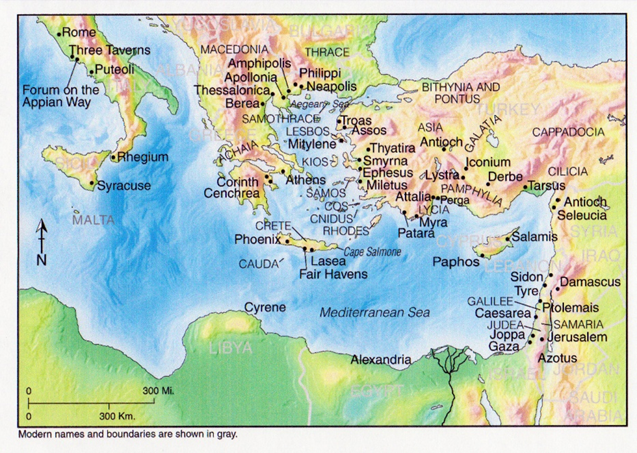
Macedonia is a Roman province north of Greece; it includes cities such as Philippi and Thessalonica. Troas is a jumping off point for Macedonia, so by the time Paul has his vision, the group is already poised to depart for Macedonia.

There are several important points in this short passage. Paul and his companions are listening closely to the Holy Spirit, allowing Him to guide them. They are not having meetings in which they consult maps or statistics. When God speaks through a vision, the mission team immediately obeys, rather than questioning God.

Obedience is key when following the Lord. Only God knows what the weather is going to be like for sailing between Troas and Macedonia, the needs of the Macedonians, and the spiritual temperature of places such as Philippi and Thessalonica.

Want success in ministry? Spend time in prayer and obey when God advises you. So many times, we might receive guidance; however, we immediately begin arguing with God. “But God,” we whine, “Why can’t I go where I want to and when I want to.” People who sell real estate know that one of the key facts about any piece of property is location. If a home or a farm is in a desirable location, the seller can ask a far higher price. God knows more about key locations than any real estate expert.

No matter what we think, God is the One who knows hearts and God is the One who knows when people are ready. Several years ago, revival broke out in a church in Brownsville, Florida, a suburb of Pensacola. For years, the Holy Spirit moved in such an amazing way that people flocked to that church from all over the world to see what God was doing. Many who visited the revival returned to their home churches, where mini-revivals also broke out.

May God help us, so that we will listen intently to Him and obey His leading rather than our own preconceived notions. May God also help us to remember that we are ministering for Him and not the other way around!

PRAYER: Father God, thank You for loving us and for caring for us. Lord, help us to have soft teachable hearts and minds willing to accept Your leading. Help us to obey and not to argue. In the mighty and precious Name of King Jesus. Amen.