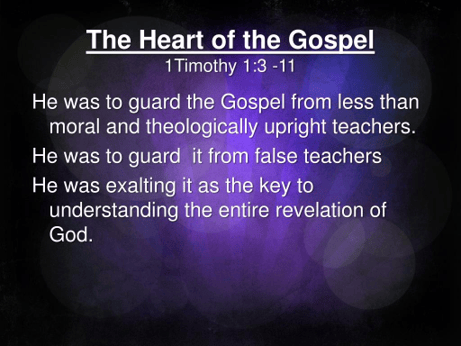
1 Timothy 1:12-17 The Lord’s Grace to Paul
12 I thank Christ Jesus our Lord, who has given me strength, that he considered me trustworthy, appointing me to his service. 13 Even though I was once a blasphemer and a persecutor and a violent man, I was shown mercy because I acted in ignorance and unbelief. 14 The grace of our Lord was poured out on me abundantly, along with the faith and love that are in Christ Jesus.
15 Here is a trustworthy saying that deserves full acceptance: Christ Jesus came into the world to save sinners—of whom I am the worst. 16 But for that very reason I was shown mercy so that in me, the worst of sinners, Christ Jesus might display his immense patience as an example for those who would believe in him and receive eternal life. 17 Now to the King eternal, immortal, invisible, the only God, be honor and glory for ever and ever. Amen.
WOW! Here Paul is really laying things on the line, reminding Timothy of Paul’s record as a Pharisee who persecuted Christians and egged on the crowd who stoned Stephen. Why does Paul tell Timothy these things at this point? Paul wants Timothy to remember that no matter how learned someone is, no matter how eloquently they can discuss philosophies or religions, they continue to act in ignorance and unbelief until they come to know Jesus Christ. Why? Ephesus is chock-full of philosophers and proponents of every kind of religion on the face of the earth. Many of these people are compelling orators who can sway audiences with their rhetoric.
Considering the fact that Timothy has traveled extensively with Paul, Timothy is probably well acquainted with Paul’s testimony; yet, Paul wants Timothy to remember all these things. Paul is reminding Timothy so that when Timothy encounters some of these smooth-talking philosophers, he will remember Paul’s testimony and realize that eloquence is no substitute for knowing Jesus Christ as Savior and Lord. It’s even possible that if Timothy encounters Jewish scribes, some of these men might remember Paul’s earlier career as a Pharisee. Now Timothy can tell such people the rest of the story about Paul.
1:17 Now to the King eternal, immortal, invisible, the only God, be honor and glory for ever and ever. Amen. Without a doubt, this single statement is one of the most wonderful praise statements gracing the New Testament. Stepping away from Timothy’s plight as he confronts the philosophers in Ephesus, let us memorize this verse and cling to it, for these words can comfort and strengthen us through dark days.
The Charge to Timothy Renewed 1 Timothy 1:18-20
18 Timothy, my son, I am giving you this command in keeping with the prophecies once made about you, so that by recalling them you may fight the battle well, 19 holding on to faith and a good conscience, which some have rejected and so have suffered shipwreck with regard to the faith. 20 Among them are Hymenaeus and Alexander, whom I have handed over to Satan to be taught not to blaspheme.
“I am giving you this command in keeping with the prophecies once made about you…” Evidently, it is God who has chosen Timothy to head the Ephesian church and who has confirmed that choice through prophecies as Paul and Timothy have traveled together. How comforting can such prophecies be?
Several years ago, we were privileged to attend a YWAM Crossroads Discipleship Training program at a time when we felt lost and uncertain about our next steps. Seemingly, the door to returning to Ghana had closed, and we were homeless and fearful about what would happen to us. That was when one of the instructors suddenly stopped his lecture and walked straight to us. Placing his hands on our heads, this anointed teacher began prophesying over us, telling us that God wasn’t finished with us and that God would also give us a home. We were encouraged and continued to seek a means of returning to Ghana. Subsequently, those prophecies were fulfilled and continue to be fulfilled up to the present day.
Here Paul is reminding Timothy of those prophecies so that Timothy will remember that God’s favor does rest upon him. Sensing God’s favor will be increasingly important to Timothy as he confronts men such as Hymenaeus and Alexander, who have evidently strayed so far from Gospel truth that Paul has washed his hands of them, leaving Satan to deal with them. But what kinds of errors are these men propounding? An AI search reveals the following:
Hymenaeus and Alexander were associated with serious doctrinal errors and blasphemies in the early Christian community.
False Teachings
- Antinomianism: Both figures promoted antinomianism, which is the rejection of moral laws and ethical standards in Christianity. This belief undermined the importance of living a morally upright life according to Christian teachings.
- Denial of Resurrection: Hymenaeus, in particular, is noted for teaching that the resurrection (of the dead) had already occurred, which led to confusion and a weakening of faith among believers.
Consequences of Their Actions
- Paul’s Warning: The Apostle Paul explicitly stated that he had delivered them to Satan to learn not to blaspheme, indicating that their teachings were not only erroneous but also harmful to the faith of others. This act was a form of church discipline aimed at prompting repentance.
These actions exemplified a significant threat to the integrity of early Christian doctrine and community life.
Wikipedia tells us: It is impossible to define exactly the full nature of this heresy, but from what Paul says regarding it, Hymenaeus and Philetus may have believed in an early form of the Christian heresy of Gnosticism. This awakening from Sin had taken place with themselves, so the Gnostics held, and therefore there could be no day in the future when the dead shall hear the voice of the Son of God and shall come forth from the grave (John 5:28).
This spiritualizing of the resurrection sprang from the idea of the necessarily evil nature of all material substance. This idea immediately led to the conclusion of the essentially evil nature of the human body, and that if man is to rise to his true nature, he must rid himself of the thralldom, not of sin, but of the body. This contempt for the body led to the denial of the resurrection in its literal sense; and all that Christ had taught on the subject was explained only, in an allegorical sense, of the resurrection of the soul from sin.
Does Paul’s statement imply that he has ceased praying for these men? No. Paul is an indefatigable prayer warrior, and it’s unlikely he would give up praying for anyone. But it’s probable that after extensive and repeated arguments with these two men, Paul has rejected them from any position of leadership within the Ephesian church and has warned as many people as possible not to listen to them or believe their teachings.
The heresies promoted by Hymenaeus and Alexander give us a bird’s eye view of the struggles Timothy has while shepherding the Ephesian church. Pastors today face similar challenges as many denominations attempt to water down the Gospel in attempts to be popular. Here Paul is warning Timothy against the temptation to compromise in hopes of attracting more members. May God help us, so that we do not sacrifice the truth of the Gospel for something less in hopes of attracting followers!
PRAYER: Father God, thank You for loving us and caring for us. Lord, help us to study Your Word so that we can tell truth from falsehood. Help us to be vigilant and to be faithful. In the mighty and precious Name of King Jesus. Amen.