Archive for July, 2026

JULY 2, 2026 REMAINING FAITHFUL AFTER A MOUNTAINTOP EXPERIENCE? #39 ARE YOU SLEEPING AT THE WRONG TIME?

July 2, 2026

Acts 20 Paul Goes to Macedonia and Greece

20:1 When the uproar was over, Paul sent for the believers and encouraged them. Then he said good-bye and left for Macedonia. 2 While there, he encouraged the believers in all the towns he passed through. Then he traveled down to Greece, 3 where he stayed for three months. He was preparing to sail back to Syria when he discovered a plot by some Jews against his life, so he decided to return through Macedonia.

4 Several men were traveling with him. They were Sopater son of Pyrrhus from Berea; Aristarchus and Secundus from Thessalonica; Gaius from Derbe; Timothy; and Tychicus and Trophimus from the province of Asia. 5 They went on ahead and waited for us at Troas. 6 After the Passover ended, we boarded a ship at Philippi in Macedonia and five days later joined them in Troas, where we stayed a week.

Paul has a sense of impending doom. This is now his third missionary journey and his reputation has preceded him to the point that Jews in Greece are plotting against his life. But there are no mistakes in God’s fine economy. God knows that Paul must visit some of these churches again to encourage them one final time, so God uses these threats to direct Paul’s itinerary. Why does Luke list all the men accompanying Paul? Looking at the names, you realize that this was a mixed group, likely composed of those who have taken Roman names as a form of protection. These men are faithful friends and colleagues, prepared to risk the rigors of long voyages over potentially turbulent waters-a mark of their dedication to Paul and to God.

Never overlook names in the Bible! While we might be bored by lists of names, God has allowed names to be included to record honor or dishonor. Read Nehemiah and you realize that God knows exactly who has risked their lives to rebuild Jerusalem and who has refused to help, choosing their own interests instead. We should be encouraged and comforted when we realize that God sees our efforts, our struggles, our dedication, and our sorrows. And now Paul is teaching in Troas for the last time.

Paul’s Final Visit to Troas

7 On the first day of the week, we gathered with the local believers to share in the Lord’s Supper. Paul was preaching to them, and since he was leaving the next day, he kept talking until midnight. 8 The upstairs room where we met was lighted with many flickering lamps. 9 As Paul spoke on and on, a young man named Eutychus, sitting on the windowsill, became very drowsy. Finally, he fell sound asleep and dropped three stories to his death below. 10 Paul went down, bent over him, and took him into his arms. “Don’t worry,” he said, “he’s alive!” 11 Then they all went back upstairs, shared in the Lord’s Supper, and ate together. Paul continued talking to them until dawn, and then he left. 12 Meanwhile, the young man was taken home alive and well, and everyone was greatly relieved.

Despite the fact that many people have been healed by contact with handkerchiefs or aprons blessed by Paul, this is the only recorded incident in which Paul acts as an instrument of resurrection. That night, Eutychus was exhausted. He had been out all day on the farm and his body was demanding rest. But this was Paul’s last night to preach, and so Eutychus cheerfully accompanied his friends, climbing the stairs to the third story of the building where there was a large room where the meeting was taking place. But by the time Eutychus reached the meeting, there were no seats left on the floor, so he positioned himself in the window. As usual, Paul’s teaching was both relevant and riveting; however, Eutychus finally fell asleep and then fell out of the window to the stone courtyard below.

“He’s dead!” Someone shouted as Paul rushed down the stairs. Taking Eutychus in his arms, Paul begged the Lord for the young man’s life. Just as people were beginning to weep, Eutychus suddenly drew in a deep breath, opened his eyes, and asked, “What happened?” The same people who had been crying over the death of this young man now began praising God. Paul went back upstairs and spoke for several more hours while friends helped Eutychus return home safely. Paul left Troas shortly after dawn, confident that God was continuing to work in his life.

It’s always tempting to focus on the results of someone’s ministry with no regard for the energy and work that ministry takes. We generally focus on the miracle of Eutychus being healed from injuries that killed him. It begs the question to argue that perhaps Eutychus isn’t really dead; these early believers know a dead person when they see one. Deaths of young people were common and these people knew enough to check pulses or look for signs of breathing. But what about Paul? What did this healing mean for him?

Paul doesn’t know what lies ahead; however, he is becoming aware that he will likely face more opposition and worse suffering in the future. As Paul is rushing downstairs to that courtyard, he is praying and the Holy Spirit begins to reassure him. Paul needs this miracle as much as Eutychus does, for Paul realizes he may run afoul of the Roman government, and the Romans are notorious for imaginative ways of torturing people. Paul has already been stoned and left for dead once. Now God graphically demonstrates to Paul that, if necessary, God can raise him up again. Paul realizes that his life remains in God’s hands.

Hudson Taylor, the founder of the China Inland Mission, was fond of saying that “Man is immortal until his work is done.” Taylor repeatedly faced death in China but eventually died of old age, his body worn from decades of ministry. Paul will leave Troas and travel to Jerusalem, where other forces will work, with Paul eventually winding up in Rome.

As I am writing this, news has come from Nigeria that Boko Haram has beheaded seven Christian leaders. We hear such things and ask “Why?” We forget that the cause for Christ has always been most compelling when people are willing to give up everything, including their very lives. The sudden deaths of these men point out the fact that there’s never a good time for us to sleep spiritually. May God help us to remain spiritually alert, willing to live or die, according to His perfect Will.

PRAYER: Father God, thank You for loving us and caring for us. Lord, please draw us nearer to You each day. Help us to remember that we are Your ambassadors to a lost and dying world. In the mighty and precious Name of King Jesus. Amen.
July 1, 2026 REMAINING FAITHFUL AFTER A MOUNTAINTOP EXPERIENCE? #38 JUST THREATEN SOMEONE’S LIVELIHOOD AND SEE WHAT HAPPENS!

July 1, 2026

The Riot in Ephesus

23 About that time, serious trouble developed in Ephesus concerning the Way. 24 It began with Demetrius, a silversmith who had a large business manufacturing silver shrines of the Greek goddess Artemis. He kept many craftsmen busy. 25 He called them together, along with others employed in similar trades, and addressed them as follows:

“Gentlemen, you know that our wealth comes from this business. 26 But as you have seen and heard, this man Paul has persuaded many people that handmade gods aren’t really gods at all. And he’s done this not only here in Ephesus but throughout the entire province! 27 Of course, I’m not just talking about the loss of public respect for our business. I’m also concerned that the temple of the great goddess Artemis will lose its influence and that Artemis—this magnificent goddess worshiped throughout the province of Asia and all around the world—will be robbed of her great prestige!”

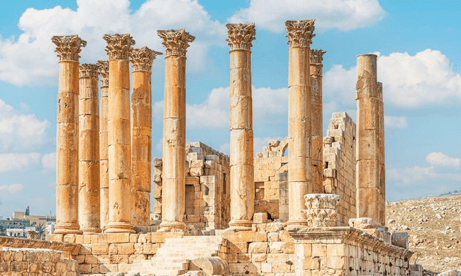
Hoo-boy! Is this guy Demetrius ever a weasel! Ephesus is the site of the temple of Artemis, an architectural wonder and a center of worship for the goddess. Artemis was the goddess of hunting, the wilderness, wild animals, transitions, nature, vegetation, childbirth, care of children, and chastity. She was often said to roam the forests and mountains, attended by an entourage of nymphs. The goddess Diana is her Roman equivalent. Artemis was one of the principal goddesses of childbirth and midwifery. In an age when the ability to bear children proved a woman’s worth and when childbirth could be dangerous, Artemis would be a very important deity indeed. (Information from Wikipedia)

The chief organizer of Paul’s opposition is a local businessman named Demetrius, who has a thriving business manufacturing silver shrines of the goddess. It’s quite likely that Demetrius cares little or nothing for Artemis; he might even consider the stories about her as fairy tales fit only for weak women; however, Demetrius cares passionately about wealth and all the ways to get it. Pilgrims stream to Ephesus from throughout the region, either to worship at the temple or merely to view it. Each one of those pilgrims is a potential customer for all kinds of souvenirs, particularly silver shrines. Demetrius is no fool and swiftly realizes that if people begin following the God Paul is preaching, Artemis will be forgotten and his business will fail. Demetrius gathers all the craftsmen working for him, plus all the local businessmen selling the silver shrines of Artemis, plus anybody else he can recruit. Priests from the temple of Artemis enthusiastically join Demetrius’ protest, for they too have been making a comfortable living by promising special prayers and encouraging generous offerings from faithful pilgrims from Achaia and beyond. If Paul succeeds in discrediting Artemis, all these men will have to find other sources of income. So the protests begin and spread throughout Ephesus.

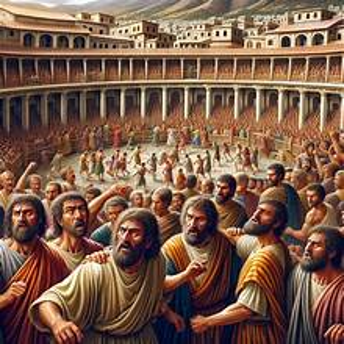
28 At this their anger boiled, and they began shouting, “Great is Artemis of the Ephesians!” 29 Soon the whole city was filled with confusion. Everyone rushed to the amphitheater, dragging along Gaius and Aristarchus, who were Paul’s traveling companions from Macedonia. 30 Paul wanted to go in, too, but the believers wouldn’t let him. 31 Some of the officials of the province, friends of Paul, also sent a message to him, begging him not to risk his life by entering the amphitheater.

32 Inside, the people were all shouting, some one thing and some another. Everything was in confusion. In fact, most of them didn’t even know why they were there. 33 The Jews in the crowd pushed Alexander forward and told him to explain the situation. He motioned for silence and tried to speak. 34 But when the crowd realized he was a Jew, they started shouting again and kept it up for about two hours: “Great is Artemis of the Ephesians! Great is Artemis of the Ephesians!”

Why would the Jews in the crowd attempt to get Alexander to speak? Remember that wherever they are, the Jews are always a vulnerable minority. It’s likely that many of the Jews are scholars and bankers and money lenders, since these trades are highly portable. With Paul being recognized as a Jew, leaders of the Jewish community are terrified that anti-Semitic protests will break out and they and their families will be attacked and have to flee town for their lives.

35 At last the mayor was able to quiet them down enough to speak. “Citizens of Ephesus,” he said. “Everyone knows that Ephesus is the official guardian of the temple of the great Artemis, whose image fell down to us from heaven. 36 Since this is an undeniable fact, you should stay calm and not do anything rash. 37 You have brought these men here, but they have stolen nothing from the temple and have not spoken against our goddess.

38 “If Demetrius and the craftsmen have a case against them, the courts are in session and the officials can hear the case at once. Let them make formal charges. 39 And if there are complaints about other matters, they can be settled in a legal assembly. 40 I am afraid we are in danger of being charged with rioting by the Roman government, since there is no cause for all this commotion. And if Rome demands an explanation, we won’t know what to say.” 41 Then he dismissed them, and they dispersed.

Once more, we see God’s wisdom in allowing the Gospel to spread at the time of the Roman Empire. Rome has strict laws against illegal meetings and the Roman courts are very efficient. If the Romans decide that citizens of Ephesus are rioting, they can easily dispatch Roman legionnaires who will like nothing more than to cut down innocent citizens in the streets. No right-thinking person wants to attract the displeasure of Rome. So Demetrius and his horde are forced to disperse, muttering threats under their breath, but returning to their homes.

The temple of Artemis was one of the Seven Wonders of the Ancient World. What eventually happened to this magnificent structure? The Temple of Artemis faced multiple destructions and rebuilds throughout its history. The first temple was built around 550 BCE but was destroyed by a flood. A second temple was constructed, which was later burned down in 356 BCE by an arsonist named Herostratus, seeking fame. The temple was eventually destroyed by invading Goths in 262 CE and was never rebuilt. Today, only fragments remain, with some pieces housed in the British Museum. Meanwhile, the Gospel remains and has spread throughout the whole world.

What can we learn from this story? The Gospel will always go forward, either because of men’s efforts or in spite of them. It’s possible that many people thought little or nothing of Paul’s teachings until the riots. Once public attention was drawn, there were probably truth seekers who began investigating the teachings of Paul. So even the riots organized to stop the spread of the Gospel may have given it even more impetus. God’s purposes will continue. The question is this: Are we helping or hurting the spread of the Gospel? Are we good advertising for God and his sovereign love and mercy, or are people turning away from God because of us? The possibilities are sobering.

PRAYER: Father God, thank You for loving us and caring for us. Lord, help us to demonstrate Your grace, Your love, and Your mercy wherever we go. Help us to remember that Your purposes are sure and that even events that appear frightening or harmful can still serve to spread the Gospel. In the mighty and precious Name of King Jesus. Amen.