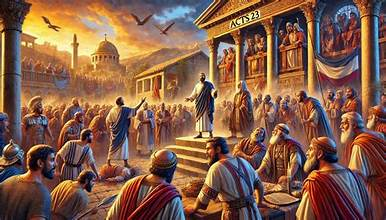
Acts 25 Paul Appears before Festus
25 Three days after Festus arrived in Caesarea to take over his new responsibilities, he left for Jerusalem, 2 where the leading priests and other Jewish leaders met with him and made their accusations against Paul. 3 They asked Festus as a favor to transfer Paul to Jerusalem (planning to ambush and kill him on the way). 4 But Festus replied that Paul was at Caesarea and he himself would be returning there soon. 5 So he said, “Those of you in authority can return with me. If Paul has done anything wrong, you can make your accusations.”
Well, Festus has come in as a new governor, and immediately travels to Jerusalem to meet the Jewish religious leaders. Despite their request for Paul to be transferred back to Jerusalem, Festus is too savvy to allow anything of the sort. Felix has already briefed Festus on the emergency transfer of Paul to Caesarea to avoid assassination and Festus isn’t about to be responsible for the murder of a Roman citizen. Failing to protect a high-ranking Roman is a good way to lose one’s place entirely or to be reassigned to a remote post far worse than Caesarea. Thanks to Herod’s extensive building program, Caesarea is quite pleasant, and it’s right on the seacoast where sea breezes play every afternoon. No, let these contentious Jewish leaders come to Caesarea if they are bent on accusing an innocent Roman.
6 About eight or ten days later Festus returned to Caesarea, and on the following day he took his seat in court and ordered that Paul be brought in. 7 When Paul arrived, the Jewish leaders from Jerusalem gathered around and made many serious accusations they couldn’t prove.
8 Paul denied the charges. “I am not guilty of any crime against the Jewish laws or the Temple or the Roman government,” he said.
9 Then Festus, wanting to please the Jews, asked him, “Are you willing to go to Jerusalem and stand trial before me there?”
10 But Paul replied, “No! This is the official Roman court, so I ought to be tried right here. You know very well I am not guilty of harming the Jews. 11 If I have done something worthy of death, I don’t refuse to die. But if I am innocent, no one has a right to turn me over to these men to kill me. I appeal to Caesar!”
12 Festus conferred with his advisers and then replied, “Very well! You have appealed to Caesar, and to Caesar you will go!”
Once more, we see the power of the Roman Empire at work as well as the shiftiness of political survivors. Festus has no more desire to get crosswise of the Jewish religious leaders than did Felix; however, Festus also realizes that Paul is innocent. When Paul appeals to Caesar as his right as a Roman citizen, Festus probably heaves a huge sigh of relief. Fine! Ship Paul to Rome and let the courts up there deal with the matter. It’s highly unlikely that these trouble-makers from Jerusalem have any desire to travel all the way to Rome. Surely, once Paul reaches Rome, there will be some legal way of his gaining release.
13 A few days later King Agrippa arrived with his sister, Bernice, to pay their respects to Festus. 14 During their stay of several days, Festus discussed Paul’s case with the king. “There is a prisoner here,” he told him, “whose case was left for me by Felix. 15 When I was in Jerusalem, the leading priests and Jewish elders pressed charges against him and asked me to condemn him. 16 I pointed out to them that Roman law does not convict people without a trial. They must be given an opportunity to confront their accusers and defend themselves.
17 “When his accusers came here for the trial, I didn’t delay. I called the case the very next day and ordered Paul brought in. 18 But the accusations made against him weren’t any of the crimes I expected. 19 Instead, it was something about their religion and a dead man named Jesus, who Paul insists is alive. 20 I was at a loss to know how to investigate these things, so I asked him whether he would be willing to stand trial on these charges in Jerusalem. 21 But Paul appealed to have his case decided by the emperor. So I ordered that he be held in custody until I could arrange to send him to Caesar.”
22 “I’d like to hear the man myself,” Agrippa said.
And Festus replied, “You will—tomorrow!”
Who was the King Agrippa mentioned here and why was his sister Bernice also mentioned? AI internet searches reveal the following: King Agrippa II was the last of the Herodian dynasty founded by King Herod the Great, the king who tried to murder the baby Jesus. King Herod the Great was of mixed heritage, including Jewish ancestry. He was born around 72 BCE and ruled as a client king under Roman authority. His father was an Idumean, a group that had converted to Judaism, while his mother was a Nabatean from North Africa. This mixed background led to debates about his legitimacy as a Jewish king.
Religious Practices
Despite his controversial heritage, Herod undertook significant renovations of the Second Temple in Jerusalem, aiming to solidify his status among the Jewish people. He also made efforts to support Jewish religious practices, although many critics within the Jewish community questioned his commitment to the faith due to his brutal rule and political maneuvers.
Legacy and Perception
Herod’s reign was marked by paranoia and violence, including the execution of numerous political rivals and family members. This brutality, combined with his mixed heritage, shaped a complex legacy that continues to provoke discussion among historians and religious scholars.
Agrippa II and Bernice played significant political roles in the Herodian dynasty, navigating complex relationships between Jewish and Roman authorities.
Agrippa II’s Role
- Agrippa II served as a client king under Roman authority, managing Jewish affairs while maintaining loyalty to Rome. His reign was marked by a lack of unified power compared to his grandfather, Herod the Great, and he acted as a cultural intermediary during a tumultuous period.
- He was involved in the trial of the Apostle Paul, highlighting the interplay between Roman governance and Jewish leadership.
Bernice’s Role
- Bernice, sister of Agrippa II, was a prominent figure in the Herodian dynasty, often acting as a political ally and advisor. Her life was characterized by strategic marriages and alliances, which were common among royal families to secure influence. Bernice was married to Polemo II, King of Cilicia, but their marriage was short-lived as she returned to live with Agrippa after the divorce.
- She shared significant power with Agrippa II, and their close relationship fueled rumors about their personal dynamics, further complicating their political image.
Together, Agrippa and Bernice represented the waning influence of the Herodian dynasty during the Roman Empire’s expansion, embodying the tensions between local governance and imperial authority.
The Herodian dynasty originated with Herod the Great, who ruled Judea from 37 to 4 BCE.
Herod was appointed “King of the Jews” by the Roman Senate, establishing a client state under Roman influence. His rise to power was facilitated by his father’s support of Roman military campaigns, which helped him gain favor with the Romans. After Herod’s death, his kingdom was divided among his sons and sister, forming the Herodian tetrarchy.
Key Features of the Herodian Dynasty
- Foundation: Established by Herod the Great, who ended the Hasmonean dynasty.
- Roman Support: The dynasty was closely tied to Roman political interests, reflecting the broader context of Roman rule in Judea.
- Legacy: The Herodian dynasty played a significant role in the political landscape of Judea during the New Testament period
See how God works! Rather than being tried in a religious court in Jerusalem, now Paul has the opportunity to preach to the highest authorities in the province. Heaven knows, anybody associated with the Herodian dynasty in any way needs the Gospel! And these authorities will be accompanied by all kinds of body guards, courtiers, assistants, and other attendants. Even if Agrippa and Bernice refuse to open their hearts, many others are about to have the chance to do so. Paul might be rubbing his hands together in glee as he sits in that prison cell. What an incredible opportunity! Paul can scarcely wait.
Paul Speaks to Agrippa
23 So the next day Agrippa and Bernice arrived at the auditorium with great pomp, accompanied by military officers and prominent men of the city. Festus ordered that Paul be brought in. 24 Then Festus said, “King Agrippa and all who are here, this is the man whose death is demanded by all the Jews, both here and in Jerusalem. 25 But in my opinion, he has done nothing deserving death. However, since he appealed his case to the emperor, I have decided to send him to Rome.
26 “But what shall I write the emperor? For there is no clear charge against him. So I have brought him before all of you, and especially you, King Agrippa, so that after we examine him, I might have something to write. 27 For it makes no sense to send a prisoner to the emperor without specifying the charges against him!”
Oh, Festus is a sly one! Rather than admit that Paul is actually innocent and should have been released months ago, Festus cloaks his confusion about the appropriate charges against Paul by seeking guidance from Agrippa and the opinion leaders. How can these men possibly refuse the opportunity to help Festus craft a diplomatic appeal to the emperor? For the rest of their lives, many of these men will boast that the governor required their assistance.
As we read the stories about Paul and the politicians thinking they are practicing wise statecraft, we realize that God is manipulating the entire situation. God already knows the hearts of the Jewish religious leaders. God knows that Festus and Agrippa II and Bernice are struggling to maintain their positions with Rome. God is giving Paul a far wider audience, even as He is systematically working for Paul to travel to Rome at Roman expense.
There’s a Bette Midler song that claims that God is watching us at a distance; however, nothing could actually be further from the truth. God is not some distant deity who has set things going, only to observe from afar. God is intensely involved in every aspect of our lives. C. H. Spurgeon was a famous nineteenth century evangelist whose sermons were so popular that newspapers printed them as soon as they were available. One man was walking dejected through London when he saw a large scrap of paper in the gutter. Curious, the man plucked the paper out of the gutter and began perusing it. The paper contained one of Spurgeon’s sermons with a strong salvation message. Coming under conviction, the man knelt on the rainy sidewalk and gave his heart to the Lord. That man later became a leader in Christian circles, all from what he thought was a chance encounter with the text of a Spurgeon sermon.
Today, do you feel caught in a web of deceit, a pawn to political forces around you? Refuse to give in to that notion! God is as close to you as your heart beat, and He loves you passionately. God is not going to allow Satan to destroy you, for He has great plans for your life. But look around, for remember that Paul was sitting in prison as God was moving powerful people to come to hear him. Those people had no idea what God was doing, but God was working out His purposes, just as He will work out His purposes in your life.
PRAYER: Father God, thank You for loving us and caring for us. Lord, we praise You and bless You for using ever detail of our lives to effect Your perfect Will. In the mighty and matchless Name of King Jesus. Amen.