Archive for August, 2026

AUGUST 2, 2026 PEACE-HOW DO WE GET IT AND HOW CAN WE KEEP IT? #17 RIBBET! RIBBET! SOMETIMES GOD HIDES HIS PEACE SO WE WILL FOLLOW HIS LEADING.

August 2, 2026

Exodus 7:25 Seven days passed from the time the Lord struck the Nile.

Exodus 8: 8 Then the Lord said to Moses, “Go back to Pharaoh and announce to him, ‘This is what the Lord says: Let my people go, so they can worship me. 2 If you refuse to let them go, I will send a plague of frogs across your entire land. 3 The Nile River will swarm with frogs. They will come up out of the river and into your palace, even into your bedroom and onto your bed! They will enter the houses of your officials and your people. They will even jump into your ovens and your kneading bowls. 4 Frogs will jump on you, your people, and all your officials.’”

5 Then the Lord said to Moses, “Tell Aaron, ‘Raise the staff in your hand over all the rivers, canals, and ponds of Egypt, and bring up frogs over all the land.’” 6 So Aaron raised his hand over the waters of Egypt, and frogs came up and covered the whole land! 7 But the magicians were able to do the same thing with their magic. They, too, caused frogs to come up on the land of Egypt.

8 Then Pharaoh summoned Moses and Aaron and begged, “Plead with the Lord to take the frogs away from me and my people. I will let your people go, so they can offer sacrifices to the Lord.”

9 “You set the time!” Moses replied. “Tell me when you want me to pray for you, your officials, and your people. Then you and your houses will be rid of the frogs. They will remain only in the Nile River.”

10 “Do it tomorrow,” Pharaoh said.

“All right,” Moses replied, “it will be as you have said. Then you will know that there is no one like the Lord our God. 11 The frogs will leave you and your houses, your officials, and your people. They will remain only in the Nile River.”

12 So Moses and Aaron left Pharaoh’s palace, and Moses cried out to the Lord about the frogs he had inflicted on Pharaoh. 13 And the Lord did just what Moses had predicted. The frogs in the houses, the courtyards, and the fields all died. 14 The Egyptians piled them into great heaps, and a terrible stench filled the land. 15 But when Pharaoh saw that relief had come, he became stubborn. He refused to listen to Moses and Aaron, just as the Lord had predicted.

God has already begun a concentrated attack on Egypt, systematically dismantling Egyptian objects of worship. First, God has attacked the River Nile, which the Egyptian believe is the source of all life and creation. Next, God floods Egypt with frogs, completing two attacks on the water of Egypt. Why frogs? Again, an internet summary yields the following information:

Divine Judgment
The plague is part of God’s judgment against Egypt, specifically targeting their idolatry. Frogs were considered sacred in Egyptian culture, worshipped as symbols of fertility and life. By sending a plague of frogs, God demonstrated His power over the Egyptian gods and highlighted the futility of their worship. David Guzak tells us “God threatened a plague of frogs for a specific reason. The Egyptian goddess Heqet (or, Heket) was always pictured with the head of a frog. Among the ancient Egyptians, frogs were considered sacred and could not be killed. Egyptians worshipped the frog as a female goddess because frogs were common around the Nile, because they reproduced rapidly, and because being amphibians they are part of two worlds, creatures of both land and water.”

Cultural Challenge
The invasion of frogs into every aspect of Egyptian life—homes, beds, and kitchens—served to disrupt daily routines and challenge the Egyptians’ sense of order. This was not merely a physical affliction but a direct affront to their religious beliefs.

Theological Message
Theologically, the plague underscores God’s sovereignty and His desire to free the Israelites from oppression. It marks a pivotal moment in the narrative of liberation, illustrating the lengths to which God will go to fulfill His covenant promises.

Progression of Plagues
The plague of frogs is the second in a series of ten plagues, each escalating in severity and purpose. It sets the stage for subsequent plagues, reinforcing the message of divine authority and the consequences of disobedience.

“The frogs could not be killed because of their sacredness, and yet such large numbers of them would be revolting in their loathsomeness, especially because cleanliness was a particular mark of the Egyptians.” (Thomas as quoted by David Guzak in Enduring Word Commentary) God has a sense of humor! How many Egyptians who formerly worshiped frogs may have changed their minds as they shoveled huge piles of dead frogs? After dealing with all those rotting frog bodies, how willing would the Egyptians be to continue worshiping them? And what would the Egyptians do with all those dead frogs? Should they bury them? Burn them? God must be sitting in heaven chuckling.

While the Egyptian magicians can make frogs appear, indicating evil occultic power, they have no power to make the frogs disappear. But Pharaoh neglects to notice this fact. On the other hand, Moses and Aaron are noting everything. Even though God first spoke to Moses through a burning bush that miraculously was not consumed, neither Moses nor Aaron had any notion of God’s real power. Now as the plagues continue to multiply, the two brothers marvel and revise their concepts of God’s power. As the plagues continue, God’s peace and certainty continue to settle deeper and deeper into Moses’ and Aaron’s spirits. And now God is about to attack Egyptian deities having to do with the earth.

Where is God’s peace in the middle of these plagues? Certainly, there’s no peace for the Egyptians, and very little peace for the Israelites because they are suffering along with the Egyptians. Why is God allowing the Israelites to suffer as well? God knows His people and He knows that if things are the least bit comfortable, they will do everything they can to stay in Egypt. So for now, God is not demonstrating His peace to His people, although those people of faith might continue to trust Him privately.

We are foolish when we demand that God must give us His peace in situations from which He wants to deliver us. Newton’s First Law of Motion, the Law of Inertia, states that an object at rest stays at rest, and an object in motion continues in motion with the same speed and in the same direction unless acted upon by a net external force. This law emphasizes the concept of inertia, which is the tendency of objects to resist changes in their state of motion.  At present, the Israelites are at rest and they would just as soon remain at rest, thank you very much! Or if someone is going to deliver the Israelites, they would like their personal lives to be torn up as little as possible.

God always has several more goals He is accomplishing than we understand. We view everything from our perspective, assuming God is most interested in us. But remember something: Centuries later, Jesus will die for the sins of the whole world. Even now, even in Egypt, God wants those Egyptians to know Him and to worship Him rather than worshiping a river or creatures of darkness and death. While we frequently read the stories of Moses and Aaron and the Israelites only from their perspective, surprise! The Egyptians are just as much God’s children as are the Israelites. God’s heart of love is reaching out to His Egyptians, longing for them to worship Him. How else can God reach the Egyptians if He does not demonstrate His almighty power over the most cherished Egyptian deities?

As we endure difficult times, may God help us to remember that His purposes are always greater than ours.

PRAYER: Father God, thank You for loving us and caring for us. Lord, help us to realize that Your purposes are the redemption of the whole world and that only when we join with You will we find true peace. In the mighty and precious Name of King Jesus. Amen.

AUGUST 1, 2026 PEACE-HOW DO WE GET IT AND HOW CAN WE KEEP IT? #16 CHANGING A HUGE RIVER INTO BLOOD? NO PROBLEM!

August 1, 2026

Exodus 7 A Plague of Blood

14 Then the Lord said to Moses, “Pharaoh’s heart is stubborn, and he still refuses to let the people go. 15 So go to Pharaoh in the morning as he goes down to the river. Stand on the bank of the Nile and meet him there. Be sure to take along the staff that turned into a snake. 16 Then announce to him, ‘The Lord, the God of the Hebrews, has sent me to tell you, “Let my people go, so they can worship me in the wilderness.” Until now, you have refused to listen to him. 17 So this is what the Lord says: “I will show you that I am the Lord.” Look! I will strike the water of the Nile with this staff in my hand, and the river will turn to blood. 18 The fish in it will die, and the river will stink. The Egyptians will not be able to drink any water from the Nile.’”

19 Then the Lord said to Moses: “Tell Aaron, ‘Take your staff and raise your hand over the waters of Egypt—all its rivers, canals, ponds, and all the reservoirs. Turn all the water to blood. Everywhere in Egypt the water will turn to blood, even the water stored in wooden bowls and stone pots.’”

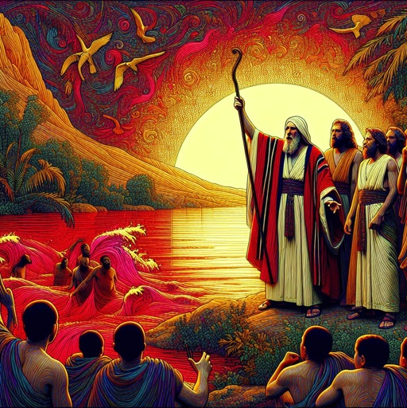
20 So Moses and Aaron did just as the Lord commanded them. As Pharaoh and all of his officials watched, Aaron raised his staff and struck the water of the Nile. Suddenly, the whole river turned to blood! 21 The fish in the river died, and the water became so foul that the Egyptians couldn’t drink it. There was blood everywhere throughout the land of Egypt. 22 But again the magicians of Egypt used their magic, and they, too, turned water into blood. So Pharaoh’s heart remained hard. He refused to listen to Moses and Aaron, just as the Lord had predicted. 23 Pharaoh returned to his palace and put the whole thing out of his mind. 24 Then all the Egyptians dug along the riverbank to find drinking water, for they couldn’t drink the water from the Nile. 25 Seven days passed from the time the Lord struck the Nile.

First, God has humiliated the court magicians and the deities they worship. Now God turns His attention to the River Nile. God knows that the Nile is of utmost importance in the religion and culture of Egypt. Just as Pharaoh is about to take his morning bath in the Nile, Moses and Aaron show up, striking the water and causing the water to become blood. Although there are some people who choose to believe that the Nile becomes full of fine red dust, that belief insults the intelligence of the Egyptians. Certainly, these people know blood when they see it! 

An internet summary informs us: Ancient Egyptians held the Nile River in profound reverence, viewing it as a divine entity essential to their civilization.

Religious Significance

  • The Nile was considered a gift from the gods, symbolizing life and fertility.
  • It was integral to the concept of Ma’at, representing cosmic order and balance.

Cultural Impact

  • The river influenced agricultural practices, enabling the growth of crops essential for sustenance.
  • It was celebrated in rituals, art, and mythology, often depicted as a source of life.

Spiritual Beliefs

  • The waters of the Nile were seen as the breath of the gods, embodying creation and the cycle of life and death.
  • Myths surrounding the Nile connected humanity to the divine, reinforcing its sacred status.

The website https://egyptmythology.com/the-sacredness-of-the-nile-in-ancient-egyptian-religion/ gives the following information: In ancient Egyptian mythology, the Nile was not just a physical entity but was personified as a divine force. The river was considered a manifestation of the god Hapi, who represented fertility, abundance, and the annual flooding that brought life to the land.

Key deities associated with the Nile include:

  • Hapi: The god of the annual flooding, depicted as a well-fed man with a green or blue skin tone, symbolizing fertility and abundance.
  • Osiris: The god of the afterlife, associated with resurrection and fertility, whose myth often intertwined with the cycles of the Nile.
  • Khnum: The creator god, believed to mold human beings from the clay of the Nile.

IV. Rituals and Worship Related to the Nile

The ancient Egyptians held numerous festivals and rituals to honor the Nile and its deities, particularly during the inundation period. These events were marked by joy and gratitude for the life-giving waters.

Major religious festivals included:

  • The Wepet Renpet: The Festival of the Opening of the Year, celebrating the arrival of the floodwaters.
  • The Inundation Festival: A celebration of the Nile’s flooding, featuring processions, music, and offerings to Hapi.

Practices and offerings made to honor the Nile involved:

  • Offering food and flowers at riverbanks.
  • Creating small boat models to sail on the Nile as offerings.
  • Prayers and rituals performed by priests to invoke blessings for a bountiful harvest.

V. The Nile in Ancient Egyptian Cosmology

The Nile also played a significant role in ancient Egyptian cosmology and creation myths. It was often viewed as a source of life and continuity, essential for both physical sustenance and spiritual renewal.

In creation myths, the Nile represented:

  • The primordial waters from which all life emerged.
  • A connection between the heavens and the earth, symbolizing the cycle of life, death, and rebirth.

The Nile’s waters were seen as a bridge between the mortal realm and the divine, reinforcing its sacred status in the cultural psyche of ancient Egyptians.

While the magicians somehow manage to replicate changing fresh water into blood, they can’t change blood back into fresh water. Now the Egyptians are stuck with digging new wells to get water for drinking and bathing. Moses and Aaron are shocked and impressed, for they have obeyed but even they have been unsure what would happen when that staff would strike the water. While the Egyptians are panic-stricken, Moses and Aaron are encouraged; certainly, a God who can turn the entire Nile River into blood can do what He wants. The brothers enjoy the peace of realizing that God is far more powerful than they have thought.

Sometimes we don’t enjoy the encouragement we might because we fail to notice what God is doing in and around us. We beg God to do a work in us and yet when He does, we don’t realize what has happened. Not sure if God is really working in your situation? Just remember those two old guys standing there by the River Nile with their jaws dropping in shock while looking at that bloody water. The same God who turned the Nile to blood can still work in your life.

PRAYER: Father God, thank You for loving us and caring for us. Lord, help us to remember that You never change and that You are still demonstrating Your unlimited power. In the mighty and precious Name of King Jesus. Amen. 

AUGUST 1, 2026 PEACE-HOW DO WE GET IT AND HOW CAN WE KEEP IT? #16 CHANGING A HUGE RIVER INTO BLOOD? NO PROBLEM!

August 1, 2026

Exodus 7 A Plague of Blood

14 Then the Lord said to Moses, “Pharaoh’s heart is stubborn, and he still refuses to let the people go. 15 So go to Pharaoh in the morning as he goes down to the river. Stand on the bank of the Nile and meet him there. Be sure to take along the staff that turned into a snake. 16 Then announce to him, ‘The Lord, the God of the Hebrews, has sent me to tell you, “Let my people go, so they can worship me in the wilderness.” Until now, you have refused to listen to him. 17 So this is what the Lord says: “I will show you that I am the Lord.” Look! I will strike the water of the Nile with this staff in my hand, and the river will turn to blood. 18 The fish in it will die, and the river will stink. The Egyptians will not be able to drink any water from the Nile.’”

19 Then the Lord said to Moses: “Tell Aaron, ‘Take your staff and raise your hand over the waters of Egypt—all its rivers, canals, ponds, and all the reservoirs. Turn all the water to blood. Everywhere in Egypt the water will turn to blood, even the water stored in wooden bowls and stone pots.’”

20 So Moses and Aaron did just as the Lord commanded them. As Pharaoh and all of his officials watched, Aaron raised his staff and struck the water of the Nile. Suddenly, the whole river turned to blood! 21 The fish in the river died, and the water became so foul that the Egyptians couldn’t drink it. There was blood everywhere throughout the land of Egypt. 22 But again the magicians of Egypt used their magic, and they, too, turned water into blood. So Pharaoh’s heart remained hard. He refused to listen to Moses and Aaron, just as the Lord had predicted. 23 Pharaoh returned to his palace and put the whole thing out of his mind. 24 Then all the Egyptians dug along the riverbank to find drinking water, for they couldn’t drink the water from the Nile. 25 Seven days passed from the time the Lord struck the Nile.

First, God has humiliated the court magicians and the deities they worship. Now God turns His attention to the River Nile. God knows that the Nile is of utmost importance in the religion and culture of Egypt. Just as Pharaoh is about to take his morning bath in the Nile, Moses and Aaron show up, striking the water and causing the water to become blood. Although there are some people who choose to believe that the Nile becomes full of fine red dust, that belief insults the intelligence of the Egyptians. Certainly, these people know blood when they see it!  

An internet summary informs us: Ancient Egyptians held the Nile River in profound reverence, viewing it as a divine entity essential to their civilization.

Religious Significance

  • The Nile was considered a gift from the gods, symbolizing life and fertility.
  • It was integral to the concept of Ma’at, representing cosmic order and balance.

Cultural Impact

  • The river influenced agricultural practices, enabling the growth of crops essential for sustenance.
  • It was celebrated in rituals, art, and mythology, often depicted as a source of life.

Spiritual Beliefs

  • The waters of the Nile were seen as the breath of the gods, embodying creation and the cycle of life and death.
  • Myths surrounding the Nile connected humanity to the divine, reinforcing its sacred status.

The website https://egyptmythology.com/the-sacredness-of-the-nile-in-ancient-egyptian-religion/ gives the following information: In ancient Egyptian mythology, the Nile was not just a physical entity but was personified as a divine force. The river was considered a manifestation of the god Hapi, who represented fertility, abundance, and the annual flooding that brought life to the land.

Key deities associated with the Nile include:

  • Hapi: The god of the annual flooding, depicted as a well-fed man with a green or blue skin tone, symbolizing fertility and abundance.
  • Osiris: The god of the afterlife, associated with resurrection and fertility, whose myth often intertwined with the cycles of the Nile.
  • Khnum: The creator god, believed to mold human beings from the clay of the Nile.

IV. Rituals and Worship Related to the Nile

The ancient Egyptians held numerous festivals and rituals to honor the Nile and its deities, particularly during the inundation period. These events were marked by joy and gratitude for the life-giving waters.

Major religious festivals included:

  • The Wepet Renpet: The Festival of the Opening of the Year, celebrating the arrival of the floodwaters.
  • The Inundation Festival: A celebration of the Nile’s flooding, featuring processions, music, and offerings to Hapi.

Practices and offerings made to honor the Nile involved:

  • Offering food and flowers at riverbanks.
  • Creating small boat models to sail on the Nile as offerings.
  • Prayers and rituals performed by priests to invoke blessings for a bountiful harvest.

V. The Nile in Ancient Egyptian Cosmology

The Nile also played a significant role in ancient Egyptian cosmology and creation myths. It was often viewed as a source of life and continuity, essential for both physical sustenance and spiritual renewal.

In creation myths, the Nile represented:

  • The primordial waters from which all life emerged.
  • A connection between the heavens and the earth, symbolizing the cycle of life, death, and rebirth.

The Nile’s waters were seen as a bridge between the mortal realm and the divine, reinforcing its sacred status in the cultural psyche of ancient Egyptians.

While the magicians somehow manage to replicate changing fresh water into blood, they can’t change blood back into fresh water. Now the Egyptians are stuck with digging new wells to get water for drinking and bathing. Moses and Aaron are shocked and impressed, for they have obeyed but even they have been unsure what would happen when that staff would strike the water. While the Egyptians are panic-stricken, Moses and Aaron are encouraged; certainly, a God who can turn the entire Nile River into blood can do what He wants. The brothers enjoy the peace of realizing that God is far more powerful than they have thought.

Sometimes we don’t enjoy the encouragement we might because we fail to notice what God is doing in and around us. We beg God to do a work in us and yet when He does, we don’t realize what has happened. Not sure if God is really working in your situation? Just remember those two old guys standing there by the River Nile with their jaws dropping in shock while looking at that bloody water. The same God who turned the Nile to blood can still work in your life.

PRAYER: Father God, thank You for loving us and caring for us. Lord, help us to remember that You never change and that You are still demonstrating Your unlimited power. In the mighty and precious Name of King Jesus. Amen.