Archive for September, 2026

SEPTEMBER 2, 2026 PEACE-HOW DO WE GET IT AND HOW CAN WE KEEP IT? #47 BEWARE OF THE GREEN-EYED MONSTER!

September 2, 2026

Exodus 20:17 “You shall not covet your neighbor’s house. You shall not covet your neighbor’s wife, or his male or female servant, his ox or donkey, or anything that belongs to your neighbor.”

This is the last of the Ten Commandments, and one of the most comprehensive. Here God is forbidding His people from coveting anything that belongs to those around them. But what does the term “covet” mean? “To covet” means to have an intense desire for something that belongs to someone else. This term often implies a longing that is fueled by envy or an insatiable wish for what others possess. It can suggest a wrongful or inordinate desire, particularly when it disregards the rights of others. Here, “an insatiable wish” indicates a wish that cannot be fulfilled or appeased, no matter how hard someone tries.

While the Israelites remained in Egypt, it’s likely that they coveted the Egyptians’ possessions, their freedom, and their social status. Israelite women might have coveted the clothing they saw Egyptian women wearing. Egyptian nobles would certainly have had better food than the Israelites. But as the Israelites were leaving Egypt, the same Egyptians loaded the Israelites with their most precious possessions, begging them to leave as quickly as possible.
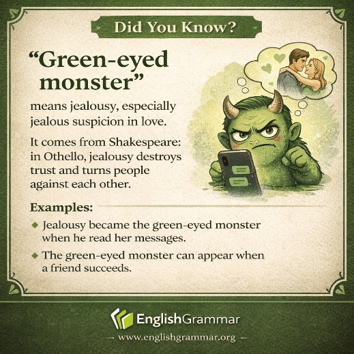
When I was a child, my mother would describe anyone envying someone else for any reasons as being influenced by a green-eyed monster. In fact, Mom was quoting Shakespeare. An internet search reveals the following: The term “green-eyed monster” refers to jealousy and originates from Shakespeare’s play Othello. In Act 3, Scene 3, the character Iago warns Othello about jealousy, describing it as a monster that mocks those it consumes. This metaphor illustrates how jealousy can take control of a person, leading to destructive behavior and emotional turmoil.

The phrase captures the essence of jealousy as a powerful, consuming emotion that can lead to tragic outcomes. Despite warning Othello of the danger of jealousy, Iago actually inflames it, manipulating Othello by suggesting that his wife, Desdemona, may be unfaithful. In the play Othello, jealousy consumes Othello, eventually causing him to murder Desdemona. When Othello learns of Desdemona’s innocence, he commits suicide because he is consumed by remorse.

This commandment helps distinguish the Law of Moses from other ancient codes of justice. When asking the question regarding moral regulations in ancient codes, we find the following: Ancient codes often addressed moral emotions indirectly rather than explicitly forbidding them. While there are no known ancient legal codes that outright ban moral emotions like empathy or guilt, many codes established guidelines for behavior that implicitly shaped emotional responses.

Key Examples:

  • Hammurabi’s Code: This ancient Babylonian code included laws that emphasized justice and retribution, which could influence feelings of guilt or responsibility in individuals. It aimed to regulate behavior through consequences rather than addressing emotions directly.
  • Ancient Egyptian Laws: These often promoted virtues like Ma’at (truth, balance, order), which encouraged moral emotions such as compassion and fairness, rather than forbidding them.
  • Greek Philosophical Texts: While not legal codes, texts from philosophers like Aristotle discussed emotions in the context of virtue ethics, suggesting that moral emotions were essential for virtuous living rather than something to be suppressed.

Overall, ancient codes focused more on regulating actions and societal order than on the emotional states themselves. While many of these writings hint at jealousy as being wrong, this commandment leaves no room for doubt: jealousy is wrong, period. Those who begin by admiring another’s possessions should watch themselves carefully, least they find themselves beginning to covet. When we covet anything, we cheapen ourselves and leave ourselves open for Satan to attack in all kinds of ways. It’s a very short jump from “I WISH I had what he/she has” to “I DESERVE to have what he/she has” to “I MUST have what he/she has.” The final step in this parade is “I will SEIZE what he/she has or destroy them in the process.” Notice that we can begin by merely admiring someone else’s possessions but end in thievery and possibly assault or even murder.

Hebrews 13:5-6 tells us, “5 Keep your lives free from the love of money and be content with what you have, because God has said, “Never will I leave you; never will I forsake you.” 6 So we say with confidence, “The Lord is my helper; I will not be afraid. What can mere mortals do to me?” When we trust in God and rest in Him, we have peace, a deep abiding peace that comforts and consoles us. We don’t have to envy anybody else, for God is our Provider and He will give us those things we need.

Perhaps one of the most poignant poems about the fallacy of envying someone else is this poem:

Richard Coryby Edward Arlington Robinson

Whenever Richard Cory went down town,

We people on the pavement looked at him:

He was a gentleman from sole to crown,

Clean favored, and imperially slim.

And he was always quietly arrayed,

And he was always human when he talked;

But still he fluttered pulses when he said,

“Good-morning,” and he glittered when he walked.

And he was rich—yes, richer than a king—

And admirably schooled in every grace:

In fine, we thought that he was everything

To make us wish that we were in his place.

So on we worked, and waited for the light,

And went without the meat, and cursed the bread;

And Richard Cory, one calm summer night,

Went home and put a bullet through his head.

PRAYER: Father God, thank You for loving us and caring for us. Lord, help us to be content, realizing that You are the Source of all things good and that You will give us what we need. In the mighty and precious Name of King Jesus. Amen.

SEPTEMBER 1, 2026 PEACE-HOW DO WE GET IT AND HOW CAN WE KEEP IT? #47 LIARS HURT EVERYONE

September 1, 2026

Exodus 20:16 “You must not testify falsely against your neighbor.”

Sometimes we assume that the Israelites had no frame of reference regarding sin before the Ten Commandments; however, that is far from true. Look at the Egyptian culture, one with which the Israelites had lived for 400 years.

Ancient Egyptians viewed bearing false witness as a serious offense, deeply intertwined with their legal and moral systems.

Legal Consequences

  • In ancient Egyptian courts, the integrity of testimony was paramount. A plaintiff was required to produce three witnesses to confirm the authenticity of a claim, and false testimony could lead to severe penalties, including losing the case.

Moral Implications

  • Bearing false witness was not only a legal issue but also a moral one. It was believed to invoke divine wrath, as the oaths taken in court included invocations against perjury.
  • The act of lying in court was seen as a violation of natural law, reflecting a broader moral principle that transcended cultures.

Spiritual Consequences

  • The consequences of false witness extended beyond earthly justice; it was considered a sin that could have spiritual repercussions.

In summary, ancient Egyptians regarded bearing false witness as a grave offense with both legal and moral ramifications, emphasizing the importance of truth in their society.

The Egyptians weren’t the only nation to have strict laws prohibiting false witness. The Code of Hammurabi originated in ancient Babylon around 1753 BC. It was created during the reign of Hammurabi, the sixth king of the First Dynasty of Babylon. The Code of Hammurabi imposes severe penalties for bearing false witness. Specifically, it states that if a person accuses another of a crime but fails to prove the accusation, particularly in cases involving life, the accuser shall be put to death. This reflects the code’s emphasis on justice and the protection of individuals from unfounded claims. Additionally, in some interpretations, the punishment for false testimony could include mutilation, such as the removal of an eye or ear.

The Bible strongly condemns bearing false witness, emphasizing the importance of truthfulness.

Key Verses

  • Exodus 20:16 states, “You shall not bear false witness against your neighbor.” This commandment highlights the moral obligation to speak truthfully about others.
  • Proverbs 19:5 warns that a false witness will not go unpunished, indicating serious consequences for dishonesty.

Importance of Truth

  • Bearing false witness can lead to significant harm, damaging relationships and communities. It undermines trust and unity.
  • The New Testament also reinforces this principle, encouraging believers to focus on honesty and integrity in their interactions.

Consequences

  • The Bible teaches that dishonesty can lead to divine judgment and societal repercussions. False testimony is seen as a serious offense against God.

How are people damaged by someone bearing false witness? Bearing false witness can cause significant harm to individuals and society. The repercussions include:

Personal Damage

  • Reputation: False accusations can ruin a person’s reputation, leading to social ostracism and loss of trust among peers.
  • Emotional Distress: Victims often experience anxiety, depression, and stress due to the false claims made against them.
  • Relationships: Trust is eroded in personal and professional relationships, leading to isolation and conflict.

Legal Consequences

  • Defamation Lawsuits: Individuals may pursue legal action against those who bear false witness, resulting in costly legal battles.
  • Employment Issues: False allegations can lead to job loss or difficulties in finding new employment due to damaged credibility.

Societal Impact

  • Erosion of Trust: Widespread false witness can undermine trust in institutions, such as the media and legal systems, affecting community cohesion.
  • Miscarriage of Justice: False testimonies can lead to wrongful convictions or other legal injustices, impacting not just individuals but the integrity of the justice system.

What about reneging on contracts? This too is a form of false witness. For years, our hospital sponsored a young man through medical school and the two years of housemanship, anticipating that he would return to serve our patients. At the time this fellow was completing his housemanship, we really needed his help, for two of our three doctors were out with injuries, throwing an enormous burden on the third doctor. At the beginning of this man’s training, he had signed a bond form, promising to serve the hospital for five years. Suddenly, at the end of the housemanship, this man wrote, claiming that he was “traumatized” at the idea of being bonded for five years and demanding a cancellation of the agreement “by mutual consent.” (He was certainly NOT traumatized while receiving money.) Despite all efforts on the part of senior hospital staff to encourage him that the bond period could be modified, he deserted our facility for another one with richer funding.

By ignoring the bond, this young man essentially bore false witness against our facility, claiming that we had somehow manipulated him. In fact, the bonding process was quite transparent and his family and friends had agreed to the bond.

This sad story serves to illustrate the fact that breaking longstanding agreements comprises a form of bearing false witness. Those breaking their agreements are demonstrating that they originally lied when they first entered into them; meanwhile, they are quite likely to shift blame onto the party suffering from their perfidy.

Ephesians 4:15 tells us, “Instead, speaking the truth in love, we will grow to become in every respect the mature body of him who is the head, that is, Christ.” When we bear false witness, we sin against God Almighty. God is just and pure and holy, faithful and true. We violate God’s nature when we lie. May God help us to remain truthful in all our dealings.

PRAYER: Father God, thank You for loving us and caring for us. Lord, help us to remain truthful in all we say and do, refusing to lie about others. In the mighty and precious Name of King Jesus. Amen.