Exodus 13 Dedication of the Firstborn
1 Then the Lord said to Moses, 2 “Dedicate to me every firstborn among the Israelites. The first offspring to be born, of both humans and animals, belongs to me.”
3 So Moses said to the people, “This is a day to remember forever—the day you left Egypt, the place of your slavery. Today the Lord has brought you out by the power of his mighty hand. (Remember, eat no food containing yeast.) 4 On this day in early spring, in the month of Abib, you have been set free. 5 You must celebrate this event in this month each year after the Lord brings you into the land of the Canaanites, Hittites, Amorites, Hivites, and Jebusites. (He swore to your ancestors that he would give you this land—a land flowing with milk and honey.) 6 For seven days the bread you eat must be made without yeast. Then on the seventh day, celebrate a feast to the Lord. 7 Eat bread without yeast during those seven days. In fact, there must be no yeast bread or any yeast at all found within the borders of your land during this time.
Even as God is delivering the Israelites, He is also ordering them on how they are to celebrate this deliverance annually for the rest of time. Why the proscription against yeast? Yeast has been used to brew beer as well as making bread and has come to symbolize the influence of Egypt. God wants His people to make a complete break with all things Egyptian, for only then will they have true spiritual peace.
8 “On the seventh day you must explain to your children, ‘I am celebrating what the Lord did for me when I left Egypt.’ 9 This annual festival will be a visible sign to you, like a mark branded on your hand or your forehead. Let it remind you always to recite this teaching of the Lord: ‘With a strong hand, the Lord rescued you from Egypt.’ [Let it remind you always to keep the instructions of the Lord on the tip of your tongue, because with a strong hand, the Lord rescued you from Egypt.] 10 So observe the decree of this festival at the appointed time each year.
God is not merely instituting a pleasant holiday but insisting that the Israelites should inculcate the reason for this celebration to their children so that those children will also pass it on to succeeding generations. And God also commands the Israelites to redeem firstborn sons and firstborn male animals with sacrifices. If an Israelite refuses to redeem a firstborn donkey, he cannot simply keep the donkey but must kill it by breaking its neck. There’s no allowance for half measures if they want God’s blessing and favor!
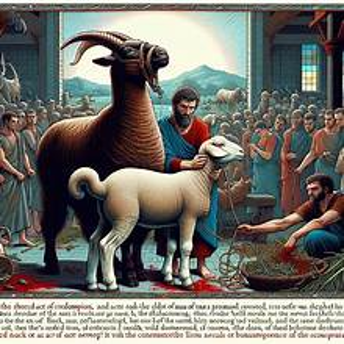
11 “This is what you must do when the Lord fulfills the promise he swore to you and to your ancestors. When he gives you the land where the Canaanites now live, 12 you must present all firstborn sons and firstborn male animals to the Lord, for they belong to him. 13 A firstborn donkey may be bought back from the Lord by presenting a lamb or young goat in its place. But if you do not buy it back, you must break its neck. However, you must buy back every firstborn son.
14 “And in the future, your children will ask you, ‘What does all this mean?’ Then you will tell them, ‘With the power of his mighty hand, the Lord brought us out of Egypt, the place of our slavery. 15 Pharaoh stubbornly refused to let us go, so the Lord killed all the firstborn males throughout the land of Egypt, both people and animals. That is why I now sacrifice all the firstborn males to the Lord—except that the firstborn sons are always bought back.’ 16 This ceremony will be like a mark branded on your hand or your forehead. It is a reminder that the power of the Lord’s mighty hand brought us out of Egypt.”
In a culture that values brands and special marks, God wants sacrifices for firstborn males to become a spiritual and mental mark. God knows that anything less than a definite act will result in gradual abandonment of the Passover ceremony with the Israelites forgetting its reason and purpose. God knows that people are lazy and forgetful. Left to their own devices, the Israelites will make a few half-hearted attempts and then allow Passover to become a pleasant memory while refusing to waste sacrificial animals to redeem their firstborn sons. God is instituting practices so dramatic that forever more, Israelite children will ask their parents the meaning of these acts. Only in this way will these people continue to commemorate God’s deliverance.
Most times when someone mentions God’s peace, we assume that it’s some kind of a divine blanket, floating down from heaven and wrapping itself around us. But look at the practices God is commanding the Israelites to follow. There must be no yeast in the household for seven days; that means no beer, no bread using yeast or any other product that involves yeast. Housewives must clean their households thoroughly. The family must eat unleavened bread for the entire seven days of the celebration, whether they like it or not. Firstborn sons and donkeys are to be redeemed by sacrificing prize lambs or young goats, an additional expense. And although God isn’t mentioning this now, later He will add that this week-long celebration is a time when people should only do necessary work such as caring for animals, cooking, etc.
God wants Passover to be a holy time, a time when people reflect on His goodness and His deliverance. The celebrations are not to be treated as an after thought but to be the primary purpose of families during this season. The Passover celebration is to mark the beginning of the year so that families will begin the new year by celebrating God and turning their hearts to Him. At the same time, God wants His people to have “sweat equity” in Passover, exerting themselves to practice the rituals rather than casually enjoying a meal, burping, wiping their mouths, and returning to life as usual.
As we read God’s instructions, we should search our own hearts. How ready are we to set aside time for God and to meditate on His goodness and His mercy? The movie Chariots of Fire tells the story of Eric Liddell, a passionate Christian athlete, who refused to run the 100-meter Olympic race for which he was most suited because the event would take place on a Sunday, choosing rather to run two other events later in the week. Liddell won a gold medal in the 400-meter race and a bronze in the 200-meter race in the 1924 Olympics in Paris, setting a record in the 400-meter race. At one point in the movie when Liddell is struggling with his decision, an American athlete quotes 1 Samuel 2:30 which says, “But I will honor those who honor me, and I will despise those who think lightly of me.” Liddell accepts this advice as coming from God. Liddell went on to become a Christian missionary in China, dying with a brain tumor in a Chinese prison camp in 1945. But eye witness accounts of Liddell’s performance at that prison camp tell of his organizing classes and games for the children and his sterling example to people of all ages.
Remember 1 Samuel 2:30. Are we honoring God or expecting Him to honor us? Are we willing to invest the necessary effort into celebrating God’s goodness so that His peace might come, or do we feel entitled as if God should send His peace on demand? Eric Liddell made his choice and chose wisely. May God help us to choose wisely as well.
PRAYER: Father God, thank You for loving us and caring for us. Lord, help us to do those things that will allow You to bless us with Your Peace. In the mighty and precious Name of King Jesus. Amen.